Showing posts with label Opinion. Show all posts

Friday, 25 November 2022

The Costs of Being Left Alone

Prompted by a recent tweet, I began to ruminate on the idea that certain people only want to be left alone. Now, that can seem extremely enticing, indeed for some even desirable. The problem is, many of the people who want to be left alone don't really want to leave you alone necessarily.


The tweet in question is provided by famous whistleblower and defector Edward Snowden. In it he compares being afraid of Libertarians politically to being afraid of cats. I do admit that, on some level, there is a bit of a point as the Libertarian Party of the United States is so whacky in its politics that the odds of them ever forming a stable government are damn near impossible. However, the ideas that they do hold are downright terrifying in what they could do to you.

Lest it sound like I'm just down on libertarians, I'm not really. Libertarian ideology actually has a few principles in personal liberty, property rights, freedom of speech, and various decriminalization ideas that I do admire. However, most of that was coopted from it's original libertarian socialists/anarchists of the late 20th century and bastardized into an extremely schizophrenic defense of laissez-faire capitalism, which means many of the good things about the ideology do come from a completely different place in the political spectrum. That one of the main ideas of libertarianism is that it wants to completely dismantle many existing government regulations on just about everything and let "the market" take over is really just an enormous problem. Essentially, while I like their take on personal liberty and rights, I find their look at trying to craft a society to be downright horrific.

I've written a bit before using fictional examples of how this is probably a bad idea, but I'd like to just make a quick summary of why that is. For reference, in the Libertarian Party's platform is a stated desire to allow employers to refuse to recognize a worker made union, effectively negating the leverage of collective bargaining or such protections. While it is not against unions, it does not offer any protection or inherit legitimacy, which is an enormous blow to the mere existence of labor organizing when one traces its history.

Secondly, it supports free market solutions to healthcare. The free market solutions in the United States as it already exists are so hideously expensive and inefficient in delivering care that it's near cartoonish, and this is with minimal government intervention in the healthcare system. Among wealthy nations it has the highest rate of hospitalizations from preventable causes, and the highest number of deaths from preventable causes. Quite simply, it spends an enormous amount of money on healthcare, while creating an enormous financial barrier to actually seeking that care (indeed, most bankruptcies in the US result from unexpected medical spending). Any objective analysis would conclude that the problem rests with the issue of making healthcare a commodity rather than a public service, but the Libertarian Party concludes the opposite.

Thirdly, it supports market based solutions to the environmental crisis. This is, put simply, almost so ludicrous that it barely rates a comment. However, it is an insidious idea that is in vogue that we can simply use the free market to get out of climate change, even though oil and gas companies spent decades running climate denial propaganda, and private corporations are notoriously unaccountable for the environmental damage they cause, while overselling their commitment to fighting it. But the market will solve all!

While these are just small examples of what is really wrong with the Libertarian platform and ideology, let me swing this back to Snowden's original message. He says "Sure, they're not in power now, but someday they might take over and... uh, leave you alone, I guess, since that's kind of their whole deal."

Let's look at this for a second; on one hand, he's saying that with a Libertarian government they will say "We can't tell you what to do," and well, sure, here's a question? What's the flip side of "we can't tell you what to do?" It's "You can't tell me what to do."

That's where the problem sets in. It's a similar problem I have with anarchism, where it depends very much on community norms and peer pressure to enforce conformity, but in libertarian ideology the extreme emphasis on individualism creates a Randian nightmare where what you want doesn't really matter if no one is going to bother to help you. With one ideal of libertarian ideology being a "night watchmen state" which merely enforces contracts through the judiciary and police, while enforcing the 'non-aggression principle' through the same and defending liberty with an army, the ability to do much beyond basic property rights becomes a bit complicated.

Broadly speaking this is a problem with both libertarianism and anarchism since both tend to look at the vacuum a loss of government function would create and assume utopia. As the old adage goes, nature abhors a vacuum and so something must fill it. In the libertarian world that's the market, which as I lay out in my longer essay, has no accountability to the public good. 

As an example, let's say for instance that a company builds a factory on a river. Since there is no regulation on what kind of waste they can dump into that river, they begin dumping harmful industrial byproducts into it. This causes the local environment to be poisoned, leading to the drinking water supply of a local town to be contaminated and people die. Naturally, some people will organize and try and sue the company that caused it. In the libertarian philosophy, case closed, but is it? Quite a lot depends on the people being able to afford a good legal team, and a company which has the capital to build that factory in the first place will almost overwhelmingly be able to afford a good legal team (or potentially SLAPP suit the problem away before it starts). The corporate legal team will almost inevitably win this, and the people who have lost loved ones or who are still living with a poisoned water supply will still have that problem. The overwhelming legal defense for the corporation might be "it was their individual responsibility to prepare for what might happen, no one stopped them from looking into living downriver from a factory might be like, it's their fault if they weren't prepared!"

If that seems like a ludicrous idea, projective personal responsibility onto the victim, allow me to refer you to the story of the MacDonald's Hot Coffee lawsuit. Despite becoming the poser child for a frivolous lawsuit, most of what you know about the case is actually wrong. The victim, Stella Liebeck, was a 79 year old woman who was in a parked car when she accidentally spilled coffee on herself, because the coffee was at 180–190 °F (82–88 °C) it caused third degree burns to her legs an genitals, nearly killing her, requiring extensive surgeries and skin grafts, costing 20,000$. Liebeck merely wanted her medical expenses covered, but MacDonald's framed this as a case of greed, among a litany of other crazy claims. Indeed, this was framed as a 'personal responsibility issue" and a concentrated effort was made to portray this as a "clumsy, greedy woman wanted money for her own mistake" rather than "company serves coffee capable of melting skin" to the public. That Liebeck won was astonishing.

Though let me give you another, more concretely libertarian example. In his book A Libertarian Walks into a Bear,  tells the story of personal liberty run amok in a New Hampshire town called Grafton. A weird mix of libertarian activists moved in and, effectively, took over the town government. They cut services to the bone, paring down police, fire, road maintenance, and even the public library to an absurd degree to the point where they almost existed in name only. The town's legal fees skyrocketed because it became an extremely litigation heavy region, the local police force was so handicapped by budget cuts that they could hardly ever put their single police cruiser on the increasingly pothole cratered roads for fear it was so unsafe, and the number of accidents and medical incidents practically overwhelmed what medical services were available.

The title comes from the fact that, by doing away with bylaws and many other ordinances that prevented big groups of people from living in the woods, trash began to be dumped everywhere. So bears showed up. With easy food, and some people even feeding them just because they enjoyed it, bears lost their fear of humans. That led to confrontations and bear attacks. When some frustrated people got mad at people who fed the bears, they were told that anything that happened wasn't really the bear feeders problem.

As I said, the flip side of "we can't tell you what to do" is "you can't tell me what to do" and as seen here, with the government pared down to nothing, life got immeasurably worse as no one bothered to take responsibility for anything. The book did show a fascinating divide among the libertarian ideology, and how many people had such broad ideas on what libertarianism is. The author treats most of the people sympathetically, and does an excellent job showcasing the slow motion collapse of a civil society. While he treats the people with sympathy (and occasional incredulity) I can say for certain that there was a lot of "fuck you, got mine" on display, which unfortunately tends to be a very common underlying theme in many proponents of libertarianism. 

These examples are, overall, just a few reasons why people are genuinely afraid of libertarianism politically. While the broad ideas of freedom and individual liberty are indeed admirable, they come attached to a series of poorly thought out other political ideas. From dismantling healthcare to effectively ceding economic primacy to unaccountable corporations, libertarian political emphasis on individual freedom does not make up for the broad structural damage it could introduce from a lack of protections or responsibility. 

Wednesday, 11 November 2020

What If the Central Powers Won WWI 2

Last time, I discussed the Schlieffen Plan enacted by Germany in 1914. Though that plan was very flawed from the get go, it working as a 'stop gap' to make a short victorious war for the Central Powers is a prerequisite for the the whole premise of that piece. The changes would follow logically, and the Germans would of course have a reason to seek peace. That is a scenario where the Central Powers can absolutely be seen as the unambiguous winners of the war. This scenario though, well it's one that certainly doesn't have an unambiguous win, but one which can still see a Central Powers victory.

The Kaiser in a communications trench, April 1918

Option 2) Peace of Exhaustion

I have talked about this before, discussing the 'victory' from the German Spring Offensive in another article. However, even that was technically a German defeat as the Entente still had the upper hand at the negotiating table. For this article, I'll be looking at the Entente not having the upper hand, and instead examining a peace of exhaustion. I would highly recommend reading my previous article about the Spring Offensive and victory, as I'll be using a few of the same ideas here, but with a different outcome and series of events.

However, for this all you really need to know is that there are two important differences from our timeline. The first is that in this TL the United States, for whatever reason, chooses not to intervene in the First World War. Without intervention, the Germans are not facing the serious manpower crunch they were facing in 1918 with the Entente now experiencing a windfall of millions of fresh troops coming from North America and their financial system being propped up by American loans. Without American loans, it is questionable that the Entente could have 'borrowed' its way further into 1919 and both sides would have found themselves deeply in the economic red as the year wore on. 

That though, is an extremely convoluted and hypothetical economic speculation. I'm not really an expert on it and there's so many competing narratives, whether the US could afford to let the Entente nations, who had borrowed heavily from them, default, whether the Central Powers treasuries could have foot the bill for another year of fighting economically, if the Germans could get supplies from their conquered territories or riches to sustain the war effort, ect; it's a lot of economic speculation, so let's stick with what we know.

Without the imminent threat of American intervention, one can ask whether the Germans would be as compelled to launch their OTL planned "Spring Offensive" to deliver a decisive knock out blow. My own speculation is that, yes, they would want to try and launch one vicious offensive in the spring and summer of 1918 to try and force the remaining Entente powers to the negotiating table. This, potentially, avoids another year of war and another grueling winter. The Entente too, will have no enormous pool of fresh American manpower waiting to replenish their ranks.

For the purposes of this scenario we can speculate that the Germans, in this scenario, manage to take Amiens. This would have been, something of a catastrophe for the British and French. Amiens was the major rail line connecting the two Entente armies, and even though some French forces had been dispatched to the north to support the British, it is debatable they could have managed to keep well supplied had Amiens fallen. 

This loss was the nightmare scenario for the men fighting the Germans at this point. Amiens was probably the only true strategic target (besides Hazebrouk) the Germans might have captured in their offensive in 1918. Doing so would have given them an actual strategic advantage that the original attack very significantly failed to produce.

However, like OTL, these German forces would still be exhausted, and to take Amiens they would have, undoubtedly, have had to take more casualties than they did historically. For the purposes of argument let's say that as compared to OTL the Germans lose 180,000 of their best, irreplaceable, troops. That's 20,000 more than OTL, but probably reasonable based on how well Amiens was historically defended. That means that, for follow up operations that are supposed to drive the British back to the Channel ports, they have even fewer troops to attempt it with.

I don't think it's a stretch to imagine that this version of Operation Georgette would be a disaster as well. With fewer men, a desperate British defense, and most likely having to hold off an Entente counter offensive towards Amiens, the Germans simply flail uselessly against the British defences, while by the skin of their teeth holding Amiens.

This will mean that, by May, it has become clear to the Germans that they cannot win a decisive military victory in the West. The Germans would have no chance of taking the vital rail center at Hazebrouk, which supplied the British armies in Flanders, and be facing a possible Entente counterattack over the summer. 

Here, much of this scenario does run similar to my piece from back in 2018 which speculates about a naval battle of Terschelling and German attempts at negotiation, but I will add one more speculation. The Entente will, naturally, try one do or die offensive of their own. This waits until the high summer, June and July, to get rolling, giving the Germans time to dig in. Even with their desperate straights, the Germans in their new positions manage to roughly hold their gains, and importantly, still cling to Amiens.

The failure of the Entente counterfactual "Summer Offensive" will signal to both sides that the European War has reached a stalemate. On the global front, the British most likely are stalemated in Mesopotamia and Palestine, having withdrawn troops to the more important fronts in Europe, and otherwise are engaged in chasing Paul von Letto-Vorbeck around German East Africa. Though the Entente is dominant at sea, holding on in France, and still, technically, more economically sound than their Central Powers opponents, both sides will have to face the facts that they can't win a decisive victory.

Enter America, as a peace broker.

Without the Entente driving the Germans to the table, or vice versa, the Germans will have just as many cards to play. Potentially approaching the Americans themselves, the new Austrian Kaiser and the German Kaiser, could play up their desire for peace and ask the United States to act as mediator. This would effectively be a diplomatic coup, which would probably earn German and Austria-Hungary sympathy with Americans and the still powerful German and Central European populations and voting blocs in America. Woodrow Wilson would probably insert himself, somehow, into the peace deal, but at this point the Central Powers can semi-dictate terms.

This then, is what I would imagine:

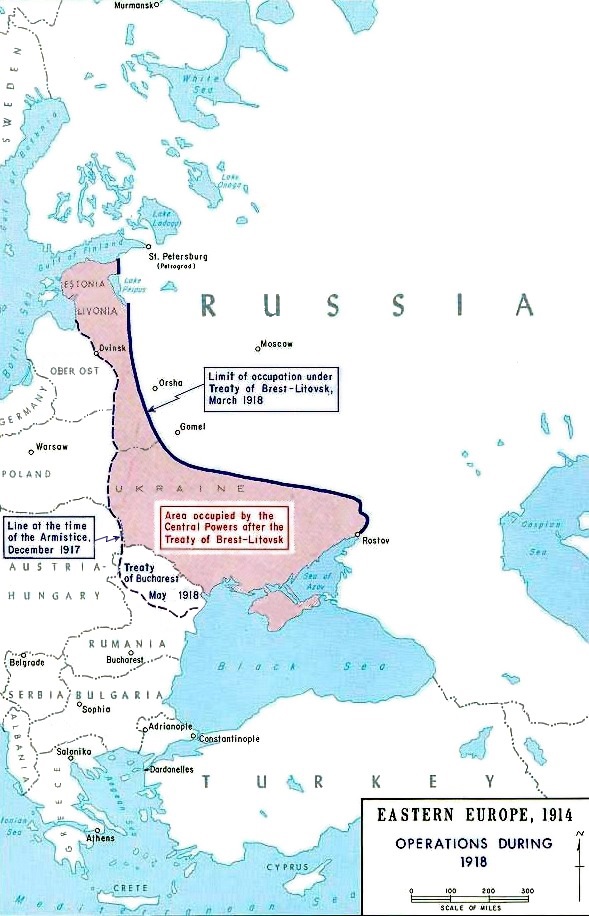
The German gains in the East, already established by the Treaty of Brest-Litovsk, are ratified, since there is fundamentally nothing the Entente can do to change that and Russia is embroiled in civil war and not an effective member of the Entente anymore. This means that the Germans split off client states in Poland, the Baltics, and Ukraine to act as satellites in Eastern Europe.

Meanwhile, the Ottomans have been promised all the land they lost in the 1877-78 Russo-Turkish War, and without the British to detain them, they have a chance to reclaim some of it. The historic Transcaucasian Democratic Federative Republic would probably form, then break apart, for similar reasons. The Ottomans may end up seizing much of what becomes Armenia and some of Georgia, and the total outcome depends quite a bit on the outcome of the Russian Civil War.

In the West, the Entente is forced to accept that the Germans now have a say in the government of Belgium. The United States will insist on Belgian territorial integrity, but I have no doubt the Germans will manage to keep Belgium under their thumb diplomatically in exchange for a status quo antebellum on the borders. After four years of bloodshed, not much will have changed on the European frontier.

The Germans though, will lose the totality of their colonial empire in exchange. Despite Lettow-Vorbeck's heroic actions in Africa, this is not enough to prevent the British and French from navally dominating them. Japan controls their Pacific and Asian colonies, and the British take what is left.

The biggest problem though, will be Russia. They are a boil that needs to be lanced. In a scenario with a reasonably intact Germany, the British and Germans will probably manage to get over their anger at one another and support the White Russians in the war, but, the Germans might also get caught up in being bankrupt, and the British too. With the need to keep a lid on their own new Eastern European empire and money and economic problems at home, it's not a stretch to think both Britain and Germany will be too busy gobbling up their own gains, and cash strapped to boot, to support the White Russian forces. 

Shorn of Western support, the Whites are crushed like they were in our own history, and the Bolsheviks come to power creating a bit of a truncated USSR.

Technically, the Germans have won World War I. They have lost no territory in the West, gained territory in the East, and are triumphant against Russia, who was considered one of their most dire enemies. They have however, lost their global colonial empire, severely damaged their economy, and now must keep a lid on unrest in the East. Their enemies are not any better off though. The French have buried an entire generation for little gain, the British have enlarged their empire, but are broke and in hoc to the United States, and the Russian Empire is no more. Germanies allies though, are basket cases. The Ottomans have lost their religious ruling mandate to an Arab revolt, the Austro-Hungarians are broke and facing unrest at home, and arguably only Bulgaria has made any gains.

Everyone is broke though, so technically everyone is a loser. The notable exceptions are the United States and Japan.

The 1920s and 1930s will be interesting. An economic downturn is very likely, and unrest across the East most likely unfolds throughout 1919 and well into the 1920s. The Austrian Empire may manage to survive by federating, but it might also go down in flames.

In the East, the Germans will probably face pressure from the new USSR which will try to ignite communistic/nationalistic uprisings against the German puppet governments, and any forces sympathetic to them in the decaying Ottoman Empire. This may, in time, lead to a second war, one maybe supported by vengeful Western powers. Or, maybe, broke and gorging themselves on German colonies the former Entente will let Germany and Russia squabble over central and eastern Europe, only looking to increase their hold and stabilize their own empires. Meanwhile, Japan and the United States will becoming rising powers in the Pacific. 

While only technically a German victory, it is still a victory. One of mutual exhaustion to be sure, but one where the Central Powers have, arguably, gained more than they lost.

Wednesday, 9 September 2020

What If The Central Powers Won WWI

There's a pretty healthy market for works on alternate history regarding WWII or a Nazi Victory and I've read a lot of it, but there seems to be something of a dearth speculating on what might have happened if the Axis had never risen at all. What if, instead, Germany stood ascendant in Europe, the Entente were humbled, and the Central Powers had stood triumphant in the Great War?

So there's two options for a Central Powers victory, the 'quick' victory of knocking out France in 1914 and then turning around and bruising Russia until it asks for an armistice in 1915-16 or the long painful drawn out peace of exhaustion circa 1918. I'll cover both in these coming articles.

Option 1) The Short War

The Imperial German Military, prior to 1914, had won a series of stunning victories over it's European opponents from 1864-1870, whether the Danes, the Austrians, or the French, they had shown an incredible ability to take the fight to the enemy and overwhelm them forcing peace on them. With how wars had gone afterwards, the Russo-Turkish War, the Second Boer War, and even the Russo-Japanese War, European military planners had every expectation that any war they fought would be relatively swift and decisive. A multi-year slugging match was not envisioned by almost anyone at the time.

That was the basis around which the Schlieffen Plan was made. The quick knockout blow to France, and then turning around to bring the fight to Russia. In brief summation, a quick knockout blow to invade France through Belgium, swing around and sucker punch the French, and occupy Paris and force the French nation to the negotiating table. 

Was this a feasible plan in real life? Would the French have simply surrendered? Eh, very hard to say, but probably not. It was a flawed plan with many holes, and was absolutely dependent on the French doing as the Germans wanted, which as we saw in our own timeline, wasn't going to happen. It was inflexible, inaccurate, and didn't allocate nearly enough men before it began getting messed around with during the historic Battle of the Frontiers. Then the logistics are another story of flawed improvisation. The Great War channel does an excellent video on the plan and why it failed historically.

For the purposes of this discussion, we're going to assume that the Germans do manage to swing around the French and occupy Paris, forcing the British and French armies towards the Channel and the south of France. The French, demoralized and looking for an easy peace, decide that they will accept negotiations with the German Empire, but no armistice is signed right away, and the BEF is allowed to slip away.

Now, important to note here is that until a peace treaty is signed, the Germans cannot send all of their strength to the Eastern front with Russia. They have to keep enough troops to occupy the portions of France they have, and occupy Belgium to prevent the British from trying to sneak their way back into the Continent. Instead, negotiations probably muddle through to the beginning of 1915, and the Germans take some land, annexing a strip of the coast at Dunkirk to vassal state Belgium, and then the regions around Briey which control much of French iron production.

However, it should be noted that the Germans will want to negotiate a quick treaty, so they probably will not be able to be as harsh as they like. The French will not have been decisively defeated, French armies are still in the field, they still have British money and ships backing their own not inconsiderable armed forces and economy. They may forgo most land claims entirely save Briey, and the Dunkirk strip in exchange for a larger indemnity to keep the French out. 

Assuming then, that the French fold for a quick armistice for a large indemnity, a minor loss of territory, and no change in their colonial empire (something which the Germans would have been pretty powerless to effect) then it could be speculated this would be a success for the Germans. Now they can afford to turn more men to the East and go beat up Russia.

This doesn't mean they're done fighting though. The British will be rearing to go fighting on the seas, they will most likely send troops to fight in Russia instead of France, while diverting more effort to messing up the Ottoman Empire in the Middle East. However, there would be fewer neutral powers, like Italy and Romania, willing to join this war on the side of the Entente with the Central Powers so clearly triumphant.

How much of a difference British forces in Russia makes is hard to quantify. Their ships will certainly still help strangle the German economy, even though they'll be stretched thinner. British troops in the Baltics would probably prevent the Germans from so completely overrunning them and act as an important shield to St. Petersburg. However, with the Russians themselves not having much more luck than OTL against getting battered, and possible strains between British and Russian commanders, it is unlikely they can really hold off the Germans into 1917 without both sides deciding to sue for peace. The Germans would have the worry of French deciding to break their treaty, as they are merely humbled but not broken, and the British and Russians would be bearing the brunt of the fighting.

Peace in this scenario will probably mean similar annexations from the Russians (an independent Poland, Ukraine and Belarus) but probably the Baltics will stay in Russian hands. The Russians too will be forced to pay an indemnity. Something similar enough to Brest-Litovsk, but not exactly it, changing with the face of the war.

Now, with Britain probably having been forced to withdraw from the Continent with both of her allies bowing out of the war, she could choose to fight on. However, with only her navy and smaller army, there are few places they could actually menace the Germans. They can keep beating up the Ottoman's, but what would that serve? They could keep the blockade going, but that is a costly and long term solution which may not bear fruit with the recent German conquests. The Germans themselves, facing the problem of Napoleon, would probably try more indirect attacks on Britain, as they couldn't hope to invade the little island.

Instead, the two sides will probably find themselves each making an unhappy peace with one another, the Germans settling in to an uneasy control over much of the Continent, and the British, unbowed, unbent, unbroken, looking to the future when they can unseat Germany. The Great War ends, late 1916.

It's important to note that despite the Germans laying out their strategic hopes in the historic Septemberprogramm, there is practically no way they will get everything they want from their victories. Changing circumstances in the war, the need to garrison new conquests, and the simple need to keep certain players out will mean that the Germans can't just take what they want. Even the Entente Powers in 1918/19 at Versailles simply couldn't dictate terms to the defeated Central Powers as they fell apart. They had to make many sacrifices, and they had overwhelming military power. The Germans here, will not. I think there is far too much speculation around a Central Powers victory giving them everything they desire, when the historic Entente victory came with so many pitfalls of its own.

So what happens to the other Central Powers in this scenario?

Though Germany took the blame for starting the war at Versailles the country which arguably bore the guilt for feeding the conflict into a larger war was that doddering institution known as the Austro-Hungarian Empire. Though a Serb assassinating Franz-Ferdinand started the conflict, Austria-Hungary's increasingly strident and almost insane demands forced Russia's hand which triggered an avalanche of military mobilizations and interlocking alliances that would leave millions dead. Historically, the empire was battered into submission and the death of Emperor Franz Joseph and the succession of his great-nephew Karl, meant that there was no truly stable force to keep the empire alive and the Fourteen Points of Wilson, coupled with increasing nationalistic unrest and defeat, splintered the Empire permanently.

Here though, if the treaties can be concluded in 1916, you have an Emperor who has lived through a successful war and when he dies it may well be in a nation at peace. The new Emperor Karl, who appeared to support a more federated empire, may be able to bring stability to the various realms which comprise this great chunk of Europe. With some minor concessions from Serbia and Russia in territory, the Empire may very well thrive and be able to rebuild. A victorious Germany next door will be a very good way to keep a lid on things, and the need to mind Germany's new vassal states in Eastern Europe will probably cinch cooperation between the two. The empire will probably be stable, for a time at least.

The Ottoman Empire on the other hand, the one power which Britain would probably concentrated a lot of its energy on, would still be badly beaten up. The British would have done their best to kick off regional revolts like they did in our timeline, the Armenian genocide would still have taken place, and the Ottoman's would most likely still have suffered at the hands of Russia in the Caucuses. It would be the now very sick man of Europe, and even with help from its other Central Powers benefactors would probably not be long for the world.

Nationalistic revolts, angry Arabs, Kurds, and Armenians, all probably see the Ottomans descending into nasty civil wars and revolts in the 1930s perhaps as the army will eventually get fed up and overthrow the Sultan. Expect it to break up before too long I think.

The last member of the Central Powers, mighty little Bulgaria, will also be quite pleased with what it accomplishes. Having been badly beaten in the Second Balkan War, the Bulgarians nursed hearty grudges against all their neighbors, and historically the ascendancy of the Central Powers in 1915 brought them in on their side. Here, that obviously still happens, and so they help crush Serbia, and then go on to menace Greece and Romania into neutrality while sending men to help bludgeon the Russians. Historically the were promised the portions of Serbia in Vardar and east of the Morava River. They may even be able to use the victory to level concessions from Romania for the portion of Dobruja they had so wanted historically. Either way, Bulgaria will be the big winner from this war. 

In the rest of the world, a white peace with Britain may see the Germans take control of the Belgian Congo, as a stepping stone for a greater German empire in Africa as they can't force Britain's hand in Africa, nor that of France. They may be forced to relinquish their Pacific holdings, but with the Congo in their hands, no great loss. The British Empire remains untouched, the Japanese Empire has made some minor gains at the Germans expense, and so are probably on Germany's hit list for the future.

Hypothetical Europe/Africa circa 1918

What about the neutrals though? Those who didn't join the war?

The obvious elephant in the room is the United States. Having sat the war out they haven't yet had to build up their military strength, and having only partially fallen menace to Germany's submarine warfare campaign, they will maybe only see naval expansion as a necessity. Without having mobilized a large wartime army, no Zimmerman Telegram to make them feel threatened at home, it is unlikely they will truly develop the military muscle and nationalistic pride they had in our timeline. Instead, I think it likely that the ethnic nationalism (first language newspapers, purely German speaking communities among others) persists to a great degree in the 20th Century, possibly until well past the midpoint. The US is more concerned about the chaos in Mexico on it's southern border and collecting the debts the Entente owes them.

Italy meanwhile, is sulky because Austria still controls territory it considers Italian, they have competing ambitions in the Adriatic, and Italy still wants to expand its African empire. They are probably side eyeing the Central Powers whom they screwed over by staying neutral, and the Germans and Austrians are doing the same to them. Romania, for her part, is simply feeling lucky it sat out the war. There's an uneasy peace in Europe.

By 1920 the world is in an uneasy new status quo. France, Britain, and Russia will all be hopping mad, and looking for revanche, while Germany is busy policing a new colonial empire in Africa and Eastern Europe, neither of which may take kindly to being occupied. How long this can last is open to debate, but with a well armed and still wealthy Britain to back Germany's enemies, I think it's only reasonable to conclude both sides would be looking for Round 2, and with a short decisive war being the norm, why not?

Since if I continue this piece to cover the war of exhaustion we're going to run over four to six thousand words, I'm going to split this into two for a part two, Peace of Exhaustion! Stay Tuned!

Wednesday, 2 September 2020

So About John A. Macdonald Again

I last spoke on the subject of John A. Macdonald back in 2017. In that little essay, I made many statements on why Macdonald is a flawed man, and some of the mistakes he made. I also pointed out why it is important we remember him and what he accomplished for Canada. Also in that first article I made some mistakes when talking about his past actions and the legacy he left us. In light of recent events, I hope to make some corrections, but also stand comprehensively by the good and the bad of our first Prime Minister's legacy, and why I'm unwilling to forget either of those thing.

In my previous essay I did mention what I thought were the positives of Macdonald's legacy, and to begin this one I would like to point out many of his faults before I expound on why it is important he be remembered, and why our current historiography is perhaps not up to the task of doing it.

Firstly, yes, Macdonald was absolutely a racist and that's something that even if you subscribe to judging people by their time period, he was no paragon of tolerance and virtue. He dismissed the Indigenous peoples of Canada who would not settle to farm land and adopt Anglo-Saxon culture as savages. In his multiple dealings with the Métis people he referred to them as half-breeds, a slur on their Indigenous-European roots. 

He was even extremely racist against the Chinese, exceptionally so for the time, wholeheartedly supporting the efforts of British Columbia to expel them from the province and desired to exclude them from the right to vote even in his aforementioned 1885 Franchise Act. He said "...if they came in great numbers and settled on the Pacific coast they might control the vote of that whole Province, and they would send Chinese representatives to sit here, who would represent Chinese eccentricities, Chinese immorality, Asiatic principles altogether opposite to our wishes; and, in the even balance of parties, they might enforce those Asiatic principles, those immoralities … the eccentricities which are abhorrent to the Aryan* race and Aryan principles, on this House." This shocked even his contemporaries, many of whom objected to denying those of Asian extraction the vote. In the end, Macdonald managed to exclude them however.

He also sanctioned the Davin Report in 1879 which was directly responsible for the creation of the Residential School System which would be used in Canada until the 1990s. I want to make clear here that the report specifically highlighted that taking children from their families to 'civilize' them was the best option, and this was supported by Macdonald.

As I said before, Macdonald was directly responsible for the Residential School System, which is a shameful stain on our history. To be clearer than I was in that original essay, the sanctioning of that system, and it's perpetuation by our government long after it was shown to be unhealthy and ineffective and also not even cost effective, was an act of cultural genocide. Though it did not, in sheer numeric terms, kill many people, it caused irreparable damage to Indigenous culture and communities wherever it was implemented and has lasting and terrible effects to this day. 

To continue from my earlier comment on the Franchise Act of 1885, however, one could cynically examine the prospective Indigenous right to vote as an attempt to enshrine as a method of control over Indigenous polities. It would, in the language presented, effectively destroy the traditional structure of Indigenous self-government. It would take away their unique rights as tribal entities, and assimilate them into the broader Canadian society, effectively cutting up communally owned tribal land into individually owned properties. Though ostensibly they were allowed to keep their tribal affiliation, they would lose any special privileges under the Indian Act (another note on the Act below).

Despite this, does this itself make the attempt to at least grant the franchise to the Indigenous peoples, even with long strings attached, an ignoble thing? Some would say yes, and considering that relations with the government are fraught and full of federally exploited loopholes and are imposed in a top down style to this day, that would not be an incorrect view. However, considering almost no legislation was put forward to try and even engage Indigenous peoples in a discussion about voting again until the 1940s, and then not granted on their terms until the 1960s, some might say that as this bill was being pushed in 1885 after a full blown rebellion, it was still a progressive attempt for its day. Though let it be known that Macdonald did say "The great aim of our legislation has been to do away with the tribal system and assimilate the Indian people in all respects with the other inhabitants of the Dominion as speedily as they are fit to change." It must not be forgotten that even the most benevolent seeming actions by the government then (and arguably still) were about assimilation into the Canadian whole.

Friday, 21 August 2020

Planetary Invasions

In science fiction the idea of our planet being invaded, or other planets being invaded, is sufficiently old enough to be a trope. It all started back when H. G. Welles imagined Martians slinging themselves towards Earth to mash us with their tripods and death gas. From there it's evolved into many different scenarios some of which still involve us on Earth, to fascinating wars between the stars of other human or alien civilizations. Recently I've been pondering on that after I watched two very interesting videos between people who examined the idea of planetary invasions.

The first is from the excellent channel Space Dock which puts together wonderful work on the spaceships and vehicles of many franchises. They themselves have a drama called the Sojourn coming soon. Definitely check it out. But for our purposes watch their brief video on Planetary Invasions.

In contrast we have one video from Isaac Arthur discussing the subject. It's a longer one and it raises many interesting points. His channel is simply amazing for an in depth look at futuristic science based concepts on how we may do things in the future. It's honestly one of the best futurist channels and series I've ever encountered, sincerely worth checking out if you're interested in that kind of thing.

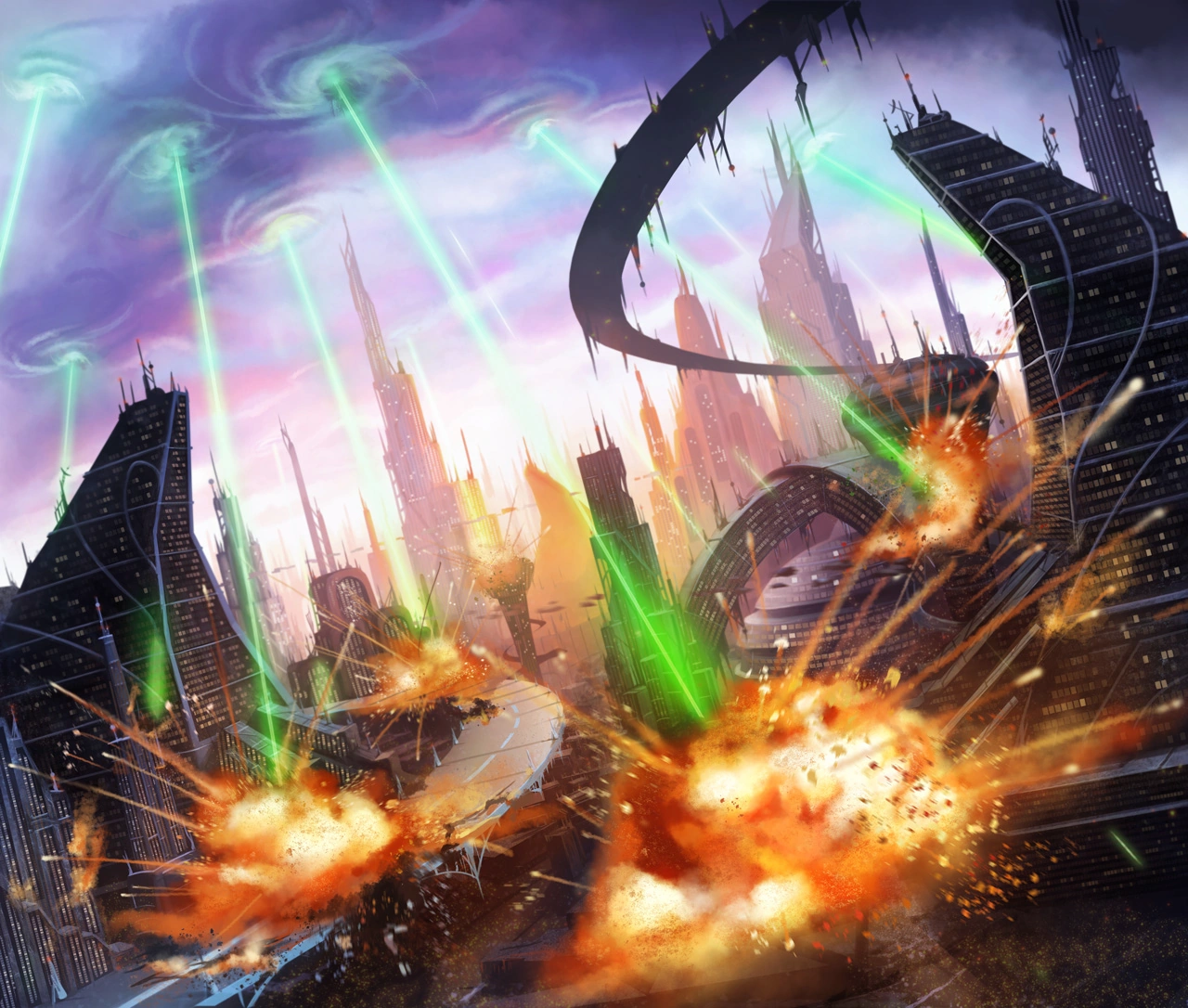
Credit to Alexander Tooth, from wookiepedia

Both these videos raise very good points, and they have contrasting opinions. In the first video we do see that it is argued that a planetary invasion is basically infeasible. Some Operation Barbarossa style mass landing and invasion taking years, decades, or perhaps centuries, to fully pacify a planet through mechanized warfare from above and below. The crux of the argument is that this is a huge waste of time and resources, especially when you presumably have ships in orbit that can hammer your opponent at your leisure. Then if you have no hope of relief and no friendly ships in the area, fighting on serves no purpose. You don't need legions of soldiers, just large landing forces to take and hold the vital aspects of planetary infrastructure and then garrison forces to keep the planet yours.

The second video has a more wide ranging view. It presumes that planetary assaults or invasions are feasible. The main point is that, after all, if you're jetsetting around in space with any sort of casual interstellar travel then the mobilization of resources to invade and crush another world or system of habitats (especially if you rule over multiple star systems and have great automation) is almost trivial. That being said, it makes a very pertinent point that a planet is not necessarily a helpless target. 

It is a point worth considering as any civilization which can do travel casually at interstellar distances is probably not really having to worry about the whole issue of delta-v in a gravity well. That means that, while an opponent who does control the orbitals has an advantage, the people at the bottom of that well are not nearly so defenceless as we might assume through our lens of 21st century technology where an asteroid barreling through our gravity well is a very terrifying prospect. Your vital sites are probably ringed with powerful railguns or missile batteries which can shoot destruction at any ship foolish enough to park in orbit.


In fact with that view, the traditional image of a ship parking itself in orbit and blasting a planet with it's weapons seems silly. No ship could risk parking in orbit without worrying about taking crippling damage or being rendered combat ineffective. The proper image might be a vessel in the age of sail bombarding a land fortification and having to outnumber the guns of the fort to hope to overpower them before it can be rendered ineffective itself. The planet can shoot back.

What you might see instead is ships engaging in what amount to bombing runs, first moving to cripple or take any orbital defences, then moving in unpredictable patterns to try and crush the ground based defences. If that doesn't work, clearing a landing corridor to insert marines who can disable or capture those defenses so the fleet can put itself in a position to command the ultimate high ground and compel a plant's surrender would be your next best bet. In the book Tiamat's Wrath there is an interesting example of this that works very well from both a tactical and a dramatic perspective.

This is actually a point I've considered for some time. I've mused about interstellar warfare before and why it might happen. In my own, as yet unfinished Service to the State science fiction novel, I've thought about how you could make a planetary invasions feasible, so my own view actually falls somewhere between that of the two videos.

Part of that view does come from finding that in universes like those of the Honor Harrington series that if you've countered gravity to the point you're using it in your weapons, the idea you can't make some kind of planetary based weapons system which could cripple or severely damage a ship seems baffling. It does seem to me that there would need to be an invasion, but one aimed at very limited and achievable goals so your fleet could enforce the threat of death from above.

Some blame might come from Robert Heinlein's Starship Troopers which, though an excellent novel I recommend everyone read, did draw it's inspiration pretty heavily from the work of paratroopers in WWII and the island hopping campaign in the Pacific theater. In the Pacific the small Japanese garrisons which held out across numerous little islands with their coastal batteries and then fighting to the last man against the power of the American gun line and the overwhelming firepower of Marine divisions set the course for the campaign. The Japanese might have inflicted casualties, but they had only the small resources of their islands to call upon and no hope of resupply. This has, I think, colored interpretation of how planetary assaults might go. A planet doesn't generally have that problem unless you wreck the infrastructure so thoroughly that further resistance is simply futile.

In Isaac's video he makes a very good point about the resources of a planet, and how future technology might make it possible to basically weaponize an entire planet's population, or make them know no fear. However, even with fantastic automation or fearless soldiers, there is a point where your offensive options and economic support would be so ground down that your ability to resist is functionally irrelevant as the invading power could zap you whenever they felt like it and destroy or immobilize your remaining assets. At that point, it's either guerrilla resistance or surrender.

That's why in my mind I think a planetary invasion might fall somewhere between these extremes of Honor Harrington and Starship Troopers. A planet isn't defenceless unless it has no real orbital defences or ground based weapons, and even with those ships can work to attire them, and then send in the marines to seize and hold them until the fleet in orbit can establish an advantageous position. Unless you know you have a relief fleet coming, there's no reason to keep fighting.

Of course, this is all just speculation and trying to harmonize the plausible with the realistic and make compelling story telling. Future warfare is liable to be so destructive it's unimaginable to today's soldiers or civilians. It does make for interesting reading or musings though.

Monday, 8 June 2020

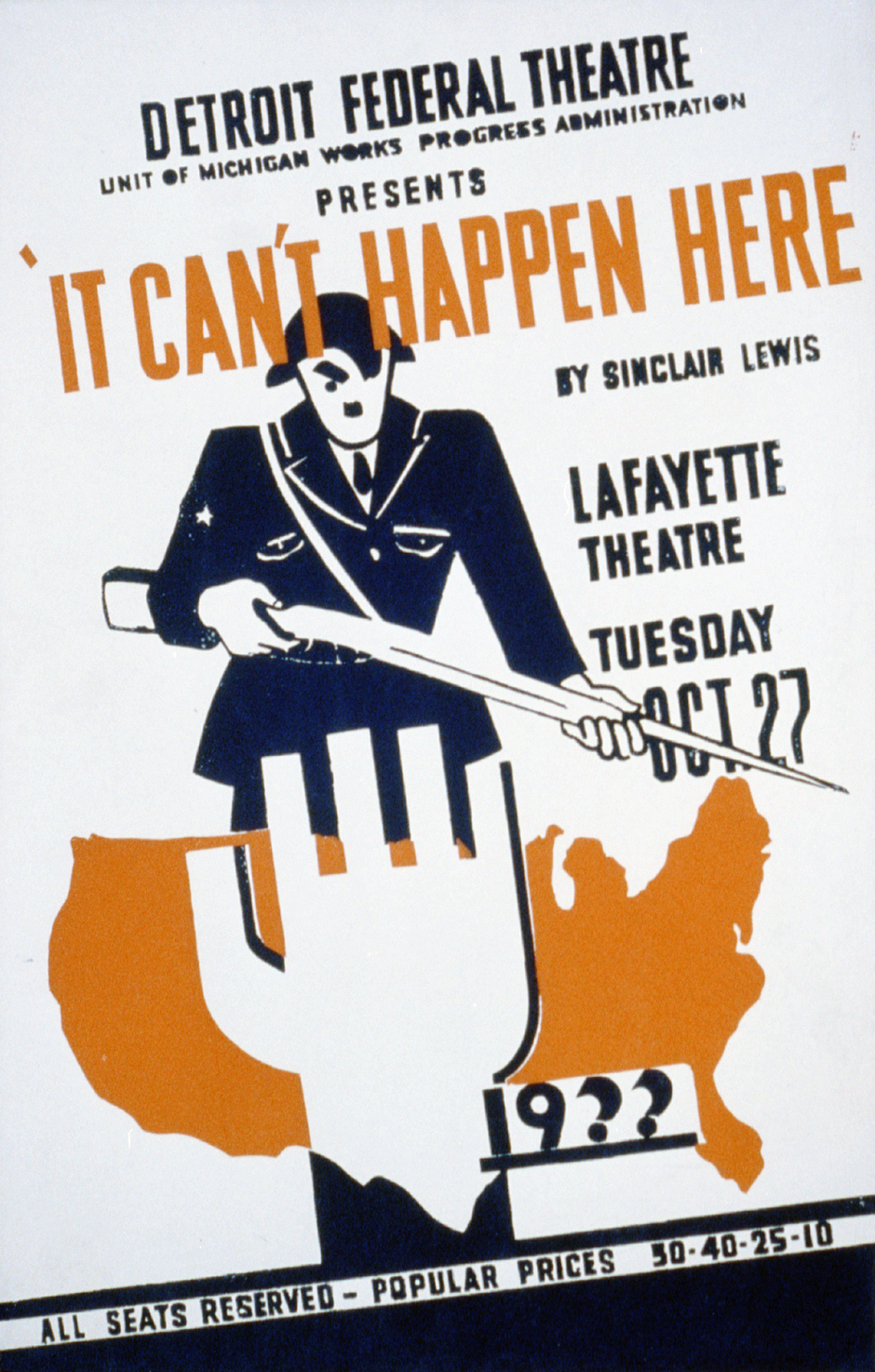
It Can't Happen Here

In 1935 Sinclair Lewis published the novel It Can't Happen Here as a deadly, if semi satirical, rebuttal to the very American execptionalist attitudes of the 1930s which believed, very firmly, that fascism was impossible in their country. And is a little disturbing when one considers that the real life Business Plot was happening around the same time. In that story, Berzelius "Buzz" Windrip wins the 1936 United States election in a landslide on a populist platform. He does so against all odds, and defying expectations. Into this unexpected breach of political norms he runs on a populist platform, promising to restore the country to greatness and brining back prosperity and power and giving every American a 5,000$ check per year.

To help do so he rapidly outlaws dissent, jails his enemies and trains "Minute Men" paramilitary corps who crack down violently on any who oppose Windrip's policies, like eliminating the power of Congress. Over time he sends enemies to concentration camps and consolidates his power through violence and fear. Despite this, a majority of Americans approve and see it as necessary to returning their country to glory.

This has negative consequences, to say the least. Depressingly, parts of it might sound a little familiar to modern readers.


I'm writing this because I have worryingly seen far too many Americans engage in American exceptionalism regarding this very issue. "It can't happen here" I have seen said "We're a First World country, and that kind of thing doesn't happen in First World countries" even when saying in the same breath that Donald Trump is anomalous in American history. 

Yes, this is an article talking about Donald Trump. 

I admit, I have commented sparingly on him since 2017. It was more than I could bear as he progressively chewed his way through the norms of American democracy and engaged in further divisive and violent rhetoric while causing problem after problem in the world. Frankly, I had problems of my own, and then democracy in Canada seemed to be trundling on just fine without calling out the authoritarian to our south. I would get by, and Canada would survive.

Then came Covid-19. 

To date, at the time of writing (June 7th 2020) Covid-19 has killed 112,000 Americans, and that number rises by roughly 1,000 dead per day, with no sign of stopping. Added to that the recent protests and riots around the death of George Floyd, which have gone international, and we see that Trump himself is part and parcel of a greater problem afflicting American politics. He used his own militarized police to get a shamefully awful photo op in Washington. And you see the police reacting with violence to being held accountable. They attack citizens they are supposed to protect, the media, and nurses and volunteers while applauding and supporting men who strike the elderly.

Why? The media is the enemy of the people. There are good people on both sides. And in this case, the police are the other side.

Frankly, Trump has been for years now normalizing violence against his enemies, the media and citizens who don't do what he tells them. The police, perhaps frustrated that a militant culture cultivated in their midst has been viewed more with horror than support by the populace, have latched on to the populist Trumpian message applauding them for violence while lashing out against the perceived disloyalty of the public to the police as an institution. It hasn't been pretty, and Trump has encouraged it, and will continue to encourage it for as long as he can. He wants to see his enemies get hurt, which is why he inflicted that on them to get his disturbing photo op.


I've watched the narrative unfold from the relative calm of my home in Ottawa. However, I saw portions of one of the biggest protests the capital of Canada has ever seen when over 14,000 turned out in solidarity with protesters in the US. It was a big, bold moment, and our own Prime Minister made a direct repudiation of Trumprian tactics by joining the protesters and kneeling in solidarity with them on Parliament Hill. It was, in imagery at least, a powerful moment. One marked by the terrible contrast of Trump having to gas and beat his own citizens to get a photo.

From cbc.ca

Where does that leave the American situation though? In my opinion, the protests and the global support of them, are not just about the death of George Floyd, they're of course about the horrible racist violence we see in the US (and Canada), but they're also, at least at a secondary level, a damning indictment of Donald Trump. The man who is the face of all that is wrong with America, even if he isn't the root problem. It shows that thousands, millions, are mad, pissed off, and willing to take to the streets to make that fact known. When over 100,000 Americans have died and millions are unemployed because of Trump's shoddy response to the Covid-19 epidemic, this is perhaps the straw that broke the camels back and people need to vent. And perhaps this is a precursor to a wave of anger which will sweep Trump from office in November.

If I think that though, why do I talk about a 1935 book proclaiming a warning that fascism can happen in America?

Well, it can, and it very well might if Americans don't take that lesson to heart. Trump has every reason to try and rig the election in his favor, whether by simply cooperating with a corrupt Republican Party which cares more about power than governance, or by inviting yet more foreign interference to win the election for him. If he can win the judiciary and even a fraction of the military and national security forces to his side, he can crush dissent to an illegitimate win and extend his tenure in office by another four years, protecting himself from the ongoing investigations into his corrupt actions while in office.

Some might comfort themselves that "this can't happen here" but I think this is our generations warning that it can. Whether in the United States or Canada, it can happen here, and we had best be on our toes to prevent it, rather than imagining ourselves immune to what we consider other countries' problems.

Monday, 18 May 2020

The Problem with Trudeau's Firearms Ban

The recent Order in Council put forth by Justin Trudeau in response to the tragic events in Nova Scotia has caused no small amount of public debate. However, the ban itself is problematic in the way it was implemented, but also because it won't do a single thing to stop another massacre.

Now full disclosure, I like guns and have absolutely no problem with people owning them. I also think that the government is right to try and regulate what kind of weapons can be owned, there really is no reason for an individual to own a weapon which can be made to go fully automatic (which is a terrible waste of ammunition anyway). I am of the personal opinion though, this Order in Council was simply a publicity stunt, however well meaning it might have been. I hope to outline both why the gun debate in Canada is long settled, and why the current ban will do absolutely nothing to prevent another massacre.

Via Tactical-life.com

First though, let me clear something up. There has been a lot of push back from gun owners regarding the ban. Many claiming it infringes on their "right" to own weapons. Important thing to know, in Canada you do not have the right to bear arms. There is no second amendment like law which ensures Canadians have access to weapons, and we are probably better off for it. The law is very clear on that fact, and the Supreme Court has ruled twice, quite comprehensively, on the subject.

The first Supreme Court case to rule comprehensively on the issue was 1993's R. v. Hasselwander it was declared, in a specific rebuttal to an appeal to American ideals: The American authorities should not be considered in this case. Canadians, unlike Americans do not have a constitutional right to bear arms. Indeed, most Canadians prefer the peace of mind and sense of security derived from the knowledge that the possession of automatic weapons is prohibited.

In 2005 in R. v. Wiles it was confirmed that: "Possession and use of firearms is a heavily regulated privilege, and the loss of that privilege does not support a finding of gross disproportionality because it falls short of a punishment “so excessive as to outrage standards of decency” Thus confirming that the ownership of firearms in Canada is indeed a privilege. 

Owning firearms in Canada is very well regulated, and while handguns can be owned under very strict circumstances, it is very rare. There are an estimated 12.7 million firearms in Canada, and by and large, we seem to be very responsible gun owners and our current laws work. Even with a relatively large percent of personally owned weapons, gun crime is very low in this country, even if it has been rising in some urban areas. I would personally say this is a victory for our firearms laws and our own gun culture on the whole.

Hopefully this has been educational regarding both the existing laws, and gun crimes in this country. Now let's talk about why the ban will do no good.

I want to draw attention to the fact that the shooter in Nova Scotia actually did not legally own the firearms he used in the attack. They were in fact smuggled in from the United States. This is not unusual in Canadian crimes. It is estimated 70% of the weapons used in Canadian gun crimes come into the country illegally from the United States. These statistics, I think, bear out that any attempt to ban the ownership of guns in the hands of law abiding Canadians, with whatever intention, is utterly irrelevant in actually preventing the importation of illegal guns into the country.

If the Liberal government truly wants to act in practice to reduce gun crime, they should be working harder to stop the illegal importation of weapons into the country through a bilateral solution. Instead, they have chosen to act in a way which not only comes off as antagonistic, but is also not addressing the root of the problem. What is worse is that 2019 Angus Reid polling found that a majority of gun owners would be receptive to a total assault weapons ban. The optics of the Order in Council are, if anything, terrible, and now are dependent on a broad coalition to actually pass legislation - which since the Liberal government declined to adopt a formal coalition, puts them in hock to other parties.

While the Angus Reid polling does certainly suggest that support for items like handgun and assault weapons bans are high, even in a majority among gun owners, it also points to the fact that for the largest part of the population, this is a settled matter. Both in the courts of law and the courts of public opinion, these are not debates to be had. What has to be pointed out however, is that rather than flashy 'feel good' bans like the current move, we should instead be raising public awareness of what will actually go towards preventing massacres like these from happening again.

There is much more that could be done, like the aforementioned better attempts to crackdown on illegal imports, bilateral agreements with our neighbors, or even fighting to bring back the long gun registry. Raising these issues is much more helpful than a sudden and unexpected ban, and this is the conversation our leaders should be having.

It isn't an outright ban of certain weapons, but well researched and implemented policy which will help address Canadians' fears. So far, we seem to be lacking that from our elected leaders.

Wednesday, 6 May 2020

The Fermi Paradox Problem

Where is all the life out there? Why hasn't it contacted us? That was the basis of the question asked by Enrico Fermi at Los Alamos in 1950, creating the Fermi Paradox. Since then this seeming paradox has confounded scientists, futurists and writers for over seventy years. There have been an exhaustive number of explanations for why that is. Isaac Arthur does many great videos on them. And we have competing ideas about the plausibility of extraterrestrial life.

However, in a controversial take, I'm declaring there is no paradox.

The reason I'm saying so has a relatively simple premise, we simply don't have the means available to us to determine whether life is out there definitively. For reference, we've only been searching the skies for sign of intelligent life for less than a century, and we've been scanning for habitable plants beyond our solar system for far less than half a century. The tools we're using are not yet advanced enough to make a detailed observation of our closest neighboring star, let alone stars beyond that.

Our information is so limited we can't even say for certain what's on the majority of other planets in our solar system. There could be alien ruins on Mars right now and we could just be missing them.

Heck, alien probes could have visited us recently and we would have no idea. They could remain beyond our detection if they so chose, or we simply wouldn't be able to properly identify them. Or they could have visited us one thousand, ten thousand, or ten million years ago and we wouldn't know at all.

From our very Earthbound perspective we have limited data enough on our own solar system, to be then extrapolating from that limited data to try and make sweeping proclamations of the billions of stars in our own local galaxy is the height of folly, or at least an Earth-centric logical fallacy. To assume that our planet, which has had organized civilized life on it for just over 10,000 years, is so interesting or important among many billions of others is almost as silly as the geocentric ideas that the Sun rotated around the Earth. This in turn simply assumes alien life would be rotating around the Earth.

The above is very oversimplified to be sure, but let me address a few other problems with issues of timescale. According to our own understanding of physics, it would take even a civilization with sub-light capabilities (that is, unable to go beyond the speed of light) only a few million years to reliably visit/colonize the entire galaxy. This idea has problems because firstly it assumes civilizations unifying or staying homogeneous enough to carry out such a long term project. Our own science fiction writers and theorists have already posited a few practical problems with humans undergoing such projects (the book Aurora is a great look at that) but we would have no idea of the problems faced by an alien species in undertaking such a project. Secondly there's an implicit statement of intent, which as noted above may not be practical and simply may not exist. Any given alien species might not even see the need to expand beyond its own solar system, or just the next few neighboring solar systems. Even then, as I've said before, space is vast and going beyond a few thousand light years may just exceed the ability or interest of any given species.

Even for the moment accepting that the proposition is true and some species has perhaps colonized the entire galaxy at some point, that possibility isn't even out of the realm of feasibility. It may have happened a billion years ago, but then Earth might have not looked appealing to these alien colonizers. They might not have found any planets in our solar system to be appealing and simply categorized this system and moved on for greener pastures as it were. We quite simply can't say for sure.

Then of course we have the explanation for this 'paradox' that the aliens themselves might be too, well, alien for us to identify. We might be looking for the interplanetary equivalent of the Klingons when our closest intelligent neighbors might look more like the Hanar. We might just be searching for the wrong aliens. Even then, we could be looking for megastructures like the Dyson Sphere, when the aliens themselves might just prefer colonizing their own solar system and building artificial orbital rings around these planets. We can't say for sure.

These of course are just a few points in favor of throwing out the idea of the so-called Fermi Paradox. There are far too many assumptions and potential projections of our own assumed behaviors onto other alien species, which might blind us to very real signs of interstellar life. All these assumptions, and then reasonable objections to the premise, really push the Fermi Paradox from a true paradoxical question about the great silence of the universe, to something more like a trivially interesting thought experiment with no actual bearing on the nature of life among the stars.

It is that latter option which sums up the so-called paradox far better than any of the serious thought given to it by the scientific community, in my own humble opinion.

Tuesday, 17 March 2020

Some Thoughts on the Coronavirus Outbreak

As the sheer reality of the Coronavirus Outbreak has become apparent, I've had plenty of time to ruminate both on the nature of our preparedness itself and the challenges that such a pandemic actually puts on our society.

For my own perspective, I was one who thought that this viral outbreak in China would be rather similar to other outbreaks we as a society have faced in the past. Another shot in the arm to the WHO and various health organizations as predictions of mass death and social shutdown alarm us. Invariably these would all come to naught as global health agencies were able to crack down on the disease and some minimal social disruption. We would muddle through.

I was incorrect.

With the current outbreak we have seen a very fast spreading virus which shows, quite alarmingly, how unprepared our interconnected world is for the spread of a very infectious virus. While the current outbreak has nothing on the truly severe diseases of the past, especially the 1918-1920 Spanish Flu epidemic of one hundred years ago, it shows quite alarmingly how vulnerable we are to one similar to it. We are merely fortunate that the virus, while infectious, is not quite so deadly as it could be.

In my own experience this has been one which has been worse than either the SARS outbreak, or the H1N1 outbreak a few years ago. None of these caused, in my country at least, the widespread social disruption and shut downs as this current outbreak. I think that is probably a comfort mindset of "it only gets bad somewhere else" which I had become used to. This was a foolish error, and I ought to have prepared more accordingly.

Mind you, I did take precautions. I always have food on hand, I was well stocked in toiletries, and I made sure to cancel international travel plans. Fortuitous as the day of cancellation there was an outbreak right where I would be travelling to! I prided myself on some foresight for that one, but I did not pride myself on how little thought I had given to the outbreak in general. That was an error on my part.

Given the absolutely massive panic buying and hoarding going on the world over, I am happy I didn't have to make any extremely necessary trips to grocery stores right away. Truly, that same panic buying and hoarding of supplies proves that one of the most dangerous parts of any outbreak, or really any disaster, is human stupidity. People overreacting and putting their needs above others or simply making poor choices which adversely effect collective society as a whole. It is that kind of thing which is probably inevitable any time these crises pop up, and is arguably one of the most damaging. Almost as damaging as idiots who disregard social distancing to prevent the spread of the disease in the first place.

This article here though has also given me something to mull over. It exposes that in times of crisis we accept that certain issues we take for granted are very ridiculous. For instance, the American TSA is now allowing large bottles of hand sanitizer on planes, which begs the question was there any good reason for not doing so? There are many other issues put on display in the article which we, in any country, ought to ask ourselves why in times of crisis they can be relaxed but in normal times have to be encouraged? Food for thought.


As a final thought, if you haven't seen the film Contagion you should really take the time to go and see it on Netflix. It isn't meant to scare you, but it is a wonderful look at peoples reactions in a worst case scenario and how you can do yourself some good and isolate during times like these. The only scary thing you should take away is that the film presents a best case scenario for stemming the tide of infection. Viruses and vaccines can be tricky, and sometimes it takes time to fight them. So I encourage people to stay vigilant and stay safe, even in a regular flu season.

So please, wash your hands, cough into your elbow, and practice social distancing if you're concerned about being sick or getting sick. Stay safe everyone.

Friday, 31 January 2020

Things Science Fiction Takes for Granted

I've been on a bit of a sci-fi kick recently, if not in reading in what I've been researching in my spare time. I've noticed we take a few things for granted when it comes to reading or writing sci-fi, no matter what type it is. In brief, I'm going to list out the things we don't even bat an eye at.

1) FTL, Faster Than Light Travel

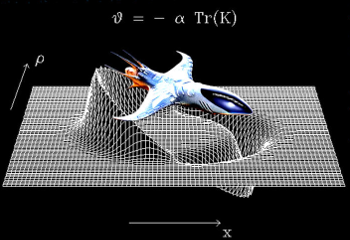
This seems perhaps an obvious one, space opera tends to be impossible without some measurable means of transiting the stars in a reasonable time frame, but it is one that, until recently, was even theoretically impossible. With the cultural popularity and theoretical applications of the Alcubierre Drive, it seems that we can justifiably speculate on how an FTL civilization would function. However, before this, when breaking the light speed barrier was beyond the realm of plausibility, we had to simply invent it as science fiction.


I don't think too much needs to be said about this one, as its premise is quite simple and the scope for storytelling it grants is pretty broad. That said, I don't think that writers should fall into the trap that you can only tell good space opera with FTL. The solar system is vast enough that we can tell many stories inside of it, without ever having to leave the heliosphere. That space is big is an understatement, and so we can do much to fill up the void between planets.

2) Artificial Gravity

This one is also a standard feature, but the one that seems least likely to ever be feasible within the realm of known physics. Gravity as we know it is generated by the spin of an object exerting force on the items upon it, essentially pulling on them. To do that you need something which can artificially replicate that force. In most science fiction though we seem to see artificial gravity being a standard applied everywhere. The mechanics of this are usually poorly explained, and well beyond the scope of our physics. Thus, one is forced to conclude that this is an unfeasible prospect based on our current understanding of modern science.

However, we can generate artificial gravity through things like centrifugal force, or simple thrust. The books in The Expanse series (and television series) show this through both aspects, and it is fascinating to watch the differences in gravity and problems it creates for our characters when they must do without it on occasion. Knowing that this is a plausible thing too, might change many people's perspective on what is 'realistic' and 'unrealistic' in science fiction.

I personally look forward to the day when we have a rotating habitat in orbit around Earth to start to get some hard data on this.

3) Interplanetary Colonization

One thing that is practically taken as gospel in almost every piece of science fiction is the idea that humanity will spread to the stars and plant our flags on other worlds and terraform them to suit our needs. Now, we have a history here on Earth of spreading across the continents, from the early Polynesian peoples to the Age of Discovery when Europeans began planting flags all over the world. It would make sense then that we would seek to expand that process to the final frontier. But does it really?

For one thing, space is big. Really, really, big. It would take centuries to travel to even some of the closest stars near to our solar system without FTL. Even travelling between the various planets in the solar system at the moment would take months or years with current technology. Even with some future technology it would take a long time to reach some place like Proxima Centauri, our closest star.

Even then, once we got to another solar system, would we even be able to colonize it? Kim Stanley Robinson's Aurora has some interesting answers on that. However, even assuming that we could terrform another planet, it would take a long time, centuries or millennia. So why not just build some islands in space?


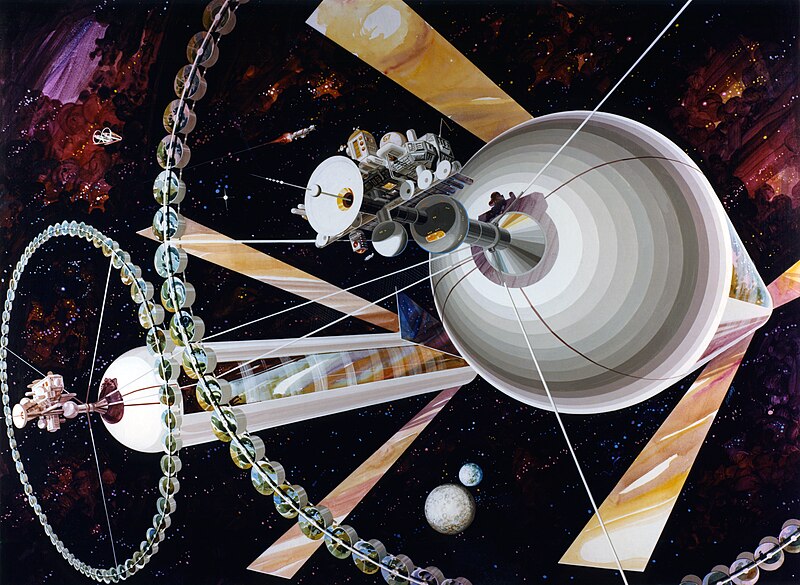
This brings you to the idea of the O'Neill Cylinder! At its simplest this is a large tube, either built independently or into a hollowed out asteroid, and spun up to provide gravity. Something like the terrarium from 2312.  The idea was originally floated in the book The High Frontier by physicist Gerard K. O'Neill, which talked of building rotating habitats in Earth/Moon orbit, or at the stable Lagrange points in Earth's orbit. These can be of varying sizes, but the advantages are you can create and settle them however you like! Want an arctic like location? No problem! Eternal tropics? No problem! All you need to do is create a cylinder with a certain diameter and length, spin it up and light it and voila!

And O'Neill's design isn't even necessarily the only one. You could build even larger, potentially with the truly massive McKendree Cylinder. Unlike O'Neill's more modest island in space, here you would practically be building a continent in space. Measuring 460 km in radius and 4600 km in length per the original proposal, you could have a living area inside with the same land area as Russia! You could even build it bigger with stronger future materials!

Building something like this turns into decades, or maybe a century, of work. Something far removed from the travel times between the stars or the length of time it might take to terraform somewhere like Mars. We could have continent sized living space in the future, yet this seems to get overlooked fairly easily. Perhaps we should start thinking of those types of stories more. You don't even need to leave the Solar system to have an 'interplanetary' adventure!

4) AI

Artificial Intelligence, or the reasonable facsimile thereof, has been an expectation of science fiction since at least the 1950s. Presumably most well known is Robert Heinlein's "Mycroft" who was birthed when an engineer on the moon progressively plugged in more and more computers until they gain sentience as one single being. Sadly, to some people the idea hasn't advanced much beyond that.

There is a strange belief in what is known as "The Singularity" in which computers will advance so quickly and so fast that just one day they will "wake up" and AI will be born. Now there's a few problems with this idea. Firstly that our rapid advancement in technology and efficiency is nowhere near as rapid as proponents even 20 years ago predicted. Futurist Ray Kurzweil predicted in his 1999 book The Singularity is Near that by 2010 we would have a computer capable of emulating human intelligence, and by 2020 such computers would be available for "one-thousand dollars" to us. Well, it's 2020 and barring some massive change no such computer is on the horizon.

Largely the idea is a vast misunderstanding of Moore's Law, which even the observer himself said was not a hard fast law, but an observation. It is even clear today that the rapid increase of processing power in computing is reaching a state of diminishing returns. Exponential growth cannot continue forever.


Even overlooking the issue of the Singularity, what would an AI actually look like? Would it have human level intelligence? Maybe, but would we recognize that intelligence? That last question is probably the most important when considering the issue of AI, would we even recognize it for what it was if we had it? Let me be clear, creating an 'artificial brain' which can solve complex problems is already within our grasp, whether it be made to play games of go or jeopardy. However, one which will be able to complexly interact with and communicate/reason with its human creators will take time and we might not even realize it was self aware as it wouldn't have the same desires/fears/ambitions as we do.

This is why I personally tend to dismiss out of hand fears of 'god like' AI destroying either humanity or the planet. In fact, I think AI will probably be far 'simpler' than we imagine when/if it does show up. For now though, its a highly theoretical concept with some wild out there ideas which fiction has almost done a disservice to.

5) Space Capitalism

So this is an important one. In many, many future scenarios it is hundreds or thousands of years in the future and everyone is either still working a 9-5 job, or working towards getting a pension or government benefits. Now, this makes sense since it would take a lot to put readers in a frame of mind where they grasp a post-capitalist society. However, is this the best way to try and imagine the future?

There have been many attempts to imagine a post-capitalist society in science fiction. Whether it was Gene Roddenberry's post-scarcity Federation of Planets, or the Mondragon Accords put forward by Kim Stanley Robinson. Now, each of these do depend on future technologies to be feasible (the magic replicators in the former and quantum computing in the latter) and it isn't far fetched to believe that our future economic systems will be driven by post-scarcity concerns or technological advances.

One future technology with the potential to upend the current economic order as we understand it is fusion power. An expected massive leap in power production and orders of magnitude more efficient and safer than our current atomic power generation. This could, almost overnight, upend our way of producing power as we know it and put the current hydrocarbon power generation methods the world largely depends on in decline. That would change some key economic inter-dependencies, such as on foreign oil or even the whole natural gas industry.

Now some of this does depend on the idea of a 'post-scarcity' society. It should be understood that 'post-scarcity' does not mean that we have everything, it just means that obtaining resources and a high standard of living is not impossible for the average person as goods are produced cheaply and available to all. This would though, arguably eliminate the need for traditional capitalism as we know it and lead to something close to the UBI (Universal Basic Income) that has been mooted around the last few years. Even just the UBI would undermine our understanding of politics and economics as it stands.

The future though, might not be more egalitarian but more corporate. With men like Elon Musk and Jeff Bezos driving the current future of space travel, it seems like we're possibly going to have shares be more important in the near future than any sort of workers cooperative in space.

However, the ideas for a post-capitalist future are many, and even here I can only list some ideas for why writers ought to be imagining a post-profit driven society.

----

These of course, are just a few things that science fiction is often using as a standard for the genre. They aren't the only big tropes, but I think they are at least the top five. What do you think, and what would you like to see more of in science fiction?