Showing posts with label Canada. Show all posts

Monday, 8 November 2021

The Trent War

On this day, one hundred and sixty years ago, the United States warship, the USS San Jacinto, fired a warning shot across the bow of the British Royal Mail Steamer, the RMS Trent. In doing so, the captain of the Jacinto, commanded by Charles Wilkes, was taking an action which would nearly plunge the United States into war. Such a war would surely have been one of the greatest calamities of the 19th century, plunging the whole English speaking world into a conflict which would surely wrap the whole world in flames.

The Trent Affair, has been called the Cuban Missile Crisis of the 19th century, and coming almost exactly one-hundred years before that Earth shaking crisis, that is an apt comparison. For some background, the United States and the British Empire in 1860, were not good friends. While the US had close economic ties to Britain, and many immigrants from the British Isles (and primarily Ireland) still came to the US, the economic and political elite in Britain were somewhat aloof of "Cousin Jonathan" as the US was then known. There had been war scares since the War of 1812, with border crisis like the 1838 Caroline Affair, The Aroostook War, the Oregon Boundary Dispute, and only in 1859 the abortive "Pig War" which nearly set the two nations to war over a pig in the Pacific. In each case, cooler heads prevailed and diplomacy proved the order of the day. 

In any case, in 1861 the slaves states in the Union seceded after the election of Abraham Lincoln to the White House. The new so-called Confederate States tried to form an explicitly slave holding republic, and in response the Union called for 75,000 volunteers to crush the rebellion. From there, four years of bloodletting followed. That same year, Britain declared neutrality in the conflict, granting belligerent rights to both sides. This outraged the Union as they felt it was a step towards recognizing the Confederacy as an independent nation, as it granted some recognition of Confederate warships, and the right to take on provisions. Though this was not, in fact, a step towards recognition, it did show a certain bias in British thinking at the time. They remembered how the Thirteen Colonies had been impossible to subdue, and many concluded that the Confederacy - with roughly as much territory as western Europe - in seceding was a fait accompli which would mean it was only a matter of time before the North was forced to recognize that the United States were united no more.

Of course, the Union would not do that without a fight, and so the Confederates sought proper recognition from the powers of Europe. This was exactly why the Jacinto stopped the Trent, in order to seize two Confederate diplomats bound for Britain and France. Truthfully, the account of this stop and seizure must be read to be believed, from belligerent passengers facing down armed US Marines, diplomats hopping through portholes, and a swell on the waves nearly knocking everyone together in a dangerous pile of bayonets and human limbs, it is a minor miracle that no one was hurt, let alone killed. And historically, even with British outrage, the Trent Affair was resolved diplomatically.
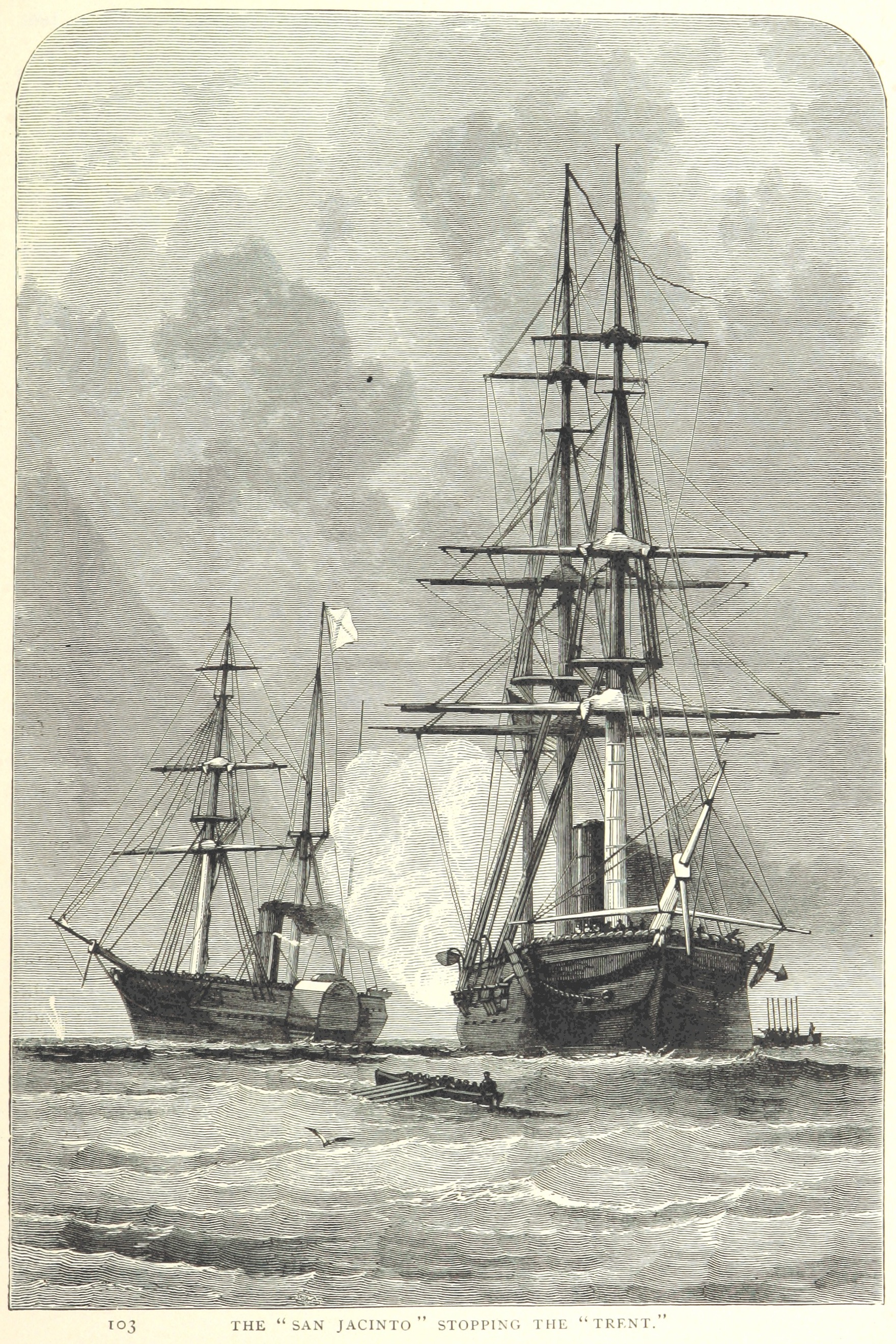
This of course begs the question, well what would have happened if someone had been killed and the crisis was not resolved diplomatically? The answer is war, a great and terrible war.

For simplicity, we can assume that someone is killed on board the Trent and Britain is outraged. Abraham Lincoln of course would not be fool enough to intentionally goad Britain into war, and most likely he would have either capitulated, or pushed for foreign mediation of the problem. Ironically, he would have run into what in the 21st Century we would term, a public relations problem. As mentioned, many in Britain assumed that the secession of the South was a done deal, and the North would have to cut its losses. The other thing many assumed was that in doing so, the United States would make good on those losses and turn around and invade Britain's North American possessions in Canada to do that. This was not helped that those making decisions in London did not know much about Lincoln and his cabinet, it had only one recognizable man, William Seward. The problem was that William Seward was known for often saying the US should invade and annex Canada, which naturally - to the British Prime Minister at the time, Lord Palmerston - meant that this was indeed the plan.

Historically, when the British responded to the Trent Affair, they sent an ultimatum with an expiration date of seven days. This was to ensure that the United States could not do what many in Britain feared it would do and simply make peace with the South, turn its armies north, and seize Canada. If Lincoln were, in this counterfactual scenario, to send a suggestion hoping for international arbitration, Britain would most likely see this as a stalling tactic and prepare for war.

Truthfully, that is exactly what took place historically. Britain, upon receiving news of the events on the Trent, ordered out 11,000 soldiers and all the arms and other engines of war they would need. At the same time, in the United Province of Canada, orders were given in late December to muster 38,000 militia, while in Nova Scotia and New Brunswick, new volunteer companies were being formed. The British were evidently prepared to send 28,000 men immediately to North America. How many Canadians could have been mustered and armed is an open question, but in April of 1862, 14,000 men were available, and it is hard to doubt that in a war crisis, anything less could have been raised, and more surely could have. Should the British have fully committed to the war they could have mustered a great number of soldiers from the British Isles, troops stationed in the Mediterranean, and other places. The crisis did end historically in December, but had more men been sent, the size of the British forces prepared to fight the Americans would not be inconsequential.

The United States army in early 1862 numbered over 500,000 men. Nothing to sneeze at! However you can't move all those men to attack Canada, you need many facing off against the Confederacy, will have to dislodge others to defend the coasts, and some are also serving in the interior or in California! My own guess is the Union could shake loose roughly 12-14 divisions (3 Corps) to defend New England and invade Canada, call that roughly 150,000 men overall.

On the naval side, there is more of a mismatch. In 1862, the size of the Royal Navy showed over 465 screw vessels, 115 paddle vessels and 110 sailing ships, totaling 690 vessels in all. I provide here another tabulation here which shows only the major sailing ships and not the nearly 200 gunboats in service, which can be perused in the December 1861 Naval List. It should however, be a sobering number in comparison, with roughly 339 active ships worldwide.

The United States Navy, by contrast, had 264 ships. Of these however, roughly only 100 vessels were steamships, the remainder being sailing ships or other ships converted for the needs of the naval blockade. Not many are fast or modern steamers, or even proper warships. This puts them at a severe disadvantage.

Important to note however, that at the start of the war Britain has an advantage in ironclads. Whether it be older broadside batteries built for the Crimean War, or modern warships like the ironclad HMS Warrior or her smaller sister Defence, the British can send larger and superior ships to North American waters. The USS Monitor would not be launched until March, and she is restricted to New York, and her only company would be the USS Galena, who had very thin armor compared to any other ironclad of the period. Sister Monitors would most likely only be rolling out roughly 90 days after the Monitor's initial launch. This leaves very little to hold the line until roughly June/July 1862, and the British too will be building more ironclads of their own.

Not only will this war not be confined to the Atlantic, but on the Great Lakes both sides will be scrambling flotillas of gunboats. On Lake Erie, the US has an advantage by having the only functional warship, the USS Michigan, but on Lake Ontario, they will be scrambling to catch up as Britain can send gunboats or ironclads up the Saint Lawrence to help control that lake and defend Canada. The Richelieu River would also end up as a battleground as well, with flotillas needed to be constructed to defend or attack towards Montreal. In each case the Canadians have an initial advantage due to the proximity of British guns and sailors and access to the St. Lawrence once it opens in the spring.

We do of course need to discuss the third combatant, the Confederacy. They would have roughly 270,000 troops present for duty at the start of 1862, and without the need to defend their own coasts from attack, would be free to redeploy thousands to support their armies in Virginia and Tennessee. Though they don't have much of a navy, that doesn't really matter when you have the biggest navy on Earth stepping up for you does it?

This is, very roughly, the strength of the various sides going to war in 1862 should this war go hot.

How then, might this war be carried out?

At some point in early January/February 1862 the USN and Royal Navy will fight a series of skirmishes, ranging from ship to ship fights to more than likely one pitched battle in the North Atlantic and the Caribbean. We know roughly what the British hoped thanks to a brilliant article by Kenneth Bourne, commissioners appointed to the task in 1862, and the British commander of the North American and West Indies Squadron did leave ideas for what he hoped to accomplish written down. This would mean that in the first months of the war Britain would be putting most of her efforts into either destroying or driving to port as much of the USN as they could. This would maybe net a few modern ships, but I credit the US enough to think they would begin evacuating ships and men from likely points of attack by the RN once the British minister in Washington leaves, while leaving just enough old or less reliable ships (and men in forts) to hold what they have and enforce a legal blockade so that in the event war does not break out, they cannot be said to have let up on the blockade.

These first few months would lead to a depressing bit reading in the North as the newspapers reported on forts captured, ships sunk or captured, and likely thousands going to prison camps in British colonies or the Confederacy. Many ships though, would make it to port, and be able to harass the British as they tried to set up a blockade of over 1,200 miles of coastline. There is no serious doubt they could sustain this blockade, merely how long it may take to be effective. 

While Britannia rules the waves, much of the war on land would be stalled. The British would have advanced partially overland, seizing posts across the border in Maine to control the route their soldiers historically marched through. They may also launch an overland raid into New York to seize (or more likely raze) the incomplete Fort Montgomery at the head of Lake Champlain. This would undoubtedly cause outrage in the Union, and they would be chafing for the chance to strike back.

We can also make a pretty good guess on how this would go as none other than future General in Chief of the Union armies Henry Halleck had written about the most important way to attack Canada in the 1840s, an overland attack on Montreal. This serves two purposes, first it cuts off the western portion of Canada (modern Ontario) from support from Britain by sea, and secondly it delivers control of the Saint Lawrence River below Quebec to the invader. Most likely an army would (as had been done in 1775 and 1812-13) advance up the Richelieu River to attack the city and attempt to take it. 

Problematically, the British know this, and would most likely be prepared to meet the Union somewhere on the field of battle in between. Expect the first great clash between an American "Army of the Hudson" and the British "Army of Canada" somewhere along the banks of the Richelieu in May of 1862. 

Meanwhile the Union would be sending an army to invade Canada West. This would both tie down troops otherwise intended to defend Montreal, and also snag bits of British territory to use as bargaining chips at the peace table. If they could cross the Saint Lawrence and take Kingston, they would be able to concentrate on besieging Montreal and then potentially Quebec. 

The British for their part, wished to attack the city of Portland Maine in order to seize an all weather railroad terminus at the Atlantic. This would most likely lead to a British attack, and potentially siege, of the city, further tying down US troops who would otherwise be used elsewhere. 

What then is the Confederacy doing? Considering they could have gathered as many as thirteen divisions in northern Virginia (potentially 125,000 men) I think that Joseph Johnston would be under great pressure to attack Washington. Meanwhile, McClellan and the Army of the Potomac (most likely a similar size) is going to be waiting to either attack or be attacked. How that campaign would play out would be up in the air, but it would feature two of the largest armies ever assembled in North America going head to head. Considering the fair amount of blunders and problems in handling command and control in 1862 on both sides in the Peninsula Campaign and the Seven Days Battles, I don't expect anything definitive to be decided.

Out West, a similar situation holds true. Albert Sydney Johnston (historically of Shiloh fame) would most likely find himself facing a similar situation he faced in April of 1862 historically, but now he has access to everything he can get his hands on. I fully anticipate he may go forward and attack the still disparate Union armies and re-invade Kentucky. Will he prove more successful than Braxton Bragg? 

Beyond the Mississippi, I can see little really changing, though some quirks of fate may drive the Confederate fortunes better or worse. On the Pacific slope, other than a blockade of San Francisco, the British probably seize the San Juan Islands, bloodlessly ending the Pig War.

My own expectation is that by July of 1862, the British will have seized Portland, while blunting the early invasion of Canada East, keeping them out of Montreal. In Canada West, the Union will have captured Toronto and everything west of it. Meanwhile, on the Virginia front, two massive armies will grapple with one another like clumsy giants, pushing the battle lines north or south as the fortune of war goes, though to give credit I do think McClellan could push the Confederates out of Centreville and towards the Rappahannock. Out west, the Confederates, if they do better than at Shiloh historically, blunt any invasion and are marching back up the river towards Nashville, seeking to drive the Union out.

Where the war goes from here, who can say? Economically, the Union would be in a pickle as the blockade would hurt their economy, and most Union finances came from either money earned on the tariff, taxes and printing money. The Confederate economy relied on printing money and it sent them into an economic tailspin that ended up destroying the nascent nation as effectively as Union cannon and warships. The blockade would hurt, while perversely the Confederacy is open for business and can sell cotton on the world market to their hearts content, which most likely makes for a much better economic situation. Britain too would be hurt, but not nearly so badly as the United States. 

If Lincoln can politically manage to accept a 'white peace' with mild reparations before the end of 1862, he absolutely will. However, should he be unable to do so, I can unfortunately see the war dragging into 1863-64 to the Union's detriment. Every year another man, rifle and bullet is spent fighting Britain in Maine or Canada, is another year the Union is not fighting the Confederacy and not strangling their economy. Even should the Union make peace with Britain, is it likely they can turn around and continue the war into 1865, or potentially even 1866? This is perhaps the only scenario where the Confederacy could emerge as a functional and not economically wrecked nation, and if it did, that would have terrible consequences for world history as the Slave Power pushes on.

I do not regard this as a good outcome. North America would be divided between four nations (Canada, The US, CSA and whatever happens in Mexico) all of whom may have reason to distrust one another. Canadians would feel bound to the mother country more than ever, and the Confederacy, if it gained its independence by foreign assistance, would most likely seek out foreign allies. 

I've covered the bare bones here, but there's much more to talk about. I've explored the topic myself, and am currently writing a projected trilogy which would cover just such a war. The first book Wrapped in Flames, is currently closing in on the 50% finished mark. I'd love to hear other thoughts on the idea, and it is one which is extremely intriguing and still worth exploring.

Wednesday, 2 June 2021

The Battle of Ridgeway

In June 1866, the year before Canada would become Canada, a group of Irish patriots under the moniker the Fenians, crossed into Canada with a simple plan. They would invade Canada and hold it hostage in exchange for Ireland's freedom. If this plan sounds insane, it's because it is. However, many were convinced they could make it work, and many would die before the whole fiasco came to an end.


The Fenians were a group of Irish rebels who were determined to free Ireland from British rule. Active for roughly twenty years. Founded in 1858 by American Irishmen and former rebels from the 1848 rising, the Brotherhood would try to recruit men to fight for Irish independence. Their earliest successes came when many men gained experience fighting in the Irish Brigade and other bloody battles in the American Civil War. Indeed, many of the future Fenian leaders such as John O'Mahoney, Thomas Sweeney and John O'Neill would see their first action in the Civil War and gain experience leading men.

In the aftermath of the Civil War, there was a large number of armed men with experience in war, but no one to fight. Why not then, the Fenian leadership asked, lead an invasion of Canada to conquer the, at this point disparate colonies and hold them hostage in exchange for Ireland's freedom? This was not a universally popular idea, and it led to a split in the Fenian leadership. However, plans for an invasion went ahead anyways. It is estimated as many as 50,000 men volunteered to be a part of this invasion. When push came to show however, the Fenians only managed to get a few thousand men organized, and most were dispersed once the American authorities got into action.

On the Canadian side, British spies actually had managed to penetrate the Fenian organization. They had successfully predicted a previous Fenian raid on Campobello Island in April of 1866 which was dispersed without issue. This in turn, lowered the guard of the Canadian authorities in Canada West (Ontario) who felt there was nothing to fear from the Fenian menace. Alarms had been common in 1865 and in 1866 the Canadians felt certain that they could control a Fenian invasion.

When John O'Neill kicked off his invasion in June it was not a secret to either Canadian or American authorities. However, none could pinpoint the exact location the crossings would take place at.

It was actually meant to be part of a broader strategy. One Fenian force would march on Toronto, another on Quebec, and they would overwhelm the Canadians. In actuality, on O'Neill's invasion of the Niagara Peninsula got off the ground, and there were only a few other small skirmishes 

In a well planned action, the Fenians first disabled the only warship on Lake Eerie, the USS Michigan by subterfuge. This allowed O'Neill to begin landing men across the Niagara River. Without USN ships to stop him, he was able to cross nearly 1,400 men to the Canadian side. The quickly seized the town of Fort Eerie, and began trying to bring over Irishmen to their side. They received no local volunteers.

Meanwhile, the Canadians quickly learned of the invasion and ordered out the militia, calling over 14,000 men to arms. In Toronto, the men of the 2nd Battalion of the Queens Own Rifles hastily mustered in Toronto and was quickly delivered to the Niagara frontier by train. They were joined by a similar quick mobilization of the 13th Battalion of Volunteers from Hamilton and two other quickly mobilized companies of militia in an ad hoc brigade. They were placed under the command of militia Col. Alfred Booker who, like the men under his command, had no experience with war, unlike the oncoming Fenians. The Canadian forces numbered about 850 men, while their Fenian counterparts numbered between 700 and 800 men.

Learning of Booker's route of march (possibly by 'tapping' the Canadian telegraph lines) O'Neill swiftly night marched his men from their initial position at Black Creek to the Ridge Road near the village of Ridgeway which would give the battle its name.

Booker's men had bivouacked for the night at Port Colborne. He had originally planned to make straight for Fort Eerie and take the town from a supposed Fenian rearguard. However, early in the morning on the 2nd, he received orders from the superior authority, British Colonel Peacock leading the 47th Foot and a larger relief column with cavalry and artillery, that he was instead to move to Stevensville and meet this column where the joined group, then over 2,000 strong, would attack the Fenian positions.

For reasons never adequately explained, Booker followed the spirit of Peacock's orders, but not the letter. Instead of moving to meet the reinforcement column along Skerk's Crossing to Stevensville, he advanced to Ridgeway and took the Ridge Road. This would lead to the Fenians learning of the change and being ready to meet the Canadians on the afternoon of June 2nd.

The following battle was, for all intents and purposes, little more than a skirmish between infantry battalions. Though each was grandiosely a brigade, none was stronger than a full strength battalion of regular infantry. There was no cavalry or artillery, and so it would come down to the skill of each individual commander. Though the Canadians behaved admirably, advancing into the Fenian fire and driving off their skirmishers and discomforting the Fenian left flank, a series of events that has never been adequately explained soon drove the Canadians from the field.

For some reason, in the midst of the Canadian advance, the order to "form square" was given. Whether it was the sighting of a party of mounted Fenians who acted as scouts, or merely a mistake by a bugler, the Canadians dutifully carried out a formation which had been drilled into them. Booker, immediately realizing his mistake, ordered the men back into line. Other accounts maintain that an attempt to relieve the front line by bringing up a fresh company of men caused confusion. Whatever the case, the Canadian militia was soon milling about in disorder. Seeing this, O'Neill ordered a bayonet charge which promptly routed the Canadian center. In contrast, the Canadian flanks withdrew methodically, skirmishing with their opponents, but the men did not regroup, and individuals and companies disorderly withdrew to Port Colborne. 

Seven Canadians would be killed at Ridgeway, while another two would die of their wounds days later. A further 22 Canadians would die of disease sustained while in camp in the subsequent weeks.

Six Fenians died on the field at Ridgeway, with another three known to have died of wounds after the fighting ended. Fenian casualties are difficult to estimate as many fled to the United States afterwards. However, another four Fenians would die in the lesser known but nearly concurrent Battle of Fort Eerie. 

A small Canadian force on the tugboat W. T. Robb, led by Colonel Stoughton Dennis who in his first action of bravely running in the face of danger, led 50 men to hold the town and hopefully capture any stragglers from an assumed Canadian victory. Instead, they encountered over 800 Fenians retreating from Ridgeway and other positions. In a doomed last stand the Canadians fought, but many were wounded - miraculously none killed - and captured. Other than this brief humiliation though, the Fenians let them go as they had to flee the oncoming British reinforcements.

In the aftermath, much blame was passed for the defeat. Only a victory at Pigeon Hill by the Canadians would salve the bitter wounds of what happened on the Niagara Peninsula. Booker was ultimately found to be moderately to blame for the fiasco, but the Canadian government at the time was quick to try and pass off the blame to the individual soldiers themselves, rather than admit it had not handled the crisis properly. O'Neill meanwhile, would be feted as a hero to the Fenian cause, and it would be celebrated. He would subsequently lead two further failed invasions of in 1870 and 1871. The Fenians themselves would peter out by the 1880s, replaced by later incarnations of the Irish Republican movement.

It was Canada's first real test of battle. The nine men who died in battle or afterwards have never properly been remembered. While most Canadian students have learned the story of the Fenian Raids and their roll in helping shepherd the various colonies towards Confederation, it is a battle itself which is rarely explored. Peter Vronsky has written perhaps the best single volume on the battle, and I myself used it as a guide to this piece. It is a book well worth reading, and may enlighten many people on a sadly unappreciated piece of Canadian military history.

One can only wonder what might have happened had the Canadians not gone the way they had, or what could have happened had Booker gone straight to Fort Eerie instead. That though, is speculation for another time!

Wednesday, 2 September 2020

So About John A. Macdonald Again

I last spoke on the subject of John A. Macdonald back in 2017. In that little essay, I made many statements on why Macdonald is a flawed man, and some of the mistakes he made. I also pointed out why it is important we remember him and what he accomplished for Canada. Also in that first article I made some mistakes when talking about his past actions and the legacy he left us. In light of recent events, I hope to make some corrections, but also stand comprehensively by the good and the bad of our first Prime Minister's legacy, and why I'm unwilling to forget either of those thing.

In my previous essay I did mention what I thought were the positives of Macdonald's legacy, and to begin this one I would like to point out many of his faults before I expound on why it is important he be remembered, and why our current historiography is perhaps not up to the task of doing it.

Firstly, yes, Macdonald was absolutely a racist and that's something that even if you subscribe to judging people by their time period, he was no paragon of tolerance and virtue. He dismissed the Indigenous peoples of Canada who would not settle to farm land and adopt Anglo-Saxon culture as savages. In his multiple dealings with the Métis people he referred to them as half-breeds, a slur on their Indigenous-European roots. 

He was even extremely racist against the Chinese, exceptionally so for the time, wholeheartedly supporting the efforts of British Columbia to expel them from the province and desired to exclude them from the right to vote even in his aforementioned 1885 Franchise Act. He said "...if they came in great numbers and settled on the Pacific coast they might control the vote of that whole Province, and they would send Chinese representatives to sit here, who would represent Chinese eccentricities, Chinese immorality, Asiatic principles altogether opposite to our wishes; and, in the even balance of parties, they might enforce those Asiatic principles, those immoralities … the eccentricities which are abhorrent to the Aryan* race and Aryan principles, on this House." This shocked even his contemporaries, many of whom objected to denying those of Asian extraction the vote. In the end, Macdonald managed to exclude them however.

He also sanctioned the Davin Report in 1879 which was directly responsible for the creation of the Residential School System which would be used in Canada until the 1990s. I want to make clear here that the report specifically highlighted that taking children from their families to 'civilize' them was the best option, and this was supported by Macdonald.

As I said before, Macdonald was directly responsible for the Residential School System, which is a shameful stain on our history. To be clearer than I was in that original essay, the sanctioning of that system, and it's perpetuation by our government long after it was shown to be unhealthy and ineffective and also not even cost effective, was an act of cultural genocide. Though it did not, in sheer numeric terms, kill many people, it caused irreparable damage to Indigenous culture and communities wherever it was implemented and has lasting and terrible effects to this day. 

To continue from my earlier comment on the Franchise Act of 1885, however, one could cynically examine the prospective Indigenous right to vote as an attempt to enshrine as a method of control over Indigenous polities. It would, in the language presented, effectively destroy the traditional structure of Indigenous self-government. It would take away their unique rights as tribal entities, and assimilate them into the broader Canadian society, effectively cutting up communally owned tribal land into individually owned properties. Though ostensibly they were allowed to keep their tribal affiliation, they would lose any special privileges under the Indian Act (another note on the Act below).

Despite this, does this itself make the attempt to at least grant the franchise to the Indigenous peoples, even with long strings attached, an ignoble thing? Some would say yes, and considering that relations with the government are fraught and full of federally exploited loopholes and are imposed in a top down style to this day, that would not be an incorrect view. However, considering almost no legislation was put forward to try and even engage Indigenous peoples in a discussion about voting again until the 1940s, and then not granted on their terms until the 1960s, some might say that as this bill was being pushed in 1885 after a full blown rebellion, it was still a progressive attempt for its day. Though let it be known that Macdonald did say "The great aim of our legislation has been to do away with the tribal system and assimilate the Indian people in all respects with the other inhabitants of the Dominion as speedily as they are fit to change." It must not be forgotten that even the most benevolent seeming actions by the government then (and arguably still) were about assimilation into the Canadian whole.

Monday, 24 August 2020

The Red River Expedition

On this day, one-hundred and fifty years ago, the Red River Expedition reached Fort Garry. In what was one of the longest treks through wild country to assert national sovereignty, Garnet Wolseley led over 1,200 men to put down what was called the Red River Rebellion, but may more accurately be known as the Red River Resistance. 

The catalyst for this incredible cross country trek was a series of poorly thought out land negotiations by the nascent Dominion of Canada. For decades men in what became Ontario had covetously eyed the vast, empty lands to the west Rupert's Land in what was controlled by the Hudson's Bay Company. Of course, these lands weren't really empty, but were home to many distinct and mostly thriving Indigenous cultures which had left their mark across the Great Plains for centuries.

One of these groups were the Métis. The Métis are a group of mixed ancestry, having been born from the union of various fur trappers with Indigenous women from across many tribes. They eventually formed their own distinct culture and community, many settling in the Red River Settlement, along the banks of the Red River between the Hudson's Bay trading posts of Upper and Lower Fort Garry. There they began to settle, mixing between sedentary farming and the great buffalo hunts which kept them fed when crops failed and harvests failed to materialize.

Along the banks of the Red River was also where the only sizable contingent of purely European settlers dwelled on the Plains north of the 49th Parallel. These were descendants of the colonists Lord Selkirk had brought in the 1810s to try and establish a more permanent presence on Hudson's Bay Company land. From there others, Americans, British subjects and French Catholics, traveled overland or the long arduous route from the sea to settle and farm. It was a mixing pot of peoples, multilingual and multicultural. Catholics and Protestants, Europeans, Métis and the Indigenous.

By the time Canada had obtained the Hundson's Bay Territory, the population was over 13,000, over half of them Métis. When the government had obtained the vast territory stretching from the Lake of the Woods to the Rockies, the people living in it were not consulted. They had no deed to their land and would be, under Canadian law, considered squatters. And so they were rightly terrified of this new development.

Anticipating the transfer, the government of Canada sent surveyors to Fort Garry in order to survey the land for settlement. The local representatives all said this was a poorly thought out idea which would cause unrest, but in typical form, the government went ahead and did it anyways. The surveyors, led by Colonel John Stoughton Dennis (one of the most singular cowards in Canadian history whose only previous claim to fame was bravely running away from the Battle of Fort Erie and having many high placed friends) was sent to command the surveyors. None of the surveyors spoke French, and they ignored all efforts by the locals to communicate. The local settlers, rightly irked by this development, coalesced around the son of a former prominent Métis leader, Louis Riel. 

He swiftly formed a Provisional government, disrupted the survey work, turned back the governor sent by Canada and seized Fort Garry at the head of 400 men. In doing so he took effective control of the colony. The local Anglophones tried to rally around Colonel Dennis, but in the face of adversity he bravely dressed as an old Indigenous woman and ran away after other Anglophone leaders were arrested.

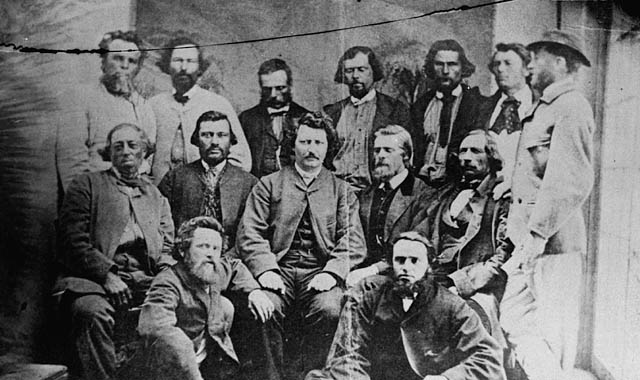
The Provisional Government (Riel in the center)

The Provisional Government then set about trying to negotiate a settlement with Canada. In doing so they established effective authority, managed to create Manitoba, and seemed to be on the path to effectively integrating into the new Dominion. However, the resistance of the Anglophone community was not yet done, and so some men continued to agitate. Though Riel had before pardoned men who had worked against him, he chose to make an example of one infamous trouble maker, Thomas Scott. Scott was an out and out racist who chose to quarrel with his guards and held the Métis in contempt. In order to demonstrate he was serious, Riel ordered his execution. 

This set off a firestorm of condemnation in Ontario. The people were convinced that Riel meant to install a French Catholic government in the new Manitoba. They demonstrated, demanding vengeance for the death of Thomas Scott. Prime Minister John A. Macdonald, who had until then been of the opinion that negotiation was the best option, could not let this go unanswered. He therefore ordered a military expedition be put together to assert Canadian sovereignty in the far flung province.

For this, the Canadian government selected the most capable officer of the Victorian Age to lead the expedition, Sir Garnet Wolseley. A man who had taken bullets for the Queen in Burma, Russia and India, he was practically bred for war. Acting as Quartermaster-General to the forces in Canada at the time, he was charged with raising a brigade of troops to serve on the expedition. He was assigned the 1st Battalion of the 60th Rifles under Lt. Col. R. J. Fielden (350 men and 23 Officers) and then two provisional battalions of militia from Ontario and Quebec, the Ontario Rifles under Lt. Col. Samuel P. Jarvis (382 men and 25 Officers) and the Quebec Rifles under Lt. Col. Louis Casault (385 men and 25 officers). Alongside these he had detachments form the Royal Artillery with four six pound guns, and men from the Royal Engineers, and voyageurs and guides. It was over 1,200 men.

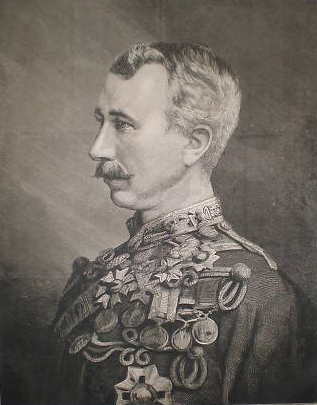
Wolseley in 1874

Being his first independent command, Wolseley did much of the legwork for the planning himself. He consulted maps, other voyageurs, and many Canadians who had experience with the area. He also did all the calculations himself and tried to figure out how long exactly it would take them to reach their destination. He managed to calculate the number of supplies they would need down to the barrel, knowing they had to bring all of it with them themselves as there was no means of resupply along the route. Ammunition, food, clothing, axes and other implements would all have to go with them. Some of the tools sent by the Regular Army were considered shoddy, and so the Canadians themselves had to replace them with local made items. He recruited many useful officers from this Canadian experience, men he would rely on in later life, a Canadian, Frederick Denison who he would employ as chief of his voyageurs up the Nile trying to save Charles Gordon, Redvers Buller, who would serve as his chief of staff in many coming colonial campaigns, and William Butler whom he employed as a spy on the dangerous service of gathering information for him from Fort Garry before trekking to meet him in the wilderness.

It was a wild expedition, Fenians threatened to attack the column (they never did), the American government refused to allow the force use of the locks at the Sault Canal, and so they had to portage overland. It was a rough going, as they had to carry all they had with them past Thunder Bay along some slightly maintained roads. Christening his position Prince Arthur's Landing (though Wolseley felt it an 'ugly looking spot'), the men proceeded largely by canoe and portage. Though they were lashed at by rain, and kept up by thunderstorms, they persevered and moved on. They traversed from the new landing to Lake Shebandowan, overland again to Fort Frances and Lake of the Woods. The whole time they expected some form of attack, but their greatest enemies turned out to be the heat and the swarms of black flies and mosquitoes.

From there, after a brief misadventure where Wolseley's calculations and maps proved to be in error, they finally to the Winnipeg River and proceeded up to Lake Winnipeg, where they made camp and Wolseley mused on its picturesque appearance. After this, it was up the river to Fort Garry. They moved cautiously, expecting some form of resistance When Wolseley's brigade arrived, they found Riel had fled not long before their arrival as he had been (rightly as it turned out) told that the troops meant to hang him. Indeed, Wolseley's remarked "Personally I was glad Riel did not come out and surrender, as he at one time said he would, for I could not then have hanged him as I might have done had I taken him prisoner when in arms against his sovereign."

That being said, the expedition was a success. They successfully traversed through over 400 miles of wilderness to establish firm Canadian sovereignty over the new province of Manitoba. It was one of the largest military expeditions across the North American continent, and a feat of spectacular logistics through largely undeveloped wilderness. Not a single man got sick or was lost to disease or desertion. Despite the lack of fighting (as the whole 'rebellion' and expedition was a largely bloodless venture) it can safely be counted as one of the greatest feats of military movement of the 19th century, certainly the greatest of it's kind in Canadian history.

Route of the Red River Expedition

Much can be read about this, and Wolseley wrote extensively about it in his own memoirs The Story of a Soldier's Life (Volume 2). I would earnestly recommend reading the accounts of this adventure.

Wolseley would go on to earn laurels and undertake many successful campaigns in Africa and Asia. Riel on the other hand would flee into exile in the United States, only to return fifteen years later and lead an altogether more violent rebellion where he would be defeated, captured, and executed. 

Monday, 18 May 2020

The Problem with Trudeau's Firearms Ban

The recent Order in Council put forth by Justin Trudeau in response to the tragic events in Nova Scotia has caused no small amount of public debate. However, the ban itself is problematic in the way it was implemented, but also because it won't do a single thing to stop another massacre.

Now full disclosure, I like guns and have absolutely no problem with people owning them. I also think that the government is right to try and regulate what kind of weapons can be owned, there really is no reason for an individual to own a weapon which can be made to go fully automatic (which is a terrible waste of ammunition anyway). I am of the personal opinion though, this Order in Council was simply a publicity stunt, however well meaning it might have been. I hope to outline both why the gun debate in Canada is long settled, and why the current ban will do absolutely nothing to prevent another massacre.

Via Tactical-life.com

First though, let me clear something up. There has been a lot of push back from gun owners regarding the ban. Many claiming it infringes on their "right" to own weapons. Important thing to know, in Canada you do not have the right to bear arms. There is no second amendment like law which ensures Canadians have access to weapons, and we are probably better off for it. The law is very clear on that fact, and the Supreme Court has ruled twice, quite comprehensively, on the subject.

The first Supreme Court case to rule comprehensively on the issue was 1993's R. v. Hasselwander it was declared, in a specific rebuttal to an appeal to American ideals: The American authorities should not be considered in this case. Canadians, unlike Americans do not have a constitutional right to bear arms. Indeed, most Canadians prefer the peace of mind and sense of security derived from the knowledge that the possession of automatic weapons is prohibited.

In 2005 in R. v. Wiles it was confirmed that: "Possession and use of firearms is a heavily regulated privilege, and the loss of that privilege does not support a finding of gross disproportionality because it falls short of a punishment “so excessive as to outrage standards of decency” Thus confirming that the ownership of firearms in Canada is indeed a privilege. 

Owning firearms in Canada is very well regulated, and while handguns can be owned under very strict circumstances, it is very rare. There are an estimated 12.7 million firearms in Canada, and by and large, we seem to be very responsible gun owners and our current laws work. Even with a relatively large percent of personally owned weapons, gun crime is very low in this country, even if it has been rising in some urban areas. I would personally say this is a victory for our firearms laws and our own gun culture on the whole.

Hopefully this has been educational regarding both the existing laws, and gun crimes in this country. Now let's talk about why the ban will do no good.

I want to draw attention to the fact that the shooter in Nova Scotia actually did not legally own the firearms he used in the attack. They were in fact smuggled in from the United States. This is not unusual in Canadian crimes. It is estimated 70% of the weapons used in Canadian gun crimes come into the country illegally from the United States. These statistics, I think, bear out that any attempt to ban the ownership of guns in the hands of law abiding Canadians, with whatever intention, is utterly irrelevant in actually preventing the importation of illegal guns into the country.

If the Liberal government truly wants to act in practice to reduce gun crime, they should be working harder to stop the illegal importation of weapons into the country through a bilateral solution. Instead, they have chosen to act in a way which not only comes off as antagonistic, but is also not addressing the root of the problem. What is worse is that 2019 Angus Reid polling found that a majority of gun owners would be receptive to a total assault weapons ban. The optics of the Order in Council are, if anything, terrible, and now are dependent on a broad coalition to actually pass legislation - which since the Liberal government declined to adopt a formal coalition, puts them in hock to other parties.

While the Angus Reid polling does certainly suggest that support for items like handgun and assault weapons bans are high, even in a majority among gun owners, it also points to the fact that for the largest part of the population, this is a settled matter. Both in the courts of law and the courts of public opinion, these are not debates to be had. What has to be pointed out however, is that rather than flashy 'feel good' bans like the current move, we should instead be raising public awareness of what will actually go towards preventing massacres like these from happening again.

There is much more that could be done, like the aforementioned better attempts to crackdown on illegal imports, bilateral agreements with our neighbors, or even fighting to bring back the long gun registry. Raising these issues is much more helpful than a sudden and unexpected ban, and this is the conversation our leaders should be having.

It isn't an outright ban of certain weapons, but well researched and implemented policy which will help address Canadians' fears. So far, we seem to be lacking that from our elected leaders.

Friday, 17 January 2020

Ottawa Underground Legend


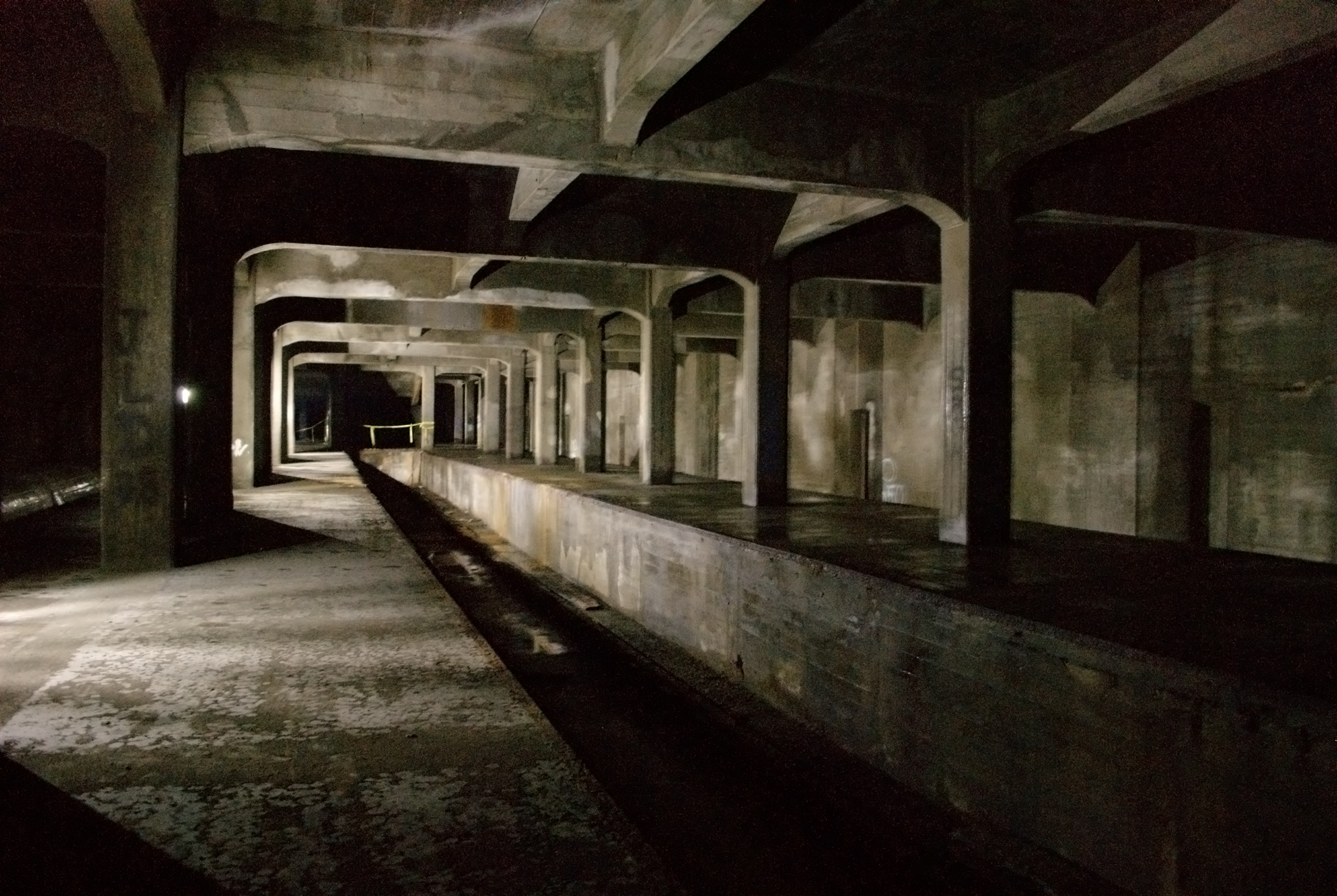
Some urban legends have more truth to them than we think. My own city, I discovered recently, has a few as well. Way back in 2012, there were reports of an abandoned rail tunnel, complete with train, compiled by an enterprising journalist of the Ottawa Citizen. He looked into rumors that someone had found an entire train just abandoned beneath the earth. So he went digging.

Bar side tales told that there was an abandoned train tunnel in the depths of Ottawa. Perhaps from an original attempt to get the city an underground rail system for its street cars, or maybe it was from an old brewery. For the latter, it was out of use since 1967, and no one had seen it since.

That was, potentially, until 2015 when some workers literally fell through the floor into the old tunnel. Needless to say, they were quite surprised and no one could figure out why it had been hidden. Mapping it out on old municipal maps, the rail line was discovered to extend perhaps as far as Carp and Rockland either way.

Now, its not clear from this latter article whether the tunnel in question refers to the conclusions of the 2012 Citizen article that the 'abandoned subway' is a part of the old brewery tunnel, or whether this is a completely different small rail system. There has been precious little follow up journalism on the subject, and it seems that it may well fall into the topic of urban folklore once more.

However, the fact that one has just happened to turn up is both fascinating and perhaps a little alarming. It should make us pause at just how many secrets cities, even small ones of only over a million, can hold after so many years. What else could be lying just beneath our feet?

A special shout out to Voices in the Attic for originally sharing and bringing this to my attention. They've got a great spooky Twitter feed to follow too. Definitely check these guys out!

Sunday, 29 July 2018

Those R&R Days

On Thursday I had an absolutely lovely day doing nothing. Now, to some people that may sound awful as I'm supposed to be writing or working, or doing whatever it is twenty-something Canadians do in the summer when our igloos melt. However, much has been happening in my professional and personal life that makes a day spent doing nothing a pure joy.

Many of you older folks may know what I'm talking about already. Days where you don't have to be rushing around or double checking things. Days when you're not really expected to do something and can just do, well, whatever.

Personally, I chose to spend that time with someone I'm rather fond of, while also taking time to expand my reading list and add more weight to my bookshelves. Adding to that realizing I also need a new bookshelf before my existing one collapses or I completely run out of floor space. Walking room is a must after all.

But I was extremely lucky to spend some time in the beautiful city I call home. After days of rain and humidity the weather was near perfect. We were able to go out and sit in the sun and do some much needed R&R (Reading and Relaxation) then move on to grab some delicious lunch at a cantina in the Byward Market. While perusing that in lovely weather, we next got to go and sit at the balcony of the Copper Spirits and Sights rooftop establishment in Ottawa. There we simply had drinks and read. There was something fun about just sitting, drinking, and reading while seeing people who knew there was a two hour wait for one of those coveted balcony seats.


If that doesn't tell you timing is everything I don't know what will.

Alas some brief, but bad, weather did come our way and drive us from our rooftop perch. However, we both got home and sat quietly for the evening, watching some fun documentaries on the hidden killers in British homes throughout history.

All in all, it was a relaxing day I wouldn't have wanted to spend any other way.

Monday, 25 June 2018

Kill Joy Killdeer

So the annual Bluesfest in Ottawa has been disrupted by a protected migratory bird laying its eggs where the main stage is to be set up. This has created a situation known now as the 'Bluesnest' which is proving birds can be real kill joys.


The bird, a Killdeer, is relatively plentiful across North America, but the eggs cannot be moved without approval from the government as they are protected under the Migratory Birds Convention Act of 1994. Yes, that is real. This causes a problem for the organizers as it potentially postpones their set up, and leads to a delay in an event which draws hundreds of thousands each year. This generates great revenue for the city and for all involved.

Amusingly while listening to the radio I have heard great support for the little bird. Many people are actively rooting for it, except perhaps those who stand to lose a lot of money. However, that the bird is even being respected at all is something that makes me proud of my country and this city. That it is making front page news is endlessly amusing since it holds up a very profitable venture.

Inevitably I think the bird and nest will be moved. There's simply too much money and publicity at stake. At most the festival may be delayed by a day or two while some wrangling takes place, but the show will go on.

Now I personally am not a huge fan of Bluesfest, but it is an important part of Ottawa summer life and draws huge crowds. The money being made and the publicity for artists who attend is huge, and as an opportunity can't be missed. While I personally won't be attending I would wish those who are attending well, and really only hope for the respect to the venue (and its local wildlife) it deserves.

However, we must hope that this respect will be understood by our avian brethren. Birds, despite their shorter lifespan, clearly have long genetic memories. Being capable of flight (and with the ability to dive bomb their excrement) they may prove more adept at ruining the festival than the organizers might like. I believe we know all too well what can happen if things get out of hand...


In the spirit of cooperation I propose we respect our flying friends and just let 'em hatch! Otherwise no one might live to enjoy the festival.

Friday, 16 March 2018

Wages of Deficit

I have in the past noted that Donald Trump is a compulsive liar. He lies about the most inane things and is almost ridiculously blase about it. The most recent, which hits close to home and may have a direct impact on my country, is his claims regarding the trade deficit with Canada. The reports seem to indicate that Trump not only made up a spurious fact regarding his own nation's trade deficit with mine, but that he simply did not know, or care to know, what the actual state of affairs was. This despite now for over two years making broad sweeping statements at rallies, on Twitter, and in interviews, regarding the supposed "unfairness" of foreign trade with the United States.

While I have made no secret of my dislike for Donald Trump as an individual, I must ask, how can Trump expect international observers to take him seriously? How can foreign leaders expect Trump to negotiate in good faith with them?

The simple answer is, they can't. Trump will not, and does not, work in good faith either with members of his own administration or international leaders who are his allies. The man seems incapable of either being honest, or even doing rudimentary research into the effects of his own policies, or the ground which they are supposed to stand on when debated by policy makers.

What is baffling, utterly baffling, about this recent exchange, is that the lie makes no sense. In no circumstances does it even seem reasonable. Its not compelling fodder for a political campaign, it isn't a reasonable position to remain in ignorance of, and it isn't even a clever negotiating tactic considering how easy it is to disprove. He just bluntly said this to a foreign leader, and his countries closest neighbor and ally, and had it easily disproved.

He then waffled on whether he was wrong by stating that "almost all" countries have a trade deficit with the US, even though that specific statement was wrong. This isn't the first time Trump has made this claim, but it was the first time he was so bluntly called on it while talking to the head of state of the nation he's been misrepresenting like this.

The short term damage is repairable, as a new blunder from the Trump White House happens nearly weekly, but in terms of renegotiating NAFTA as he wants in the long term, it is iffy any other leader will see him as negotiating in good faith or reasonably. He's just sacked his Secretary of State, has been caught totally making something up and blithely continued with it, and seems utterly unwilling to compromise on his mistake. That is not a recipe for creating a sense of good will or confidence with any of the NAFTA partners, who may be better served simply waiting out any attempts at negotiation he proposes.

For other world leaders, it should simply be taken as Gospel that Trump has no clue what he is talking about, and that his representatives don't even represent his views to the world. The unfortunate effect this may have on his foreign policy remains to be seen, but I can only repeat something I have said before, Donald Trump cannot be trusted.

Monday, 15 January 2018

Minimum Wage Ontario

One of the big topics of the New Year in Canada, or at least Ontario, is the rising minimum wage. Now as of last year the average minimum wage around the country was roughly 11.00$ on the whole, with only the province of Alberta and the territory of Nunavut having wages above 11$ at 13.60$ and 13.00$ respectively.

Ontario's minimum wage hike will be bringing minimum wage from 11.60 to an even 14.00 which means minimum wage workers will be earning about 1.90$ (rounding to 2$) extra in their paycheck. Then the next year it will rise to 15$ on the nose. This will make Ontario the highest paying province when it comes to minimum wage.

The question of course, is that a good thing?

You will find varying answers to this.

On one hand many people act as though this will destroy small businesses and send prices sky high in ways that are unimaginable. Some say that this will probably only inconvenience businesses slightly and make the workers richer. Personally, I think the truth is somewhere in the latter end of the conversation.

One of the most immediate effects it seems has been to bring Tim Hortons into conflict with the Labor Ministry in Ontario as they attempt to cut worker benefits to "compensate" for a pay raise. I have heard that rather than being the actions of a few "rogue managers" as Tim Horton's parent company Restaurant Brands International, claims, this is the norm across the board. It seems that this is taking place across Ontario as the company (or at the very least managers) gets greedy. Or perhaps, they're merely not as efficient at running their stores as they might otherwise have people believe.

This has been the biggest piece of news (especially with how quick the company is to do it) but with this pay hike being new, it might have made more sense for franchises to wait before pulling benefits. With other businesses though, the news seems to be taking longer to filter in as some companies seem to be hedging their bets. Undoubtedly this will raise labor costs (especially for small businesses) across the province. Indeed it seems that some have already complained that it will. Though it also comes with a litany of other advantages for employees across the board.

What we should really ask, is will this be good for the economy? Recent studies, done in 2015 and in 2016 have shown that, in all likelihood, yes it will. Job rates are probably not going to go down, and minimum wage workers will most likely be able to afford to do more with their purchasing power. Over the course of the wage raises this will mean that the average worker will be able to invest more in the economy, and productivity could even go up as workers are simply able to afford more. Which we should see as an overall boon.

Forecasting economic productivity though, is like reading so many tea leaves, and it is impossible to say for sure. Though I'm sure the average worker will be asking themselves, what could I do with even a few extra dollars from my wallet? Hopefully, that will be the question businesses ask as well.

Saturday, 18 November 2017

Change in My City

Change is sometimes dramatic, but it is often a subtle thing. The change I noticed yesterday was probably not overly dramatic, but definitely a very subtle part of the changing nature of this beautiful city of Ottawa.

Since I have lived here there has always been the light rail system. It was a constant companion to my movements for many years and helped me go in a rather limited series of directions up and down the city. They are building a new Confederation Line now to help move people to the other end of the city, which should be interesting, if still yes useful than our bus system.


However, for the longest time you didn't really have to pay for the train. There were ticket stations, but most people ignored them (and students didn't have to pay), meaning people usually just wandered on to the train. I often figured that the city probably lost a fortune on that deal. It seems though, that with the construction of this new line under way the city is looking to recoup some of that lost revenue. Part of me thinks that it is about time the city got around to this since it will be making them money, but another part is sad to see that almost anarchist system of train fare go by the wayside.

Now this isn't a big deal, as the train does need money. I just happen to remember when you could just walk down to the tracks like it was no big deal and not have to worry about anything getting in the way and hop on the train without much fuss. At the station I most often got on there was a dirt path worn down by countless feet that had scurried down that little hill running to catch a train. It's a nostalgic thought, but one which I hold fondly on to.

It is nice to see the city generating some additional revenue with these machines, and it will be fascinating to explore it on the new line as well. However, I couldn't help but reflect on the change that this has wrought, even in the smaller ways.

Change really is fascinating.

Saturday, 11 November 2017

Remembering Passchendaele

Today, on November 11th, we solemnly remember the men and women who have given their lives year after year in service of our country. This year however, it coincides with the 100th anniversary of a brutal blood letting which enveloped France exactly a century ago. This was of course the three month Battle of Passchendaele.

Courtesy of Wikimedia Commons
This bloody contest over a sea of mud for little gain was actually objected to by the commander of the Canadian Corps, Arthur Currie. He predicted that the battle would cost 16,000 Canadian casualties and was eerily accurate as it wound up costing 15,654 causlties to the Canadians.

It was an awful slog. One Canadian would say "The ground beggars description. The strongest and youngest cannot navigate without falling down."[1]. Indeed that is almost an understatement. The battlefield was a sea of mud which drowned men, mules, and horses, saw supplies simply sink into the mire, and sucked at men's legs like glue. Truly the sea of mud defies description or belief, especially belief that someone would think such a mad attack would succeed in anything.

In the end the Canadians prevailed, and the village was captured. The outcome though, has been debated back and forth for a century at this point, and it is doubtful that any consensus will ever truly be reached on the matter.

What cannot be doubted however, is the courage, valor, and unrelenting heroism shown by the Canadian Corps. They played a key role as shock troops for the Entente across the Western Front all the way to the armistice that was signed 99 years ago. Since then Canadians have been active on battlefields from France to Africa, giving their lives in the name of peace.

The valor of Canadians then and now should not be forgotten. The continued service of our men and women in uniform should be praised and acknowledged for what it is, and we should never forget those who have given their lives in service to this country at home or abroad, now and forever.

We remember.

-----

1] Pierre Burton, Marching As To War, Page 185, Doubleday Canada, 2001

Monday, 28 August 2017

So About John A. Macdonald

So it came to light recently that following this interesting trend in tearing down statues in the United States, some bright minded people have decided the best thing to do is try to remove the name of our first PM from some schools for reasons which seem rather far fetched. Felipe Pareja, who put forward the motion claims: "it might be difficult for Indigenous students and teachers to go to a school named after someone who he says was complicit in the genocide of Indigenous people."

Felipe Pajera is clearly not a historian.

Monday, 19 June 2017

Sailing to Sarantium

Recently I just polished off a pair of books I hadn't read since grade school. Those two lovely novels were a part of the Sarantine Mosaic by Guy Gavriel Kay, and they were Sailing to Sarantium, and Lord of Emperors. Each is a tale of travel, self realization, passion, and ultimately, betrayal. Sarantium, is ultimately a city of wonders. Join me now as I describe this world and how it all ties together in one great journey.

Credit to harryguinness.com

Sunday, 28 May 2017

A Beautiful City

Many days I wake up and look out my window and I have to smile, because I live in a very beautiful city. Canada's capital may not be as old as say, London, New York, or even Quebec City, but Ottawa is still a very beautiful place.

Originally known as a lumber town more notable for the scope of the violence between its French and Irish lumbermen, its choice as Canada's capital was a compromise which satisfied no one and displeased many. Almost until the last minute people were hoping minds would be changed and that the capital could be moved somewhere else rather than this little hilly city which it seemed was only fit for habitation by swine and lumber barons, and the two were not necessarily mutual exclusive. However, the city stuck, and just in time in 1867, the Parliament Building was completed

Just in time

Tuesday, 13 October 2015

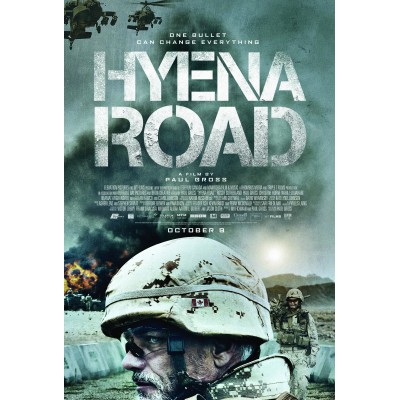
Hyena Road

I just had the absolute pleasure to watch the 2015 Canadian film Hyena Road. I have to say it was a spectacular movie, way more moving than the recent WW2 film Fury. It was, simply put, a masterful piece for a Canadian film.


The film is set at an unspecified time during the War in Afghanistan and is a Canadian film written, produced, and directed by Paul Gross (of Passchendaele fame) which was a real treat to see. The story follows the tale of a sniper team as it secures a road (Hyena Road) being constructed deep into the heart of Taliban territory, while they come into contact with a mysterious Afghan elder known only as 'the Ghost' and in the process get neck deep into local conflicts that are raging all around them. Overlooking all is a wily cynical intelligence officer trying to see the big picture.

Hyena Road's story is masterfully done with each character getting an adequate amount of screen time, and it will constantly leave you guessing as to what happens next. The main characters are all fully fleshed out with supporting scenes, and the myriad of sub plots all roll together in a simply fascinating ending that leaves you literally on the edge of your seat. I really don't want to say too much about the story for fear of spoilers but suffice to say it is well done. There are a series of overarching stories which really come together in a big way at the end.

Our principle cast of characters leads with Paul Gross who plays the aforementioned intelligence officer whose voice over narration sets the stage for our setting and much of the overlying narrative. In the beginning we see the squad consisting of Ryan (Rossif Sutherland) Travis (Allan Hawco) Hickie (David Richmond-Peck) and Tank (Karl Campbell) caught in a dangerous mission which they must navigate out of using their wits and aid from NATO forces directed to them by Captain Jennifer (Christine Horne) whom Ryan is far more intimately involved with than regulations might allow. The mysterious tribal elder The Ghost is played by Neamat Arghandabi, who despite not speaking a single word of English in the film, is a force all his own merely by his presence.

My only complaint that I  might offer up regarding characterization is that the side characters were in need of a bit of fleshing out versus the main characters, but each is a joy to watch as witty and natural banter seems to flow right from the beginning to end whether it is from soldiers under fire or men and women in a non regulation relationship trying to show their feelings.

One of the nice things about this film is that it really is a love letter to the Canadian Forces, showing off professionalism and character, getting the military jargon down to a tee. At the same time it portrays them as human beings with flaws, conflicts, fears, and problems all their own; not attempting to white wash them or show them as incapable of making mistakes. You feel that these are real characters, serving in a real war in stressful situations who can live or die at any moment. The film really keeps you in a state of anxiety regarding the characters fates and I give it a real thumbs up for that.

While it also doesn't shy away from portraying soldiers as real people with flaws (and some very colorful vocabularies) it definitely doesn't shy away from violence. The film's opening scene is a teenaged boy burying an IED and receiving a fist sized hole through his chest for his troubles. The gore is realistic, and surprisingly it felt almost tasteful for how not over the top it was. Blood is shed, and many people die, but it isn't the point of the movie.

That being said, this isn't a Hollywood blockbuster. The production values show at times with some scenes being simply stock footage, but the editing tends to hide this well. There are some moments where it certainly doesn't do the film credit (such as really blatant insertions of real soldiers footage into scenes where it doesn't totally make sense) and some moments where the special effects aren't quite right, but that is forgivable.

Overall this is an excellent film. I have to admit it had me on the edge of my seat for much of the run time, which is a decent two hours. I would really encourage anyone who likes a good war film to go out and see it, especially if you're a Canadian. It's important to support local film efforts and this is a film that sincerely deserves that support.

So if you can, buckle your seatbelt and strap in for a trip down Hyena Road.

Friday, 13 February 2015

Why I Love/Hate the Emberverse

WARNING: SPOILERS AHEAD

Hey there readers I'm just here to talk about a particular series that is both very near, and very far, from my heart.

S.M. Stirling was, in my teen years, one of my favorite writers. He can craft amazing worlds, write some fairly catchy dialogue, and turns out scenarios that are at times so wild that you can't help but be sucked in (I don't think I will ever forget the skirmish with bandits where the protagonists take refuge in what turns out to be an abandoned pornographic store in The Protector's War). And he has written many excellent adventure books, Conquistador, and the Peshawar Lancers which are just too fun to read. He of course is also the author of the infamous Draka series which has probably been picked over as much as A Song of Ice and Fire for details.

However, he is probably currently most famous for his newest (and longest running) series, the Emberverse. The basic premise is that on March 17th 1998, at 6:15 pm a worldwide event known as the Change disables all electronic technology, and even alters the laws of physics which prevents gunpowder and even steam technology from functioning properly, in an instant thrusting humanity back several centuries. The first book in the series (Dies the Fire) follows an excellently written post-apocalyptic scenario where two groups struggle to survive in this fundamentally changed world.

The book follows an interesting cast of characters as they build a new world (even reality) out of the ashes of the old, some good and some bad. The different societies and nations which emerge are fascinating, and the characters themselves are just great. That's not to say they don't go through some hardship. Though from the individual duels and skirmishes, to the sweeping battles of the later series each battle scene is a joy to read and amazingly detailed with twists and turns around every corner.

You have former marine Mike Havel who leads a motley band of survivors in a quest for safety across the Mid West after having survived a plane crash, and Juniper Mackenzie, a Wiccan priestess who bards her way across Oregon who leads her own group to her inherited cabin in the Williamite Valley. Mike founds a warrior society of soldier settlers who take their own territory and hold it against all comers, while Juniper founds a neo-Celtic clan that adopts its new identity with gusto that makes even its founder slightly uncomfortable. These societies develop into things of their own, well beyond their founders intentions in interesting ways.

The first trilogy in the series is fantastic, well fitted together and each book has a tight narrative that you can really sink your teeth into. I will shamelessly admit that they are some of my favorite books of all time, and I have probably read each one at least three times. Mike Havel, Astrid, Juniper, and Nigel Loring are a four very interesting characters who grope their way through a changed world and establish themselves and the groups they bring with them as a new nation, each with its own very unique quirks. They are shaped by the presence of a central antagonist in the form of the neo-feudalist warlord Norman Arminger and his hyper-competent wife Sandra.

While the series tends to present things on unashamedly black and white lines (good guys good, bad guys bad) it doesn't detract from the superb world building, and some of the greatest battle scenes in fiction. The books all tied together well, and presented a compelling story about leadership, survival, and change.

Imagine my pleasant surprise at hearing that a new saga for the Emberverse would be appearing all the way back in 2007. This saga got off to a great start, with an interesting new cast of characters and the promise of exploring more of post-Change North America. We even had amazing new villains in the form of the scary dogmatic religious CUT (Church Universal and Triumphant) and its Prophet, Sethaz.

Now don't get me wrong, these books got off to an amazing start, but they started to teeter on the edge of disappointing very swiftly.

Though I should start by saying that Stirling's skill at world building has not decreased, and the books continue to be amazing romps through a totally different world (which technically counts as alternate history) with the amazing innovations and different survival techniques we've come to see, the force driving that adventure however, diminishes significantly with each volume.

There's no shortage of interesting characters. We have the mercenary salvage man from out East, Ingolf Vogeler, the son of amazing archer extraordinaire Edaine Alyward (and his lovable pooch Gabranth), Father Ignatius from the amazing Knight Templar-esque monks of Mount Angel, and Odard Lieu, son of a villain from the previous trilogy. We also have returning characters in the form of the all-grown up Matilda Arminger (only daughter of the villain Norman Arminger) the twin daughters of Mike Havel, Ritva and Mary, and finally the bastard child of Mike and clan chief and priestess Juniper Mackenzie, Rudi.

I think many readers will understand why I list him last.

At the heart of the series problems from here on in really is this one character. While we have a cast of excellent supporting characters, but they tend to take the back burner whenever Rudi is on screen. Rudi is a very dull, uninteresting, and very poorly executed heroic character whose very presence tends to drag down the novel. In fact he renders almost every other character inconsequential. The main villain of the series (Sethaz) gets progressively less and less screen time until he effectively becomes mostly background noise with only his secondary villains having any screen time at all, and even then its fairly secondary to the plot. He can really do no wrong, and this is outrageously demonstrated in one scene where Matilda overhears a conversation where it sounds as though he is having an affair with another woman and sets up what could be some amazing character drama...only for the next chapter to start with how she was wrong because when she asked Rudi whether he was cheating on her he angrily said no. For me at least that really torpedoed any sense of realism in character development.

The overarching plot of this saga isn't even bad. It's a quest to find a magic sword which will counter the influence of the a dark power which is feared to be rising alongside the CUT. This is backed up by the trials and tribulations of the questers as they cross the vast expanse of North America and run into local politics, CUT allies, savage neobarbarians, and being constantly pursued by CUT fanatics. Some very fun adventures take place amongst the new Sioux nation (with a gripping event involving buffalo) and we get an in depth look at the new nation of Iowa, arguably the most powerful nation in North America now, with a bevy of satellite states surrounding her in the crop rich plains. There's even a great background story about things back home with the war!

The problem again though, is Rudi. The book often goes out of its way to break the "show don't tell" rule when we run into him, and characters will spend pages talking about all the reasons you should like him and all the reasons why he is amazing, and why he is such a good leader. None of this is actually shown to us the readers (unlike with previous archetypal leaders like Juniper or Mike) and we have Rudi with many informed abilities. He is never in any clear danger as he is absolutely unbeatable in combat (which before we see this many other characters spend a good deal of time informing us) and even the sub plot back home tends to devolve around describing how awesome a leader Rudi will be. Despite suffering a serious wound at one point, it doesn't even wind up seriously inconveniencing him as the series goes on. His presence drains any tension from the books and you don't even fear for his friends as things continue. In fact his friends situations get even less screen time and very little development beyond off hand mentions of things happening or a few scenes here and there.

The books from The Scourge of God on really suffer thanks to this. To me, the ultimate disappointment came when we arrived at The Lord of the Mountains where the series had been building up to an epic battle between the forces of good and evil. Now as I've mentioned Stirling can write amazing battle scenes, and with a series that has airships and hot air balloons still being a practical thing the immense undertaking that is plotting and portraying this battle should have been easy for him. Instead we have a series of incredibly underwhelming build ups and an absolutely disappointing let down with a waste of all the books potential epic moments which flop spectacularly in showing us the culminating battle between good and evil. From wasted pages describing the teenage adventures of two squires who are supposed to deliver a message, to simple scenes of meetings where the good guys cheerfully predict their victory over their foes. The book has zero tension, and in an ultimate sin manages to make what should have been an amazing battle boring and utterly unengaging.

However, the novels afterwards have been, well, not incredibly interesting. Despite much tension of when Rudi is supposed to die (a prophecy that he will not live to see his first gray hair) the books play it fairly tamely and he simply dies before he gets any gray in his hair, in middle age. He lives a long healthy life, and becomes a great king. Again we don't really see any of this and are for the most part informed of it by other characters.

The most recent release, The Golden Princess, is now primed to follow a new set of characters into a new quest, for a new sword.

While this one promises to be more nautical, and somewhat more engaging in that it will take readers from the deserts of California to Australia, and finally Japan, it has thus far disappointed. I can say with absolute confidence that people should wait until the follow up volume, The Desert and the Blade, comes out. You will find yourself much more satisfied, since Princess is very lacking in plot advancement versus overflowing with obligatory scenes where characters talk about how amazing Rudi is and describe the very technical feudal terms for feudal government and the neo-Celtic lifestyle. The story honestly just seems to cut off half way through, so I hope the new book will pick up where we left off.

In spite of  the series great  flaw with an unrelatable hero, it does mostly play to Stirlings strengths of world building, battle, and adventure. And you know what? That's a good thing. People may not like the characters, and I'm one of them, but the world Stirling builds is so detailed and intricate that you can't help but want to explore it. He crafts some amazing societies which you will find yourself going back and reading about just to catch glimpses of them. He paints a hauntingly beautiful picture of a completely changed North America built on the bones of our old civilization, and its wonderful.

Though I may not have cared to deeply for the meat of the second saga, I reiterate my love for the first trilogy and recommend it as an excellent series to anyone who wants to enjoy a good book. Stirling is still a good writer, and while it may take a while for the new books to get into the swing of things I fully expect that like the previous books it will contain some amazing gems that will leave you saying "Holy Crap! Did that just happen!?"

It has for me, and I hope it will for many others.