Showing posts with label Space. Show all posts

Sunday, 9 July 2023

The Ross 248 Project

Humanity has a future amongst the stars. One such star system is the Ross 248 system which sits 10 light years away from Earth. As a red dwarf star Ross gives off less intense radiation than our sun, but is much dimmer. The creators of the anthology, Les Johnson and Ken Roy (real scientists who've also done some real great fiction) chose this because it was suitable for their purposes. They modeled the system on the Trappist-1 planetary system, which gives the readers (and importantly the writers) a shared universe with firm rules to play in. In doing so they draw on real science, and extrapolations of other existing scientific ideas to create the fascinating world of The Ross 248 Project.

In the 27th Century, so the premise goes, four starships; Ceres' Chariot, Copernicus, Guardian E, and 34-of-Kristie, arrive within decades of one another within the Ross 248 system and begin establishing habitats for the various peoples of humanity. By the 25th Century, in the background, there's a few distinct groups. Regular humans from Earth and her Lunar colonies, Cerites who are the genetically modified peoples that live on Ceres, Artificial Intelligences which propagate through careful selection of futures, and members of the Space Patrol, a transnational military arm of Earth and her colonies which exists to protect people from the dangers of space or the domination of space as a tactic against other factions. These are the different groups populating the stories.

Below I will be posting largely spoiler free reviews of these stories!

Garden of Serpents (Patrick Chiles): Arriving at Ross 248e, a small planet optimistically named Eden, the Space Patrol vessel Guardian E heads into this seemingly good to colonize world to set up a beach head so the scientists can get down to business. The soldiers go first to make sure there isn't anything that decides humans are tasty with whatever the local variant of ketchup is. Private Chandler makes his way down with his fellows and at first its nothing but a boring patrol, and then members of his unit begin to disappear without a trace. Well paced and full of a subtle edge of threat, I enjoyed this one because it set the tone for the potential dangers of an alien world right off the bat. It also has a good communication between soldiers, with a good sense of duty mixed in. The ending is suitably thrilling, and one which I think may take readers by surprise!

The only critique I might personally offer is that, tonally, it seemed off with the rest of the anthology. There was nothing wrong with the story at all however. Chiles characterization and prose are excellent.

And a Child Shall Lead Them (Stephanie Osborn): The Cerites from the Solar System are setting up their own little colony on the airless moon Liber and Arinna, a Cerite who has not yet reached adulthood to earn the 'C' prefix to her name like her parents C'Ekeko and C'Eiru, or her awkward suitor C'Helios, is working on her study of the star Ross 248 itself. It's difficult as a child among her people to be taken seriously, and occasionally she resents that fact. However, she does know a lot about stars, but will it be enough to convince them that something potentially disastrous is coming? The "disaster movie" vibe of this story was terrific in the best sense of the word. It has enough legwork put in by Osborn that the growing sense of unease hits you early on, and then the pel mel scramble as the story builds is gripping to read. My biggest problem was leaving my lunch break and not finishing it in one sitting!

Once again, nothing wrong with the story, as it is functionally amazing and well plotted with its highs and lows. However, without a concrete understanding of Cerite biology going in immediately the reader may be somewhat lost as they could find the flow confusing without knowing the ins and outs of Cerite society. That said, it sets up the Purple Parrot Bar, a water cooler which will show up again and again in this anthology!

Philosophical and Material Foundations of the Space Patrol (Brent Ziarnick): Less of a story and more of a treatise on this universe's Space Patrol, its founding, and what it represents as an institution and its goals. I loved this one because it takes real history and ideas and fleshes them out into what an institution could be and why it might be called for. In case no one had picked it up, the Space Patrol is based off Interplanetary Patrol from Robert Heinlein's Space Cadet novel, with similar goals and a relative detachment from national governments as well. It is institutionally further fleshed out with more for readers to understand. While I enjoyed it, I did hope we got a bit more of the "future history" to set up this institution, but it comes only in the broadest sense. Still well written from a philosophical perspective and worth checking out in the anthology just for its ponderings.

Somebody's World (Laura Montgomery): Yes, in space, we will still have lawyers. Laura Montgomery writes an interesting depiction of salvage rights in another solar system. I must sadly say I did not really enjoy this story. Not that it was boring, as it offered some tantalizing mysteries, but the argument between the lawyers of whether they had the right to settle the planet, who owned it, ect, seemed so trite. It didn't help that there does not seem to be a large oversight body which can definitively come down on what the law is, even the Space Patrol seeming nebulous in that regard. Without a sense of stakes, who benefits, or why this is the most important thing for us to be doing, the story felt wound together from twine with my suspension of disbelief constantly at a dangerous breaking point. Perhaps someone with more background in law than myself would be riveted, but it just wasn't for me.

Kraken Rising (Daniel M. Hoyt & E. Marshall Hoyt): Set on the water world of Poseidon, we get a front row seat to some intense machinations between scientists. The brilliant, but distractible, scientist Adam believes he can turn the water world into a planet humans can easily inhabit quickly. His old friend and colleague Sabrina, is at odds with his data, and the project managers of the whole endeavor see no point in trying to run a messy colonization effort that stands a not inconsiderable chance of also ruining the planet for life for centuries if it goes wrong. Unfortunately, Adam decided he knows better. It's a race against time to see who can reach him first and, hopefully, make sense of his plans. Its a fun story told in flashbacks, present action scenes, and with some running scientific explanations. I loved this story because it was two well established characters and a deteriorating friendship all against the backdrop of a potential doomsday device going off! The action was solid, and the imagery they evoked of a water world always trapped in a slight crimson storm painted a haunting, yet beautiful, picture in my mind. The Hoyts knocked this story out of the park, one of my favorites in the anthology!

Terraforming Planets Under a Red Sun (Matthew S. Williams): Another essay versus a story. However, this one is great for prospective science fiction writers who enjoy info which could be invaluable to world building. Williams writes a great essay chock full of useful scientific information.

Dim Carcosa (D. J. Butler): Private Investigator Prashanth Satyadeva on Toe Hold is having trouble. First, he has a series of strange and unrelenting dreams that claw at his mind when he sleeps, depriving him of rest. Secondly, the daughter of the colonies one coffee consortium (and thus fabulously wealthy family) has gone missing and no one knows where she may have gone. That means he has to navigate the currently decaying colony to try and track her down. But life on Toe Hold is difficult as a resource shortage and crammed living space is making people much more tribal than they may have been even a decade ago. Can he navigate the various factions on Toe Hold, keep his head on his shoulders, and figure out what is wrong with his head? A really clever detective story, and I'm a sucker for science fiction crime stories. With a readers deeper understanding of the issues in Ross 248 by this point, there's a lot to enjoy as Prashanth works his way through the corridors of the various habitats. If you understand the title reference, you'll find this story extra fun!

Echoes of a Beating Heart (Robert E. Hampson): Childhood can be hard, especially when you're not technically a child. Davey is a young Artificial Intelligence growing up with a human family on Eden while his mother (the AI that 'birthed' him, Juno) resides aboard a ship. His human 'parents' Hans and Molly are helping socialize him with humans. However, Davey, like any child, is bored and a bit moody. What can his whole family do? Fortunately, a new family moves into the dome where he resides and they soon begin getting together and researching the planet itself. They start their own adventures, and like any children on the cusp of being teens, get into trouble. As someone who is never particularly moved by stories about AI, I have to commend Hampson for how he wrote about a hypothetical development and childhood of AI. It made for an extremely compelling story of maturing, fitting in, and how what are effectively two different life forms can interact and thrive in the same environment. The friendships and family bonds formed are quite touching, and you see the work put in by all participants to keep the children, mechanical and biological, safe and thriving. Definitely one of the best in the anthology.

1-of-Antonia (Monalisa Foster): Taking a bit of a break from the Ross 248 system, we travel back to Pluto where AIs have their own little culture. It is also where humans go to immerse themselves in virtual reality. How this works is well explored by Foster as a man refuses to leave his virtual world and an AI, the titular heroine, is tasked with bringing him out. It's a bit off kilter at first getting run back to the Sol System, but the story it establishes works to immerse you more in how virtual reality is placed into this setting. I did enjoy the way this story played with how the lure of virtual worlds could be addicting, maybe even semi-soul destroying.

MTBF (Mean Time Between Failure) (J. L. Curtis): Another detective story, but with a buddy cop addition. Nik and Bear, two members of the Patrol, one human and one AI, are tasked with taking over the banking system on the world of Nordheim in the emerging colony of New Hope. There they will run transactions, and most importantly, police errors in the system which could spawn disasters. Unfortunately for them, at New Hope there seems to be many disasters, but small. Why are they only showing up now, and who is behind it? Why would someone want to sabotage a thriving new colony? Curtis runs the angles well here, with a fun mystery that obscures the outcome for readers. Is it a rebellious AI? Some shady human faction? Curtis leads you through this with lots of clever worldbuilding, funny characters and high stakes. Definitely one of the best installments in the anthology!

A Field of Play (K. S. Daniels): Once again back in the Solar System at Pluto, we have our first all AI cast working for human good. Yato and Noburu, the 'children' of the AI Chandra, are tasked with running a simulation of the future for a wealthy client. In doing so they make some disturbing discoveries about humanities trajectory and fall into the robotic version of despair. How can you make your imperative to protect humans align with what looks like the mathematical certainty of human caused self-destruction? Daniels writes a convincing voice for AI, while also presenting them with a fascinating problem to solve. I absolutely can't spoil this one because it has elements that bring much of the anthology together!

Not Too Tired (Les Johnson & Ken Roy): The story by the men who put it all together! Unfortunately, I can't go very deep into details as it picks up almost as a direct sequel to Field of Play with narrative elements which takes from almost every other story. Needless to say, you combine the hard science these two authors have with some well driven conflict set up over the arcs of these smaller stories, and you arrive at some excellent drama to end the anthology off on!

As usual, Baen has delivered us an anthology packed to the brim with excellent stories. Filled with hard science fiction, and a few fantastic elements, you have an anthology that delivers all the perils of settling a new star system from the comforts of your home. If you love space colonization stories, don't miss this one!

Friday, 18 November 2022

Manticore Ascendant Series

Beginning in 1993, readers were introduced to the world of Honor Harrington and the cold war between the Star Kingdom of Manticore and the People's Republic of Haven by David Weber. We see Manticore as it is gearing up to fight one of the greatest conflicts in the Post Diaspora era in 1900 PD. However, it was not always so, and the Star Kingdom had a very rough beginning. This review will be as spoiler free as possible.


The Manticore Ascendant series coauthored with Timothy Zahn (and Thomas Pope) which brings us all the way back to 1529 PD, centuries before Honor Harrington was born, and well before the Royal Manticoran Navy ever reaches its prime. The Kingdom is beset by political troubles, the aftermath of a deadly plague, a navy which is merely occupied by career chasers, well meaning patriots, and dead weight looking for a paycheck. In short, not the well disciplined, elite force which people have come to know and love.

Enter Travis Uriah Long, a well meaning kid adrift in a family situation defined by indifference. After getting caught up with a bad crowd, he gets the chance to turn his life around in the Navy in A Call to Duty. Joining the navy however, Travis is seeking structure and comradery, and he finds that structure in the rules and regulations that all spacers are supposed to follow. Unfortunately, he finds himself instead mocked and disliked for his "Stickler" attitude to rules and the way they can be too binding at times.

This plays out poorly with his fellows, and leaves him on a fast track to being stuck at low ranks forever. However, when an effort to sell warships in the Secour system is highjacked by pirates, Travis plays an instrumental role in saving the day. However, he becomes embroiled in national politics as his brother Gavin, Baron Winterfall, is enmeshed with the schemes of the Chancellor of the Exchequer, Earl Breakwater. This sets the stage for a political saga which will roil the Kingdom for years to come.

Meanwhile, an unseen enemy is plotting against the Kingdom, and in the sequel,  A Call to Arms, the Kingdom is on a slow roll to invasion that Travis must also fight against. It's a steady burn towards an absolutely momentous series of action packed battles which culminate in the first threat to the Star Kingdom in centuries.

From there, the series heads to A Call to Vengeance where the perpetrators of the attack are tracked by Manticore and her allies across numerous star systems in order to attempt to bring them to justice. From the Silesian Confederation to the outer edges of Haven space, Travis and his friends track the men responsible for the brutal assault on their homeworld. It combines the best aspect of space warfare with some clever diplomatic and spy thriller drama. 

I can't spoil the resolution, since it was genuinely surprising and fun for me, but I will say that it does an excellent job at fleshing out the larger Honorverse. Introducing more of the politics of the Andermani Empire, and the broader context of the Silesian Confederacy well before we saw it in Honor's time.

The most recent installment, A Call to Insurrection, picks up a few years after the last great engagement, and leads us directly into some of the fallout from the battles after the attack on Manticore. Here, we see that Gustav Anderman's new empire is, if not in turmoil, still not as secure as he made it out to be. Rebellion and rivalry still crop up at all levels, and many are worried that whoever inherits the Empire will not be able to fill his shoes. 

While not quite as action packed as the previous installments, it does deliver a finale to be proud of. I really enjoyed the wider look at the Honorverse, while also seeing how the characters were growing.

The series truly is a wonderful successor (precursor?) to the Honorverse main series. It shows us the rough edges of Manticoran politics, and the time before it was a power to be reckoned with on the galactic stage. From backbiting politics, the troubles of monarchs, and the rough and tumble nature of early space travel, we see a lot of what it took to create a modern, vibrant star nation.

Travis is our principle viewpoint character, but he's not the only one. His Academy friend, Charles "Chomps" Townsend, is our second most encountered character, and the way he deftly works through intrigue and the intricacies of various politics will leave you guessing as to his ultimate assignments, and his journey is one you really have to read to enjoy! Gavin Velacott is the next most used character as he keeps us up to date with the various trials the politics of Manticore are undergoing. The little "slice of life" moments for all of our characters really do flesh out the universe too.

Each book is rounded out by a larger supporting cast, and an equally colorful array of villains (and so far only one overarching antagonist) who interact and often plot against one another. These all tie together in a series of plots which, as yet, have yet to reach their full ramifications. It's going to be interesting to see how it all ties up!

Of course, it also delivers on prime space battle action, which if you're reading David Weber, isn't that what you're looking for? The exploration of early Honorverse warfare is perhaps one of my favorite matters. From early impeller rings, the logistics of using spinning habs to keep people from experiencing full weightlessness, and big radiators hanging off the side! It makes for a very different form of battle from what we see in later novels.

Readers who love good military science fiction will be enthralled by the stories told and the battles fought. The collaboration between two great authors in a familiar setting has produced some excellent results. I can't wait to see what they produce next, and you should definitely check out the series!

Thursday, 3 March 2022

Battlestar Galactica Season 1

It has been forty years since the Cylons rebelled against humanity in one of the most destructive wars the human species has ever faced. Now however, the two sides have agreed to an uneasy peace. The Twelve Colonies of Kobol have thrived, and some have even forgotten the lessons of the Cylon War and are interested in bringing increased advances in computing to humanity to make their lives better, one notable advocate is Gaius Balter. One man who hasn't forgotten the lessons of the last war is Commander William Adama of the elderly Battlestar Galactic which is one of the last vessels of the First Cylon War. On its way to a decommissioning ceremony to become a museum he is looking forward to a retirement from the Colonial Fleet and seeing the transfer of the men and women under his command to new duty stations.

From the ever outrageous ace pilot Kara "Starbuck" Thrace, his alcoholic Executive Officer Colonel Saul Tigh, and his estranged son Lee "Apollo" Adama, his people are important to him and he wants to see them turn out well. Onboard is the Secretary of Education Laura Roslin and her staff, looking for a smooth transition from the ship's final assignment.

Little do they know, the Cylons are coming back. 

Friday, 2 July 2021

Red Mars

In 1992 Kim Stanley Robinson published the first book in his phenomenal trilogy about the colonization of Mars. Taking a look at the information we had on Mars at the time, how it might effect people living there, and telling a very deep story about community, Robinson paints a fascinating picture of life on the Red Planet, and how humans end up changing the environment of Red Mars.

Come the year 2020, the first humans set foot on Mars. John Boone is the first man out of the lander, and in one small step becomes the most famous man in the Solar system since Yuri Gagarin orbited Earth or Neil Armstrong. Returning to Earth, he puts his heart and soul into creating a mission to settle Mars. Wrapped up in the heady wines of fame, discovery, and international popularity, Russia and the United States begin constructing everything they need to settle the Red Planet.

With a reasonably vigorous testing system, a faux Martian settlement in Antarctica, and lots and lots of psychoanalysis, the United States, Russia, and various others from numerous nations representing one hundred in number, set off to colonize Mars on the ship Ares in 2026. Led by John Boone, his American counterpart Frank Chalmers, the excitable Russian Arkady Bogdanov, and the other Russian leader Maya Toitovna, the First Hundred head to Mars.

From there we have an exciting series of landings, struggles against nature, and exploration. From the landing of the First Hundred on Mars, the exploration of the Martial North Pole, and the struggles of building in low gravity, the initial backdrop for the colonization of Mars is vividly realized. There's many poignant and breathtaking explorations of Martian vistas, the world around them, and the different skies people see.

Much like all of Robinsons work, the story is also very ideological. There are those who want to terraform Mars as fast as possible, known as Greens, while there are those who want to be slow and methodical, keeping Mars pristine, known as Reds. Then others want to simply learn how to live in coexistence with this environment, for as long as possible. This ideological debate informs much of the early story, and it seems there are those willing to go to any lengths to see their views come out on top.

There is also no agreement on how Mars should be governed, or even developed. Initially the UN supports the slow approach, but pressure from a world that is overpopulated, resource hungry transnational corporations, and other factors, push them along the quick path. Then comes the question of who exactly governs Mars. Who sets the laws, who polices people, and who profits from all the work being done? That is an extremely messy question with no easy answer.

I found that, from the trip on Ares on, the story hooked me. Personally, I enjoyed the more confined element of the ship over from a story telling view, but it worked very well introducing us to all the various characters. It established personalities, ideologies, and competing interests very effectively for the eventual struggles which would culminate in the final acts of the novel. None of the characters ever felt like a cardboard cutout, and many had interesting depths. Some were better than others, but they generally didn't interact enough outside the First Hundred to really flesh the world beyond them out, so one might say the story is told almost exclusively from their view of it.

Some elements were told simply for plot. The idea of a stowaway on something as sensitive as a colonization mission to Mars is a bit extreme. Then a few of the ideological and cultural patterns did stretch belief (no idea who the Big Man of Mars is supposed to be represented by) but nothing really pulled me out of the story or ruined it. Reading this story with all we know now in the 2020s - and without a First Man on Mars - is interesting, as we see what people thought of Mars in the 90s. It's definitely going to be interesting how many speculations from the novel end up being correct from looking at the Martian environment.

Red Mars is an amazing piece of the classic science fiction canon, and a strong opening in this trilogy. Definitely worth checking out!

Friday, 31 January 2020

Things Science Fiction Takes for Granted

I've been on a bit of a sci-fi kick recently, if not in reading in what I've been researching in my spare time. I've noticed we take a few things for granted when it comes to reading or writing sci-fi, no matter what type it is. In brief, I'm going to list out the things we don't even bat an eye at.

1) FTL, Faster Than Light Travel

This seems perhaps an obvious one, space opera tends to be impossible without some measurable means of transiting the stars in a reasonable time frame, but it is one that, until recently, was even theoretically impossible. With the cultural popularity and theoretical applications of the Alcubierre Drive, it seems that we can justifiably speculate on how an FTL civilization would function. However, before this, when breaking the light speed barrier was beyond the realm of plausibility, we had to simply invent it as science fiction.


I don't think too much needs to be said about this one, as its premise is quite simple and the scope for storytelling it grants is pretty broad. That said, I don't think that writers should fall into the trap that you can only tell good space opera with FTL. The solar system is vast enough that we can tell many stories inside of it, without ever having to leave the heliosphere. That space is big is an understatement, and so we can do much to fill up the void between planets.

2) Artificial Gravity

This one is also a standard feature, but the one that seems least likely to ever be feasible within the realm of known physics. Gravity as we know it is generated by the spin of an object exerting force on the items upon it, essentially pulling on them. To do that you need something which can artificially replicate that force. In most science fiction though we seem to see artificial gravity being a standard applied everywhere. The mechanics of this are usually poorly explained, and well beyond the scope of our physics. Thus, one is forced to conclude that this is an unfeasible prospect based on our current understanding of modern science.

However, we can generate artificial gravity through things like centrifugal force, or simple thrust. The books in The Expanse series (and television series) show this through both aspects, and it is fascinating to watch the differences in gravity and problems it creates for our characters when they must do without it on occasion. Knowing that this is a plausible thing too, might change many people's perspective on what is 'realistic' and 'unrealistic' in science fiction.

I personally look forward to the day when we have a rotating habitat in orbit around Earth to start to get some hard data on this.

3) Interplanetary Colonization

One thing that is practically taken as gospel in almost every piece of science fiction is the idea that humanity will spread to the stars and plant our flags on other worlds and terraform them to suit our needs. Now, we have a history here on Earth of spreading across the continents, from the early Polynesian peoples to the Age of Discovery when Europeans began planting flags all over the world. It would make sense then that we would seek to expand that process to the final frontier. But does it really?

For one thing, space is big. Really, really, big. It would take centuries to travel to even some of the closest stars near to our solar system without FTL. Even travelling between the various planets in the solar system at the moment would take months or years with current technology. Even with some future technology it would take a long time to reach some place like Proxima Centauri, our closest star.

Even then, once we got to another solar system, would we even be able to colonize it? Kim Stanley Robinson's Aurora has some interesting answers on that. However, even assuming that we could terrform another planet, it would take a long time, centuries or millennia. So why not just build some islands in space?


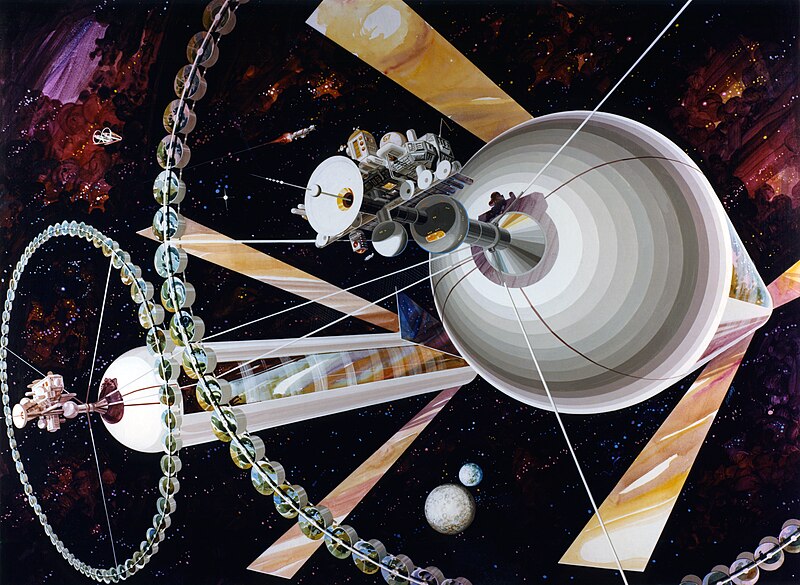
This brings you to the idea of the O'Neill Cylinder! At its simplest this is a large tube, either built independently or into a hollowed out asteroid, and spun up to provide gravity. Something like the terrarium from 2312.  The idea was originally floated in the book The High Frontier by physicist Gerard K. O'Neill, which talked of building rotating habitats in Earth/Moon orbit, or at the stable Lagrange points in Earth's orbit. These can be of varying sizes, but the advantages are you can create and settle them however you like! Want an arctic like location? No problem! Eternal tropics? No problem! All you need to do is create a cylinder with a certain diameter and length, spin it up and light it and voila!

And O'Neill's design isn't even necessarily the only one. You could build even larger, potentially with the truly massive McKendree Cylinder. Unlike O'Neill's more modest island in space, here you would practically be building a continent in space. Measuring 460 km in radius and 4600 km in length per the original proposal, you could have a living area inside with the same land area as Russia! You could even build it bigger with stronger future materials!

Building something like this turns into decades, or maybe a century, of work. Something far removed from the travel times between the stars or the length of time it might take to terraform somewhere like Mars. We could have continent sized living space in the future, yet this seems to get overlooked fairly easily. Perhaps we should start thinking of those types of stories more. You don't even need to leave the Solar system to have an 'interplanetary' adventure!

4) AI

Artificial Intelligence, or the reasonable facsimile thereof, has been an expectation of science fiction since at least the 1950s. Presumably most well known is Robert Heinlein's "Mycroft" who was birthed when an engineer on the moon progressively plugged in more and more computers until they gain sentience as one single being. Sadly, to some people the idea hasn't advanced much beyond that.

There is a strange belief in what is known as "The Singularity" in which computers will advance so quickly and so fast that just one day they will "wake up" and AI will be born. Now there's a few problems with this idea. Firstly that our rapid advancement in technology and efficiency is nowhere near as rapid as proponents even 20 years ago predicted. Futurist Ray Kurzweil predicted in his 1999 book The Singularity is Near that by 2010 we would have a computer capable of emulating human intelligence, and by 2020 such computers would be available for "one-thousand dollars" to us. Well, it's 2020 and barring some massive change no such computer is on the horizon.

Largely the idea is a vast misunderstanding of Moore's Law, which even the observer himself said was not a hard fast law, but an observation. It is even clear today that the rapid increase of processing power in computing is reaching a state of diminishing returns. Exponential growth cannot continue forever.


Even overlooking the issue of the Singularity, what would an AI actually look like? Would it have human level intelligence? Maybe, but would we recognize that intelligence? That last question is probably the most important when considering the issue of AI, would we even recognize it for what it was if we had it? Let me be clear, creating an 'artificial brain' which can solve complex problems is already within our grasp, whether it be made to play games of go or jeopardy. However, one which will be able to complexly interact with and communicate/reason with its human creators will take time and we might not even realize it was self aware as it wouldn't have the same desires/fears/ambitions as we do.

This is why I personally tend to dismiss out of hand fears of 'god like' AI destroying either humanity or the planet. In fact, I think AI will probably be far 'simpler' than we imagine when/if it does show up. For now though, its a highly theoretical concept with some wild out there ideas which fiction has almost done a disservice to.

5) Space Capitalism

So this is an important one. In many, many future scenarios it is hundreds or thousands of years in the future and everyone is either still working a 9-5 job, or working towards getting a pension or government benefits. Now, this makes sense since it would take a lot to put readers in a frame of mind where they grasp a post-capitalist society. However, is this the best way to try and imagine the future?

There have been many attempts to imagine a post-capitalist society in science fiction. Whether it was Gene Roddenberry's post-scarcity Federation of Planets, or the Mondragon Accords put forward by Kim Stanley Robinson. Now, each of these do depend on future technologies to be feasible (the magic replicators in the former and quantum computing in the latter) and it isn't far fetched to believe that our future economic systems will be driven by post-scarcity concerns or technological advances.

One future technology with the potential to upend the current economic order as we understand it is fusion power. An expected massive leap in power production and orders of magnitude more efficient and safer than our current atomic power generation. This could, almost overnight, upend our way of producing power as we know it and put the current hydrocarbon power generation methods the world largely depends on in decline. That would change some key economic inter-dependencies, such as on foreign oil or even the whole natural gas industry.

Now some of this does depend on the idea of a 'post-scarcity' society. It should be understood that 'post-scarcity' does not mean that we have everything, it just means that obtaining resources and a high standard of living is not impossible for the average person as goods are produced cheaply and available to all. This would though, arguably eliminate the need for traditional capitalism as we know it and lead to something close to the UBI (Universal Basic Income) that has been mooted around the last few years. Even just the UBI would undermine our understanding of politics and economics as it stands.

The future though, might not be more egalitarian but more corporate. With men like Elon Musk and Jeff Bezos driving the current future of space travel, it seems like we're possibly going to have shares be more important in the near future than any sort of workers cooperative in space.

However, the ideas for a post-capitalist future are many, and even here I can only list some ideas for why writers ought to be imagining a post-profit driven society.

----

These of course, are just a few things that science fiction is often using as a standard for the genre. They aren't the only big tropes, but I think they are at least the top five. What do you think, and what would you like to see more of in science fiction?

Thursday, 30 March 2017

Not Your Average Alien Invasion: Out of the Deeps

We all know the classic tropes for alien invasions. The Martians (or whomever) come down to earth, they begin burning our cities, slaughtering our populations, and generally taking over our land masses. They start to terraform Earth more to their liking, and humans generally must scatter before their superior technology. This is a staple set all the way back in 1898 by H. G. Wells in 1898. So we all know what to expect. Or do we?

Tuesday, 19 February 2013

Spots the Space Marine

Well readers it seems a large company have once again embarrased themselves over a ridiculous issue. I can't even begin to comprehend why they would have chosen this issue to embarass themselves over! What am I talking about you ask? Why the Games Workshop Space Marine controversy!

http://www.bbc.co.uk/news/technology-21380003

Now for those of you who haven't heard about the controversy (or didn't want to read the article) it boils down to this. Spots the Space Marine is an Amazon Novella written by author M.C.A Hogarth. The story is set in the future where humanity has allied with an alien race engaged in a brutal war with another expansionist race of aliens. The titular character is a space marine who is taking part in the fight against these aliens.

As an aside I've now purchased the novella and I have to say it's written in an interesting format which flows very well and since it's already in partial script format it would transfer easily to television or film. I highly reccomend readers look it up.

http://www.amazon.com/Spots-Space-Marine-Defense-ebook/dp/B006MGJYOE

In line with the rest of the article however, it gets weird. UK based Games Workshop sent a legal application for the book to be taken off Amazon because 'the book infringed on their trademark'. Now Amazon of course took the book down, but this understandbly upset the author, who posted about it and from there the story spread.

It garnered attention from other bloggers, authors, and members of the science fiction community who rightly called it 'absurd' and demanded the legal action be called off. In turn this prompted massive backlash from many of Games Workshops's own supporters and Warhammer players who launched a campaign of their own speaking out against the ridiculous action.

In response Games Workshop released a statement (which due to events I do not have a copy of, more on that in a second however) and have said:

"The law requires us to protect our trademarks in certain ways – and if we do not – we might lose them. As you can imagine, we do not want to lose our trademarks as we would no longer be able to create the great miniatures and tabletop hobby wargames that we pride ourselves on!"

Now let me just say something here, the idea of trademarking the term 'space marine' which has been around since 1932 is ridiculous. It would be like trademarking the word 'drone' or the name 'Enterprise' for a ship. However, Games Workshop has claimed that the loss of being able enforce a tradmark on the term would somehow cause a loss in their revenues or sales to their tabletop games. One of their biggest reasons for cracking down on the term was because of their recent forays into paperback publishing with Warhammer 40k fiction which can be found in the Black Library and much of that fiction has of course featured the ever popular space marine chapters of the Warhammer 40k universe.

Or video game series with the 40k logo


 However, the thought that someone else using the term space marine in an independent setting will somehow detract from the international sales of these books is absurd. In fact many of Games Workshop's own fans saw through this thinly veiled bully attempt and called them out on it, which lead to the Facebook page for Games Workshop on Facebook being taken down, as mentioned earlier.

Now when you upset your own fans that much you know you have made a mistake. As of time of writing no further legal action has been taken against Hogarth and Spots the Space Marine is back up for sale on Amazon. How Games Workshop will deal with the fallout among their consumer base and supporters remains to be seen, but hopefully they can manage it with grace and dignity.

As a final aside I would normally defend an author or companies intellectual copyright or trademarks, in this case however (just as with the case of DC and Marvel owning the word 'superhero') I do not support it. The idea that you can own a common phrase or word in the English language just because it ties into your franchise is absurd, it would be like Tolkien claiming he owned the term hobbit or halfing, or J.K. Rowling saying she owned the word 'muggle'. This is a case of legal overstretch and murkey copyright laws as they attempt to gain dominance over a subject, but thus far from lack of support and outspoken disagreement they have not been able obtain it.

I would encourage readers to use space marine as much as they please in their own stories or events and to always remember that free press and expression is important, and we can't let people pick and choose what words they want to trademark.

Space Marines forever readers!

Saturday, 25 August 2012

A Sad Day with a Historic Passing

Today readers I was saddened to hear that the first man on the moon had passed away. That's right ladies and gentlemen the man who said 'The Eagle has landed' and made that historic walk has passed today leaving us with a great legacy to be fulfilled. He was the first to leave his prints on the lunar soil, and they shall remain there as a legacy to him for millenia to come. Yes Neil Armstrong has passed away today.

Though he was not the last man in the moon we have much to do to live up to this brave pioneer's legacy. Though we have not set foot on the moon in over four decades we can only hope we will do so again in the future so the bravery, sacrfice and courage of these early space exlporers can live on and give us a shining hope in the 21st century.

Let us remember the many historic moment when he said 'That's one small step for man, and one giant leap for mankind.' I salute you Neil Armstrong and may your memory spur us all on to greater deeds as we gaze starward and begin to explore that final frontier.