Showing posts with label Culture. Show all posts

Wednesday, 2 September 2020

So About John A. Macdonald Again

I last spoke on the subject of John A. Macdonald back in 2017. In that little essay, I made many statements on why Macdonald is a flawed man, and some of the mistakes he made. I also pointed out why it is important we remember him and what he accomplished for Canada. Also in that first article I made some mistakes when talking about his past actions and the legacy he left us. In light of recent events, I hope to make some corrections, but also stand comprehensively by the good and the bad of our first Prime Minister's legacy, and why I'm unwilling to forget either of those thing.

In my previous essay I did mention what I thought were the positives of Macdonald's legacy, and to begin this one I would like to point out many of his faults before I expound on why it is important he be remembered, and why our current historiography is perhaps not up to the task of doing it.

Firstly, yes, Macdonald was absolutely a racist and that's something that even if you subscribe to judging people by their time period, he was no paragon of tolerance and virtue. He dismissed the Indigenous peoples of Canada who would not settle to farm land and adopt Anglo-Saxon culture as savages. In his multiple dealings with the Métis people he referred to them as half-breeds, a slur on their Indigenous-European roots. 

He was even extremely racist against the Chinese, exceptionally so for the time, wholeheartedly supporting the efforts of British Columbia to expel them from the province and desired to exclude them from the right to vote even in his aforementioned 1885 Franchise Act. He said "...if they came in great numbers and settled on the Pacific coast they might control the vote of that whole Province, and they would send Chinese representatives to sit here, who would represent Chinese eccentricities, Chinese immorality, Asiatic principles altogether opposite to our wishes; and, in the even balance of parties, they might enforce those Asiatic principles, those immoralities … the eccentricities which are abhorrent to the Aryan* race and Aryan principles, on this House." This shocked even his contemporaries, many of whom objected to denying those of Asian extraction the vote. In the end, Macdonald managed to exclude them however.

He also sanctioned the Davin Report in 1879 which was directly responsible for the creation of the Residential School System which would be used in Canada until the 1990s. I want to make clear here that the report specifically highlighted that taking children from their families to 'civilize' them was the best option, and this was supported by Macdonald.

As I said before, Macdonald was directly responsible for the Residential School System, which is a shameful stain on our history. To be clearer than I was in that original essay, the sanctioning of that system, and it's perpetuation by our government long after it was shown to be unhealthy and ineffective and also not even cost effective, was an act of cultural genocide. Though it did not, in sheer numeric terms, kill many people, it caused irreparable damage to Indigenous culture and communities wherever it was implemented and has lasting and terrible effects to this day. 

To continue from my earlier comment on the Franchise Act of 1885, however, one could cynically examine the prospective Indigenous right to vote as an attempt to enshrine as a method of control over Indigenous polities. It would, in the language presented, effectively destroy the traditional structure of Indigenous self-government. It would take away their unique rights as tribal entities, and assimilate them into the broader Canadian society, effectively cutting up communally owned tribal land into individually owned properties. Though ostensibly they were allowed to keep their tribal affiliation, they would lose any special privileges under the Indian Act (another note on the Act below).

Despite this, does this itself make the attempt to at least grant the franchise to the Indigenous peoples, even with long strings attached, an ignoble thing? Some would say yes, and considering that relations with the government are fraught and full of federally exploited loopholes and are imposed in a top down style to this day, that would not be an incorrect view. However, considering almost no legislation was put forward to try and even engage Indigenous peoples in a discussion about voting again until the 1940s, and then not granted on their terms until the 1960s, some might say that as this bill was being pushed in 1885 after a full blown rebellion, it was still a progressive attempt for its day. Though let it be known that Macdonald did say "The great aim of our legislation has been to do away with the tribal system and assimilate the Indian people in all respects with the other inhabitants of the Dominion as speedily as they are fit to change." It must not be forgotten that even the most benevolent seeming actions by the government then (and arguably still) were about assimilation into the Canadian whole.

Monday, 8 June 2020

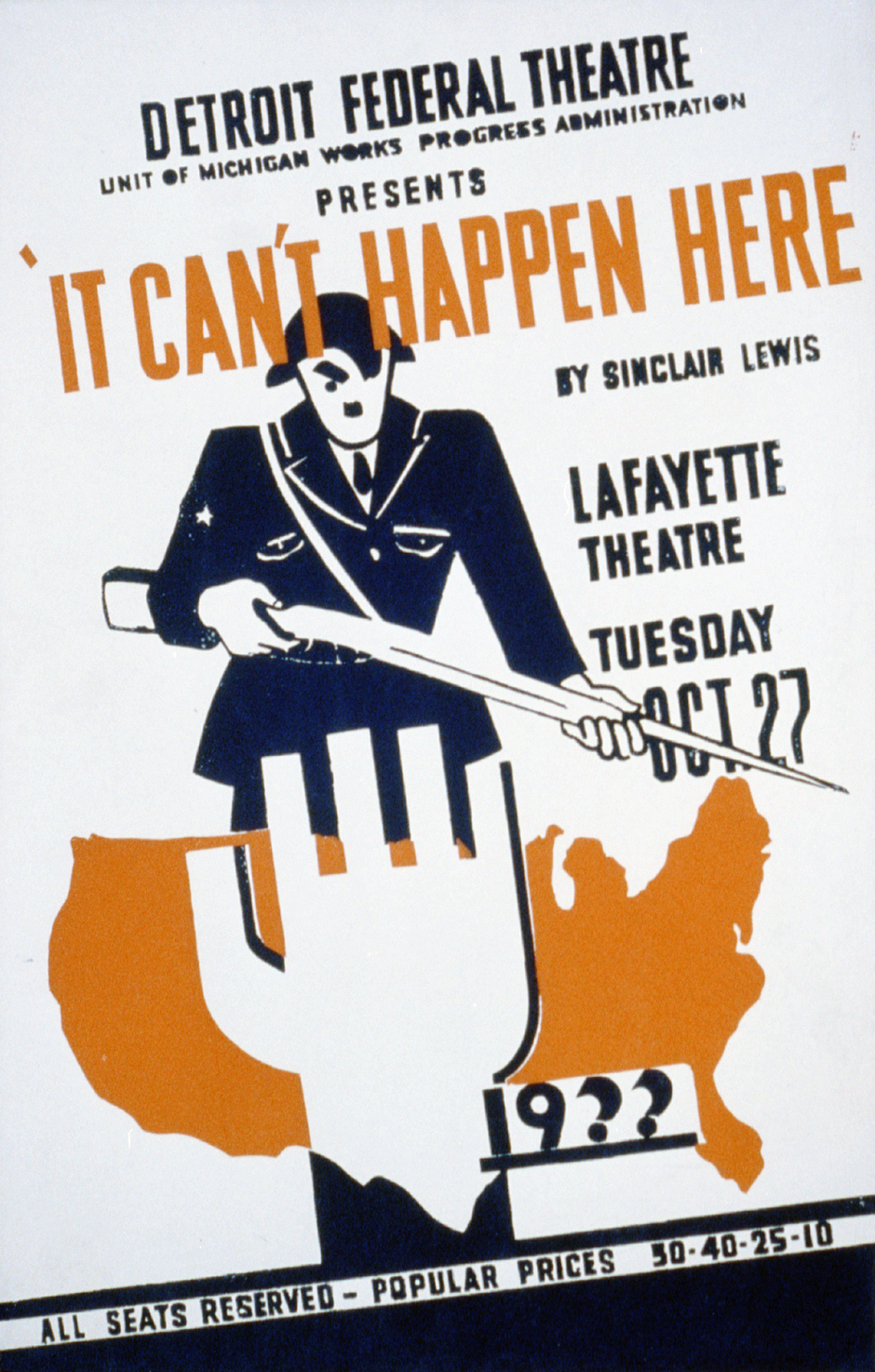
It Can't Happen Here

In 1935 Sinclair Lewis published the novel It Can't Happen Here as a deadly, if semi satirical, rebuttal to the very American execptionalist attitudes of the 1930s which believed, very firmly, that fascism was impossible in their country. And is a little disturbing when one considers that the real life Business Plot was happening around the same time. In that story, Berzelius "Buzz" Windrip wins the 1936 United States election in a landslide on a populist platform. He does so against all odds, and defying expectations. Into this unexpected breach of political norms he runs on a populist platform, promising to restore the country to greatness and brining back prosperity and power and giving every American a 5,000$ check per year.

To help do so he rapidly outlaws dissent, jails his enemies and trains "Minute Men" paramilitary corps who crack down violently on any who oppose Windrip's policies, like eliminating the power of Congress. Over time he sends enemies to concentration camps and consolidates his power through violence and fear. Despite this, a majority of Americans approve and see it as necessary to returning their country to glory.

This has negative consequences, to say the least. Depressingly, parts of it might sound a little familiar to modern readers.


I'm writing this because I have worryingly seen far too many Americans engage in American exceptionalism regarding this very issue. "It can't happen here" I have seen said "We're a First World country, and that kind of thing doesn't happen in First World countries" even when saying in the same breath that Donald Trump is anomalous in American history. 

Yes, this is an article talking about Donald Trump. 

I admit, I have commented sparingly on him since 2017. It was more than I could bear as he progressively chewed his way through the norms of American democracy and engaged in further divisive and violent rhetoric while causing problem after problem in the world. Frankly, I had problems of my own, and then democracy in Canada seemed to be trundling on just fine without calling out the authoritarian to our south. I would get by, and Canada would survive.

Then came Covid-19. 

To date, at the time of writing (June 7th 2020) Covid-19 has killed 112,000 Americans, and that number rises by roughly 1,000 dead per day, with no sign of stopping. Added to that the recent protests and riots around the death of George Floyd, which have gone international, and we see that Trump himself is part and parcel of a greater problem afflicting American politics. He used his own militarized police to get a shamefully awful photo op in Washington. And you see the police reacting with violence to being held accountable. They attack citizens they are supposed to protect, the media, and nurses and volunteers while applauding and supporting men who strike the elderly.

Why? The media is the enemy of the people. There are good people on both sides. And in this case, the police are the other side.

Frankly, Trump has been for years now normalizing violence against his enemies, the media and citizens who don't do what he tells them. The police, perhaps frustrated that a militant culture cultivated in their midst has been viewed more with horror than support by the populace, have latched on to the populist Trumpian message applauding them for violence while lashing out against the perceived disloyalty of the public to the police as an institution. It hasn't been pretty, and Trump has encouraged it, and will continue to encourage it for as long as he can. He wants to see his enemies get hurt, which is why he inflicted that on them to get his disturbing photo op.


I've watched the narrative unfold from the relative calm of my home in Ottawa. However, I saw portions of one of the biggest protests the capital of Canada has ever seen when over 14,000 turned out in solidarity with protesters in the US. It was a big, bold moment, and our own Prime Minister made a direct repudiation of Trumprian tactics by joining the protesters and kneeling in solidarity with them on Parliament Hill. It was, in imagery at least, a powerful moment. One marked by the terrible contrast of Trump having to gas and beat his own citizens to get a photo.

From cbc.ca

Where does that leave the American situation though? In my opinion, the protests and the global support of them, are not just about the death of George Floyd, they're of course about the horrible racist violence we see in the US (and Canada), but they're also, at least at a secondary level, a damning indictment of Donald Trump. The man who is the face of all that is wrong with America, even if he isn't the root problem. It shows that thousands, millions, are mad, pissed off, and willing to take to the streets to make that fact known. When over 100,000 Americans have died and millions are unemployed because of Trump's shoddy response to the Covid-19 epidemic, this is perhaps the straw that broke the camels back and people need to vent. And perhaps this is a precursor to a wave of anger which will sweep Trump from office in November.

If I think that though, why do I talk about a 1935 book proclaiming a warning that fascism can happen in America?

Well, it can, and it very well might if Americans don't take that lesson to heart. Trump has every reason to try and rig the election in his favor, whether by simply cooperating with a corrupt Republican Party which cares more about power than governance, or by inviting yet more foreign interference to win the election for him. If he can win the judiciary and even a fraction of the military and national security forces to his side, he can crush dissent to an illegitimate win and extend his tenure in office by another four years, protecting himself from the ongoing investigations into his corrupt actions while in office.

Some might comfort themselves that "this can't happen here" but I think this is our generations warning that it can. Whether in the United States or Canada, it can happen here, and we had best be on our toes to prevent it, rather than imagining ourselves immune to what we consider other countries' problems.

Monday, 4 May 2020

Preppers not Prepped

In the past few days I've been watching with almost abject disbelief as across the United States people have suddenly begun protesting the existing quarantine and stay at home orders. Among their ranks seem to be many members of the so-called preppers (along with a disturbing numbers of alt-right individuals and those waving the Confederate flag). And many of these protests seem, well, extremely stupid. Especially for people who call themselves preppers.

First thing is first, yes this is a pandemic and its a worryingly virulent one. Not deadly per-se, but worryingly virulent. We have to be extremely thankful that we were able to catch it and set up measures designed to keep the virus from getting worse.


Before moving on, let me state this, people who are able to stay home or are non-essential are absolutely doing the right thing. They are working to stop the spread, bend the curve, and ensure the virus does not afflict the general public more than it already has. It is literally the least one can do to endure this somewhat cozy catastrophe we currently find ourselves in.

Secondly, despite the title of the article, I want it to be clearly known I am not in any way shape or form anti-prepper. In fact, I identify as one. What I'm going to be calling out today is essentially 'survivalism' as over the last few years I have noticed that it has largely taken a turn from an idea of general preparedness to simply embracing an apocalyptic vision of the destruction of society. People should not take that view and then assume everyone who prepares (or preps if you will) is a bunker dwelling wingnut who is counting ammunition waiting for society to collapse.

To give some helpful information to you, I have to thank the folks over at Worst Year Ever Podcast for providing this helpful link to theprepared.com. They have a lot of useful information for you, and the link itself can help you confront the what seems to be daunting task of preparing to help yourself and others in a time of need. Basically, be prepared to be able to help yourself and others in times of emergency or natural disaster.

Moving on though, I've seen at many of these protests people equipped in camouflage gear with rifles prominently displayed. Many of them talking about their rights with such interesting slogans as "my body my choice" or "I want a haircut" and the message boils down to the government can't make you stay at home. What is clear though, is that most of these people either don't take the ongoing pandemic seriously, or they are simply enraged that the government is quarantining them and keeping them from such creature comforts as haircuts, bars, and coffee shops. Now it's important to note that not all these people are survivalists, and many are spoiled and entitled middle-aged white people wanting to force other menial laborers back to work to accommodate their boredom and personal appearance. But for those out parading with guns and talking about rights, or seeming "prepared" it becomes apparent that these people couldn't be less prepared. Or as I saw one Twitter commentor postulate, this was not the apocalypse they were promised.

The survivalist community has its roots in the culture of the 50s, with dire visions of nuclear armageddon on the horizon, mushroom clouds expanding over every city and society collapsing into anarchy as the government is suddenly driven underground. It evolved from there towards fears of things like famine, Malthusian collapse, and economic depression. The most extreme views probably gained traction in the 70s however as fears of nuclear war, oil collapse and societal collapse writ large set in.

This all gave way to perhaps more extremist elements in the 90s during the Clinton years, fears of Y2K, and then the general conspiracy mindset that seemed to crop up in that era with broad distrust of the government in the US at least. Events like Ruby Ridge, Waco, and the Oklahoma City bombing also brought issues like survivalism into the public sphere, and not in a good way. September 11th began a new wave in the 2000s with fears of terrorist attacks and biological weapons. This probably reinforced the negative view of survivalism. It was a view already present, and one which I walked into when I first stumbled onto preppers in 2009 while cruising the internet.

Now, in that vein, with fears of terror attacks, the perceived threat of dirty bombs and high jacked nukes, coupled with my own childhood experiences, this seemed like a very reasonable worldview. Stock up on essentials, prepare and get away from cities.

Even back them though, I was able to pick up on the dark undercurrent I was able to find in survivalist literature. Way back in 2012 I read probably one of the worst books I've read in my entire life which was written by a survivalist. It largely contained really hateful right wing talking points, pretty terrifying racism and anti LGBT attitudes, conspiracy claptrap, and gleeful murder of the enemies of the protagonists. Another book which I only read the opening chapter of talking about a modern Carrington Event had the protagonist murder a police officer in cold blood after refusing to stop for him and the officer drew a weapon in self defense.

Yeah, there's some pretty sick survivalist literature out there.

Even some of the better 'survivalist' literature can often have some dark undertones. I was a pretty avid reader/collector of prepper recommended fiction in the 2010s, and let me say it can be disturbing at times unless you implicitly agree with the views of those who wrote it.

Some common themes were; total breakdown of society, looting and rioting on a spectacular scale, violence breaking out swiftly as social bonds collapse, and tyrannical government taking hold. Violence and rape was a common theme. The 'unprepared' becoming ghoulish criminals almost overnight and large cities falling into orgies of violence and murder where the 'golden horde' would spread out and devastate the countryside was a common theme. In more extreme scenarios like nuclear attack and EMP that might be semi-accurate as modern society is suddenly and rudely thrown into uninformed chaos, but by and large that just isn't true. This view of humans as violent animals was common in books even where society just fell into economic collapse.

Most of this fiction focused too much on almost fetishist description of guns and ammunition, violent confrontations with looters and bandits, and eventually a group and their preferred ideology emerging from the chaos and setting the world right.

There was very little about the more mundane inconveniences. Long lines at stores, no reliable electric power or internet, no barbers, and the problems faced by being isolated together for a long period of time even with friends and loved ones. Not even about the sudden loss of our supplies of toilet paper! These problems it seems, are far more pressing and important than preparing for a shoot out with gun wielding looters.

Indeed, this pandemic perhaps shows how hollow all this fiction is, and that it is more reflective of those who write it rather than society as a whole. As the world has faced massive privation and fear over a fast spreading disease, people have by and large banded together, helped each other out, and obeyed social distancing guidelines. Acts of kindness have been the norm, and people have gotten together and talked, even handing out supplies. My own family were the recipients of clothe masks by a kind neighbor who was making them!

Contrary to what survivalist literature has expected, cities have not devolved into riots, the government has not taken steps to deprive people of basic liberty, and we haven't seen a massive spike in crime. In fact, in my own Canada at least, the reaction has been largely a peaceful process of self isolation and community support and outreach. All across the world much the same is happening, and people are earnestly trying to stop the spread of the disease.

Why then is this upsetting many survivalists? With my comments on their fiction above, and the words of that Twitter comment in mind, you may see why.


People reacting calmly, reasonably, and no massive government overreach flies in the face of their world view. There is no Hobbesian war of all against all, and other than panicked sell outs of toilet paper, people haven't really done anything stupid by and large. This is not what was expected, and those who have been expecting societal collapse seem to have been shocked by that. The people who stockpiled bullets and ammunition are suddenly the poor cousins of those who stockpiled canned food and community good will.

Of course this doesn't speak for all of them. But the extremists, those who seem to have earnestly believed they will be the ones to outlast the 'sheep' in society, they seem to be facing the fact that prepping is more mundane and, dare I say, boring than their fiction led them to believe. There is no tyrannical government plotting to take away their rights, people are not dying in the streets, and calm and measured response proving preferable panicked looting. So instead, they must act as though orders to quarantine, and being inconvenienced from their creature comforts, are what they must fight against.

As I said before, this is stupid. Right now we are riding a very mundane wave of disease, potentially only the first wave, and we are only asked to do the bare minimum to stay healthy. For economic reasons I can understand many people are frustrated they can't work and might not be making money (especially in the United States) but to demand an end to quarantine because you want a haircut? Or to be going around with your ammunition fearing government tyranny because of social distancing orders? That is simple unpreparedness, and it sadly lays bare that many of these survivalists, might not survive the inconvenience.

Stay home, stop the spread.

Thursday, 31 October 2019

Lovecraft Country

What could be scarier than a unknown entity stalking you across the cosmos? Being a person of color in 1950s America of course! Back then you didn't know whether the white man you saw on the corner would shout a racial slur, or whether he might summon a lynch mob to hang you for being in the wrong neighborhood. Against this backdrop, the specter of cosmological horrors from beyond space and time can only make things worse! How do you combine the two? You take a little trip to Lovecraft Country!


Written by Matt Ruff, I picked up this novel in 2018, and have given it a lot of thought in the last year. It's a very interesting work balancing the mundane fears of the African American community already present in the United States in the 1950s with the more esoteric panic of monsters from beyond the veil of time and space. Understandably our protagonists in this story are struggling against both the prejudice of the white community which wishes to 'put them in their place' and the monsters which want to put them in their stomachs.

Told in chapters from the perspectives of various characters it first takes up the mantle of Atticus Turner, a Korean War veteran who did his time fighting the communists for Washington. Sadly, that earns him very little respect from white veterans, and even less from the average white man in the North of the United States. He finds that his father has gone missing. Accompanied by his uncle, George who wrote The Safe Negro Travel Guide (based heavily on the Negro Motorist Green Book), they discover his father has been kidnapped by the mysterious Samuel Braithwhite of Ardham. To free him, he must travel to this remote and rural area to take part in some strange ritual which may cost him his life. There though, he may have an ally in the strange son of his tormentor, Caleb.

From here, the story explores the minutia of life in 1950s America for people of color. Of course, it adds to that by throwing in ghosts, monsters, curses and other sundry issues which would drive the average man mad.

It is a fascinating tale which almost reads like a series of interconnected TV episodes, which ironically is what it was originally opted as. It picks up with ghost stories, interplanetary travel, cursed dolls and even heist plots, all with an overarching battle between equally dangerous wizards in the background. It makes for, what is in effect, an engaging series of short stories wrapped up as a novel. They all tie together quite neatly, making for some very exciting reading.

Ruff tells a fascinating story. One which comes together and has creeps and spooks which could easily come from the real Lovecraft country. It is compelling at its heart because it isn't just a regular series of horror stories. It does its best to examine the challenges facing African Americans in the United States before the Civil Rights era, and uses these characters to tell a frankly fascinating story\ies which can be enjoyed from the comfort of your living room, and will hopefully make you think. For fun stories and some great ideas, I heavily encourage you to read it, and look forward to the series coming out in the future!

Wednesday, 25 September 2019

The Testaments

Three months ago I mentioned my excitement at seeing the long awaited, if somewhat surprising, sequel to the The Handmaid's Tale. When The Testaments dropped on September 10th in my city I was quick to pick a copy up. Sadly, I was not as quick to read it as I was working through my existing reading list at the time and didn't believe rushing things would bring me any benefit. However, I was finally able to get back in to the world Atwood crafted in 1985.


I will admit, I was a little trepidatious at first. I generally am not a fan of sequels published long after the fact, and see them as usually being far inferior to their progenitors. However, I was lucky enough to see an interview with Margaret Atwood hosted live from London at a local theater. In it, I heard  some excerpts read from the book, and an altogether too brief talk with the author about her work and her decisions for writing it after so many years.

Naturally of course, many of them had to do with the current politics in the United States, but they were also influenced by the advent of the Me Too movement, and campaigns for women's rights the world over. It was also because the Handmaid has become a surprisingly popular and effective method of protest. Showing up at pro-Choice rallies, and standing as a silent testament to the suffering women will endure when the rights to their bodies are taken away by men. In that case, how could she not write a sequel to explore more of the world of Gilead?


The Testaments is very different from the original. The original, which told the story through one narrator's view which often included hazy recollections, is now told through three distinct perspectives. They are alternatively called: The Ardua Hall Holograph, Witness 369A and Witness 369B. Each has their own names, but as with the case of identity in much of Atwood's work, those prove to be fluid and I won't spoil anything by using the various identities and pseudonyms characters operate under, save one.

Using three different perspectives to tell the story set in Gilead is, in my opinion, genius. Though only one of the narrators is an adult, all three convey a different set of ideas, cultural upbringings and motivations. Each is quite understandable, sympathetic, and ultimately engaging in keeping you interested in the outcome of these in-universe historical documents.

The one character whose name I will reveal, is that the Ardua Hall Holograph is one of the villains from the first book, the erstwhile leader of the Aunts, the women who control other women in Gilead, Aunt Lydia. Hers is a shocking story, one which shows an amazing insight into what creates an authoritarian regime, what one must do to survive in one, and how one can be brought down. In doing this Atwood effectively wields empathy like a cudgel, as no doubt those who had read the original book or watched the television series felt they could never like or sympathize with a woman who engaged in the wholesale abuse of other women. The story of Aunt Lydia shows this not to be true.

It is a fascinating tale of how indoctrination and reshaping a narrative is used to control and coerce subject populations in authoritarian regimes. We see the start of Gilead, and a great deal of the brutality used to begin the control of women as seen in The Handmaid's Tale. What is fascinating is that, other than the specific roles of Aunts, Handmaid's, Wives, ect, Atwood has drawn almost entirely on real historical precedent for how awful regimes are established and keep power.

As a small aside, this can almost be seen as a snub against those who insist "it can't happen here" or that the United States is somehow immune to the power of authoritarian instigators. Indeed, such an idea has been snubbed as far back as the 1930s in a very literal way. A good message to take from this book, and its predecessors then, are that our democratic rights must be guarded very carefully. Hence the powerful, silent symbolism of the Handmaid.

Wednesday, 29 August 2018

Hang on a Minute: A Discussion of Execution

Recently, I found myself in the oddest discussion. At work I began talking about hangings with someone after we had been discussing the punishments of the earlier eras. How exactly the conversation got to this point I'll never know, but suddenly we were discussing hangings.

The concept of execution by hanging has been around for centuries. It is still the go to method of vigilante mobs, and the method of execution in Japan (where in July the plotter of the Tokyo Subway attacks was executed). In concept it is remarkably simple. In its more 'scientific' form, the condemned is dropped from a height calculated to break their neck and kill them instantly. In its simplest form, it chokes off the airways of an individual via strangulation. Either way, absent intervention, you're dead.


These kinds of executions were often carried out in public, and are a staple of films for just that reason. From the classic Clint Eastwood Westerns, Pirates of the Caribbean, to the oldest films first made. Heck, the last public execution in the United States was in 1936, the execution of Rainey Bethea in Kentucky, drawing a crowd of 20,000.

Public executions were common spectacles. Going as far back as society itself to show the power of the state. They were seen, apparently commonly, as a macabre form of entertainment. It was an interesting dual purpose in keeping the masses happy and showing the power of the state in one event. An interesting example in Canada is the execution of Patrick Whelan in 1869 at Ottawa. He was accused of killing Thomas D'Arcy McGee, and it is almost undeniable he was railroaded through a trial aimed purely at establishing his guilt. Some 5,000 people turned out to watch his execution.

It is interesting that, in my hometown of Perth Ontario, we also had a series of public hangings.

The story I am the most familiar with is the hanging of Thomas Easby in 1829. Easby, whose wife and four children were found dead in the charred remains of their log cabin. Only one child survived, and with rumors flying that Easby had killed his family, he was promptly adopted by a neighboring family. The story goes that the child would beat dolls and say "This is what daddy did to mommy" or when seeing a fire built, remark something similar. This led to Easby's arrest.

He was tried and convicted, and finally sentenced to death. It led to a public holiday in Perth allegedly "Schools were closed, work of all kinds suspended, and settlers came from all parts of the District, bringing with them their families to witness an event which it was hoped would have a great moral influence on the community." There was a sort of carnival atmosphere I have read, and many brought picnics to witness the spectacle.

The second public hanging took place in 1851, when Francis Beare was hung in front of the court house. Apparently many 'well dressed females' were in attendance for this killing. It seems as though people were eager to see justice done. Though it is mentioned there was less of a carnival atmosphere at this execution.

Now, what I did not know, was that the last execution in Perth took place in 1910, though it was not public. Rufus Weedmark was convicted of strangling his wife in 1910, and sentenced to hang. Since public executions were now no longer allowed, he was hanged inside the confines of the county jail. Apparently a 'great crowd' gathered around the jail, but could not see anything.

These are the only hangings that took place in Perth, but at no point did they fail to draw a crowd.

It is interesting that we are drawn to such grizzly spectacles, and that we can find so much fascination in reading about them. Now, not everyone does, as the woman I was having this conversation with felt that it was rather ghastly and moved on from it. Maybe we are heading away from such fascination with it.

However, considering I've just written this piece pondering on the subject of hangings, and you're reading it...maybe not.

Monday, 13 November 2017

Change in Fantasy

A broad title, but one I thought I ought to address after reading both this recent piece by Christopher Nuttal, and the attendant piece he was writing based on. The idea of course raises some interesting questions regarding a sort of stasis in Science Fiction and Fantasy, whether that be Medieval Stasis, or simply technology and mores being stuck Twenty Years in the future or in Modern Stasis.

For this article though I will be examining only the idea of fantasy being stuck in medieval stasis, and the sort of changing social mores that we might associate with medieval society.

This isn't just technology mind you, but the world as we understand it with the divine right of kings, an all powerful nobility, and the common display of peasants and landowners who struggle against the upper classes. Often times, we find this exact paradigm present in fantasy, or at least a rough facsimile of it in a written work. A sort of "standard fantasy setting" if you will.

Picture it; a number of rural villages, big castle overlooking them, and in the cities nobles and merchants squabbling over money with the king. Knights in armor ride around alternatively slaying dragons or oppressing the peasantry. Dirty hovels cling to the roadsides and inns pander to wayward travelers (which oddly enough, is something of an anarchism in itself). Sometimes monsters stalk the night, and demons terrorize the land. These will either be dismissed or hindered by a stand in for the Catholic Church. And of course, everyone will speak with an English accent.

This of course, is an error in fantasy.

Monday, 28 August 2017

So About John A. Macdonald

So it came to light recently that following this interesting trend in tearing down statues in the United States, some bright minded people have decided the best thing to do is try to remove the name of our first PM from some schools for reasons which seem rather far fetched. Felipe Pareja, who put forward the motion claims: "it might be difficult for Indigenous students and teachers to go to a school named after someone who he says was complicit in the genocide of Indigenous people."

Felipe Pajera is clearly not a historian.

Sunday, 14 September 2014

Why I Prefer AD vs. CE

Well recently in one of my Christianity classes we got into the topic of what BCE and CE means, and contrary to some, no it does not mean 'Christian Era' instead it is a 'neutral' term meaning 'Common Era' which is supposed to define the commonly used dating system in the modern era. Now understand this, the debate over the use of Common Era (or BCE/CE vs. BC/AD) is not a modern phenomenon, in fact the use of CE goes back nearly 400 years with the first use of CE appearing in Latin in 1615 and English in 1708 showing that, despite what some would think, we are not unique in attempting to change the dating system.

Now here's the thing, most arguments against the use of BC/AD are those who are attempting to pursue an idea of 'religious tolerance' or pluralism and inclusiveness in the dating system adopted by the world in an attempt to be more neutral to the global community. Never mind that this in and of itself is absurd since the Gregorian Calendar was foisted on the globe through the imposition of European ideas on local cultures completely upending their own way of time telling and was imposed by force. Nor does it take into account already existing counter calendar systems which are explicitly religiously based (such as the Muslim calendar or the Japanese Imperial calendar which measures the year from when the first emperor sat on the throne). It also ignores the fact that the Gregorian Calendar currently has religious ties to ancient religions built into it (the months and days being named after gods). The most important thing is that, for all intents and purposes, the global community uses this calendar for convenience sake.

However, what grinds my gears about the idea is that rather than attempt to remove any connection to previous time keeping or cultural strata they simply adapt the 'Christian' calendar making the change completely cosmetic and utterly pointless. In that same vein I sincerely doubt that most people, even of other religions, strenuously object to the use of this type of Calendar or really notice it at all to begin with.

Now for the plainly reactionary part of my little essay here. Functionally and culturally there is absolutely no need to change the dating system effectively in use for hundreds of years (well in the Western world at least) and reasons for changing it because it might 'offend' are laughable since it was through Western cultural hegemony which the current dating system became 'common'.

Though as a little aside, let me just offer up one suggestion to those who wish to make a 'neutral' dating system. Rather than simply trying to rewrite the current calender in a pointless PC exercise, how about just starting a new dating system? I know it's harder than just cosmetically altering the one we currently have, but at least it's more intellectually honest.

Here's a thought, how about we celebrate one of man's crowning achievements as the new more neutral dating system? Let us hypothesize that we can start if from October 4th 1957, when Sputnik was placed in orbit and man finally had access to the high frontier. We can say that starting that day is a new era (or hell just starting on the new year of 1958 for convenience sake) and every year after (we can say that the time from October 4th to December 31st is the 'year zero') becomes a year of the new Cosmic Era (CE). That would make today September 14th 56 CE. Rejoice for one of the greatest moments of mankind's history!

Now that may seem just silly, but it's a hell of a lot more honest than just trying to tie in a 'correct' idea to the existing dating system. It has worked without popular complaint for the last hundred years (or I suppose technically since we started the Gregorian calendar). To me though, it is just as silly to implement a cosmetic change which no one really cares about, and no great majority is asking for.

This is one of those traditions I will gladly stick too.