Showing posts with label Space Marine. Show all posts

Friday, 21 August 2020

Planetary Invasions

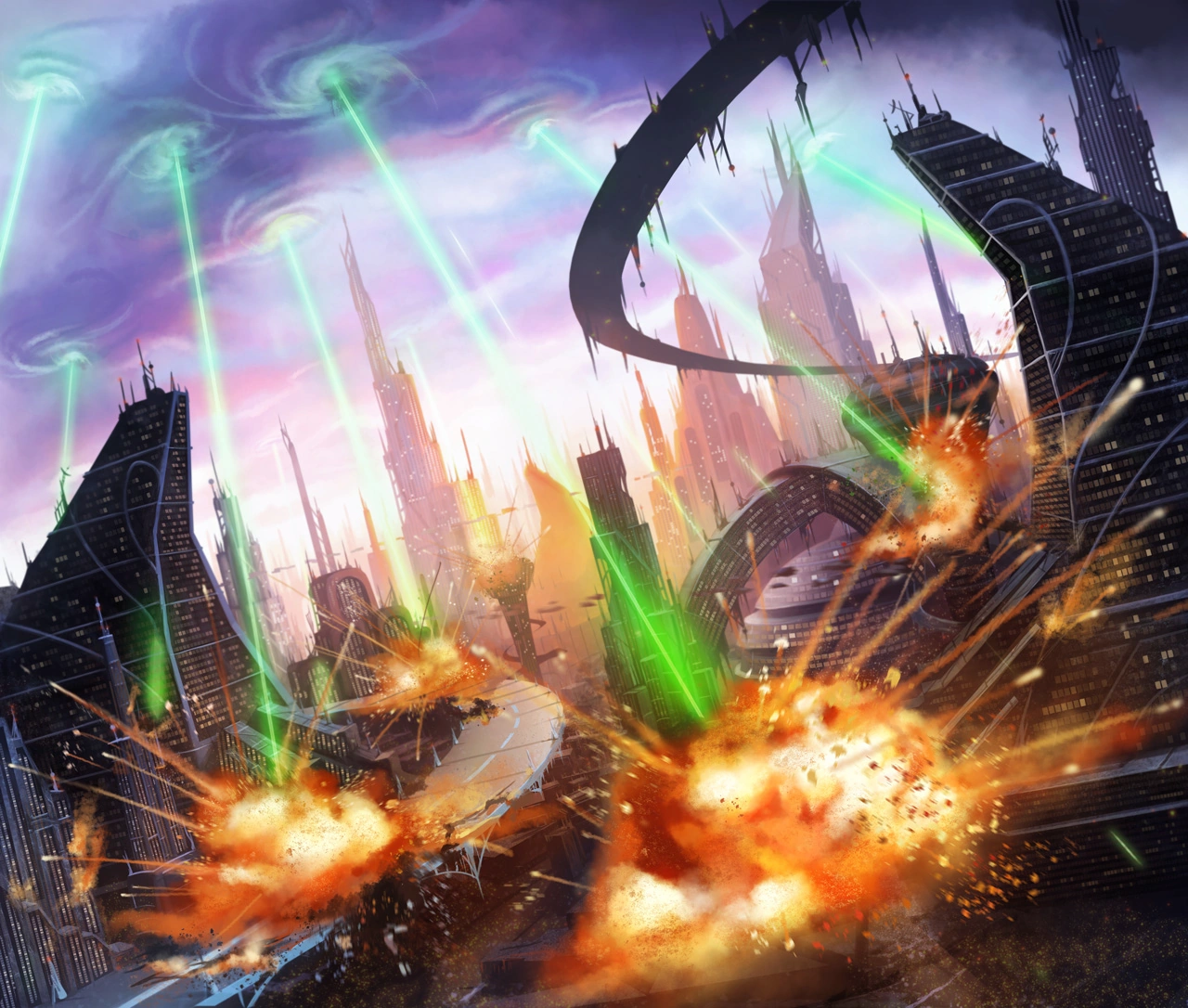
In science fiction the idea of our planet being invaded, or other planets being invaded, is sufficiently old enough to be a trope. It all started back when H. G. Welles imagined Martians slinging themselves towards Earth to mash us with their tripods and death gas. From there it's evolved into many different scenarios some of which still involve us on Earth, to fascinating wars between the stars of other human or alien civilizations. Recently I've been pondering on that after I watched two very interesting videos between people who examined the idea of planetary invasions.

The first is from the excellent channel Space Dock which puts together wonderful work on the spaceships and vehicles of many franchises. They themselves have a drama called the Sojourn coming soon. Definitely check it out. But for our purposes watch their brief video on Planetary Invasions.

In contrast we have one video from Isaac Arthur discussing the subject. It's a longer one and it raises many interesting points. His channel is simply amazing for an in depth look at futuristic science based concepts on how we may do things in the future. It's honestly one of the best futurist channels and series I've ever encountered, sincerely worth checking out if you're interested in that kind of thing.
Credit to Alexander Tooth, from wookiepedia

Both these videos raise very good points, and they have contrasting opinions. In the first video we do see that it is argued that a planetary invasion is basically infeasible. Some Operation Barbarossa style mass landing and invasion taking years, decades, or perhaps centuries, to fully pacify a planet through mechanized warfare from above and below. The crux of the argument is that this is a huge waste of time and resources, especially when you presumably have ships in orbit that can hammer your opponent at your leisure. Then if you have no hope of relief and no friendly ships in the area, fighting on serves no purpose. You don't need legions of soldiers, just large landing forces to take and hold the vital aspects of planetary infrastructure and then garrison forces to keep the planet yours.

The second video has a more wide ranging view. It presumes that planetary assaults or invasions are feasible. The main point is that, after all, if you're jetsetting around in space with any sort of casual interstellar travel then the mobilization of resources to invade and crush another world or system of habitats (especially if you rule over multiple star systems and have great automation) is almost trivial. That being said, it makes a very pertinent point that a planet is not necessarily a helpless target. 

It is a point worth considering as any civilization which can do travel casually at interstellar distances is probably not really having to worry about the whole issue of delta-v in a gravity well. That means that, while an opponent who does control the orbitals has an advantage, the people at the bottom of that well are not nearly so defenceless as we might assume through our lens of 21st century technology where an asteroid barreling through our gravity well is a very terrifying prospect. Your vital sites are probably ringed with powerful railguns or missile batteries which can shoot destruction at any ship foolish enough to park in orbit.
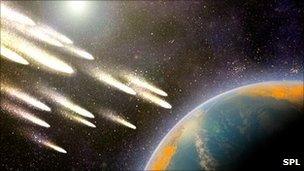

In fact with that view, the traditional image of a ship parking itself in orbit and blasting a planet with it's weapons seems silly. No ship could risk parking in orbit without worrying about taking crippling damage or being rendered combat ineffective. The proper image might be a vessel in the age of sail bombarding a land fortification and having to outnumber the guns of the fort to hope to overpower them before it can be rendered ineffective itself. The planet can shoot back.

What you might see instead is ships engaging in what amount to bombing runs, first moving to cripple or take any orbital defences, then moving in unpredictable patterns to try and crush the ground based defences. If that doesn't work, clearing a landing corridor to insert marines who can disable or capture those defenses so the fleet can put itself in a position to command the ultimate high ground and compel a plant's surrender would be your next best bet. In the book Tiamat's Wrath there is an interesting example of this that works very well from both a tactical and a dramatic perspective.

This is actually a point I've considered for some time. I've mused about interstellar warfare before and why it might happen. In my own, as yet unfinished Service to the State science fiction novel, I've thought about how you could make a planetary invasions feasible, so my own view actually falls somewhere between that of the two videos.

Part of that view does come from finding that in universes like those of the Honor Harrington series that if you've countered gravity to the point you're using it in your weapons, the idea you can't make some kind of planetary based weapons system which could cripple or severely damage a ship seems baffling. It does seem to me that there would need to be an invasion, but one aimed at very limited and achievable goals so your fleet could enforce the threat of death from above.

Some blame might come from Robert Heinlein's Starship Troopers which, though an excellent novel I recommend everyone read, did draw it's inspiration pretty heavily from the work of paratroopers in WWII and the island hopping campaign in the Pacific theater. In the Pacific the small Japanese garrisons which held out across numerous little islands with their coastal batteries and then fighting to the last man against the power of the American gun line and the overwhelming firepower of Marine divisions set the course for the campaign. The Japanese might have inflicted casualties, but they had only the small resources of their islands to call upon and no hope of resupply. This has, I think, colored interpretation of how planetary assaults might go. A planet doesn't generally have that problem unless you wreck the infrastructure so thoroughly that further resistance is simply futile.

In Isaac's video he makes a very good point about the resources of a planet, and how future technology might make it possible to basically weaponize an entire planet's population, or make them know no fear. However, even with fantastic automation or fearless soldiers, there is a point where your offensive options and economic support would be so ground down that your ability to resist is functionally irrelevant as the invading power could zap you whenever they felt like it and destroy or immobilize your remaining assets. At that point, it's either guerrilla resistance or surrender.

That's why in my mind I think a planetary invasion might fall somewhere between these extremes of Honor Harrington and Starship Troopers. A planet isn't defenceless unless it has no real orbital defences or ground based weapons, and even with those ships can work to attire them, and then send in the marines to seize and hold them until the fleet in orbit can establish an advantageous position. Unless you know you have a relief fleet coming, there's no reason to keep fighting.

Of course, this is all just speculation and trying to harmonize the plausible with the realistic and make compelling story telling. Future warfare is liable to be so destructive it's unimaginable to today's soldiers or civilians. It does make for interesting reading or musings though.

Thursday, 27 February 2020

The Super Soldier Conundrum

Recently I read an article regarding the very unhealthy obsession Western media has had for the Spartan mythos. While it does concentrate on the modern far right's unhealthy obsession with what has always been a deeply problematic image, it did get me thinking about one other aspect of the Spartan image. The super soldier.

Now, perhaps the most well understood modern reference to the super soldier is the men and woman of the SPARTAN program from the Halo franchise. I admit, I grew up on those video games and surrounding media, and found them cool, as any young adult uninformed about the horrors of war would. What did help was that the novels by Eric Nylund, especially Fall of Reach, went to great lengths to describe the blatant immorality and cruelty in the creation of the SPARTAN program. Essentially kidnapping and torturing children to create a group of well trained and augmented soldiers superior to any individual soldier produced via natural training.

Naturally though, this does raise the question of what purpose an augmented super soldier actually serves? Especially in a science fiction setting where a warship in orbit is probably far more useful than an augmented super soldier on the ground in most situations. Sure a squad of elite super soldiers faster and more deadly than a platoon of regular men may be useful in a surgical strike, but would they actually be worth more in an age of nuclear arms and guided missiles? The obvious rejoinder would be that even today special forces serve a purpose, for surgical strikes and to help gain information, but they are not war winners by themselves. Even a group with exponentially more ability than the modern SAS or Navy Seals would be of questionable utility in many respects vs slightly more augmented regular soldiers.

To be honest, creating a super soldier program makes very little sense. It offers no innate advantage over regular special forces outside specific context, and the costs/morality is something which is horrific to consider. Unless you are engaged in infinite war, like the Space Marines in Warhammer 40k, then you really don't have a use for them. And even if you do construct them, what on earth do you do with them in peace time?

My own, as yet unpublished novella Integration, deals with this idea. Could a super soldier really reintegrate into society peacefully? Can they even be seen as anything other than a threat by the government which created them? Would someone indoctrinated into military service be able to just hop back into civilian society without issues?

Ultimately, this is really an answer for fiction to think about. Well, so far at least...

Thursday, 5 September 2013

A Review of Space Marine

Well for the first time on this blog dear readers I will be reviewing a video game! This time I am going to be reviewing the video game, Space Marine!


Now I have written about the idea of Space Marine's and the Games Workshop franchise of Space Marine. Here I'm going to be reviewing the 2011 game of similar name, Space Marine! Set in the grim darkness of the 41st millennium, where there is only war, we are thrust into the hellish landscape that is the Imperium of Man playing as its premier super soldier, the titular space marine. You play as Captain Titus of the Ultramarines Chapter (the poster boys of 40k) following him as he attempts to unleash hell on the xenos enemies of mankind.

The Orks have invaded Forge World Graia, a planet devoted to military production, especially that of the massive war titans which protect mankind. Titus must stop the Ork invasion by any means necessary, even if it means teaming up with some of mankind's more brutal agents in order to do so.

The game is fairly well written plot wise, if pretty simple. You learn to love the dry wit of Sergeant Sidonus, not want to slap young Leandros and hope that poor Lt. Mira and her Guardsmen aren't overrun by the greenskin hordes. There are enough twists and turns in the plot to keep you guessing but it is straightforward with the whole theme of the grim future.


Now on to the important aspect, the game play!

The game is not your average third person shooter game. It instead devotes much of its time to close combat and amply rewards the player for doing so. For instance, the only way to regain lost health in game is to go in and execute an enemy. That really made me want to just wade in and start slaughtering the green menace.

It also gives you lots of wonderful weapons in order to do this. From the simple combat knife to the gargantuan Thunder Hammer you have a vast variety of ways to slice up Orks. You also get coated in gore while doing so and many times Titus's nice blue armor was just covered in a new layer of red!


Each weapon has advantages and disadvantages. The regular weapons allow you to fire your bolter and other weapons in accord or to quickly switch back to larger weapons for long range combat. The large weapons like the Thunder Hammer only allow you to use your bolt pistol since the Thunder Hammer requires two hands to wield and one to hold aside otherwise.

The trade off is fair though since the bolt pistol works just as well as a bolter (with a slower rate of fire) and the Thunder Hammer simply devastates anything in its path from the lowliest boy to the meanest Nob.

That's not to say that shooting is lacking either. The guns you are given are an impressive arsenal of closer quarters weapons, and long range firepower. Each can cut a swathe through Ork hordes with either masses of fire or with sheer explosive power. None of them are lacking but the way the game implements them is.


For a game with focuses so much on close quarters battle, the idea of having enemies who can stand off and blast you is a little jarring. You can answer in kind but I found that longer ranged enemies when employed in great numbers, were a slight game breaker. I could defeat them after one or two tries but being mauled by Orks with cleavers while being ventilated by Orks with guns (or rockets) became a serious issue. The worst part was of course the bomb squigs, which were an instant kill no matter the circumstances. Trust me I haven't let such profanity loose at fictional characters since watching Twilight.

While this doesn't diminish the game in itself, it does present a unique and irritating challenge to the pure flow of game play. While switching between weapons is generally flawless, the sections where one has to use a two handed weapons (or one forgets to switch and has no option of changing it) get absurdly difficult rather quickly and it becomes a series of innovative 'stay alive' ideas until you manage to kill everything in sight.

This doesn't ruin the game, but makes it just a bit more challenging and is hopefully a balance issue they will work out in the sequel.

The fun parts though are when you get to run around with a jump pack and smite your enemies from above. These are well place throughout the game and happily break up the tedium of run, hack/slash, and shoot. A number of other sections with vehicles and fun objects serve the games purpose well.


There are only two moments which could really be called boss fights. They tend to be wave attacks until you can smash at the tougher than normal boss. They're pretty fun but I have to say the final boss battle is rather anti-climactic.

That aside though this really is a wonderful game! It's well balanced, has no bug issues, and plays really well. Though many hardcore 40k fans disliked it I have to say they have no clue what they're missing! It plays well and is a barrel of fun, its also reasonable short with a campaign that can't be over a good 20 hours of game play.

All in all I say you ought to pick it up and try it out. So go, enjoy a romp in the grim darkness of the 41st Millennium!