Where is all the life out there? Why hasn't it contacted us? That was the basis of the question asked by Enrico Fermi at Los Alamos in 1950, creating the Fermi Paradox. Since then this seeming paradox has confounded scientists, futurists and writers for over seventy years. There have been an exhaustive number of explanations for why that is. Isaac Arthur does many great videos on them. And we have competing ideas about the plausibility of extraterrestrial life.
However, in a controversial take, I'm declaring there is no paradox.
The reason I'm saying so has a relatively simple premise, we simply don't have the means available to us to determine whether life is out there definitively. For reference, we've only been searching the skies for sign of intelligent life for less than a century, and we've been scanning for habitable plants beyond our solar system for far less than half a century. The tools we're using are not yet advanced enough to make a detailed observation of our closest neighboring star, let alone stars beyond that.
Our information is so limited we can't even say for certain what's on the majority of other planets in our solar system. There could be alien ruins on Mars right now and we could just be missing them.
Heck, alien probes could have visited us recently and we would have no idea. They could remain beyond our detection if they so chose, or we simply wouldn't be able to properly identify them. Or they could have visited us one thousand, ten thousand, or ten million years ago and we wouldn't know at all.
From our very Earthbound perspective we have limited data enough on our own solar system, to be then extrapolating from that limited data to try and make sweeping proclamations of the billions of stars in our own local galaxy is the height of folly, or at least an Earth-centric logical fallacy. To assume that our planet, which has had organized civilized life on it for just over 10,000 years, is so interesting or important among many billions of others is almost as silly as the geocentric ideas that the Sun rotated around the Earth. This in turn simply assumes alien life would be rotating around the Earth.
The above is very oversimplified to be sure, but let me address a few other problems with issues of timescale. According to our own understanding of physics, it would take even a civilization with sub-light capabilities (that is, unable to go beyond the speed of light) only a few million years to reliably visit/colonize the entire galaxy. This idea has problems because firstly it assumes civilizations unifying or staying homogeneous enough to carry out such a long term project. Our own science fiction writers and theorists have already posited a few practical problems with humans undergoing such projects (the book Aurora is a great look at that) but we would have no idea of the problems faced by an alien species in undertaking such a project. Secondly there's an implicit statement of intent, which as noted above may not be practical and simply may not exist. Any given alien species might not even see the need to expand beyond its own solar system, or just the next few neighboring solar systems. Even then, as I've said before, space is vast and going beyond a few thousand light years may just exceed the ability or interest of any given species.
Even for the moment accepting that the proposition is true and some species has perhaps colonized the entire galaxy at some point, that possibility isn't even out of the realm of feasibility. It may have happened a billion years ago, but then Earth might have not looked appealing to these alien colonizers. They might not have found any planets in our solar system to be appealing and simply categorized this system and moved on for greener pastures as it were. We quite simply can't say for sure.
Then of course we have the explanation for this 'paradox' that the aliens themselves might be too, well, alien for us to identify. We might be looking for the interplanetary equivalent of the Klingons when our closest intelligent neighbors might look more like the Hanar. We might just be searching for the wrong aliens. Even then, we could be looking for megastructures like the Dyson Sphere, when the aliens themselves might just prefer colonizing their own solar system and building artificial orbital rings around these planets. We can't say for sure.
These of course are just a few points in favor of throwing out the idea of the so-called Fermi Paradox. There are far too many assumptions and potential projections of our own assumed behaviors onto other alien species, which might blind us to very real signs of interstellar life. All these assumptions, and then reasonable objections to the premise, really push the Fermi Paradox from a true paradoxical question about the great silence of the universe, to something more like a trivially interesting thought experiment with no actual bearing on the nature of life among the stars.
It is that latter option which sums up the so-called paradox far better than any of the serious thought given to it by the scientific community, in my own humble opinion.
Showing posts with label Life. Show all posts
Showing posts with label Life. Show all posts
Wednesday, 6 May 2020


Friday, 31 January 2020
Things Science Fiction Takes for Granted
I've been on a bit of a sci-fi kick recently, if not in reading in what I've been researching in my spare time. I've noticed we take a few things for granted when it comes to reading or writing sci-fi, no matter what type it is. In brief, I'm going to list out the things we don't even bat an eye at.
1) FTL, Faster Than Light Travel
This seems perhaps an obvious one, space opera tends to be impossible without some measurable means of transiting the stars in a reasonable time frame, but it is one that, until recently, was even theoretically impossible. With the cultural popularity and theoretical applications of the Alcubierre Drive, it seems that we can justifiably speculate on how an FTL civilization would function. However, before this, when breaking the light speed barrier was beyond the realm of plausibility, we had to simply invent it as science fiction.
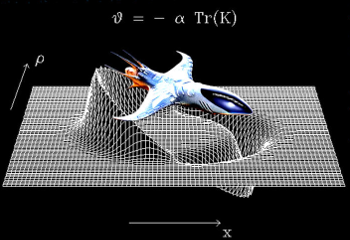
I don't think too much needs to be said about this one, as its premise is quite simple and the scope for storytelling it grants is pretty broad. That said, I don't think that writers should fall into the trap that you can only tell good space opera with FTL. The solar system is vast enough that we can tell many stories inside of it, without ever having to leave the heliosphere. That space is big is an understatement, and so we can do much to fill up the void between planets.
2) Artificial Gravity
This one is also a standard feature, but the one that seems least likely to ever be feasible within the realm of known physics. Gravity as we know it is generated by the spin of an object exerting force on the items upon it, essentially pulling on them. To do that you need something which can artificially replicate that force. In most science fiction though we seem to see artificial gravity being a standard applied everywhere. The mechanics of this are usually poorly explained, and well beyond the scope of our physics. Thus, one is forced to conclude that this is an unfeasible prospect based on our current understanding of modern science.
However, we can generate artificial gravity through things like centrifugal force, or simple thrust. The books in The Expanse series (and television series) show this through both aspects, and it is fascinating to watch the differences in gravity and problems it creates for our characters when they must do without it on occasion. Knowing that this is a plausible thing too, might change many people's perspective on what is 'realistic' and 'unrealistic' in science fiction.
I personally look forward to the day when we have a rotating habitat in orbit around Earth to start to get some hard data on this.
3) Interplanetary Colonization
One thing that is practically taken as gospel in almost every piece of science fiction is the idea that humanity will spread to the stars and plant our flags on other worlds and terraform them to suit our needs. Now, we have a history here on Earth of spreading across the continents, from the early Polynesian peoples to the Age of Discovery when Europeans began planting flags all over the world. It would make sense then that we would seek to expand that process to the final frontier. But does it really?
For one thing, space is big. Really, really, big. It would take centuries to travel to even some of the closest stars near to our solar system without FTL. Even travelling between the various planets in the solar system at the moment would take months or years with current technology. Even with some future technology it would take a long time to reach some place like Proxima Centauri, our closest star.
Even then, once we got to another solar system, would we even be able to colonize it? Kim Stanley Robinson's Aurora has some interesting answers on that. However, even assuming that we could terrform another planet, it would take a long time, centuries or millennia. So why not just build some islands in space?
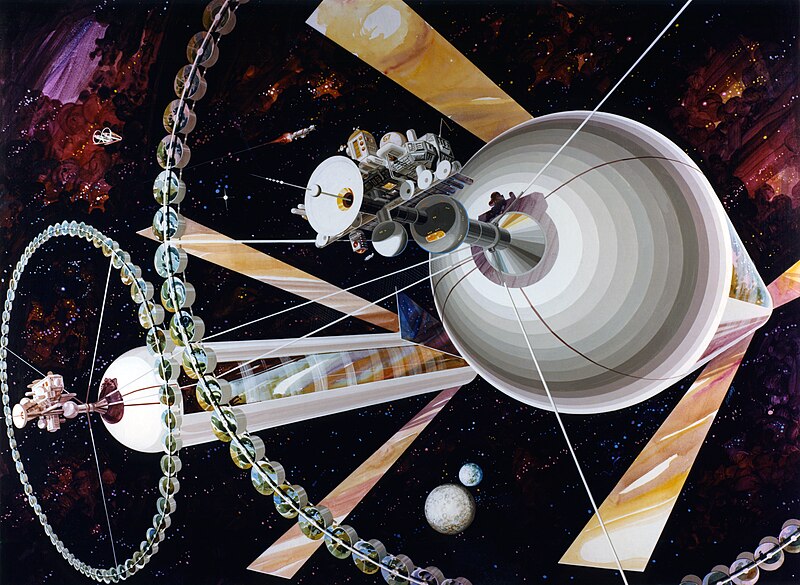
This brings you to the idea of the O'Neill Cylinder! At its simplest this is a large tube, either built independently or into a hollowed out asteroid, and spun up to provide gravity. Something like the terrarium from 2312. The idea was originally floated in the book The High Frontier by physicist Gerard K. O'Neill, which talked of building rotating habitats in Earth/Moon orbit, or at the stable Lagrange points in Earth's orbit. These can be of varying sizes, but the advantages are you can create and settle them however you like! Want an arctic like location? No problem! Eternal tropics? No problem! All you need to do is create a cylinder with a certain diameter and length, spin it up and light it and voila!
And O'Neill's design isn't even necessarily the only one. You could build even larger, potentially with the truly massive McKendree Cylinder. Unlike O'Neill's more modest island in space, here you would practically be building a continent in space. Measuring 460 km in radius and 4600 km in length per the original proposal, you could have a living area inside with the same land area as Russia! You could even build it bigger with stronger future materials!
Building something like this turns into decades, or maybe a century, of work. Something far removed from the travel times between the stars or the length of time it might take to terraform somewhere like Mars. We could have continent sized living space in the future, yet this seems to get overlooked fairly easily. Perhaps we should start thinking of those types of stories more. You don't even need to leave the Solar system to have an 'interplanetary' adventure!
4) AI
Artificial Intelligence, or the reasonable facsimile thereof, has been an expectation of science fiction since at least the 1950s. Presumably most well known is Robert Heinlein's "Mycroft" who was birthed when an engineer on the moon progressively plugged in more and more computers until they gain sentience as one single being. Sadly, to some people the idea hasn't advanced much beyond that.
There is a strange belief in what is known as "The Singularity" in which computers will advance so quickly and so fast that just one day they will "wake up" and AI will be born. Now there's a few problems with this idea. Firstly that our rapid advancement in technology and efficiency is nowhere near as rapid as proponents even 20 years ago predicted. Futurist Ray Kurzweil predicted in his 1999 book The Singularity is Near that by 2010 we would have a computer capable of emulating human intelligence, and by 2020 such computers would be available for "one-thousand dollars" to us. Well, it's 2020 and barring some massive change no such computer is on the horizon.
Largely the idea is a vast misunderstanding of Moore's Law, which even the observer himself said was not a hard fast law, but an observation. It is even clear today that the rapid increase of processing power in computing is reaching a state of diminishing returns. Exponential growth cannot continue forever.

Even overlooking the issue of the Singularity, what would an AI actually look like? Would it have human level intelligence? Maybe, but would we recognize that intelligence? That last question is probably the most important when considering the issue of AI, would we even recognize it for what it was if we had it? Let me be clear, creating an 'artificial brain' which can solve complex problems is already within our grasp, whether it be made to play games of go or jeopardy. However, one which will be able to complexly interact with and communicate/reason with its human creators will take time and we might not even realize it was self aware as it wouldn't have the same desires/fears/ambitions as we do.
This is why I personally tend to dismiss out of hand fears of 'god like' AI destroying either humanity or the planet. In fact, I think AI will probably be far 'simpler' than we imagine when/if it does show up. For now though, its a highly theoretical concept with some wild out there ideas which fiction has almost done a disservice to.
5) Space Capitalism
So this is an important one. In many, many future scenarios it is hundreds or thousands of years in the future and everyone is either still working a 9-5 job, or working towards getting a pension or government benefits. Now, this makes sense since it would take a lot to put readers in a frame of mind where they grasp a post-capitalist society. However, is this the best way to try and imagine the future?
There have been many attempts to imagine a post-capitalist society in science fiction. Whether it was Gene Roddenberry's post-scarcity Federation of Planets, or the Mondragon Accords put forward by Kim Stanley Robinson. Now, each of these do depend on future technologies to be feasible (the magic replicators in the former and quantum computing in the latter) and it isn't far fetched to believe that our future economic systems will be driven by post-scarcity concerns or technological advances.
One future technology with the potential to upend the current economic order as we understand it is fusion power. An expected massive leap in power production and orders of magnitude more efficient and safer than our current atomic power generation. This could, almost overnight, upend our way of producing power as we know it and put the current hydrocarbon power generation methods the world largely depends on in decline. That would change some key economic inter-dependencies, such as on foreign oil or even the whole natural gas industry.
Now some of this does depend on the idea of a 'post-scarcity' society. It should be understood that 'post-scarcity' does not mean that we have everything, it just means that obtaining resources and a high standard of living is not impossible for the average person as goods are produced cheaply and available to all. This would though, arguably eliminate the need for traditional capitalism as we know it and lead to something close to the UBI (Universal Basic Income) that has been mooted around the last few years. Even just the UBI would undermine our understanding of politics and economics as it stands.
The future though, might not be more egalitarian but more corporate. With men like Elon Musk and Jeff Bezos driving the current future of space travel, it seems like we're possibly going to have shares be more important in the near future than any sort of workers cooperative in space.
However, the ideas for a post-capitalist future are many, and even here I can only list some ideas for why writers ought to be imagining a post-profit driven society.
----
These of course, are just a few things that science fiction is often using as a standard for the genre. They aren't the only big tropes, but I think they are at least the top five. What do you think, and what would you like to see more of in science fiction?
1) FTL, Faster Than Light Travel
This seems perhaps an obvious one, space opera tends to be impossible without some measurable means of transiting the stars in a reasonable time frame, but it is one that, until recently, was even theoretically impossible. With the cultural popularity and theoretical applications of the Alcubierre Drive, it seems that we can justifiably speculate on how an FTL civilization would function. However, before this, when breaking the light speed barrier was beyond the realm of plausibility, we had to simply invent it as science fiction.
I don't think too much needs to be said about this one, as its premise is quite simple and the scope for storytelling it grants is pretty broad. That said, I don't think that writers should fall into the trap that you can only tell good space opera with FTL. The solar system is vast enough that we can tell many stories inside of it, without ever having to leave the heliosphere. That space is big is an understatement, and so we can do much to fill up the void between planets.
2) Artificial Gravity
This one is also a standard feature, but the one that seems least likely to ever be feasible within the realm of known physics. Gravity as we know it is generated by the spin of an object exerting force on the items upon it, essentially pulling on them. To do that you need something which can artificially replicate that force. In most science fiction though we seem to see artificial gravity being a standard applied everywhere. The mechanics of this are usually poorly explained, and well beyond the scope of our physics. Thus, one is forced to conclude that this is an unfeasible prospect based on our current understanding of modern science.
However, we can generate artificial gravity through things like centrifugal force, or simple thrust. The books in The Expanse series (and television series) show this through both aspects, and it is fascinating to watch the differences in gravity and problems it creates for our characters when they must do without it on occasion. Knowing that this is a plausible thing too, might change many people's perspective on what is 'realistic' and 'unrealistic' in science fiction.
I personally look forward to the day when we have a rotating habitat in orbit around Earth to start to get some hard data on this.
3) Interplanetary Colonization
One thing that is practically taken as gospel in almost every piece of science fiction is the idea that humanity will spread to the stars and plant our flags on other worlds and terraform them to suit our needs. Now, we have a history here on Earth of spreading across the continents, from the early Polynesian peoples to the Age of Discovery when Europeans began planting flags all over the world. It would make sense then that we would seek to expand that process to the final frontier. But does it really?
For one thing, space is big. Really, really, big. It would take centuries to travel to even some of the closest stars near to our solar system without FTL. Even travelling between the various planets in the solar system at the moment would take months or years with current technology. Even with some future technology it would take a long time to reach some place like Proxima Centauri, our closest star.
Even then, once we got to another solar system, would we even be able to colonize it? Kim Stanley Robinson's Aurora has some interesting answers on that. However, even assuming that we could terrform another planet, it would take a long time, centuries or millennia. So why not just build some islands in space?
This brings you to the idea of the O'Neill Cylinder! At its simplest this is a large tube, either built independently or into a hollowed out asteroid, and spun up to provide gravity. Something like the terrarium from 2312. The idea was originally floated in the book The High Frontier by physicist Gerard K. O'Neill, which talked of building rotating habitats in Earth/Moon orbit, or at the stable Lagrange points in Earth's orbit. These can be of varying sizes, but the advantages are you can create and settle them however you like! Want an arctic like location? No problem! Eternal tropics? No problem! All you need to do is create a cylinder with a certain diameter and length, spin it up and light it and voila!
And O'Neill's design isn't even necessarily the only one. You could build even larger, potentially with the truly massive McKendree Cylinder. Unlike O'Neill's more modest island in space, here you would practically be building a continent in space. Measuring 460 km in radius and 4600 km in length per the original proposal, you could have a living area inside with the same land area as Russia! You could even build it bigger with stronger future materials!
Building something like this turns into decades, or maybe a century, of work. Something far removed from the travel times between the stars or the length of time it might take to terraform somewhere like Mars. We could have continent sized living space in the future, yet this seems to get overlooked fairly easily. Perhaps we should start thinking of those types of stories more. You don't even need to leave the Solar system to have an 'interplanetary' adventure!
4) AI
Artificial Intelligence, or the reasonable facsimile thereof, has been an expectation of science fiction since at least the 1950s. Presumably most well known is Robert Heinlein's "Mycroft" who was birthed when an engineer on the moon progressively plugged in more and more computers until they gain sentience as one single being. Sadly, to some people the idea hasn't advanced much beyond that.
There is a strange belief in what is known as "The Singularity" in which computers will advance so quickly and so fast that just one day they will "wake up" and AI will be born. Now there's a few problems with this idea. Firstly that our rapid advancement in technology and efficiency is nowhere near as rapid as proponents even 20 years ago predicted. Futurist Ray Kurzweil predicted in his 1999 book The Singularity is Near that by 2010 we would have a computer capable of emulating human intelligence, and by 2020 such computers would be available for "one-thousand dollars" to us. Well, it's 2020 and barring some massive change no such computer is on the horizon.
Largely the idea is a vast misunderstanding of Moore's Law, which even the observer himself said was not a hard fast law, but an observation. It is even clear today that the rapid increase of processing power in computing is reaching a state of diminishing returns. Exponential growth cannot continue forever.
Even overlooking the issue of the Singularity, what would an AI actually look like? Would it have human level intelligence? Maybe, but would we recognize that intelligence? That last question is probably the most important when considering the issue of AI, would we even recognize it for what it was if we had it? Let me be clear, creating an 'artificial brain' which can solve complex problems is already within our grasp, whether it be made to play games of go or jeopardy. However, one which will be able to complexly interact with and communicate/reason with its human creators will take time and we might not even realize it was self aware as it wouldn't have the same desires/fears/ambitions as we do.
This is why I personally tend to dismiss out of hand fears of 'god like' AI destroying either humanity or the planet. In fact, I think AI will probably be far 'simpler' than we imagine when/if it does show up. For now though, its a highly theoretical concept with some wild out there ideas which fiction has almost done a disservice to.
5) Space Capitalism
So this is an important one. In many, many future scenarios it is hundreds or thousands of years in the future and everyone is either still working a 9-5 job, or working towards getting a pension or government benefits. Now, this makes sense since it would take a lot to put readers in a frame of mind where they grasp a post-capitalist society. However, is this the best way to try and imagine the future?
There have been many attempts to imagine a post-capitalist society in science fiction. Whether it was Gene Roddenberry's post-scarcity Federation of Planets, or the Mondragon Accords put forward by Kim Stanley Robinson. Now, each of these do depend on future technologies to be feasible (the magic replicators in the former and quantum computing in the latter) and it isn't far fetched to believe that our future economic systems will be driven by post-scarcity concerns or technological advances.
One future technology with the potential to upend the current economic order as we understand it is fusion power. An expected massive leap in power production and orders of magnitude more efficient and safer than our current atomic power generation. This could, almost overnight, upend our way of producing power as we know it and put the current hydrocarbon power generation methods the world largely depends on in decline. That would change some key economic inter-dependencies, such as on foreign oil or even the whole natural gas industry.
Now some of this does depend on the idea of a 'post-scarcity' society. It should be understood that 'post-scarcity' does not mean that we have everything, it just means that obtaining resources and a high standard of living is not impossible for the average person as goods are produced cheaply and available to all. This would though, arguably eliminate the need for traditional capitalism as we know it and lead to something close to the UBI (Universal Basic Income) that has been mooted around the last few years. Even just the UBI would undermine our understanding of politics and economics as it stands.
The future though, might not be more egalitarian but more corporate. With men like Elon Musk and Jeff Bezos driving the current future of space travel, it seems like we're possibly going to have shares be more important in the near future than any sort of workers cooperative in space.
However, the ideas for a post-capitalist future are many, and even here I can only list some ideas for why writers ought to be imagining a post-profit driven society.
----
These of course, are just a few things that science fiction is often using as a standard for the genre. They aren't the only big tropes, but I think they are at least the top five. What do you think, and what would you like to see more of in science fiction?
Sunday, 29 July 2018
Those R&R Days
On Thursday I had an absolutely lovely day doing nothing. Now, to some people that may sound awful as I'm supposed to be writing or working, or doing whatever it is twenty-something Canadians do in the summer when our igloos melt. However, much has been happening in my professional and personal life that makes a day spent doing nothing a pure joy.
Alas some brief, but bad, weather did come our way and drive us from our rooftop perch. However, we both got home and sat quietly for the evening, watching some fun documentaries on the hidden killers in British homes throughout history.
All in all, it was a relaxing day I wouldn't have wanted to spend any other way.
Many of you older folks may know what I'm talking about already. Days where you don't have to be rushing around or double checking things. Days when you're not really expected to do something and can just do, well, whatever.
Personally, I chose to spend that time with someone I'm rather fond of, while also taking time to expand my reading list and add more weight to my bookshelves. Adding to that realizing I also need a new bookshelf before my existing one collapses or I completely run out of floor space. Walking room is a must after all.
But I was extremely lucky to spend some time in the beautiful city I call home. After days of rain and humidity the weather was near perfect. We were able to go out and sit in the sun and do some much needed R&R (Reading and Relaxation) then move on to grab some delicious lunch at a cantina in the Byward Market. While perusing that in lovely weather, we next got to go and sit at the balcony of the Copper Spirits and Sights rooftop establishment in Ottawa. There we simply had drinks and read. There was something fun about just sitting, drinking, and reading while seeing people who knew there was a two hour wait for one of those coveted balcony seats.

If that doesn't tell you timing is everything I don't know what will.
But I was extremely lucky to spend some time in the beautiful city I call home. After days of rain and humidity the weather was near perfect. We were able to go out and sit in the sun and do some much needed R&R (Reading and Relaxation) then move on to grab some delicious lunch at a cantina in the Byward Market. While perusing that in lovely weather, we next got to go and sit at the balcony of the Copper Spirits and Sights rooftop establishment in Ottawa. There we simply had drinks and read. There was something fun about just sitting, drinking, and reading while seeing people who knew there was a two hour wait for one of those coveted balcony seats.

If that doesn't tell you timing is everything I don't know what will.
Alas some brief, but bad, weather did come our way and drive us from our rooftop perch. However, we both got home and sat quietly for the evening, watching some fun documentaries on the hidden killers in British homes throughout history.
All in all, it was a relaxing day I wouldn't have wanted to spend any other way.
Wednesday, 2 May 2018
Small Treasures
On Sunday, I had the nostalgic experience of helping empty out my grandmothers house. It had been in my family for 44 years, and I have many fond memories of it from my earliest childhood. In helping clean it out I found myself nostalgic and wistful for those younger years.
It was a place where my parents had grown into adulthood, and I too went from an infant to an adult in those halls. I have happy memories of it, running around the large household, playing in the big basement, and going through (what seemed to my younger mind) the palatial halls and rooms.

It was where I learned my love of history, my love of reading, and my early faith with the tutelage of my uncle and grandmother. In fact I think many of my best lessons in life were learned under that roof. My grandmother was one of the people who made me who I am today.
"In the same way, you who are younger, submit yourselves to your elders. All of you, clothe yourselves with humility toward one another, because, 'God opposes the proud but shows favor to the humble.'" (1 Peter 5:5)
“I have not departed from the commandment of his lips; I have treasured the words of his mouth more than my portion of food.” (Job 23:12)

It was a place where my parents had grown into adulthood, and I too went from an infant to an adult in those halls. I have happy memories of it, running around the large household, playing in the big basement, and going through (what seemed to my younger mind) the palatial halls and rooms.

The brown carpet in particular was a fixture of my childhood
It was where I learned my love of history, my love of reading, and my early faith with the tutelage of my uncle and grandmother. In fact I think many of my best lessons in life were learned under that roof. My grandmother was one of the people who made me who I am today.
"In the same way, you who are younger, submit yourselves to your elders. All of you, clothe yourselves with humility toward one another, because, 'God opposes the proud but shows favor to the humble.'" (1 Peter 5:5)

I learned manners in this dining room.
Subscribe to:
Posts (Atom)