Showing posts with label The Expanse. Show all posts

Thursday, 9 December 2021

Leviathan Falls

Across four years, and two continents, I've been enthralled by the world(s) of The Expanse series and all the amazing imagery it has thrown at me. From re-reading the series last year, to prepare for the final installment, I've been eagerly waiting for the events of Leviathan Falls to sweep me off my feet. Here now, we come at last to the end of the saga which began with the phenomenal Leviathan Wakes as we set our sights on the end of this series.

SPOILERS FOR ALL BOOKS OF THE EXPANSE FOLLOW.


Picking up roughly a year after the events of Tiamat's Wrath, we find the crew of the Rocinante in something of a stalemate with the now fading Laconian Empire. The Underground is still fighting back, but with the Laconians still being the most powerful military force, they can exert a lot of pressure, though it's unclear how long that will last. However, the events of the time of Laconian dominance have effected them all. The status quo is very much in flux, with a waning empire and dark gods scratching at the walls of reality. 

James Holden is partially traumatized from his time at the hands of his Laconian captors, while his crew now deals with the stresses of a life constantly on the run. Even with 1300 worlds to run to, it is still very difficult to flee a former hegemon. Helping them slightly is their crewmate/hostage Teresa Duarte, the now adrift daughter of the former emperor of humanity. Sent to track her down is Aliana Tanaka of the Laconian Marine Corps, so she can bring back her emperor at all costs.

As the penultimate story in this series, it is very much more of what fun we expected with daring escapades and rigorously plotted space action. There are almost no new locations, with the familiar settings of the slow zone, Laconia, and Sol being the most well charted and important overall. The mysteries of the protomolecule are explored and, in many ways, resolved as the series wraps up and we learn of the aliens who built the ring, and not a little bit about how they died. Turns out it can be a really bad idea to park your empire in an alternate reality.

Once again our shared humanity is one of the main ideas being explored, and on showcase in this work is the power of individuality and the privacy of our own minds. That too does a very fascinating exploration of the concept of a hive mind. It speaks to how the human mind, a singular and individual piece of equipment is something that is not used to being shared with others. We like the privacy of our own heads, and the idea of people being able to ferret out our deepest thoughts and secrets is both terrifying and violating. Humanity did not evolve for those structures! Tanaka's story does an amazing job exploring this, and she might be the best character to explore it through.

As the story continues it wraps up the stories of the crew of the Rocinante mostly to our immediate satisfaction. Holden and Naomi have reunited after a painful separation, but are still deeply in love. Alex is still flying, but realizing that all this rebelling, fighting and running is making him miss out on seeing his family grow up and his ability to connect with them. Amos is, well he's still Amos no matter what.

Outside of that crew we have Elvi and Fayez, last seen in Tiamat's Wrath doing research on the entities that killed the gate builders. They and their very cool ship the Falcon are still trying to understand the creatures that came before them and use that understanding to keep the creatures wanting to wipe humans out away from us, or at the very least find a way to negotiate with them. Their story is very much one of discovery and ethics and I felt it was handled in a very tasteful manner, especially in the time it was written!

Between them all is Teresa Duarte, now effectively an orphaned child. She has been, somewhat, adopted by Amos and is used to being obeyed without question, and so has difficulty fully fitting in with the various crews. She is still a child, a very powerful and well educated child, but a teenager all the same when it comes down to it. Her desires and interactions were rather well explored, but I felt that for all her introduction, she was almost criminally underutilized, and unlike many of the cast, did not receive a proper ending to her story overall.

Our main protagonists do all get very satisfactory wraps on their major arcs otherwise, with some mysteries solved, character traits being brought to their logical ends, and successful evasions of some (but not all) disasters reached. For Holden, I was a little surprised that he did not manage to find a way, with all the research available and the eventual power, to negotiate with the dark gods. However, it is to the credit of the series that the aliens are, well, alien and it keeps them enigmatic and mysterious beyond the broad strokes to the very end. Something that I still very much appreciate. Maybe some won't, but I do think that it is clever how we never get the whole picture.

The ending though, is gut wrenching. I was on the verge of tears as I read some of the final lines, but the epilogue had me laughing out loud for how well some things read. It leaves many questions unanswered, but satisfactorily wraps up the series in a way that will leave readers both intrigued and heart broken. 

For all galaxy hopping saga, that might be all we can ask for. 

Friday, 30 April 2021

Babylon's Ashes

After the events of Nemesis Games have, almost literally, broken the world, the Solar System finds itself engaged in the most destructive war in history. Governments have fallen, countless are dead, and the crew of the Rocinante find themselves struggling to keep up in a world choking on Babylon's Ashes.

Going forward, there are major spoilers for the series, so below the cut will include a much richer review.

In broad strokes, Babylon's Ashes more than Nemesis Games is a war story first and foremost. More so than even Caliban's War was. Picking up in the immediate aftermath of the status quo shattering events of the last book, we're thrown right into things as our cast, the crew of the Rocinante and a legion of new and familiar faces, are attempting to adjust to how much the world has changed once again.

We're given a sweeping narrative that runs from Earth to the edge of settled space and in the slow zone we first saw in Abaddon's Gate. Taking many familiar faces, Avasarala, Prax, Bobbie Draper and Anna, there's a wide amount of latitude to explore the tragedies of a solar system at war. Economic dislocation, creeping tyranny, and tragic loss from piracy, starvation and battle. It does an amazing job at humanizing war, especially one on a scale not before seen in human history.

It also does a wonderful job of humanizing people. So many stories about war too easily devolve into "us and them" stories, but this one doesn't. It acknowledges that people, whether from Earth, Mars or the Belt are people - no matter the physiological differences. One of James Holden's best traits shines through as, in response to Free Navy propaganda, he makes videos about the lives of average Belters trying to eke out an existence in the most hostile living arrangements known to man. He tries to show that, regardless of ideology, birthplace, or distance, everyone is human. It's a truly touching moment that tries to dismantle the usual dichotomy of war.

Alongside those moments, it manages to give us a gripping story of ending a solar system wide war. It begins as the forces of Earth and Mars are trying to consolidate and defending themselves from flying rocks thrown by the Free Navy. Holden and his crew go on a daring mission to blind their opponents to finally give the beleaguered Earth some breathing room. From there, it's a series of feints, attacks, and chases to try and gain advantage.

One of the small things I will criticize with this novel is that, while it nails the human element of war very well, the specifics of the war are left very vague. Outside of some moments near the end of the story where I have a definite idea of the numbers, the stakes involved in various battles and chases are extremely vague. I never know who held the balance of power, how many ships were involved, and whether one side really had the upper hand. The book could have been made so much more tense by the breakdown of what was lost, and what assets were where so I could sense out the course of the war. 

However, since the human element is more important, I can forgive it. As one character puts it, "war isn't just torpedoes and battle lines."

Through the character of Michio Pa, a tertiary character from Abaddon's Gate, we get the divided loyalties of someone who believes they're doing the right thing in war. To some, she's a pirate, from her own perspective she's a freedom fighter trying to bring justice to the people of the Belt. The vision put forward by the Free Navy, a Belt no longer under the heel of Mars and Earth, economic justice for Belters, and true void cities, is intoxicating. However, the increasingly brutal means put forward to make that a reality, are at odds with her own morality. 

It also examines the rolls of leaders. Even the flaws with the Great Man Theory of history. It shows us the leaders we have, while great, are not necessarily infallible geniuses. One of the best moments is when Fred Johnson simply says, he's doing what he knows in the best way he can. 

The narrative climaxes in a satisfying way, trying to seek solutions to the problems which led to the war in the first place. I quite enjoyed the effort to look at humanity through a full glass, and with the major players earnestly trying to find methods to solve the problems which caused the war, but with just enough ambiguity for the future to keep you invested in what comes next.

Moreover, it has some amazing moments which will probably not be forgotten in this series, but many spoilers follow.

Sunday, 21 March 2021

Nemesis Games

I've been keeping up pretty regularly with the works of James A. Corey and The Expanse, both in show format and in dead tree form. Now though I've finally come to one of the most game changing books in the series. The verse as you know it is about to be upended. Here, we get a look inside the head's of each member of the crew of the plucky ship Rocinante. In this installment, James Holden and his crew will face their greatest challenges yet as they sit down for Nemesis Games.

Taking place roughly a year after the events of Cibola Burn, Holden and the crew are back on Tycho Station, their ostensible home base. However, one by one they are drawn off by personal needs. With their ship in dock for extensive repairs after the events of the last novel, they have some unexpected down time. They find themselves with personal matters cropping up.

For Amos, there is a funeral on Earth. For Alex, his wanderlust for his Martian heritage and old life creeps up on him. For Naomi, a message from her past she never expected comes over the horizon at her, giving her no choice but to go it alone to try and confront her demons.

Nemesis Games is notable for being the first book in the series where we get a look at the personalities of the whole crew of the Rocinante and not just it's erstwhile captain James Holden. Though Naomi, Amos and Alex have been along for the ride all along, we haven't gotten much beyond smaller looks at their pasts, their secrets, and the issues which brought them out to the ice hauler Canterbury so long ago. In this story, told entirely from the POV of the crew as they diverge across the solar system, we share their own secrets, their fears, and anxiety at losing touch - even briefly - with their surrogate family as they endure the greatest terrorist attack in human history.

Events in the Sol system and the myriad of worlds beyond have been largely focused around the thousand new worlds opened up to humanity by the Gate. That presents a singular problem for Mars whose centuries old terraforming project now stands in peril as there are easily accessible worlds to stand on only a year or two's travel away. Why waste your time in domes when you can hop on a spaceship and see the open sky? For the people of the Belt too, who have spent their lives downtrodden by the power of Earth and Mars, they fear they will be overlooked in this land rush. There are many competing ideas about this, and how this gets resolved, and some are much more violent than others.

In the wake of a stunning declaration of war on, effectively, humanity, the crew of the Rocinante are left struggling to find their way home to their ship. Whether trying to maintain calm on Tycho Station, racing around Mars on a potentially deadly investigation or trapped on Earth, things get grim for not only them, but humanity as a whole.

Since we're getting such a more intimate look at the crew and their own personal dynamics, I felt this was one of the most surprising yet desirable turns the story of The Expanse could take. It made for enlightening reading. Characters who had thus far only played supporting roles were given the center stage at last while their own interactions and feelings towards one another were more deeply explored. Set against a suitably dramatic backdrop, it felt like the collapse of the status quo was much more intimate, something a broader lens might have achieved, but not with the same effect of interconnected fear and familial love.

Explorations on what it means to be human, the interconnectivity of society and the very real concerns people have over their own potential irrelevance are well explored. The social issues, while not heavily hammered on, take a forefront in this story. You get a real feeling that, even in the 24th century society can't quite pull itself together properly. There is though, still hope.

Nemesis Games is the first book in the series to end on a very definitive cliffhanger. You're left with the situation overall still in turmoil, threats unresolved, and terrible problems yet to be revealed. This is my second time reading the book, but it did make me want to immediately leap onto the sequel, Babylon's Ashes. A great novel and an excellent hook for continuing the series!

Monday, 25 January 2021

Cibola Burn

Since the events of Leviathan Wakes the protomolecule has opened up a thousand new worlds to human exploration. The different powers of the Solar System all have a different idea on how they should be explored. One such world, whose name varies, orbits a star far from Earth. The UN claims to administrate it, but refugees from the upheaval in the Solar System have already established a colony. With a UN chartered company trying to enforce claim over the planet and the OPA having a stake in the outcome, each side calls on the one man who might be able to make the difference and mediate the conflict, James Holden.

This world though hides many secrets. It's an unfamiliar planet whose very nature just might be hostile to human life. The Rocinante once again rides into danger in Cibola Burn.

In the fourth book of the Expanse we finally ride out of the Solar System proper for some interstellar adventure. An alien sun shines above alien soil as the problems of how we legislate the first true extra-solar colony are ironed out. Who has the rights? The "squatters" who got there first, or the charter that the UN has given some corporation to survey and mine that world's resources? It's actually a rather poignant take on the problems of colonialism, the use of force to achieve ends, and how in the face of the truly alien, humanity would be far better coming together.

However, as is so often the case, petty tribalism, jurisdiction, and plain old fashioned racism make things worse.

On the planet Ilus (or New Terra) there are two distinct factions. The first are the colonists (or squatters) that settled after the events of the war in the Solar system which started over the course of the first book. On an old freighter and desperate for survival, they've pinned everything on running to the new star system to make a new life. Opposing them is a survey team from Royal Charter Energy, originally a purely scientific mission, it is meant to claim the planet under a UN mandate. Things quickly go awry.

Basia Merton is a refugee from Ganymede briefly met in Caliban's War who just wants a new life for his family. He may have to use violence to achieve that end. Elvi Okoye, an exozoological specialist from Earth, here to study a new planet. Finally, an old side character, one Dmitri Havelock, finds himself in his old role providing security, but now he has to choose between the contract and his morality.

Before I had gotten properly into the Expanse, I heard, extremely erroneously, that it was based on the old show Firefly. The series was far too centralized in the politics of oppression, great power problems, and the nefarious actions of corporate entities. There really wasn't anything resembling a space western in the series at all. However, Cibola Burn is arguably one of the best done space westerns ever produced. With numerous allusions to the frontier, the idea of the edge of civilization, and how we bring our society past the "settled" core.

It creates a complex swirl of ideas of ownership, war, tribalism, colonization and "who owns the land" all play a big part in this story. On a world not truly natural, it also explores man against a truly alien frontier. We haven't been exposed to this planet's creatures before. That becomes an increasingly apparent problem for both humans and animals,

As usual, the series explores concepts of identity to a group, race, and morality. It's a fabulous look at what people do on the edge. I found myself sympathizing with both sides of the conflict, even though there's absolute villains on each side. It made for an interesting example of looking at each side and trying to portray the escalations as responses to something another character has to justify for themselves. 

Finally, we get some further insight into the designers of the protomolecule and their ancient civilization. It's far to intriguing to spoil so I sincerely recommend reading it for yourself!

This is an amazing fourth installment in the series, carrying the Rocinante beyond Sol and into a new world. We get a setting we aren't used to in this series and see an entirely alien planet for the first time. There's deepening mystery, high stakes, and as always, well set up surprises that you don't see coming! The Expanse continues to entice and entertain.

Wednesday, 6 January 2021

Abaddon's Gate

After the events of Leviathan Wakes and Caliban's War the powers of the Solar System, Earth, Mars, and the Outer Planets Alliance are all in an uneasy coexistence as the dangers of the protomolecule appear ever more apparent. A mysterious object has formed around Uranus, and everyone is afraid of potentially waking a sleeping giant. So someone decides to do just that, and now humanity wants to investigate this strange phenomenon in our Solar System.

We're going to explore Abaddon's Gate, but on the other side, will we find heaven, or hell?

The third book in the Expanse series of novels, it follows the crew of the Rocinante and a small cast of new characters as they head out to the void beyond Uranus. James Holden is back, and ever since the events of the last two books, he's just trying to keep his head down and keep his little clan of Naomi, Alex and Amos on the Roci alive. There's one small problem with that though, he's being haunted by a ghost. Torn between madness and curiosity, he's finding it impossible to stay out of the spotlight and more sinisterly, someone might be guiding his actions to get him there.

In this story we're joined by a new cast of minor characters. In one corner you have Earth born member of the OPA, Carlos "Bull" de Baca. A long time subordinate of OPA head honcho Fred Johnson, he's been chosen to help keep a disparate crew of Belters together as they try to show the flag in an upcoming mission on the OPA's new dreadnaught. The only problem is, due to political necessity, he's been placed as third in command. With an egomaniac as a captain, and an XO of uncertain loyalties, he's going to have a hell of a time keeping the ship together, not to mention himself out of trouble.

Then we have Annushka "Anna" Volovodov, a Methodist preacher who along with her wife and child have been doing a tour of duty on Jupiter's icy moon Europa. Always one to do first and ask forgiveness later, her own curiosity is getting the better of her when she agrees to join an interfaith mission accompanying the fleet heading out to possibly one of the greatest missions in human history. As one who identifies as a Methodist myself, I found her character to be one of the most fascinating to read as she not only accurately reflected much of my own relationship with the divine, but was a human, fallible, and great to view the story through.

Finally, we have the mysterious Melba. She's nobody, trying to hide and keep her head down. She has her own mission to the stars. One which might end up getting a lot of people killed.

Like the previous installment, the book focuses less on the aliens we might encounter in the stars, but more on the human reactions to what happens when we face something down we know precious little about. As poor Anna discovers, the Earth, despite being under the ostensible aegis of the UN, is just as factionalized as it was pre-unification. Similarly, Bull struggles with his own erstwhile comrades of the OPA. Factionalism, competing agendas, and just plain old petty grudges bog down as much of the human endeavors as anything the aliens do.

Taking place largely in one location, this novel was also a bit different from the last pair of books which included chases around the Solar system, battles over multiple moons and planetoids, and a lot of what you'd call rock hopping. Here though, it's all set in one main location. It was very easy to follow the trajectory of the action and you don't find yourself consulting a map of the planets for a while. Not that I mind that, but one location can be a nice breather from stellar wide action.

As I mentioned with Anna being a fascinating character to read about, I enjoyed that this book was also looking at what humans could accomplish when they pulled together and didn't try to mess each other up. The humanitarian element was warming, especially in a pretty potent speech Anna gives to try and keep everyone together, decrying racism and the silly ideas that just because someone was born on Mars or in the Belt that they're somehow fundamentally different from people who grew up on Earth. Despite the inhuman ways people can act towards one another, we can still come together.

It's a supremely strong third installment to this series, and well worth picking up.

Monday, 4 January 2021

What I Read in 2020

The year 2020 was a long, long year for me. Quite honestly it almost feels like the period between January and March was one year, between March and June was another and then June to September, and finally October to January. So, I feel like I've been through four years when its been just one. Thankfully though, I read a lot in the four years of 2020!

I managed to read 72 books and 34,204 pages between them. I'm not sure if that's a record for me or not, but it certainly outpaced what I read last year. I had actually planned 2020 as a fresh start in a new decade, especially for reading. I had started the year with the goal of doing a massive re-read of my favorite book series for the year. I had dedicated myself to re-reading a lot of my old favorites to see if they stood up, and then to maybe, maybe downsizing my collection. I mostly expanded it though. In the course of my re-read I went back to a few of my old favorites, The Moon Is A Harsh Mistress, Leviathan Wakes, Jennifer Government, and then branching into some of my favorite fantasy series. A re-read of Joe Abercrombie's amazing First Law series, then re-reading all of the Stormlight Archive so far in anticipation of the release of Rhythm of War this year. Finally I re-read, perhaps the perfect trilogy in the first three books of A Song of Ice and Fire. Though I had to put off my combined reading of A Feast for Crows and A Dance With Dragons until 2021.

On the whole, the re-read was highly successful. I didn't get to all of what I wanted, but I managed to read a lot of new books too.

Normally my year has pretty bog-standard reading. Fantasy, science fiction, and the occasional mystery, historical fiction or alternate history. This year however, I was committed to reading more on social issues, some on political issues, and generally more books by authors I had not yet read, but especially by women and people of color. 

A small cross section of what I read!

One of the first books I branched out on and took a chance with was The Secret History by Donna Tart. It's a novel set in the 1980s in Vermont at Hampden College. Young Richard Papen leaves his home in California to study Ancient Greek, and while there he meets an eccentric group of wealthy students partake in an almost cultish devotion to the art. From there, dark things transpire and poor Richard is thrown into a world well beyond his understanding. It's honestly one of the most fascinating and frustratingly good books I've read in years. Well recommended!

Something more in my usual wheelhouse that I read for the first time was 2312 by Kim Stanley Robinson. Originally written in 2012, it was the authors attempt to reach 300 years in the future and grapple with what humanity might look like. It tells a compelling story of love, loss, and a humanity startlingly distinct, yet also depressingly still similar to our own 21st century selves. It's an old planetary romance novel in the style of recent reads. A solid piece of science fiction literature!

A non-fiction book I distinctly enjoyed was The Global Crisis by Geoffrey Parker. It's a fascinating look at war, religion and climate change in the 17th century. It supposes an idea of a "general crisis" taking place across the globe brought about by previous socioeconomic conditions, religious awakenings and social upheaval, but most of all, by climate change. The 17th Century was a genuine era of emergency, encompassing the whole world with events like the Thirty Years War in Europe, the collapse of Ming China, the near extinction of the Virginia Colony, the establishment of the Tokugawa shogunate, and the Puebla Revolt. It was referred to by some as the "Age of Iron" due to there being a genuine sense of global calamity. It's a very academic work (and I read the abridged version!) but it is chock full of information, research and first hand accounts of the people of the era. It established to me that this was one of the most fascinating periods in human history. 

In other realms of non-fiction, I also read The Sport and Prey of Capitalists by Linda McQuaig. It's a very short, but spectacularly enlightening read. It details the history of public ownership of utilities and natural resources in Canada, while also detailing long campaigns of poor deals and mismanagement by private entities. It compares and contrasts the systems here with those of other countries. There's notes on missed opportunities and possibilities for how we can make our own institutions better.

A book which acted as a real eye opener for me was Why Women Have Better Sex Under Socialism by Kristen R. Ghodsee. From showing how many early socialists were women, to the egalitarian thinking of other socialists and socialist writers, it also highlights how modern liberal democracy, and capitalism in particular, has made women less free and arguably less equal as well. It's a spectacular examination of how in Eastern Bloc nations, there was a long history of, at the very least, pandering to women's rights, establishing job and childcare opportunities to make something of a more level playing field among men and women, and makes a compelling argument that had the Eastern Bloc not adopted such policies, there would have been little impetus for Western nations to adopt them as well. Far from cheerleading for the East Bloc however, it rightly points out their flaws and failings, while also arguing that the ideas behind socialism could do a lot for our economic lives, and even our love lives.

I think the most shocking, if not the most radical book I read in 2020 though was The Uninhabitable Earth: Life After Warming by David Wallace-Wells. It fleshes out what he wrote in a 2017 article, and runs the range of possible global outcomes across various levels of warming. He points out that with rising temperatures - and they will rise, it's only a matter of by how much - there's a gambit of problems which will impact across multiples spheres. Mass extinctions, spreading disease, rising sea levels, frequent natural disasters and increased risk of internal and external conflict between peoples. It's a grim read, but with a hopeful message. It pairs really well with another novel I read this year, The Ministry For the Future. Both are somewhat shocking examinations of the potential ramifications of climate change, and frankly, I would advertise them as must reads.

On a more fictional note, I also read Mexican Gothic by Silvia Moreno-Garcia. I've done a longer review for this one, but in brief; it takes the usual horror of Gothic fiction and transplants it to the highlands of Mexico. The story has everything you love from Gothic literature, creepy old houses, a reclusive family, and a very deep and disturbing mystery.

Another author who I was very fortunate to run into again was Max Brooks. I was able to re-read his cult classic World War Z, and his new, unique work Devolution. It was amusing to discover this year as well that the one movie monster my dad has a fear of is bigfoot. I got more than a little mileage out of this book by describing it to him. A fun and very unique take on the monster horror style, I definitely recommend this to horror buffs everywhere!

I also caught up with Brandon Sanderson's works by reading Rhythm of War. This is the latest work in the Stormlight Archive and a very well done piece. It defies a lot of your expectations and takes you deeper into the world of Roshar and his fictional cosmere as a whole.

Finally, one of the best novels I read this year was The Parable of the Sower. In my bid to expand beyond works I'd already read, I tried to find works recommend by others. This novel by Octavia Butler was highly recommended in many different circles and by many different authors. I dove in to this world in our near future and found myself entranced. It was a phenomenal read and one which I have to recommend to anyone who loves science fiction. Tracking down the sequel is one of my main reading goals for 2021, along with the rest of my reading list.

Of course, I did read 72 books this year, so I had a lot to choose from to celebrate. These books specifically though, were easily in the top ten of what I read among the re-reads to start the decade. I managed to reconnect with old favorites, while finding lots of new work which I could enjoy! I'm happy for what I accomplished this year, and I'm hoping I can read more next year!

Friday, 21 August 2020

Planetary Invasions

In science fiction the idea of our planet being invaded, or other planets being invaded, is sufficiently old enough to be a trope. It all started back when H. G. Welles imagined Martians slinging themselves towards Earth to mash us with their tripods and death gas. From there it's evolved into many different scenarios some of which still involve us on Earth, to fascinating wars between the stars of other human or alien civilizations. Recently I've been pondering on that after I watched two very interesting videos between people who examined the idea of planetary invasions.

The first is from the excellent channel Space Dock which puts together wonderful work on the spaceships and vehicles of many franchises. They themselves have a drama called the Sojourn coming soon. Definitely check it out. But for our purposes watch their brief video on Planetary Invasions.

In contrast we have one video from Isaac Arthur discussing the subject. It's a longer one and it raises many interesting points. His channel is simply amazing for an in depth look at futuristic science based concepts on how we may do things in the future. It's honestly one of the best futurist channels and series I've ever encountered, sincerely worth checking out if you're interested in that kind of thing.

Credit to Alexander Tooth, from wookiepedia

Both these videos raise very good points, and they have contrasting opinions. In the first video we do see that it is argued that a planetary invasion is basically infeasible. Some Operation Barbarossa style mass landing and invasion taking years, decades, or perhaps centuries, to fully pacify a planet through mechanized warfare from above and below. The crux of the argument is that this is a huge waste of time and resources, especially when you presumably have ships in orbit that can hammer your opponent at your leisure. Then if you have no hope of relief and no friendly ships in the area, fighting on serves no purpose. You don't need legions of soldiers, just large landing forces to take and hold the vital aspects of planetary infrastructure and then garrison forces to keep the planet yours.

The second video has a more wide ranging view. It presumes that planetary assaults or invasions are feasible. The main point is that, after all, if you're jetsetting around in space with any sort of casual interstellar travel then the mobilization of resources to invade and crush another world or system of habitats (especially if you rule over multiple star systems and have great automation) is almost trivial. That being said, it makes a very pertinent point that a planet is not necessarily a helpless target. 

It is a point worth considering as any civilization which can do travel casually at interstellar distances is probably not really having to worry about the whole issue of delta-v in a gravity well. That means that, while an opponent who does control the orbitals has an advantage, the people at the bottom of that well are not nearly so defenceless as we might assume through our lens of 21st century technology where an asteroid barreling through our gravity well is a very terrifying prospect. Your vital sites are probably ringed with powerful railguns or missile batteries which can shoot destruction at any ship foolish enough to park in orbit.


In fact with that view, the traditional image of a ship parking itself in orbit and blasting a planet with it's weapons seems silly. No ship could risk parking in orbit without worrying about taking crippling damage or being rendered combat ineffective. The proper image might be a vessel in the age of sail bombarding a land fortification and having to outnumber the guns of the fort to hope to overpower them before it can be rendered ineffective itself. The planet can shoot back.

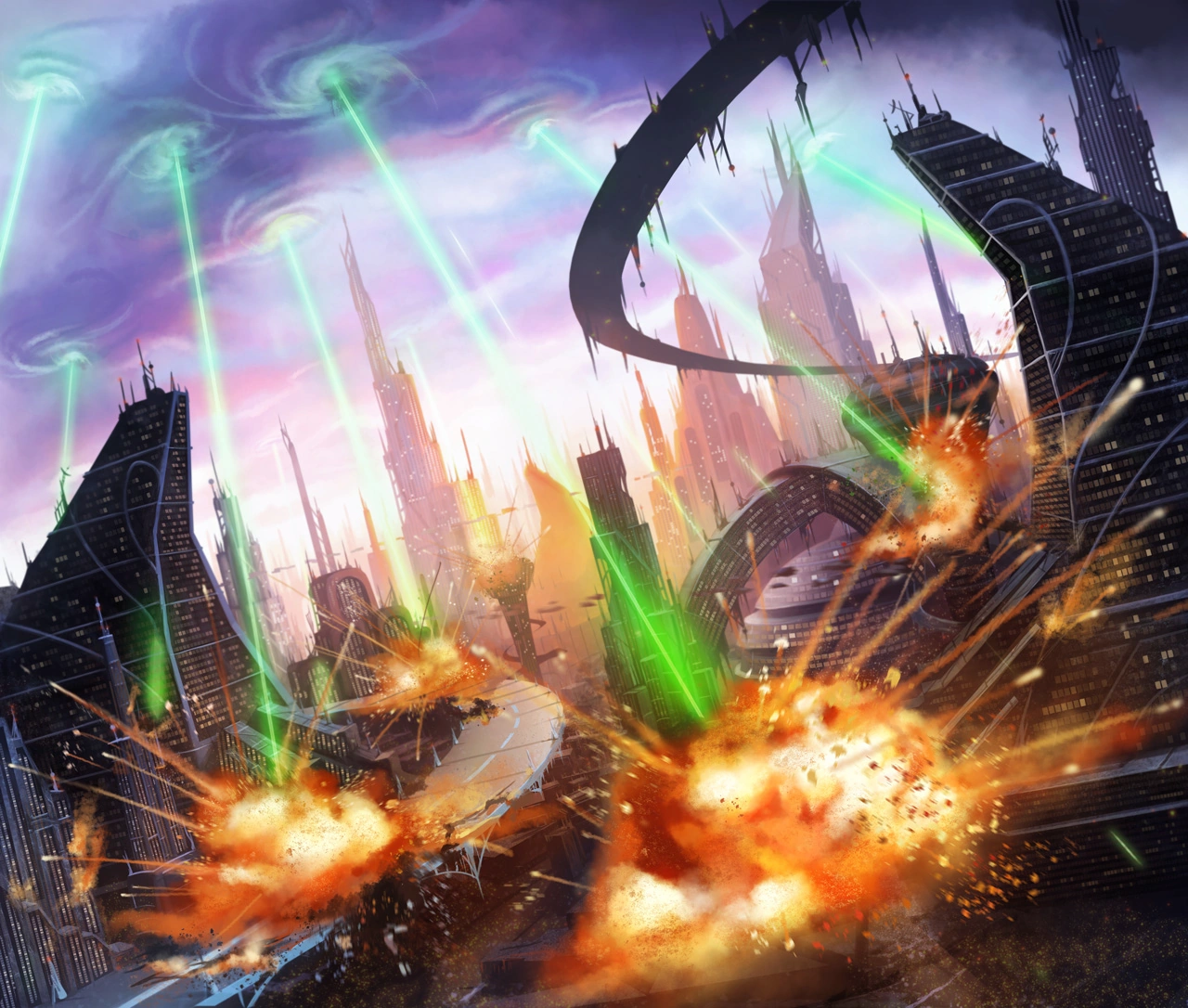
What you might see instead is ships engaging in what amount to bombing runs, first moving to cripple or take any orbital defences, then moving in unpredictable patterns to try and crush the ground based defences. If that doesn't work, clearing a landing corridor to insert marines who can disable or capture those defenses so the fleet can put itself in a position to command the ultimate high ground and compel a plant's surrender would be your next best bet. In the book Tiamat's Wrath there is an interesting example of this that works very well from both a tactical and a dramatic perspective.

This is actually a point I've considered for some time. I've mused about interstellar warfare before and why it might happen. In my own, as yet unfinished Service to the State science fiction novel, I've thought about how you could make a planetary invasions feasible, so my own view actually falls somewhere between that of the two videos.

Part of that view does come from finding that in universes like those of the Honor Harrington series that if you've countered gravity to the point you're using it in your weapons, the idea you can't make some kind of planetary based weapons system which could cripple or severely damage a ship seems baffling. It does seem to me that there would need to be an invasion, but one aimed at very limited and achievable goals so your fleet could enforce the threat of death from above.

Some blame might come from Robert Heinlein's Starship Troopers which, though an excellent novel I recommend everyone read, did draw it's inspiration pretty heavily from the work of paratroopers in WWII and the island hopping campaign in the Pacific theater. In the Pacific the small Japanese garrisons which held out across numerous little islands with their coastal batteries and then fighting to the last man against the power of the American gun line and the overwhelming firepower of Marine divisions set the course for the campaign. The Japanese might have inflicted casualties, but they had only the small resources of their islands to call upon and no hope of resupply. This has, I think, colored interpretation of how planetary assaults might go. A planet doesn't generally have that problem unless you wreck the infrastructure so thoroughly that further resistance is simply futile.

In Isaac's video he makes a very good point about the resources of a planet, and how future technology might make it possible to basically weaponize an entire planet's population, or make them know no fear. However, even with fantastic automation or fearless soldiers, there is a point where your offensive options and economic support would be so ground down that your ability to resist is functionally irrelevant as the invading power could zap you whenever they felt like it and destroy or immobilize your remaining assets. At that point, it's either guerrilla resistance or surrender.

That's why in my mind I think a planetary invasion might fall somewhere between these extremes of Honor Harrington and Starship Troopers. A planet isn't defenceless unless it has no real orbital defences or ground based weapons, and even with those ships can work to attire them, and then send in the marines to seize and hold them until the fleet in orbit can establish an advantageous position. Unless you know you have a relief fleet coming, there's no reason to keep fighting.

Of course, this is all just speculation and trying to harmonize the plausible with the realistic and make compelling story telling. Future warfare is liable to be so destructive it's unimaginable to today's soldiers or civilians. It does make for interesting reading or musings though.

Wednesday, 11 March 2020

Caliban's War

As another part of the Great 2020 reread, I come to the second book in The Expanse series, Caliban's War. I originally read this roughly two months after I had read the first book, largely because it had taken me a surprisingly long time to make the time to read it. However, diving in I was not 100% sure what to expect with it, but again found myself pleasantly surprised.

If you miss the symbolism in this title I will be genuinely surprised! As a general warning, there will be major spoilers for Leviathan Wakes below. If you haven't read the first book in this series, drop everything you're doing and go read it!


Picking up 18 months after the events of the original novel, humanity is struggling to cope with the realization they are not alone in the universe after the Eros Incident. Venus is a churning hive of alien activity doing god knows what, while the fragile coalition between the governments of Earth and Mars has shattered from a cold war into a semi warm war which threatens to engulf the Solar System in flames once more.

Enter Gunnery Sergeant Roberta "Bobbie" Draper of the Martian Marine Corps, 2nd Marine Expeditionary Force. She and her squad are on patrol on Ganymede, the breadbasket of the Outer Planets and one of the safest moons in the Jovian System. Suddenly the find themselves rushed by their UN counterparts, only to discover both sides are under attack by some kind of horrible monster. Her communications jammed, she has no way to signal the orbiting fleets that there has been no kind of attack and hostilities commence unleashing absolute hell on Ganymede.

Praxidike Meng, a scientist on Ganymede, finds that in the chaos someone has taken his daughter. Desperate to find out what has happened to her as the warfare and collapse of civilized society on his home moon threatens to engulf him, he has no choice but to turn to the one man who may be able to help him, but this man has started wars with his honesty before.

Watching all of this is Deputy Undersecretary of the United Nations Chrisjen Avasarala, a capable take no crap politician in the byzantine factionalism of the United Nations Secretariat which governs Earth and its colonies in the Solar System. As she's watched the familiar pattern of Earth-Mars-Belt relations has crumbled. Now she has to deal with a resurgent OPA, an Earth-Mars Cold War threatening to go hot, and above all, the alien life forms on Venus. In her attempt to keep a lid on things, she finds herself drawn into political schemes beyond her wildest dreams.

Finally, the crew of the rogue gunship Rocinante are back! Their captain, James Holden, has been playing policeman for the OPA for over a year and followed the orders of Frederick Johnson, but he yearns for more work, for something beyond the gun for hire role. He might get his chance as a humanitarian disaster, a missing girl and a mean politician cajole him into another solar mystery.

Aside from the first installment, this book is probably one of my favorites in the whole Expanse series. I have reread it, or even sections of it, three times now. It introduces two of the strongest female characters in the series, and manages to ratchet up the tension just as brilliantly as the first book did as each chapter progresses. From fighting monsters and disbelieving superiors, to watching the slow collapse of the artificial ecosystem that is the moon of Ganymede, we are treated to the horrors of war, human greed, and tribalism.

The novel goes to decent lengths to outline why humanity, poised with the greatest and possibly most existential threat to its existence, would rather fight itself than deal with the problem at hand. Shadowy and short sighted forces would rather re-fight old wars than bring about lasting change in the Solar System. This leads to many bad decisions, and many bad actors trying to profit from human misery on an interplanetary scale.

Despite not being explicitly a war story, it goes to not inconsiderable lengths to look at what war can do to people and communities. The fighting on Ganymede causes widespread destruction and even brings out the worst in many people. For all that, it handles scenes of space combat superbly and displays some of the best short ship to ship battle sequences I've read. The first fights to the later big fleet actions flow beautifully across the pages and I was quite pleased with the way they played out.

Growth in our characters and their interactions are wonderful. The relationship forged between Bobbie and Avasarala, and eventually Bobbie and the crew of the Rocinante are wonderful to watch. I enjoyed their dynamics and the clever plot which got the ball rolling, and the execution of the finale was spectacular.

A well done sequel in a well done science fiction series. Definitely pick it up!

Tuesday, 14 January 2020

Leviathan Wakes

So, we come to the first book of the 2020 re-read. I originally read this novel in the span of three days while I was in Australia after my brother recommended it to me. I was a bit skeptical, but I picked it up and I literally couldn't put it down. I don't think a book has ever had me going "holy crap" as I finished chapter after chapter of the book as much as this one did.

That book, was Leviathan Wakes.

From wikimedia commons

The premier novel in the Expanse series was actually written by two authors under the pen name James S. A. Corey, the pen names for Daniel Abraham and Ty Franck. The work originally began as a setting for a large role playing game, but author Abraham said "People who write books don't do this much research," and so the genesis for this now eight book series was born.

It is set centuries in the future, roughly in 2350. Earth supports a large and bloated population of 30 billion. Mars is Earth's wayward daughter colony and eternal terraforming project, or one giant science experiment. Meanwhile on the lesser asteroids and planetary bodies, Ceres, Ganymede, Eros and hundreds or thousands of smaller asteroids and stations, the people of the Belt struggle to survive in the most hostile environment known to man. But into all this, a massive spanner is thrown into the works by a man named James Holden.

Minor spoilers follow this point.

The story is told through two viewpoint characters, the first being the XO on an old icehauler the Canterbury after being drummed out of the navy. Righteous and sure of humanities good side, he has a dangerous habit of speaking his mind too freely. Secondly is a native "Belter" and detective Josephus "Joe" Miller who works the beat on Ceres for the resident police force Star Helix Security. Cynical, jaded, and something of an alcoholic, he works to keep people breathing and enforce the laws on the Belt's busiest port when he gets a strange case on his desk.

With two characters who have such diametrically opposed views of humanity, it is fascinating to see them put in similar situations time and time again, while also overcoming amazingly Herculean odds to accomplish their goals. The two are perfect foils for one another, and I don't think I've encountered a duo like them for a while.

They fit organically in the established setting described above. It is a world rich with political tension, inequality and for the reader, utter wonder at how far it seems mankind has come in colonizing the Solar System. However, as they show, this isn't without cost as the Inner Planets (Earth and Mars) squat on the neck of the Belt (the various moons and asteroids) giving them no representation of their own. Instead a myriad of resistor groups has formed the OPA (Outer Planets Alliance), terrorists, pirates or freedom fighters and a government all their own, depending on who you ask.

Into this ugly mix is the destruction of Holden's ship the Canterbury, with only a small batch of surviving crew members, Naomi Nagata, Alex Kamal, Amos Burton and Shed Garvey, surviving as they were on a shuttle at the time (these secondary characters also helps round out the story as well) This one act kicks off a round of violence solar system wide, and poor Detective Miller gets stuck in the middle of it on Ceres with his Earther partner Dmitri Havelock.

Each chapter in the story ups the stakes further and further, ratcheting the tension higher in each chapter. Even the few precious scenes where the characters feel slightly safe are few and far between as they end up thrust from one system spanning disaster to another. Like I said, I was almost invariably saying "holy crap" as each one ended since things seemed like they couldn't get worse.

The interplay of themes like government, representation, freedom of information, revenge, coupled with Holden's quintessentially optimistic view of humanity versus Miller's pessimistic view of it presents a nice play by play between the chapters. With Miller at first analyzing Holden through various lenses as either an insane optimist or eventually or as a righteous man with a big mouth. When the two do finally meet face to face it makes their interactions just that much more interesting!

In terms of science fiction the authors have intentionally gone for 'Wikipedia level plausibility' being that the technology and ideas you see in the series are not so far-fetched that they distract you from the story while also being real enough they can work plot points out through contemporary understandings of science and physics. I appreciated that as it let me have a base understanding of the setting, as well as seeing what technically worked and guessing at how some events might play out. I ended up being pleasantly surprised more often than not.

This also shines into the action of the series. With ship to ship combat having to take into account things like high gee maneuvering, which could accidentally crush the human body. Dodging around point defense cannon shots, torpedoes and railgun rounds is serious business, but the forces involved are similar to those put on modern fighter pilots. Power armor also makes an appearance as the modern militaries want their soldiers to survive in the airless radiation of space. That makes gunfights even more interesting! Though old fashioned gunslinging is the norm for this first installment.

Quite honestly the interplay between characters and ideas, and the massive solar system spanning implications of the meta plot kept me hooked to the point I was just unable to set the book aside either the first or the second time. Even with a second, perhaps more jaded, read through I really can't say I find anything wrong with the book. It comes together on numerous levels, the story rising and falling, giving you time to breath and then whipping you forwards on a break neck pace. It just works in all the right places I think.

I'm glad that I started the year with this book, as it is definitely one of the best science fiction books I have ever read. It will forever stand out in my imagination as a book which has set the standard for stellar science fiction!