Showing posts with label Post-apocalyptic. Show all posts

Sunday, 16 April 2023

Serpent Sword

Welcome once again to the world of Battle for the Wastelands in the newest installment of Matthew Quinn's epic steampunk fantasy Serpent Sword! Picking up shortly where the first installment left off, the Merrills are fighting hard to drive as fast as they can to the old capital Jacinto so they can stop the rush of Grendel's numerically superior armies and maybe, just maybe, carve out a land where they can be free. Will our heroes manage to keep Grendel on his heels, or will his forces end up grinding the Merrills into the dust?

As a disclaimer, I was given an advance copy for review purposes.


The sequel is undoubtedly more action packed than the initial installment, with a long series of short, sharp, vicious fights that never let me tear my eyes away from the page for too long. It's a huge rollercoaster from start to finish. The action is up front, up close and personal, and more in line with what we'd semi-recognize in the modern world as the two sides, the Merrills now better equipped with Old World weaponry, and the forces of Grendel now better armed with the might of the Northlands behind them, get to grips with one another. In a nice touch, we often see the Merrills trying to conserve all that Old World weaponry, while Grendel can use it with (relative) impunity.

Andrew Sutter is in the thick of the fray this time as some of the hard riding and hard fighting cavalry at the tip of the spear of the rebel advance. He gets some wonderful character building in a few scenes (and some fun with his new squeeze, Alyssa) which helps ground him and the whole rebel struggle. We, mostly, see the action of the war through his eyes as Alonzo Merrill is either politicking, directing strategy, and the big bad Grendel is doing the same.

Speaking of everyone's favorite warlord, Grendel is once again in action. This time he's first picking up the pieces of the now unlamented dead Jasper Clark, formerly of the Flesh Eating Legion. Rebellious generals, unreliable vassals, and tantalizing hints of what lies across the desert are all at the heart of his worries in this volume. Once again I loved reading the villain perspective. His concern for whether his empire will survive, and how it will survive is at the forefront of his musings. He is seriously concerned about how to keep one (or more) of his unruly vassals from turning on him if his military situation goes south. Indeed, he sees the rebellion as more of a distraction than anything else.

That said, he's just as concerned about his impulsive son Falki. With Falki in the fight he still has a stable of concubines and heirs back home, but they're engaged in harem politics of their own. This is another potential headache as the chaos of war may prompt some unwise decisions by them. One in particular, the imprisoned Catalina Merrill, is still scheming and trying to remind her son of his true heritage. 

Catalina is a much more active character in this book. Though she is still imprisoned, she acts out in small ways to try and influence Grendel, whether appealing to his political nature, or by establishing covert links with the resistance in her homeland. Her plot was quite thrilling to read here as it has all the hallmarks of a spy thriller, but also shows just how villainous Grendel can be. In one memorable scene he calmly talks about destroying the remnants of her family and subjecting her people to a cruel rule, only to ride in as a savior on a white horse and free them from the very oppression he forced on them. It was a very cold and calculating plan, and Grendel's villainous impulses are so well written by Quinn that I loved any scene Grendel was in because of it.

The action too, of course, cannot be faulted. From fighting armored trains, battles with mutants, and the delightful use of language to establish the setting, we have some unique scenes. For me, the most visceral came when the Blood Alchemy Host, one of Grendel's more disturbing band of allies and literal monsters, got involved. It raised the stakes considerably, and had some grim and gruesome connotations. Let's just say, weasels are not fun when they grow past a certain size!

With the Merrills outnumbered and outgunned though, they must resort to desperate measures to try and win a peace on their terms. Hence the name of the book itself. I won't give away any spoilers, but for fans of The Romanov Rescue by Tom Kratman, you'll definitely see something you like in this book! From start to finish Quinn is clever in his use of the technology in his world, and all the ways it can be exploited against the enemy!

Definitely worth checking out, and please go out and support Matthew Quinn with this excellent new steampunk series!

Saturday, 18 March 2023

The Last of Us Season 1

In 2003, a mutated fungus which had managed to make its way to human hosts through contaminated crops caused a global outbreak. In mere weeks millions were infected and driven by the urge to spread the infection. The Cordyceps Brain Infection wrought havoc on the globe and forced humanity back into fortified strongholds, leaving those who could not flee behind its walls to fend for themselves in a crumbling wilderness.

On the day of the infection, Joel (Pedro Pascal), his brother Tommy (Gabriel Luna) and his daughter Sara (Nico Parker) are trying to flee like so many others, only for tragedy to strike and his daughter dies in his arms. Twenty years later, he is estranged from his brother and living in the Boston Quarantine Zone (QZ) working as a smuggler alongside his love interest Tess. He gets an offer to transport a girl named Ellie (Bella Ramsey) to the headquarters of a group of freedom fighters called the Fireflies. In doing so, he might just save humanity.

Thus begins probably the greatest videogame adaptation of all time in The Last of Us. Spoilers follow!


The opening episode is one of the best adaptations of a game I've ever seen. Expanding on game material and the constraints of live acting, it delivers an amazing rendition of the chaos of the early infection and the loss suffered by the characters. It establishes the bleak tone of this post-apocalyptic world, fleshes out our main characters, and gets the message of grim reality across amazingly well. By the end I couldn't wait to see episode two and what might happen next.

The Last of Us, through its first few episodes, had moments before the opening credits rolled that set up how the virus was scientifically feasible for fiction purposes, as well as showing us some events from before the outbreak. The very first episode opens with a fake TV interview from 1968 in which two scientists talk about their fears over the future. One, portrayed by John Hannah, presciently warns that in a warming Earth many terrible diseases, but also fungus, could well end up infecting humans. In the second episode this is also done through the reaction of a mycologist in Indonesia discovering the first victims of the infection mere days before the outbreak. While a few pre-outbreak moments take place in other opening episodes, it was a sad thing to see that it was dropped across a few and we instead got into the immediate opening credits. I had hoped that each episode would open with some backstory, a cool scene spinning the pre-outbreak world or the post-outbreak aftermath before the present, but I can understand the time constraints.

In episode three, we have one of the bigger divergences for possibly the best post-apocalyptic love story ever told. It's the meeting of lone and closeted survivalist Bill (Nick Offerman) - who has effectively turned himself into Robert Neville from I am Legend - is bunkered down in an abandoned town. One day a trap is set off by Frank (Murray Bartlett) and the two develop an unlikely romance. In a short film style we explore their relationship, problems, and introduction to Joel and Tess. It was a bit of a departure from the full plot, but it expands the emotional stakes for Joel and Ellie each, while also telling one of the most tear jerking stories I've seen in a while. Simply a phenomenal episode.

Episodes four and five are a smaller arc where the characters take a detour through Kansas City only to be caught up in the aftermath of a violent revolution against the old authorities. Kathleen (Melanie Lynskey) has inspired her followers to rebel and take the city from them and is engaged in a brutal series of reprisals. Here the two leads meet Henry (Lamar Johnson) and Sam (Keivon Woodard) who must work together to escape. In an action packed finale, we see that the wages of revenge are death, and just how bleak this world is! Wonderful series of scenes and acting which made it all come together.

Episode six sees Joel and Ellie meeting up with Tommy again, and meeting his new wife Maria (Rutina Wesley). In some extremely humorous explorations of survivor politics and ideas, we see the brothers reunite and Jeol and Ellie bond. It sets up the ending quite well.

Another small arc in episodes seven and eight address the final bonding of the pair, and an effective flashback to Ellie's discovery of her immunity. It also giving us one of the most iconic game villains, the cult leader David (Scott Shephard). David is an excellent foil as the sinister leader, and his introduction was a magnificent turn around and play on expectations while being supremely well acted. His creepy obsession with Ellie and desire to dominate her is fiendishly portrayed, and the final showdown is perfect. Joel's rampage through his followers sets up the final act of the show quite well.

Episode nine is probably the most divisive for me personally. It's very short for one, probably one of the shortest episodes. It also hews extremely closely to the game which, while very inspiring as an adaptation, felt like it missed some opportunities to do some legwork for the second season. Well done and effective at tugging your emotions, it could have been better I feel.

Overall however, the show is amazing. The acting of Pascal and Ramsey is stupendous with Pascal bringing out the jaded survivor in Joel and the ferocious protectiveness of a father who has already lost one child. Ramsey's portrayal as the 14 year old Ellie is really well done, and she's hilarious to watch, while delivering some amazing lines and well acted scenes. Her chemistry with Pascal is also excellent, making the pair an effective onscreen team.

The supporting cast is also amazing. One of the best performances I felt was given by Lynskey as Kathleen, where she hammered home how brutal this world is, even just between people.

The chemistry of the characters was superb, and we saw many important bonds formed. This was, ostensibly, a zombie show. However, the infected do not take center stage and are mostly an environmental threat, not the drivers of the plot. While the infection is omnipresent, zombies and killing them is not the point of the show. That made it a nice departure from The Walking Dead, but also allowed viewers to focus on the story and the more human element. It added something to the genre that really hadn't existed for a while.

Departures from the game and additions to the story we well done, and for myself, pretty universally well received. I think this is destined to go down as one of the best adaptations of all time, with an amazing story being told and being visually stunning. Definitely one to watch!

Thursday, 3 March 2022

Battlestar Galactica Season 1

It has been forty years since the Cylons rebelled against humanity in one of the most destructive wars the human species has ever faced. Now however, the two sides have agreed to an uneasy peace. The Twelve Colonies of Kobol have thrived, and some have even forgotten the lessons of the Cylon War and are interested in bringing increased advances in computing to humanity to make their lives better, one notable advocate is Gaius Balter. One man who hasn't forgotten the lessons of the last war is Commander William Adama of the elderly Battlestar Galactic which is one of the last vessels of the First Cylon War. On its way to a decommissioning ceremony to become a museum he is looking forward to a retirement from the Colonial Fleet and seeing the transfer of the men and women under his command to new duty stations.

From the ever outrageous ace pilot Kara "Starbuck" Thrace, his alcoholic Executive Officer Colonel Saul Tigh, and his estranged son Lee "Apollo" Adama, his people are important to him and he wants to see them turn out well. Onboard is the Secretary of Education Laura Roslin and her staff, looking for a smooth transition from the ship's final assignment.

Little do they know, the Cylons are coming back. 

Wednesday, 3 June 2020

Son of Grendel

Just last summer I had the delight to pick up Matthew Quinn's full length novel, Battle for the Wastelands, and I thoroughly enjoyed it. Here now we're getting another little look into the world of Battle before the next book. Here comes the short story Son of Grendel!


This story is definitely a villain story, and very strong for that fact I think. It follows both a resistance fighter, Robert Dalton and Falki Grendelsson, son of the Lord of the Northlands, Grendel and a member of the Obsidian Guard

We begin seeing the death of a favorite of Grendel's, and so he has to respond by sending his son as a sign of the seriousness of the matter. Falki goes with his own company of Obsidian Guard to reinforce those already present. There they must bring the rebels to heel.

From here we get a good look at little skirmishes which tend to make up insurgencies like this, another look at the brutality it requires to make an empire, and the very crude yet effective use of both carrot and stick. In one case Falki helps feed a community, and in another he hangs those who would help the insurgents.

This story never shies away from the fact it is a villain story, and Falki, while not seeing himself as a villain, manages to have some depth for a character who is, well, pretty clearly the bad guy. I do sympathize with him and his past (if not his actions) and I found him to be a very interesting viewpoint for this story. It's a well done villain, but not one we might see on a redemption arc.

Robert Dalton bears the unfortunate mantle of being one of the men who got this whole mess started. He was a freeholder who was, with others, forced from his home to make way for Grendel's veterans, and he wants revenge. Having once lived in the Camrose Confederation, he found his home absorbed into this new empire. Mistreated and marginalized, he fought back. It's a tale as old as civilization, and it resonated with me. 

With tyrant lizards, gunfights and villains galore, this is a fun short story which I recommend checking out!

Tuesday, 28 January 2020

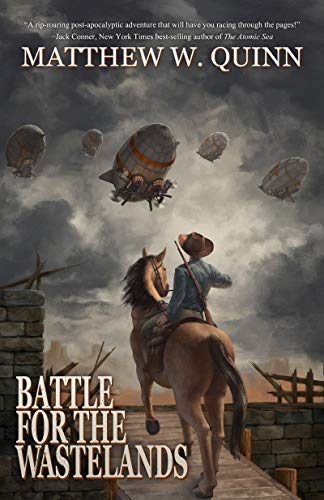
Battle for the Wastelands

Recently I got to read a book I have wanted to read for a long time. Fellow blogger and writer Matthew Quinn had talked about his full length novel Battle for the Wastelands for many years. After a long process of submissions, Mr. Quinn finally went the self publishing route and made his novel available to the public! Here's my full review of Battle.


Set in an indeterminate period after a post apocalyptic event, we find our protagonist Andrew Sutter, traversing the wastes along the Iron Desert within the fertile Basin. His home. Carroll Town, is ruled over by the despotic and terrifying Flesh Eating Legion under the command of rebel turned warlord Jasper Clark. With a terrible drought afflicting them, a heavy tribute is demanded, sparking a minor rebellion and when Andrew takes up arms, he finds he might not know what true battle holds.

Meanwhile, the ruthless warlord Grendel, first lord of the Northlands, is struggling to hold his fledgling empire together. Though he has largely crushed all his foes, his underlings are now clashing with one another. It threatens to split his tenuous hold on the Basin lands into splinters and destroy everything he has built. Within his new realm he has friends and enemies. One being his concubine and former woman of the ruling Merrill family, Catalina, who seeks a way to plot against him. The other is Alonzo Merrill, leader of a ragtag rebel army opposing Grendel and his cronies, but fighting a losing war along the Southern Wall, a series of fortifications designed to drive the remainder into the desert.

Can the rebels manage to beat the first lord of the Northlands? Or will they be swallowed up by the progress of empire?

I definitely found that the novel was fast paced, which was good for the amount of information you receive when reading it. It starts off with a brief introduction into the Iron Desert and Caroll Town, but then its hard fighting and lots of dying!

Andrew is, without a doubt, our main viewpoint character. He is the audience surrogate seeing the issues of the world at large. Young, headstrong, and very unsure of himself he finds himself thrust into a war he barely understands until it gets personal. Seeing the despotism of Grendel's empire up close, he throws himself whole heart into fighting it.

While I enjoyed Andrew, I actually don't think he was the most interesting character in the book. His young naivety and limited scope for viewing the problems in the Basin as a whole, made him have only a one track mind. That is, the specific struggle against the Flesh Eating Legion under Jasper Clark. This was an engaging story, with a great cast of supporting characters (who had a terrifying life expectancy) that kept me hooked.

Many of Andrew's scenes were where the action in the story shone through, and it starts off bloody. It then gets up close and personal. Largely, this is where the meat of the story excels, with it being well described and satisfyingly bloody. From knife to bayonet wounds, to the after effect of mortar bombardments, you aren't left in the dark about the horrors of combat. Though after a point, some of the description did feel perfunctory, especially in the first third where it didn't come off as quite as strong.

The use of old vs. new style weapons was pretty clever. The dirigibles flying around give any enemy a massive advantage in both scouting and firepower, but there are ways to defeat this. The most obvious course is to have a dirigible of your own, but there are other ways. I think one of my favorite visuals from the book is when Andrew and other Merrill troops are waiting behind a rise in a hill, all rifles aimed skyward with a 'balloon popper' cannon to try and blow a patrolling dirigible out of the sky if it spots them. Coupled with the rarity of Old World weapons (automatic rifles and machine guns) you get some pretty awesome steampunk action with bolt action rifles going against SAW weapons on occasion and all the imbalances that creates.

Perhaps the most interesting aspect though, is the politicking in the villain camp. While the good guys are (largely) united in purpose, the bad guys are quickly devolving into fighting amongst themselves. Grendel is after all, a warlord, and the people he works with or conquered were also warlords. And much of Grendel's time is now spent dealing with his uppity subordinates.

In the neo-fuedal future setting of the world, this works quite well. This is why I really appreciated Grendel as a character. All of Grendel's scenes are deliciously Machiavellian as we see the tyrant plotting and outsmarting opponents while trying to crack the problem of how to pass on his empire to his heirs. His son Falki (who will be starring in an upcoming novella) is something of a pain in the ass for the tyrant. Though Falki is clever in his own right, he is still a boy used to immature outbursts and doesn't quite understand the fine art of terror and politics the way Grendel does. The two competing view points between the two makes for some nice tension in Grendel's plot, and it makes me look forward to how they will play out in the future.

Grendel of course, keeps a bevy of concubines, and they too have their own politics. Trying to get their sons higher in the line of succession, and in Catalina's case, trying to get him to remember his Merrill heritage rather than the role Grendel is trying to set for him. Of course, Grendel is not entirely blind to that either. Catalina will hopefully be a major character in the future, and I look forward to seeing her use her position to her advantage as well as she possibly can.

In these scenes we also get useful world building. We learn how Grendel runs his empire, the various (and myriad) factions he employs, and even delightful little details like union/guild systems which can do things like go on strike! It makes for some fascinating interplay, and at the end of the novel seems to be setting the scene for intrigues and struggles for the good guys! I really look forward to seeing more of that in the future.

The one place where I think the world building did not shine though was establishing the overall setting. I had actually believed this was a future Earth, and while I couldn't match the geography in my head, things began to break apart as I read more. The exact nature of the Old World is left mysterious, and with little tell for how it fell apart or what technology was left behind. Much of this was based off of the world 'moving on' in the Dark Tower series, but I think that more explicit calling to the different nature of this world and then a smidge more info or theories about the Old World would have helped ground the setting.

Enjoyable little nods to the Old World abounded, one scene where Andrew is wandering through the Iron Desert and finds the remains of an abandoned house was a fun aside. The weapons and their rarity/effectiveness was a fun jump in any action scene. I did find myself hoping that other Old World tech which wasn't just weapons would come around, and maybe that will be a future plot point. Fingers crossed.

If I had to make one criticism of the novel, it was that I found the first act to not be as strong as it might have been. Andrew's early arc is well established, but we wait a while for anything to come involving Grendel or the Flesh Eating Legion (which itself could probably have been fleshed out more too) and their overall place in this world. Once we get past the initial Caroll Town arc though, the story picks up, snagging your attention and never letting go. The second and third acts I breezed through as I had time.

As a story though, it makes a valid argument for steampunk not being dead or unusable as a genre. Dirigibles, trains, telegraphs and machine guns are all intelligently and compellingly used. The Western look and feel is never wasted, and the clever plots and compelling characters are well put together. If you're looking for some great action and a really, really fascinating villain, I cannot recommend Battle for the Wastelands enough. And with a novella coming out in the near future, you won't be waiting for more from this fascinating world! Check it out!

Tuesday, 22 January 2019

IO (2019)

I mentioned, in a recent post other works coming out in the near future, that a Netflix film called IO was coming out on the 18th of January. This film had some gorgeous looking shots and a really good trailer. Not to mention a poster which made it look like it would be very entertaining.

So did IO take us to the Jovian system and back?


We begin on an Earth very different from our own, where, as explained by the overarching narration, the atmosphere has turned against us. People asphyxiated in their sleep or choked to death in the streets during toxic storms as the world changed. In response, humanity organized a massive exodus in 100 shuttles to a preexisting station that was built to harness energy from Jupiter's moon Io. Mankind had left Earth behind.

Not all of humanity though. One notable dissenter was Dr. Henry Walden (Danny Huston) who believed that mankind could learn to evolve and thrive, even on this new toxic Earth. He and his family stayed behind, establishing themselves at higher altitudes to escape the toxic weather and study the new world they found themselves in and try to adapt.

Friday, 13 February 2015

Why I Love/Hate the Emberverse

WARNING: SPOILERS AHEAD

Hey there readers I'm just here to talk about a particular series that is both very near, and very far, from my heart.

S.M. Stirling was, in my teen years, one of my favorite writers. He can craft amazing worlds, write some fairly catchy dialogue, and turns out scenarios that are at times so wild that you can't help but be sucked in (I don't think I will ever forget the skirmish with bandits where the protagonists take refuge in what turns out to be an abandoned pornographic store in The Protector's War). And he has written many excellent adventure books, Conquistador, and the Peshawar Lancers which are just too fun to read. He of course is also the author of the infamous Draka series which has probably been picked over as much as A Song of Ice and Fire for details.

However, he is probably currently most famous for his newest (and longest running) series, the Emberverse. The basic premise is that on March 17th 1998, at 6:15 pm a worldwide event known as the Change disables all electronic technology, and even alters the laws of physics which prevents gunpowder and even steam technology from functioning properly, in an instant thrusting humanity back several centuries. The first book in the series (Dies the Fire) follows an excellently written post-apocalyptic scenario where two groups struggle to survive in this fundamentally changed world.

The book follows an interesting cast of characters as they build a new world (even reality) out of the ashes of the old, some good and some bad. The different societies and nations which emerge are fascinating, and the characters themselves are just great. That's not to say they don't go through some hardship. Though from the individual duels and skirmishes, to the sweeping battles of the later series each battle scene is a joy to read and amazingly detailed with twists and turns around every corner.

You have former marine Mike Havel who leads a motley band of survivors in a quest for safety across the Mid West after having survived a plane crash, and Juniper Mackenzie, a Wiccan priestess who bards her way across Oregon who leads her own group to her inherited cabin in the Williamite Valley. Mike founds a warrior society of soldier settlers who take their own territory and hold it against all comers, while Juniper founds a neo-Celtic clan that adopts its new identity with gusto that makes even its founder slightly uncomfortable. These societies develop into things of their own, well beyond their founders intentions in interesting ways.

The first trilogy in the series is fantastic, well fitted together and each book has a tight narrative that you can really sink your teeth into. I will shamelessly admit that they are some of my favorite books of all time, and I have probably read each one at least three times. Mike Havel, Astrid, Juniper, and Nigel Loring are a four very interesting characters who grope their way through a changed world and establish themselves and the groups they bring with them as a new nation, each with its own very unique quirks. They are shaped by the presence of a central antagonist in the form of the neo-feudalist warlord Norman Arminger and his hyper-competent wife Sandra.

While the series tends to present things on unashamedly black and white lines (good guys good, bad guys bad) it doesn't detract from the superb world building, and some of the greatest battle scenes in fiction. The books all tied together well, and presented a compelling story about leadership, survival, and change.

Imagine my pleasant surprise at hearing that a new saga for the Emberverse would be appearing all the way back in 2007. This saga got off to a great start, with an interesting new cast of characters and the promise of exploring more of post-Change North America. We even had amazing new villains in the form of the scary dogmatic religious CUT (Church Universal and Triumphant) and its Prophet, Sethaz.

Now don't get me wrong, these books got off to an amazing start, but they started to teeter on the edge of disappointing very swiftly.

Though I should start by saying that Stirling's skill at world building has not decreased, and the books continue to be amazing romps through a totally different world (which technically counts as alternate history) with the amazing innovations and different survival techniques we've come to see, the force driving that adventure however, diminishes significantly with each volume.

There's no shortage of interesting characters. We have the mercenary salvage man from out East, Ingolf Vogeler, the son of amazing archer extraordinaire Edaine Alyward (and his lovable pooch Gabranth), Father Ignatius from the amazing Knight Templar-esque monks of Mount Angel, and Odard Lieu, son of a villain from the previous trilogy. We also have returning characters in the form of the all-grown up Matilda Arminger (only daughter of the villain Norman Arminger) the twin daughters of Mike Havel, Ritva and Mary, and finally the bastard child of Mike and clan chief and priestess Juniper Mackenzie, Rudi.

I think many readers will understand why I list him last.

At the heart of the series problems from here on in really is this one character. While we have a cast of excellent supporting characters, but they tend to take the back burner whenever Rudi is on screen. Rudi is a very dull, uninteresting, and very poorly executed heroic character whose very presence tends to drag down the novel. In fact he renders almost every other character inconsequential. The main villain of the series (Sethaz) gets progressively less and less screen time until he effectively becomes mostly background noise with only his secondary villains having any screen time at all, and even then its fairly secondary to the plot. He can really do no wrong, and this is outrageously demonstrated in one scene where Matilda overhears a conversation where it sounds as though he is having an affair with another woman and sets up what could be some amazing character drama...only for the next chapter to start with how she was wrong because when she asked Rudi whether he was cheating on her he angrily said no. For me at least that really torpedoed any sense of realism in character development.

The overarching plot of this saga isn't even bad. It's a quest to find a magic sword which will counter the influence of the a dark power which is feared to be rising alongside the CUT. This is backed up by the trials and tribulations of the questers as they cross the vast expanse of North America and run into local politics, CUT allies, savage neobarbarians, and being constantly pursued by CUT fanatics. Some very fun adventures take place amongst the new Sioux nation (with a gripping event involving buffalo) and we get an in depth look at the new nation of Iowa, arguably the most powerful nation in North America now, with a bevy of satellite states surrounding her in the crop rich plains. There's even a great background story about things back home with the war!

The problem again though, is Rudi. The book often goes out of its way to break the "show don't tell" rule when we run into him, and characters will spend pages talking about all the reasons you should like him and all the reasons why he is amazing, and why he is such a good leader. None of this is actually shown to us the readers (unlike with previous archetypal leaders like Juniper or Mike) and we have Rudi with many informed abilities. He is never in any clear danger as he is absolutely unbeatable in combat (which before we see this many other characters spend a good deal of time informing us) and even the sub plot back home tends to devolve around describing how awesome a leader Rudi will be. Despite suffering a serious wound at one point, it doesn't even wind up seriously inconveniencing him as the series goes on. His presence drains any tension from the books and you don't even fear for his friends as things continue. In fact his friends situations get even less screen time and very little development beyond off hand mentions of things happening or a few scenes here and there.

The books from The Scourge of God on really suffer thanks to this. To me, the ultimate disappointment came when we arrived at The Lord of the Mountains where the series had been building up to an epic battle between the forces of good and evil. Now as I've mentioned Stirling can write amazing battle scenes, and with a series that has airships and hot air balloons still being a practical thing the immense undertaking that is plotting and portraying this battle should have been easy for him. Instead we have a series of incredibly underwhelming build ups and an absolutely disappointing let down with a waste of all the books potential epic moments which flop spectacularly in showing us the culminating battle between good and evil. From wasted pages describing the teenage adventures of two squires who are supposed to deliver a message, to simple scenes of meetings where the good guys cheerfully predict their victory over their foes. The book has zero tension, and in an ultimate sin manages to make what should have been an amazing battle boring and utterly unengaging.

However, the novels afterwards have been, well, not incredibly interesting. Despite much tension of when Rudi is supposed to die (a prophecy that he will not live to see his first gray hair) the books play it fairly tamely and he simply dies before he gets any gray in his hair, in middle age. He lives a long healthy life, and becomes a great king. Again we don't really see any of this and are for the most part informed of it by other characters.

The most recent release, The Golden Princess, is now primed to follow a new set of characters into a new quest, for a new sword.

While this one promises to be more nautical, and somewhat more engaging in that it will take readers from the deserts of California to Australia, and finally Japan, it has thus far disappointed. I can say with absolute confidence that people should wait until the follow up volume, The Desert and the Blade, comes out. You will find yourself much more satisfied, since Princess is very lacking in plot advancement versus overflowing with obligatory scenes where characters talk about how amazing Rudi is and describe the very technical feudal terms for feudal government and the neo-Celtic lifestyle. The story honestly just seems to cut off half way through, so I hope the new book will pick up where we left off.

In spite of  the series great  flaw with an unrelatable hero, it does mostly play to Stirlings strengths of world building, battle, and adventure. And you know what? That's a good thing. People may not like the characters, and I'm one of them, but the world Stirling builds is so detailed and intricate that you can't help but want to explore it. He crafts some amazing societies which you will find yourself going back and reading about just to catch glimpses of them. He paints a hauntingly beautiful picture of a completely changed North America built on the bones of our old civilization, and its wonderful.

Though I may not have cared to deeply for the meat of the second saga, I reiterate my love for the first trilogy and recommend it as an excellent series to anyone who wants to enjoy a good book. Stirling is still a good writer, and while it may take a while for the new books to get into the swing of things I fully expect that like the previous books it will contain some amazing gems that will leave you saying "Holy Crap! Did that just happen!?"

It has for me, and I hope it will for many others.

Wednesday, 30 July 2014

Flashing Steel Flashing Fire: A Short Story Collection.

Well readers here I being you another excellent review. I have given some glowing reviews of the works of author Matthew Quinn's work before. Here though I offer you the opportunity to enjoy all of Quinn's published works, as well as three new stories as yet seen by the world in one easy reading location.

I present to you, Flashing Steel and Flashing Fire!


This is of course an anthology, making it one of Quinn's longest published works so far. I've reviewed some of the stories available in the publication already, so I think I'll just stick to talking about two of the stories contained herein.

The first new story I'd like to talk about is Nicor. Nicor is a sort of combination period piece combined with a horror story. Here we have the Vikings taking on an eerie mythological swamp beast in a battle to the death and they find their weapons and courage almost useless when fighting the beast. Its interesting as it's told through the POV of a young first time raider who has never been a-reaving before. His nervousness and uncertainty paint a vivid contrast to the experienced raiders he stands beside. With a fun twist at the end it's a delight.

Next we have Lord Giovanni's daughter. I have to admit that this one was the most difficult for me to read, not because it was a bad story, but because I have very little point of reference for the villainous reptilians who populated the story. Imagining them was difficult so it took me a while to properly get into it, but once I did we had the right amount of wit and creativity to make for a fascinating read!

The next new piece is the very interesting prologue to an aborted fantasy series called Lord of the Dolorous Tower. This one is interesting as it has a fascinating blend of post-apocalyptic fiction and high fantasy. The characters are essentially two lovable rogues from their village who go exploring an old tower. It offers some fascinating ground work for a world in which it is suffering from an asteroid strike. It deals with some fascinating magic and world building while giving us a great romp with these two explorers, though it is a wee bit dark I'll just say.

Finally we have the ending piece Westernmost Throne. It's a 'political' horror story which is fairly unique in and of itself. It follows the tale of a young political secretary who discovers she may be in just a tad over her head when her up and coming political boss turns out to be more than he seems... I won't say too much here as it needs to be read to be appreciated. This one certainly subverts expectations! I can say I quite enjoyed it and I think you will too!

Now that't it for all the new material, but it has a number of old favorites like Melon Heads and Illegal Aliens! If you've ever read any of Matthew Quinn's work before I highly recommend you pick this piece up! It's a fantastic anthology and as I've said before, Mr. Quinn does not disappoint.

So I heartily encourage you to go pick it up!

Wednesday, 30 October 2013

The War of the Worlds

Well readers I recently heard the CBC's presentation of the classic H.G Wells radio broadcast, War of the Worlds. I have to say that despite the medium of the message being the radio and the spoken word, it was thrilling! Contrary to flashy images on the screen, chiseled actors portraying grim heroes and big CGI budgets giving me a towering Martian tripod to stare at, my imagination proved to be a far more tantalizing mode for seeing the Martian invasion of the United States.

The narration, sound effects, and back and forth mode of depicting and showing the Martian attacks and landings in a narrative was fabulous! I could see B-17 bombers flying a doomed sortie at the Martian walkers, sat in horrified wonder as the brave artillery troops shot vainly at the advancing Martian war machines, felt the panic of the forlorn news caster in New York as the tripods arrived and the 'Black Smoke' descended upon the city choking thousands to death.

The vintage feel of the preformance didn't matter to me and made it all the more exciting! For a Halloween presentation I don't think you could have found something better! It was a wonderful treat to have on this pre-Halloween evening.

I can only imagine the shock and confusion some poor Americans must have felt when this first came over the radio and all the calls local police and civil service stations must have received as annoyed/panicked people called in to see if it was real or not!

This is a great historic repeat of the original broadcast long ago on October 30th 1938, made in a less jovial atmosphere as fears of a new war across the world spread, fears that would sadly be proven right. It was a scary thing for a new generation fueled by a new media source in the form of the radio.

I'm quite glad to have been able to listen to it and very pleased to have seen so many other versions of it, but I am even more pleased to say; now I've heard everything too!

Saturday, 24 November 2012

The Case for Prepping

Well readers I suppose many of you might start to consider me an odd duck after this post, but if that is the case, so be it. What I aim to do today is make a valid case for the idea known as survivalism. Now some of you may have passing aquaintance with the idea of survivalism and may have seen movies where so called 'survivalists' are featured.

For a moment let me sketch out the the typical mental image that people see when they hear the word survivalist. For most people the word evokes images of a man (usually in his late 40s early 50s) holed up in a bunker beneath his house surrounded by stockpiles of MRE's canned food and cradling an M-16 in his arms while checking his other illegally obtained weapons and waiting for the Soviets or New World Order to come knocking. Now while this stereotype isn't completely undeserved (as an unfortunate number of websites and authors show) it is only focusing on the extreme fringe of so survivalist movement. Many people who identify as survivalists have recently been using the term 'prepper' to differentiate themselves from this fringe. I myself use it as I am not in the process of prepping for a global collapse, but rather more local things.

More about me in a moment though. What people will find today is that may preppers are people who are members of the Green movement and want to get back to the land. Or they are simply people who live in areas that are at risk for terrible weather and other natural disasters (hurricanes and earthquakes and the like). Most people will simply have an emergency supply of food, batteries, and blankets to be used in case of a terrible power outage or storm. If you do something basic like that then yes dear reader, you are indeed a prepper. It's even just the little things that make someone a prepper, if you are preparing for any kind of freak hit mother nature can throw at you, you fall into the category of prepper.

Though now some of you may be asking 'Stienberg why do you prep? Surely you aren't afraid of the NWO nor do you need to fear the weather so much?' well readers I'm glad you asked that!

As I'm sure many of you will remember back in 1998 we had the mother of all ice storms which came down on us like the wrath of an inebriated and severely ticked off Jack Frost! For some readers who may not remember, or who would like to see how devastating this was I present you these:

This is some trees bent under their own weight from the ice (one having its branches totally ripped off)
No these aren't ice scupltures.
This is a twig, covered in two inches of ice, to illustrate just how bad this was.
Now I was just a little rascal at this time, but I do still remember three things in abundance. One was that a great big tree was literally uprooted and smashed across the road blocking part of the neighbourhood, the other was that our power didn't work for days, and that we eventually had to flee to my grandmothers house because it was to cold to stay in our own.

The problem grew so great and many communities (like my own) were isolated and the roads impassable from the ice sheets and debris covering them. Eventually the army was called in and I can remember how glad my parents were to see helicopters flying overhead and for a soldier to come and check on us.

That time dear readers, was bad. Some froze to death in their homes (especially the elderly) and many who did leave to stay with relatives who did have power, returned to find their homes looted by opportunistic scavengers (of both the four and two legged variety). Now it wasn't anarchy in the streets, nor a world ending disaster, but it made many people quite upset and uncomfortable and made me realize just how fragile our modern way of life is. My father for instance, has not owned a house without a woodstove since.

Now of course I was to young at the time to really appreciate these details. As I got older though, I began to really see the effects that a few days without power could have on people. Take the 2003 blackout for instance. I was again cast into a world of darkness and no power, but was thankfully warm as it was summer. So these memories have weighed heavily on me as I see how catastrophic man made screw ups can be.

From the time I was sixteen onwards I began asking myself what I could do in situations like these. So from there I began reading about disaster prepardness and storm shelters. What will surprise readers is that it wasn't any man made disaster that finally tilted me over the edge into full on prepper, but a fictional one.

I purchased the Zombie Survival Guide (and consequently have reviewd it on Amazon as MDStien) many years ago. I bought this book as friends and I had become infatuated with zombie movies, and all the post-apocalyptic aspects there of. This book really got me thinking, what if the power goes out for weeks at a time? What if I get caught up in a riot or other civil disturbance? And even, what if maybe, just maybe a horde of undead flesh eating monsters tries to force its way into my home? The last one aside (well I'd focus that on burglers really) these are very important questions. What will I do if I'm without power for a number of days, or what will I do if there is a critical shortage and I have to stock up on food for something, and even what if I'm stranded in the great Canadian wilderness?

These are all important questions people should ask themselves. It's little things like that which can throw our entire world into disorder. Especially with food, there's an old saying 'every country is three meals away from a revolution' and if an entire region were deprived of food for many days I can assure the reader that things would not end well.

I personally began scanning the web and blogosphere for websites which might help me prepare. Eventually I've come across two important websites which have given me tips and tricks to help prepare. One is the famous Survivalblog by James Wesley Rawles a well known author and blogger on the subject. His political leanings do however influence his writings and ideas about survival and he has a bit of a militia bent to him. That being said he also spends a considerable ammount of time on weapons and other self-defense ideas. However, his blog is an excellent resource for starting preppers, and his book How to Survive the end of the world as we know it, is a must have for starting preppers as it gives you an idea of where to begin, and where to go.

Now Rawles does have another book. This one:


Now understandably this may begin to sound alarm bells in some readers heads screaming 'militia fanatic!!' and while there are some elements in the book of this, it actually reads more like Red Dawn in Weirmar Republic Germany. The author is controversial because of his viewpoints and beliefs and this will certainly turn away some readers. Though it doesn't even read as well as a regular novel I can gaurentee it is chock full of excellent ideas and tips packed into a useful narrative. His non-fiction works and blog are much less controversial and could be easier to swallow, I merely reccomend this book to people who want to see what would be described as the best-case scenario for a prepper group put into print.

Now on another note, here is a blog that is a) more Canadian and b) closer to what I'd envisage as my prepping scenario dream. Modern Homesteading is a blog begun by Victoria Gazeley when she moved to her proverbial cabin in the woods and began a life of self-sufficiency and work. Now my proverbial cabin in the woods would look something like this but that's beside the point. Gazeley sets out her ideas on self-sufficient living, and how to prep in a Canadian environment and for a rural lifestyle. This resonates with me a) because I come from a very rural background and seek to return to it and b) because it is from a Canadian perspective and will thankfully avoid foreign politics and ideological banter. The blog offers so many helpful tips and advice that you would be hardpressed to keep track of it all.

That being said online resources are not the only resources that can be used. Amazon has a plethora of books and how to guides on things that can be essential for prepping, and I encourage readers to check some of these items out starting with this.

In the end dear readers I ask you to remember a few things. Being a prepper does not make a person crazy, it is something that almost everyone does to one extent or another (and some simply take it further) and that it is something we should all practice to some extent, just in case.

For now though readers I hope I have outlined the pros for a prepper mindset, and I can assure you I will be doing some more prep oriented posts in the future. Keep on reading and please give these issues some thought.

As a final note, I encourage everyone to think about Hurricane Sandy and many of the ill effects it has had when you consider prepping. If you don't think you can be affected by weird weather and natural disasters, you are oh so sadly wrong dear reader.

Friday, 14 September 2012

The Last Pilgrims: By Micheal Bunker, A Review

Recently readers I have finished an entirely new book. It is a book from my favorite genre, the post-apocalyptic sort. It revolves around an interesting post-apocalyptic premise and has a unique view on the post-apocalyptic situation. This week I bring you, The Last Pilgrims by Micheal Bunker.


This book I picked up after seeing it advertised on other sites and having visited the book's website and the author's blog. The book and author presents a unique view point on life and a post-apocalyptic scenario in general. It could count among science-fiction, but the only real science fiction element I would say it has is the quickness of the collapse in the beggining (two-weeks or so) which firmly sets it out of that genre and into the regular post-apocalyptic camp.

I've heard many comparisons of thie book to the Hunger Games, or the new TV show Revolution. To which I say, well there are a few comparisons to be made yes. One of the main characters (Ruth) does use and bow like Katniss, and yes like Revolution it is a world where there really is no modern technology and most people don't use electricity as it is unavailable. Otherwise this book stands out as something completely different in its own right, in a good way!

The story itself centers around an area in West Texas and the community of the Vallenses, an Amish-like plain people who are a thriving religious community in a fallen world. Their model of prosperity however sincerely irritates their large and powerful neighbour, the King of Aztlan, who wants this land for himself. A free independant people of course cannot be tolerated.

The story is really a retelling of the struggles of the ancient Waldensians a group of Evangelical Christians who defied the might of the Catholic Church and suffered horrendous persecution at the hands of its agents before the survivors fled to the New World.

The Good:

Micheal Bunker establishes right off the bat the kind of world we are seeing. His prlogue gives us an excellent synopsis (if not the outright cause) of the collapse and its extremely quick escalation from mere economic downturn, to minor nuclear war. Thus American (nay world) society as we know it is thrust five hundred years into the past with petty kings and lords taking up claims and projecting their power through armies of thugs. This would go ill for the pacifist Vallensian people were it not for the emergence of the Ghost Militia who are dedicated to fighting Aztlan and by extention protecting the Vallenses.

We get a clear look at the local political situation (the world one being understandably sketchy) and see just why the Vallenses are so persecuted. The king of Aztlan hates them as they are a large successful nation who are a) opposed to his rule b) setting a successful example for rebels from his own lands to follow and c) follow a faith that diverges markedly from the corrupt political Church in New Rome. Indeed he rightly fears his people taking this example and rebelling against him. The only reason he has avoided outright war thus far is internal problems, and the dogged persistance of the Ghost Militia killing his raiding parties.

Now though twenty years after the collapse, he is turning his attention to stamping them out completely. Thus our story opens with Jonathan Wall, respected leader of the Vallenses, sending a plea for help to the King of the South States. Unfortunately this is interrupted when a would be assassin just misses his target. Here we greet Phillip, the leader of the Ghost Militia as he saves Wall and brings in the assassin, Gareth, who has a ulterior motive of his own...

Then on we follow a colorful cast of characters, Jonathan's daughter Ruth, a militia rider named Timothy, a Aztlani knight named English, and Jonathan's son David.

Each character brings something unique of their own to the story, Ruth in her growing up experience, and David's internal conflict between his faith's pacifistic nature, and the brutal reality of the war creeping down upon them.

The dialogue is good, well written, but often slightly to mild mannered for my taste. Though it does serve to show how society has fallen down with the disapearence of so much of the modern slang that we know, verses a more eloquent and Biblically reflective speech that would come from a deeply religious society. This is though contrasted with the speech of those from Aztlan and beyond.

The war itself is put in very brutal terms, with heartwrenching atrocities and brutal battles. Though we clearly see that Aztlan is the evil agressor and the Vallensians a normal people caught in the middle of a territorial and religious conflict. The battle scenes though, are spectacular. You feel as though you are right in the middle and Bunker's keen eye for these details gives you an impressive mind's eye view of every fight and each tactic undertaken by the combatants.

The moral, and philisophical issues brought up by the many characters will leave you asking deep questions yourself about how prepared you are in your own life, and of course in your spiritual life.

Micheal Bunker is also something of a philosopher, practioner and writer in the world of prepardness (and if you visit his blog you will see he has a refreshing habit of practicing what he preaches) thus there is a great element of prepardness and self-sufficiency in the novel with some unique and interesting ideas that readers interested in such things may find interesting. There are also a number of health facts and tips that are pleasantly surprising (organic beer anyone?).

We also get lovingly beautiful descriptions of Texas and the landscape. The blue skies, the wonderful countryside, the deadly desert, and of course the Wall ranch which is given loving detail and sounds like a truly wonderful place to live. In fact the author has made me sincerely want to go visit this beautiful area sometime in the future.

The author has an expert way of reeling you into the story and making you care about the troubles of the Vallenses and the epilogue left me feeling both heartbroken, hopeful, and intrigued.

The Bad:

Unfortunately like all novels I read it does not get a complete pass.

Most of my issues with the book were minor, a lack of comprehensive detail and timing is one. The lack of comprehensive detail left me fuzzy on certain aspects of what was going on or how certain characters looked, I was extremely confused as to David's appearance for some time actually, and I found The Mountain was given a mean lack of characterization early on in the novel, which would have saved considerable trouble later on. The major characters, such as John, Phillip, Ruth, Gareth, and Timothy, all recieved adequate page-time for me to epmhasize with them and get an understanding for their motivations and troubles. Characters like The Mountain, and Piggy needed better characterization earlier on so we could get a better view for what they did later in the novel. That and I didn't find a good timeline of when these events started, and when they finally ended.

Also the Duke of El Paso. This is merely a personal pet peeve of mine but he did not make a good villain. Described a short, wearing boots that make him look taller, child like in appearence with a high picthed voice and ridiculous accent, he was a caricature. Thus he made for an extremely irritating character whose redeeming feature was we did not have to see him much. He exuded no sense of menace or threat which made me heave a heavy sigh and wonder what the King of Aztlan, who sounded much more sinister, was up to. It wasn't until we met Sir Jarius Whiteside, Chancellor of Aztlan, that I felt much real respect for the villains themselves. Sure they had clever plots but the offscreen nature of them left me feeling a little underwhelmed by their impact initially until we got about half way through the book.

Then of course there was a minor bit of consistency between the beggining and end of the novel. I found the low tech, and scavenger society of this world fascinating. But earlier on we are told that guns are heavy, difficult to use, and ammo is hard to come by. Then near  the end we have gun battles taking place on the large scale! It was something of a continuity error that left me scratching my head after but if one can put it aside it doesn't harm the book at all.

My one final nit-pick is that I found it to short! Not a criticism per-say but I am hoping for more by Mr. Bunker and hope that as he gets his writing legs under him he will begin writing longer works so I can keep reading longer!

The Verdict:

Overall this book is a wonderful read full of rich characters, an exciting world, excellent survival tips, and a sense of the holy and pure as well, which is immesely refreshing.

I have been impressed by Mr. Bunker's writing thus far and I eagerly await the upcoming sequel Cold Harbor and its continuation of the tale of the Vallenses.

The Last Pilgrims has been an enjoying read which kept me guessing for most of the novel. It was also a very happily unique post-apocalyptic fiction with some (thanfully) tasteful morals and a good message throughout. I would be happy to read it again and certainly will. I encourage readers who are interested in post-apocalyptic fiction to pick it up and read it, you will not be disappointed. I am glad to advertise for Mr. Bunker and let people know about his wonderful and original work.

4 out of 5 stars for this piece of wonderful literature.