Showing posts with label Writing. Show all posts

Saturday, 21 January 2023

The Republic of Patagonia

 From the Terran Coalition “Settled Planets and Interstellar Polity Database”

Vital Statistics:

Number of Planetary Bodies Governed: 2, Rocky body and satellite, numerous stations

Population: 48 Million 

System Astrography:

Stellar Body: Pacifica XII (G4V Class Star)

Planetary Bodies: In orbital order

Icarus – rocky world 0.3 AU

Patagonia – rocky world 1.1 AU

Illapa – gas giant 6.2 AU

Francesca – rocky world 6.9 AU

Isolde – rocky world 7.3 AU

Pinta – gas giant 19.7 AU


The Republic of Patagonia is a young star nation. Settled relatively recently in interstellar history, it has only established itself roughly four hundred years after the initial scouting by probes to the system. Claimed by a conglomerate of Earth and Perdican based explorers from the Terran and Perdicus systems, it was seen to be a viable endeavour with two largely equatorial continents, large icecaps and a single large, landmass in its southern hemisphere. Backers came primarily from the former United South American Nations and the Perdicus Governate, with a smattering of others. The system was properly colonized in 1309 SE and after one hundred and twelve years of atmospheric tweaking, the first unsuited humans set foot on the planet.

The First Colony Fleet was, by the standards of other ventures in the twelfth century, very small, with only 150,000 settlers in the first wave, and a further 100,000 settlers in the Second Fleet, making for an immediate colonial population (after accounting for natural growth in the interim between arrival and settlement) a mere 375,000.

While Patagonia had required only minimal planetary tweaking, the trade off was a planet very cold compared to earth standard, and a 30-degree axial tilt which caused shorter growing seasons. This gave the planet weather norms of 9-11 Degrees Celsius, and lows of -9 to -35 degrees, with temperatures lower in the higher latitudes. Consequently, anything above 15 is considered a heat wave. The weather patterns were broadly similar to the Earth region of Patagonia, something commented on by the colonial founders, which gave the planet its name proper. 

With .88g the planet was comfortable for human habitation and required no great genetic modification to the population. Coupled with a 19 hour day/night cycle and 232.3 day local year, most Terran and modified Perdican stock could thrive quite nicely. Thus, when the first proper settlements were set up in 1421 SE (or 1st Colony Year (CY) in the local calendar) the infant nation was well on its way to a comfortable existence.


Early History:

The first colonists founded the young republic on the largest central continent of Mariana. The two other continents were slowly colonized in the subsequent decades, with the other temperate continent of Valdiviana settled several years after the main colony was established, but the more Greenland like expanse of Florina near the southern pole was only inhabited one hundred and six years after the initial colonization.

However, in the early years a very real rift existed between the orbital and belt-based populations. The Belters had been the bedrock of the initial colonization efforts, as the earliest settlements hardly boasted anything beyond fifty thousand, while double that resided in space working to sustain themselves for the eventual settlement of the planet proper. A thriving system of mining, agricultural and economic centers grew up in orbit and then in the inner asteroid belt. When the planet was declared ready, over eighty percent of the initial population merely left these homes, shutting the whole system down. The twenty percent who remained dealt with a sudden, sharp economic depression.

In these early years there were very real threats of secession from these orbital groups. While not a wholly realistic goal, it did threaten the equilibrium of the delicate political balance which had been established. It was only thanks to the colonial administrator and first elected president, Dom Padros, that the nation was unified. The Constitution of CY 49 was a turning point, as it established generous subsidies for the orbital communities, guaranteed them an equal say in the established House of Representatives, and would ensure that the terrestrial based industry did not wholly eclipse the space-based industry.

While it worked for roughly a century, the Crisis of 166 CY brought matters to a head once more. By this point the colony had grown both through natural growth and a steady trickle of immigration from poorer neighboring systems, and the planetary population was at a comfortable ten million compared to an orbital/belter population of two million. By this point, the imbalance between competing interests in space and on the ground – where modern technology was making the exploitation of the planets’ resources far more practical – was creating another rift. The orbital populations were by and large self sufficient in production, largely relying on the planet for stable deliveries of foodstuffs and other goods like wood and synthetics. Meanwhile, the space-based population only provided more luxury goods and trade stuffs from other systems and Terra itself. While it was easier to obtain many rare metals and other goods in space, business interests and the more populous planetary governates had been shutting out these cheaper sources for a century.

In 166, the specter of secession loomed large once again. Tax strikes, economic hostility, and efforts to corrupt the algorithms used to process the needs of the planetary economy had become the norm in the early 60s, and now protests reached a fever pitch. The worst incident was the strike on Balboa Habitat, where the navy was required to deploy marines to quell violence against representatives of the planetary economy. 

The crisis ended in 167 with the 7th Amendment to the Colonial Constitution. It guaranteed any majority in the House must include a majority of Belter representatives, and that, beginning in 169, the economic algorithms would begin taking on preferences to ensure that the Belter economy did not stagnate and provided an adequate amount to the planet to meet their needs, including, as necessary, the right to stockpile foreign goods. While there were numerous accusations the 7th Amendment “created artificial scarcity” it was passed by a majority keen to ensure that the Belt and Patagonia did not schism formally.

The Pirate Problem

In the second century after the founding of the republic, the nation began experiencing an increasing series of incursions. The Patagonia System was peculiar in that it was located in a 15 light year region of space where the neighboring star systems were, on a galactic scale at least, very resource poor. While Patagonia itself had a rich circle of debris, slightly thinner than Sol, to draw upon, its neighbors suffered from having sparse, to no debris discs to use to boost their own economics beyond what could be obtained from local planetary bodies.

This had been, prior to 1509 SE, partially alleviated by closer systems choosing to mine the various asteroids in the system. The arrival of a new colonial venture, with the clout to back up its claim, put an end to this practice outright. In the shadows however, groups of freebooters would sneak into the system and create hasty mining operations. These were, gradually shut down as the Patagonian Navy grew, but they never stopped entirely. Matters were not helped by the privation the Belt economy found itself facing, and so high prices were established in shipments to neighboring polities. This caused resentment from the already resource poor neighbors who often tried in vain to negotiate better treaties. With the politics in Patagonia being what they were, the Belters were unlikely to side with any vote which would see a decrease in their economic activity.

In response, pirate fleets began organizing to both protect ad hoc mining operations, but also simply raid and steal ores or finished goods created or imported by the Belter population. As diplomatic attempts floundered against a wall of Belter intransience, piracy became the norm rather than the exception. Events escalated to the point where after roughly a century, acts of piracy could almost be counted by the day.

While the government in Bravos tried to deal with the problem diplomatically, it made a concentrated effort to expand the navy. The Republic had an indigenous ship building capacity, but not one which was well suited to the largescale construction of a navy. Even if it had, most terrestrial politicians were adverse to spending the billions necessary to expand the fleet or its bases. Inevitably, this was done, establishing Corchane Station as the largest refit and repair station outside the Orbital Command complex around Patagonia.

This effectively cut piracy by half but did not end it. The situation effectively went from critical to manageable. However, that still meant that roughly 2000+ Belters would lose their lives to pirate related incidents every year starting in 257 CY. This left naval matters as one of the premier political debates. Matters would come to a head in 285 CY when the largest incursion of pirates threatened to forcibly conquer a portion of the Belt from Patagonia.

A freebooter fleet consisting of mercenaries and unaccredited members of neighbouring star systems invaded with a powerful body of ships, forcibly occupying several stations in the Belt. The Patagonian Navy was caught off guard by such a powerful incursion, and initially, failed to respond. Martialling their strength, the navy under Admiral Graff Gonzales, took the battle to the freebooters at the asteroid designated P-79. In a hard-fought campaign, the bloodiest ever fought by Patagonia, the freebooter fleet was defeated, but at a heavy cost.

Though a victory, it had the odd effect of crystalizing the national political sentiment. The Belters saw it as proof that they were the most important economic asset of the system, while the planetary population were divided on whether it meant a more robust space based economic system was relevant or whether it meant that they should focus primarily on the planetary economy while writing off the more imperilled sections of the Belt economy as an economic loss. Both sides saw naval expansion as necessary, but political gridlock stopped much of the expansion proper.

However, the election of Dominic Irisarri in 292 CY and his historic budget proposals of CY 295 meant that it was decided a naval expansion was expedient. This has so far been contentious and remains a point of political controversy at time of writing.


Government:

The Republic of Patagonia is Parliamentary Republic with a bicameral system, with a democratically elected House of Representatives serving as the Congress with 608 seats, constitutionally 202 of those must represent the Belt. The upper house is the elected Senate, which has 150 members. The Congress and the Senate pass legislation but have a nebulous influence on the Executive in the form of the President and their Cabinet.

Both houses represent the various provinces on Patagonia proper, while the orbital and Belt populations are represented by districts which encompass different communities or collectives in the Belt. These are subject to the same redistricting laws as provinces on the planet which has been the source of some ire in the past.

The President is elected to a six year term and is the executive of the state. The President has broad powers, which include those over security, presiding over the selection of Supreme Court Justices, advising on the input of economic algorithms, the ability to grant pardons, grant pensions, and licenses. The President is also responsible for appointing the heads of various agencies and picking his cabinet, though party machinery plays a large role in its composition. The President also controls the setting and implementation of foreign policy.

Patagonia has a judiciary overseen by its Justice Department, whose Chief Officer is appointed by the President. The Supreme Court is the highest judicial body on Patagonia but meets exclusively in the capital at Bravos. Despite efforts to get a satellite location constructed in the Belt to ease the hearing of more far-flung cases, no effort has been made to implement such procedures.


Military:

Ever since the colony fleets arrived, a small military presence has existed in the Republic. The original military was established around six corvettes which accompanied the initial fleet and a constabulary force which had been created enroute to keep the peace on ships and then in the early settlements. This force expanded over the first century to include modern warships, a marine corps, and army. 

The navy was, originally, the highest priority of the government as the extent of the freebooter problem became clear. Within the first fifty years of the establishment of the Republic of Patagonia, the navy had expanded from the original six corvettes to a respectable force of six frigates, five destroyers and a pair of cruisers and a new series of corvettes which expanded the strike and patrol ability of the Republic within its own space. The Marine Corps was a natural outgrowth of the Navy, being used to secure stations, freebooter facilities, and police ships which were intercepted by the Navy.

The Army was a contentious establishment. The early pirate incursions convinced many that there was only the need for a navy and the Marines, and if any serious trouble ever made it to the planet, there would be no further point in resistance. The government, in light of the events of 166 CY, disagreed. Previously, all planetary defence needs were met by rotating one of four Marine regiments between different posts, backed up by special detachments of constabulary who trained in light infantry tactics. The only non marine regiment was the Presidential Guard which served as the security detail for the President and in securing important government sites around Bravos. A rapid expansion was undertaken in 175 CY, bringing the army up to a significant strength, outnumbering the Marines within a decade. Derided by some as a ‘toy force’ it was trained to repel landings and provide relief to civilian governments in emergencies. 

Considered the junior service, it has near parity in personnel size to the Marines and Navy combined, but is recruited almost exclusively from the planetary population, having less than 0.01 representation from the Belter population. 


Demographics:

The colonists were primarily of former USAN and Perdican extraction, broadly speaking one of the Four Major Settled Language Groups, with Spanish being the most common. As such, Spanish grew into the lingua franca of the colony but with Greek firm second and, peculiarly enough, a smattering of Welsh. Roughly 20,000 of the original colonists came from the Y Wladfa in South America and brought their language with them, seeing it thrive in the highlands of Valdiviana, and in some stations where the Welsh language lives on. The majority of the colonies major English-speaking populace as a third language resides in the Belt or on Mariana.

As of the last census (290 CY/1711 SE) 38,847,309 citizens of the Republic of Patagonia reside on Patagonia proper, with roughly 70% residing on the continent of Mariana, a further 21% residing on Valdiviana, and only 6% residing on the southern continent of Florina. Another 2% of the population lives on various bases and subterranean habitats on the moon orbiting Patagonia.

In the various stations and habitats of the Belt, there are 10,010,877 citizens of Patagonia. They reside on large asteroid bodies, free floating stations and habitats, and other bases around the system inhabiting a large halo of nebulously defined political blocs.

The population is 51.6% female, 49.4% male. The median age is 45, with the average lifespan being 109.

Wednesday, 12 January 2022

The Heroes

Three men, one battle, no heroes. Thus is the tagline to another epic story from Joe Abercrombie. In truth, this is about the fourth time I have read my well loved, and much worn, copy of the book. It was in fact the first I ever picked up of his. I effectively went into the world of the First Law blind and came out star struck. As such, there were some contexts I missed the first time, but when I first read (and then reread) the amazing trilogy, I fell in love with this book all over again. Allow me then, to introduce you to the epic three days in the Valley of Orsung as we see The Heroes. 

From goodreads

Picking up roughly nine years after the events of The Last Argument of Kings we see that, once again, the Union and the North are at loggerheads. A disagreement between the southern clans of the North and the new Protector have exploded into open war and so the King of the Union has backed them in their fight. Now for interminable months the two armies have snapped at one another but not yet come to battle. It's time to change all that.

Fighting for the North we have Crunden Craw and his dozen, working in and behind the lines to support the main army's four war chiefs. Slithering among them is the former Prince Calder who claims the North in the name of his slaughtered father Bethod, but so must act like a hostage while dodging assassins. A young lad named Beck decides he wants to see a real battle like his father and leaves home to take part in the war.

For the Union we have the hulking warrior Bremer dan Gorst, formerly the king's First Guard and a warrior without equal in the whole of the Union. Then we have the infamous Corporal Tunney, the longest serving junior officer in His Majesty's army, a lazy standard bearer who does his best to stay out of the way despite his officers meddling. Finally, on the sidelines, Finree dan Brock, now married to the son of the most infamous traitor in the Union, schemes to raise her husband in society and hopefully become a power to be reckoned with in society.

Behind them all though, Bayaz schemes and plots, while the leaders in the North may have some secret agenda of their own.

One thing I have to mention is that the battlefield is just as much a part of the story as the characters. Laid out in loving detail with a map that changes with the battle, you can track the action and see where everyone is in relation to everyone else. A fantastic use of visual work to help the story and I really think it needs to be commended.

The story, as usual for Abercrombie, is a brutal affair. The folly and misery of war is well on display. Men drowning in mud, bad rations, the misery of the wounded, and the stupidity of men and officers can be seen everywhere. That doesn't drown out individual moments of heroism and mercy of course, but they're far outnumbered by the butchery.

It is a well put together story which takes place over a few days on a single field of battle, with intrigues, betrayals and numerous pitfalls for each side. It shows that any great event can make for an engaging story and have plenty of room for betrayal! It is also where he started on his wonderful little vignettes of characters experiencing the events of the battle, from officers on horseback to soldiers going toe to toe with their counterparts, and many of them meet grisly fates indeed! It's a wonderful piece of writing which brings the scope of the battle to life!

Our strong female character in Finree is a wonderful foil to the men, having to scheme and politic rather than stab and batter her way to the top. There's also Calder, a well know coward who will do anything to avoid fighting! They set themselves against seasoned warriors and commanders whose perspectives really livened up the story. My personal favorite was Beck, a lad who has only heard about war in songs. He goes to earn his manhood and finds war much more than he expected. I won't spoil it, but the end of his story is perhaps one of the most tear jerking things I've read, an amazing piece of writing.

As a stand alone in the greater First Law world, its one of Abercrombie's best books in my opinion. He does some phenomenal work with this one little piece of land and makes you feel the blood and mud spilled for it. It is an amazing war story and an altogether phenomenal work of grim fantasy fiction. It sits proudly on my shelves as one of my favorite novels! Definitely pick this one up!

Sunday, 27 December 2020

Writing Update 2020

Well, for all that 2020 has been one hell of a year, it was reasonably successful writing wise. I would say I probably reached my goal of writing 100,000 words at the very least, though on very disparate projects.

Two of the big wins were completing the dark fantasy stories Priests of the White God and Winter Law which has been submitted to Grimdark Magazine, and I actually got my first rejection letter from them! Those were fun to write, with Priests probably being the most involved one as I had to look up nautical terminology to use trying to lend some depth and realism to the mostly waterborne setting. Priests ended up clocking in at 12,809 words. Winter Law ended up at 3,588, and I wrote and edited it over the course of roughly five days. So one was much more in the short story length while the other was at flash fiction length, only slightly longer than The Disappearance of Wilson.

Secondly, I self published the vignette, 2069. Only 1,400 words, this little guy is the primer for another set of short stories I aim to publish in what I'm tentatively calling the sixty-ninerverse. Those who can read that without laughing get a hearty pat on the back for their maturity. This is intended to be a series of short stories or novellas set in a very wide ranging imagining of the future of humanity inside the Solar System. From the colonization of the moon, to Mars, Venus and the outer planets, and possibly beyond. It's an exploration of the 22nd century, all the way to the dawn of the 3rd Millennium, within reason. It let's me get a bit wacky with the ideas I can explore. Essentially, it's my own little verse that doesn't need an overarching storyline and plot connecting it, and just let's me write short fiction to anthologize. Expect to see more of those in the future, with hopefully the first little anthology tentatively titled Gateway to the Stars appearing at some point in late 2021 or so once I have a few more pieces set up.

Thirdly I was almost able to self-publish an anthology this October. It is currently titled A Darkness in the Mind and will include my horror stories The Disappearance of Wilson, Priests of the White God, and two others, one titled The Closing Hour, and another story as yet untitled. This was supposed to be my big October project, but sadly that one had to go by the wayside as real life and the global pandemic interfered in a number of annoying ways. I had thought about publishing in December, but on the advice of others, I am now scheduling it for October 2021, which gives me more time to properly edit the stories, tighten the narratives, and get it as well polished as I could hope for.

The other big news was that I sat down to dig into my alternate history stories. One is A Road Not Taken, a Canadian alternate history work I mentioned at the start of the year, set around the Battle of the Ridgeway in 1866. This one aims to be as diligent in getting the details right as possible and merely to wonder what might have happened had the Canadian militia gone where they were supposed to go rather than take a fateful turn up Ridge Road in June 1866. This project is hopefully going to see the light of day come summer 2021.

The second is a project I have battered away at in various iterations for over five years by this point. This project has taken on a pretty spectacular life of its own. That is a novelization of a timeline I have long worked on at alternatehistory.com called Wrapped in Flames. Something unknown to a lot of Civil War buffs and fans of American history, but known rather well to connoisseurs of alternate history, the Trent affair of 1861 nearly put the United States and the British Empire on a collision course. The two powers came dangerously close to war. The event itself was probably the Cuban Missile Crisis of the Victorian Era, with the rising power of the United States almost pitted against the might of the British Empire near the apogee of her own power. 

Historically, the ship was stopped by the American warship San Jacinto under the command of the impulsive and cantankerous Captain Charles Wilkes (who was reputedly the inspiration for Captain Ahab of Moby Dick fame) and the two prospective envoys that the Confederate States were sending to Europe were then seized of contraband of war. This news initially elated the United States as they had, had a rough year in 1861 after the Battle of Bull Run. The British Empire on the other hand, was infuriated. Most observers in Britain thought, in 1861 and 1862, that the United States was going to lose its civil war and be split in two. Matters were not helped by the fact that neither the politicians in London or Washington understood each other, and the only politician in Washington that the British understood was then Secretary of State, William Seward, who had advocated war with Britain and annexing Canada numerous times in his life. Needless to say, the situation was ripe with the potential for misunderstanding and turning the American Civil War into a general war. However, it was Seward himself who very ably calmed the crisis and smoothed matters over with the British. Of course, what if events had gotten out of control and he was unable to do so? 

It would be safe to say the idea of the British Empire intervening in the Civil War has been explored pretty thoroughly by historians and alternate historians. It is some well worn ground, but not very well fleshed out in print. There were some efforts to write novels, but they're mostly poor fare. Robert Conroy's abysmal 1862 comes to mind. Then there's the very steampunk lite series called Britannia's Fist, which while having a unique premise, strained plausibility past the breaking point.

Wrapped in Flames aims to, through a cast of historical characters from politicians, soldiers, and seamstresses, examine what might have happened had circumstances spiraled out of control in the diplomatic situation surrounding the fraught exchange of notes between the US and the UK. The original timeline was, to be frank, terrible. I had not flexed my research muscles or writing muscles enough to make it anything beyond drek. The second version of the timeline (still writing) is better, but not overwhelmingly so. I am working on it as a sort of companion to the novelization I am writing. The timeline itself is done, in rough notes, up to the 1880s. The novelization would cover from roughly November 1861 down to December 1862. It has a fairly sprawling cast, twelve viewpoint characters thus far who move the plot in various ways throughout the novel.

Now, anyone reading this who has read the current version of the timeline needs to know they will not just be reading the timeline as it is currently posted. It very much seeks to correct a number of deficiencies, research errors, timing of events, and misconceptions I had when I began the new version back in 2016. It also, unlike the original timeline with just brief vignettes surrounded by semi-dense history book style writing, is going to be 100% narrative. As it gets closer to completion I'll be giving more details on the characters who will appear in story. I fully expect this to be a monster project topping out at 200,000 words since there is simply so much I will have to cover to tell an engaging narrative.

Don't expect much of a big progress bar on this guy, it currently sits at 47,000 words. It will take time, and we may not see the final version until 2023. I do expect though, that this project will be a trilogy, the first covering 1861-62, the second novel covering 1863, and finally the third covering 1864-65. Updates as they come!

So there we have it. Some solid progress across 2020, and going into 2021 a solid plan for what I'm writing!

Thursday, 8 October 2020

Origin to Exile

Two years ago I reviewed Day By Day Armageddon and commented on how it is one of my favorites in the whole genre of zombie literature. Here I present the sequel, Origin to Exile (or Beyond Exile) and would like to simply add on why I believe this novel is an amazing sequel to an already powerful first installment.

In the first novel we established that the dead now walk the land. Anyone who dies, for any reason, reanimates as a corpse hungry for the flesh of the living. Following a failed government campaign to eliminate the bulk of the walking dead, we now have to contend with radioactive zombies who not only spread deadly contagion wherever they walk, but also are more intelligent, agile, and deadly than their regular brethren. 

Now we put on our boots, load our guns, and follow our protagonist as he works his way across the horrific wasteland that is the former United States where the casualty rate is 99%. The dead surely outnumber the living, and we see a road to exile.

Spoilers for Origin to Exile follow.

Thursday, 3 September 2020

Writing Update Summer 2020 and Winter Law

With the steady and inexorable advance of Covid-19 at the start of the year very much messing up my plans, I have, thankfully, been able to work on a lot of writing over the past eight months. Summer was mostly productive, and the year has been very productive overall.

Firstly, I did publish my little vignette 2069 in July which was a fun experiment in second person narration, and an opening for a larger series of short stories I intend to be publishing over the next couple years. Not exclusively on this blog of course! I aim to anthologize them for fun and profit!

Secondly, over the course of the summer I finished my short story Priests of the White God which came out at 12,809 words. It is a low fantasy, nautical horror story which I intend to anthologize with some other short pieces this October, and that will be my biggest writing goal of September. It will be premiered alongside my existing piece of flash fiction, The Disappearance of Wilson and two other stories. One is The Closing Hour which features sadistic shopkeepers in a definitely-not-Walmart in sinister circumstances, I'm envisioning it as something like The Purge meets Clerks. The other is a story inspired by my time in quarantine during early Covid-19 and the depressing news hours I watched while not doing much of anything. It will probably clock in at some 7-10k words, untitled yet, but has lots of disease and a little death. 

With those four stories I'll anthologize them and hopefully have them packaged for release by late October in what is tentatively titled Darkness in the Mind.

I also, over the last few days in August, managed to churn out a dark fantasy short for the Grimdark Magazine. They had the Matthew Ward Pay It Forward Competition for short pieces of dark fantasy running for unpublished authors, maximum word count 4,000. With the 4k limit, sadly my short story Priests of the White God was ineligible. I had an idea that had been in rough form for a while though, and so I hammered out some words and a brief plot. The Winter Law is sacred, and those who break it have naught but rough justice awaiting them. Bermer is a hunter apprenticed to his master Horm, and trudging through the late winter snows with only a guide, they must figure out whether a small family of farmers has broken the law, and if they have, there can be no mercy. That is the gist of my short story Winter Law which will be submitted to the contest. Coming in at 3,588 words, I'm sending this bad boy off and seeing where it lands.

Other than those works, I have made some progress on longer works. One alternate history project currently sits at 36,000 words, and another project is currently being meticulously plotted out, my 1866 piece A Road Not Taken regarding an alternate Battle of Ridgeway. I'm currently aiming for it to be my NaNoWriMo project.

In other news, my novella Integration remains in the slush pile at Tor. Since it now is not the only long form fiction I've completed I'm going to let it sit for a time, and hopefully have more news for 2021. 

Overall, a rather productive summer for simply writing in my spare time! Hopefully by years end I'll have further updates for you all! In the meantime, I'm back to hammering on the keys!

Saturday, 8 August 2020

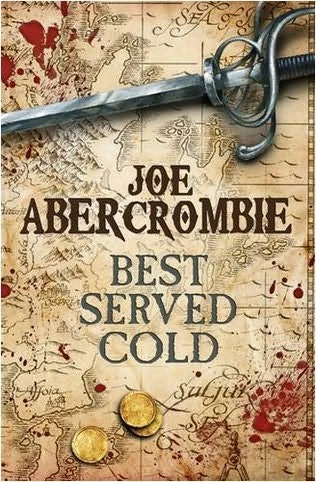
Best Served Cold

What happens when you combine Quintin Tarantino with Guy Gavriel Kay and Alexander Dumas? You get a low fantasy story of rip roaring revenge across a continent! We find these blended together in Joe Abercrombie's amazing Best Served Cold! This is hands down my absolute favorite book of Abercrombie's. I'm not exaggerating when I say it is possibly one of my favorite novels of all time either. 


I originally read this work back in the summer of 2017, and I immediately fell in love with it. By the time I had already read the First Law trilogy for the first time, and the book The Heroes so I happily jumped in to the events in this far off land of Styria. Naturally this is part of the 2020 re-read.

What is fabulous is that you don't necessarily have to know the First Law trilogy to read and enjoy this book. There's references to the former plot, the former cast (with one even showing up in the flesh) but the mentions are vague enough and with little real association to the former series that it really just serves as interesting background information to the story while informing readers well caught up on the meta-plot about things going on since the end of the original trilogy. It's nice and ambitious that way, but also won't turn off casual readers.

The new cast is largely fresh. We do have two characters we've seen before, namely Caul Shivers of the North and the infamous soldier of fortune Nicomo Cosca who was first introduced at the Siege of Dagoska in Before They Are Hanged. Both of them were sufficiently deep secondary characters they they manage to become wonderfully enmeshed in this story. 

Our main protagonist though is Monzcarro "Monza" Murcatto, Captain General of the Thousand Swords, the most feared mercenary company in all of Styria. She has fought her way to the top of the heap and is very determined to stay there. She's a new character, well actually mostly new. She's first mentioned offhandedly by Cosca in Before They Are Hanged as part of his backstory for how he fell from grace commanding the Thousand Swords. Betrayal runs deep in Styria after all. And sadly, that is precisely what happens to Monza. Despite having served loyally at the side of Grand Duke Orso of Talins for eight years, he fears her power and orders the murder of her and her brother Benna. Hurled off a mountain, crippled, and left for dead, Monza swears revenge on the seven men who were in the room when it happened.

She enlists the help of killers, mercenaries, poisoners and torturers to do this. First with Caul Shivers, and then with the numbers obsessed former prisoner the oddly named, taciturn Friendly. Padding out her merry band of assassins are the flame haired Shylo Vitari, and the preening, pseudo intellectual Master Poisoner Castor Morveer and his apprentice Day. Together they must kill seven of the most well guarded and powerful men in Styria in the middle of a war, or die trying.

The three main leads though, are Monza, Cosca, and Shivers. Shivers has set out to be a better man than what he was in the North, where he fought in wars and blood feuds. Unfortunately, he finds himself entangled in the mother of all blood feuds when Monza enlists his aid in killing her betrayers. Monza, who already had a dark reputation, has been twisted by her desire for revenge and looks at the world in a dark a cynical way. Cosca meanwhile, veers between being a genius or a madman who just loves to put himself in danger. Their different goals, becoming better, and seeking revenge, all play off one another as they attempt to change to either fit their circumstances or overcome them. Each one reaches new lows and soars to new heights. I'll leave to your imagination which that is before you read it.

At it's heart the story actually does have a pretty deep and complicated message on whether people can change, and whether revenge is worth it. As Monza leaves corpses piled up in her wake, she finds herself feeling very different, and it doesn't bring the dead back, but it makes her feel. The interplay of her conscience and that of Shivers, and Cosca's well...lack of one, is what makes this epic drama across a continent flow very smoothly and with a number of twists and turns in characters and circumstances which are deftly woven together needing to be seen to be believed.

Her foes are also interesting. Grand Duke Orso is playing for keeps across all of Styria, and that makes his role in this little drama all the more powerful. He is at the peak of his might, looking to make his sons rulers of a unified nation, and his subordinates and allies are no less powerful, but that doesn't mean their invulnerable. Our heroes, or villains depending on where you stand, go up against him and make it a very fun competition against great odds.


In fact, I think that the continent of Styria itself deserves to be seen as a character. It is a continent oft mentioned in the first trilogy, but never seen. Other than the land from which Grand Duke Orso and Queen Terez and a few minor characters, hail, it's only known for its wine, glass, treachery and mercenaries. If there's one thing which is not in short supply in Styria, it's treachery.

The continent has never been united, and it has been riven by the rivalries of the various city states. The greatest among them, Talins, Visserine, Ospria, and Sipani, having vied for position for centuries. In the current climate though, Talins has risen to be powerful enough to challenge them all for dominance, and in response Ospria and Visserine have declared an alliance with the other city states and formed the League of Eight to challenge the power of Talins. This has lead to the Years of Blood, two decades of continuous war. Steadily though, they've been ground down by Monza's military genius, and it seems Talins will reigns supreme over the whole continent with its first king ever.

These politics, and the changes in the world, are well woven into the plot. From comments on the old glory of Styria to commentary on printing presses, new inventions and new methods of war, the book deftly springs around any accusations of stagnation on the part of Circle of the World. Instead we find a very richly developed land in a renaissance fantasy which shows a changing world in terms of both technology and politics which our characters have to navigate. It's one which I hope more authors will follow.

I very much think that as a standalone book with a richly developed setting, characters, plots and motivations, it is hard to beat. I picked up many subtle details and plot points I missed in this reading, much like on my re-read of the original trilogy this year. It really made me love, revile, and revel in these characters and their story all the more.

Even if you don't think 'grim dark' fantasy is your thing, I would advise you to pick this one up and give it a try. Great story with a strong cast, and enough surprises that you definitely won't get bored!

Monday, 20 July 2020

2069

© 2020 Matthew Stienberg


Mare Tranquillitatis, Luna, United States Lunar Territory, 2069 AD

In the vacuum of space you can’t hear the whir of the drones pneumatic levers as they drive pilons home. There’s no sound from vernier thrusters as they hover above you and gently kick up Lunar regolith around your feet. You can’t even feel it as it brushes against your suit in a fine dust. The barely perceptible mist is only a haze through your helmet. Beyond you lays the scope of the cosmos, stars barely visible, and the Earth not yet rising beyond the thin Lunar horizon.

“Damn pretty innit?” Your partner says to you.

“Mhm.” You agree absently over the radio in your helmet. He’s standing on the other side of the construction site, not even in line of sight, but he knows what you’re thinking all the same. Every old Lunar veteran already knows what a rookie on their first tour is thinking.

“Pretty soon it’s gonna be coming up over the horizon. Just you wait.”

You’ve seen the pictures of course. Who hasn’t? Earth cresting the Lunar horizon,a view so alien from what anyone on Earth is used to. Even the orbital hotels, with their position right above Earth, can’t claim a view like this one. Only the moon could provide it. That’s part of why you're up here though, because there’s only one great place to get a view like it.

The buildings going up already have sponsor logos, all from big multinational companies or the US government. Winged eagles, letters, mousy ears, and shining discs proclaim a ‘who's who’ of sponsors. They’re going to be pieces of the enormous rotunda celebrating mankind's first steps on a non-Terran body. You’re disappointed you can’t see them. They’re covered in heavy tenting, keeping them free of the moon dust as the other workers call it. They won’t be unveiled again until just before the grand opening, probably not until a few months from now. By then your tour on the Lunar surface will be over though.

It seems a shame, coming all the way to the moon and not seeing where the first man planted his footsteps.There were others of course, now brutally obscured by the first working visitors, run over by great automated Lunar rovers, or otherwise lost in the unthinking rush to profit from the cheaper access to orbit. Progress they say. Destruction some call it. All you know is the pay is great, even if no one can give you any real long term prognosis on the health risks. That’s okay, the consortium is footing the bill, and that money is going to keep you comfortable for the rest of your life. It’s well worth the risk.

“They say they’re gonna name the town up here Armstrong,” Your partner chatters away. You briefly wonder if he does this because of the silence of space is so obvious otherwise. It’s way too quiet when you first step onto the Lunar surface. Some people embrace it, others want to drive it away. He seems of the latter type.

“Big debate though. Others want to call it Apollo, more egalitarian to the other guys who flew that original mission you know?”

You resist the urge to nod and just go ‘mhm’ over the radio. Your partner continues obliviously.

“Some saying it should be named after the guys who first mapped it. Some medieval Italians naturally, Giovanni and Fabricio I think, well, F-something or other anyways.”

You're pretty sure he means Francesco Grimaldi. But correcting him would disrupt his flow, and he needs to talk.

“Then some other guy, big billionaire obviously, he says he wants to stamp his name on the spot. Government says no, they won’t let him name the spot no matter how much money he throws at it. Now some weird nerds on the net want to name it after science fiction writers. The one they had in mind has a crater on Mars named after him now though. I think his ghost will be happy with that.”

You nod, briefly forgetting for a moment the action is completely meaningless in a space suit.

“Still, I think it should be Armstrong, only seems respectful y’know?”

“Armstrong sounds fine.” You say. Only mildly interested in the constant one sided conversation floating through your headset.

There’s a flash on your Heads Up Display, a warning, a drone is misbehaving nearby. You swivel your head to give the remote operators at the base a better view and more visual data to supplement telemetry data. There’s a curse over the team radio as someone swings an automated crane out of the way of one of the hovering drones dropping the pylons which will support the great rotunda.

“This is why we watch the construction site, instead of the stars. Isn’t that right people?” The shift supervisor grumbles.

“Yes, of course.” You reply. A blush creeps into your face, and you’re glad no one can see you. It’s a rookie mistake and you’ll be hazed for it in the mess hall when you get back, but it’s okay. The stars are always worth it.

You go through the motions for another hour; watching, feeding visuals back to the drone controllers and supervisors, the monotony of construction in space. Soon the day’s shift will be done and the other work crews will come in. The rotunda is coming along, soon it will be time for the more delicate hands on work the drones can’t quite replicate yet. The later crews will go over your progress with a fine tooth comb and then in a few months the obscenely wealthy will flock to the spot where men first set foot on the moon. Some government official will probably jet up to oversee the ceremony, some fiery speech about something. Definitely not about working together. Not with the Chinese and the Russians already trying to muscle in.

Word had it the Chinese were hard at work developing Shackleton Crater on the South Pole, developing Malapert Mountain for their own needs. There’s always talk in the mess hall about the ‘slow start’ at Peary Crater on the North Pole. The supervisors don’t like that kind of talk, bad for morale they say, but they never crack down on it. They’re too curious.

“You’re doing it again.” Your partner chides. Startled, you swivel back to the site. You’d been looking towards the South Pole. “Look into the feeds when you’re back on base.”

Laughing, you keep focused for the last ten minutes of the shift until the supervisor announces the all clear. There’s a rover coming to drop off the next crew, and you bound towards your own rover, your partner coming around to meet you.

No one really walks on the moon. The gravity is too low. It’s a lot of hopping, or almost dainty foot falls. Moving with slow purpose. You hop, your partner moves daintily, with the careful steps of a Lunar veteran. You beat him to the rover easy, leaning on one of the massive kevlar and mesh tires.

“You’ll get tired of that real quick you know. Loses its charm after probably the fiftieth time you go bouncing around on the Lunar surface. Walk before you run rookie.” He passes you a thumbs up which you return. You don’t think you’ll ever get tired of that.

“Though speaking of running, you hear they’re launching a space probe to Alpha Centauri next week? Those guys on Earth...”

You’re already tuning this news out as the hatch cycles open and you look over your shoulder. The tenting covering the Apollo 11 site is still there. Will be for a while yet. The rotunda takes shape, not yet having the feeling of permanence that the rest of the moon seems to exude. You look down at your own footprint, wondering how long it will take before it fades away, or is more likely walked over.

Your partner's warning rings in your ear. Will you get tired of it? Can all the wonder seen around you really end up as just a background to your work day? That seems impossible. How could it? It’s the moon, it can’t be just another tourist trap. Sparing one last look at the sheets on the rotunda, you wonder. You step inside, the hatch begins to close. It’s just another work day still.

Friday, 31 January 2020

Things Science Fiction Takes for Granted

I've been on a bit of a sci-fi kick recently, if not in reading in what I've been researching in my spare time. I've noticed we take a few things for granted when it comes to reading or writing sci-fi, no matter what type it is. In brief, I'm going to list out the things we don't even bat an eye at.

1) FTL, Faster Than Light Travel

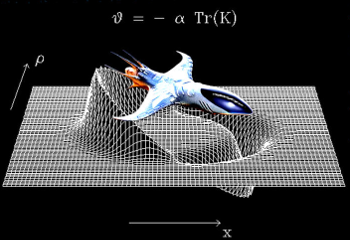
This seems perhaps an obvious one, space opera tends to be impossible without some measurable means of transiting the stars in a reasonable time frame, but it is one that, until recently, was even theoretically impossible. With the cultural popularity and theoretical applications of the Alcubierre Drive, it seems that we can justifiably speculate on how an FTL civilization would function. However, before this, when breaking the light speed barrier was beyond the realm of plausibility, we had to simply invent it as science fiction.


I don't think too much needs to be said about this one, as its premise is quite simple and the scope for storytelling it grants is pretty broad. That said, I don't think that writers should fall into the trap that you can only tell good space opera with FTL. The solar system is vast enough that we can tell many stories inside of it, without ever having to leave the heliosphere. That space is big is an understatement, and so we can do much to fill up the void between planets.

2) Artificial Gravity

This one is also a standard feature, but the one that seems least likely to ever be feasible within the realm of known physics. Gravity as we know it is generated by the spin of an object exerting force on the items upon it, essentially pulling on them. To do that you need something which can artificially replicate that force. In most science fiction though we seem to see artificial gravity being a standard applied everywhere. The mechanics of this are usually poorly explained, and well beyond the scope of our physics. Thus, one is forced to conclude that this is an unfeasible prospect based on our current understanding of modern science.

However, we can generate artificial gravity through things like centrifugal force, or simple thrust. The books in The Expanse series (and television series) show this through both aspects, and it is fascinating to watch the differences in gravity and problems it creates for our characters when they must do without it on occasion. Knowing that this is a plausible thing too, might change many people's perspective on what is 'realistic' and 'unrealistic' in science fiction.

I personally look forward to the day when we have a rotating habitat in orbit around Earth to start to get some hard data on this.

3) Interplanetary Colonization

One thing that is practically taken as gospel in almost every piece of science fiction is the idea that humanity will spread to the stars and plant our flags on other worlds and terraform them to suit our needs. Now, we have a history here on Earth of spreading across the continents, from the early Polynesian peoples to the Age of Discovery when Europeans began planting flags all over the world. It would make sense then that we would seek to expand that process to the final frontier. But does it really?

For one thing, space is big. Really, really, big. It would take centuries to travel to even some of the closest stars near to our solar system without FTL. Even travelling between the various planets in the solar system at the moment would take months or years with current technology. Even with some future technology it would take a long time to reach some place like Proxima Centauri, our closest star.

Even then, once we got to another solar system, would we even be able to colonize it? Kim Stanley Robinson's Aurora has some interesting answers on that. However, even assuming that we could terrform another planet, it would take a long time, centuries or millennia. So why not just build some islands in space?


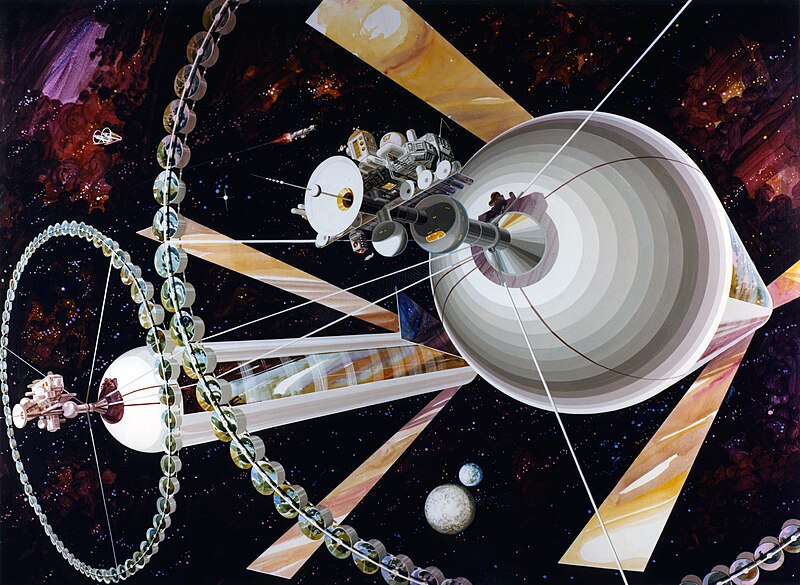
This brings you to the idea of the O'Neill Cylinder! At its simplest this is a large tube, either built independently or into a hollowed out asteroid, and spun up to provide gravity. Something like the terrarium from 2312.  The idea was originally floated in the book The High Frontier by physicist Gerard K. O'Neill, which talked of building rotating habitats in Earth/Moon orbit, or at the stable Lagrange points in Earth's orbit. These can be of varying sizes, but the advantages are you can create and settle them however you like! Want an arctic like location? No problem! Eternal tropics? No problem! All you need to do is create a cylinder with a certain diameter and length, spin it up and light it and voila!

And O'Neill's design isn't even necessarily the only one. You could build even larger, potentially with the truly massive McKendree Cylinder. Unlike O'Neill's more modest island in space, here you would practically be building a continent in space. Measuring 460 km in radius and 4600 km in length per the original proposal, you could have a living area inside with the same land area as Russia! You could even build it bigger with stronger future materials!

Building something like this turns into decades, or maybe a century, of work. Something far removed from the travel times between the stars or the length of time it might take to terraform somewhere like Mars. We could have continent sized living space in the future, yet this seems to get overlooked fairly easily. Perhaps we should start thinking of those types of stories more. You don't even need to leave the Solar system to have an 'interplanetary' adventure!

4) AI

Artificial Intelligence, or the reasonable facsimile thereof, has been an expectation of science fiction since at least the 1950s. Presumably most well known is Robert Heinlein's "Mycroft" who was birthed when an engineer on the moon progressively plugged in more and more computers until they gain sentience as one single being. Sadly, to some people the idea hasn't advanced much beyond that.

There is a strange belief in what is known as "The Singularity" in which computers will advance so quickly and so fast that just one day they will "wake up" and AI will be born. Now there's a few problems with this idea. Firstly that our rapid advancement in technology and efficiency is nowhere near as rapid as proponents even 20 years ago predicted. Futurist Ray Kurzweil predicted in his 1999 book The Singularity is Near that by 2010 we would have a computer capable of emulating human intelligence, and by 2020 such computers would be available for "one-thousand dollars" to us. Well, it's 2020 and barring some massive change no such computer is on the horizon.

Largely the idea is a vast misunderstanding of Moore's Law, which even the observer himself said was not a hard fast law, but an observation. It is even clear today that the rapid increase of processing power in computing is reaching a state of diminishing returns. Exponential growth cannot continue forever.


Even overlooking the issue of the Singularity, what would an AI actually look like? Would it have human level intelligence? Maybe, but would we recognize that intelligence? That last question is probably the most important when considering the issue of AI, would we even recognize it for what it was if we had it? Let me be clear, creating an 'artificial brain' which can solve complex problems is already within our grasp, whether it be made to play games of go or jeopardy. However, one which will be able to complexly interact with and communicate/reason with its human creators will take time and we might not even realize it was self aware as it wouldn't have the same desires/fears/ambitions as we do.

This is why I personally tend to dismiss out of hand fears of 'god like' AI destroying either humanity or the planet. In fact, I think AI will probably be far 'simpler' than we imagine when/if it does show up. For now though, its a highly theoretical concept with some wild out there ideas which fiction has almost done a disservice to.

5) Space Capitalism

So this is an important one. In many, many future scenarios it is hundreds or thousands of years in the future and everyone is either still working a 9-5 job, or working towards getting a pension or government benefits. Now, this makes sense since it would take a lot to put readers in a frame of mind where they grasp a post-capitalist society. However, is this the best way to try and imagine the future?

There have been many attempts to imagine a post-capitalist society in science fiction. Whether it was Gene Roddenberry's post-scarcity Federation of Planets, or the Mondragon Accords put forward by Kim Stanley Robinson. Now, each of these do depend on future technologies to be feasible (the magic replicators in the former and quantum computing in the latter) and it isn't far fetched to believe that our future economic systems will be driven by post-scarcity concerns or technological advances.

One future technology with the potential to upend the current economic order as we understand it is fusion power. An expected massive leap in power production and orders of magnitude more efficient and safer than our current atomic power generation. This could, almost overnight, upend our way of producing power as we know it and put the current hydrocarbon power generation methods the world largely depends on in decline. That would change some key economic inter-dependencies, such as on foreign oil or even the whole natural gas industry.

Now some of this does depend on the idea of a 'post-scarcity' society. It should be understood that 'post-scarcity' does not mean that we have everything, it just means that obtaining resources and a high standard of living is not impossible for the average person as goods are produced cheaply and available to all. This would though, arguably eliminate the need for traditional capitalism as we know it and lead to something close to the UBI (Universal Basic Income) that has been mooted around the last few years. Even just the UBI would undermine our understanding of politics and economics as it stands.

The future though, might not be more egalitarian but more corporate. With men like Elon Musk and Jeff Bezos driving the current future of space travel, it seems like we're possibly going to have shares be more important in the near future than any sort of workers cooperative in space.

However, the ideas for a post-capitalist future are many, and even here I can only list some ideas for why writers ought to be imagining a post-profit driven society.

----

These of course, are just a few things that science fiction is often using as a standard for the genre. They aren't the only big tropes, but I think they are at least the top five. What do you think, and what would you like to see more of in science fiction?

Tuesday, 3 December 2019

Writing Update 2019

Hello readers! I'm here to bring updates on my writing as of 2019.

This year has been only somewhat productive as it has been extremely busy. I have however, managed to jump onto a number of disparate projects as well as deciding on a few main projects. I'll be giving a short list of each project and listing them from primary to secondary.

Firstly, my novella Integration remains in the queue for the Tor novella pile from summer 2018, and so there it shall remain until I get feedback. Depending on the feedback, I will be shopping it around again after some editing. I will post any new updates as they come.

My goals from last year slipped by unfortunately. But I did make progress on a few works.

The first is, what I hope to be have finished by New Years, my first draft of the story Priests of the White God a nautical, fantasy, horror story which I'm hoping to self publish in 2020. Following that is another untitled horror story estimated to be around 7-10k words for publication hopefully in October 2020.

Another project, Finiphobia, unfortunately stalled out completely. The premise of two aspiring authors in a zombie apocalypse appeals to me, but managing the story has been a difficult task. I may come back to it, but for now it is firmly on hiatus.

Alongside those, I have two novella length works in the offing.

The first is a novella project I have been nipping at for a few years which I hope to polish off and complete. It is a science fiction project called The Virtue of Battle. Based somewhat on the events of the Chilean Civil War in space, it is meant to be a short military sci-fi piece to get some practice in at expanding characters and works up to novel length. Meant to be 50k words.

Another piece I'm working on is an alternate history novella, hesitantly titled A Road Not Taken. This work is based around the historical 1866 Battle of Ridgeway. The battle came about as the leader of the Canadian force, Colonel Booker, was meant to take one road to meet with another column coming down from Chippawa. However, he did not, and ended up meeting a Fenian party along Ridge Road and enduring a humiliating defeat. What if he went the way he was supposed to though? How would that have changed things? Also aimed at being 50k words, this one is slightly easier to write as it will be using a cast of historical characters and will be my first attempted foray into published alternate history.

In addition, I am still plugging away at my first full length fantasy novel with a current word count of 11,872, or roughly 10% towards its projected 100k word count. It's pretty well fleshed out, and I'm mostly happy with the story so far, but we will see how the year goes. This one has no set premier date, but is on the back burner.

Now, my goals for 2019 were very modest compared to these. In total, I'm working towards writing something like 120,000 words this coming year, and I'm hoping to have a decent amount of time to devote to it. First over Christmas, and then over the summer, with a personal goal of at least 500 words a day, working towards 1,000. It's an ambitious goal, but it is something to strive for in the new decade. 

I fully intend to keep people posted as this develops! Until next time!

Wednesday, 20 November 2019

The Mandalorian: First Impressions

Having caved and gotten a trial for Disney+ I sat up and watched the first episode of The Mandalorian last night. It had some pretty awesome trailers, good looking effects and some exciting hype surrounding it. I've been hearing people rave about it on social media so I figured, let's check it out. I've been happy through social media before.

Is a lone Mandalorian bounty hunter worth the hype?


Because there are some SPOILERS ahead, you can read more below the cut.

Thursday, 2 May 2019

Game of Thrones, Arya Stark and Mary Sues

The most recent episode of the long running and cultural milestone fantasy series Game of Thrones has, for many good and bad reasons, drawn lots of criticisms from fans. Much ink has already been spilled trying to justify or point out the flaws in the most recent episode. I think there are valid reasons for criticisms and invalid ones as well. However, let me just do a brief commentary on the show as a whole before diving in.

In case it isn't obvious SPOILERS AHEAD!!!!


Tuesday, 1 January 2019

2018 Recap

I'm happy to say I have had a successful year in 2018. In recap I finished my goals for 2018 in writing (major submission of a novella to Tor) and began new goals, writing a horror anthology which I hope to release now in 2019, working on other short stories for submission, and increasing my blog output.

I also accomplished my goal of reading over 50 books this year, coming in at 51, though I quibble if reading a series of anthologies counts, I've been informed it should so I nicely just squeak over the line.

I'm setting a new goal for 2019, aiming for 60 books read. It's realistic and I hope to make a good dent in that goal in the coming months!

Projects coming up in 2019 now:
  • Completing my short story anthology for Halloween 2019, which includes the work in progress short stories Finiphobia, Priests of the White God, and adding two other stories, one a work in progress (which I aim to be longer) and the already complete The Disappearance of Wilson and these I'm aiming to release in October 2019!
  • Working on completing a travelogue of my time crossing the Pacific and back, which has been under way for about a year. It will chronicle my visit to Hawaii and Australia and my first time dipping my feet in the Pacific, with visits to Honolulu, Pearl Harbor, and Adelaide. Hopefully a short humorous piece. Tentatively preparing for a February release.
  • Work on other as yet secret projects which I won't reveal too much about. One is science fiction and another is a long term fantasy project. Both are hopefully going to reach novel length at 100,000 words.
These projects, among other things, should keep me busy through the coming year. Lots to do and much to be accomplished!

All in all 2018 was a very good year for me. Personally, professionally, and writing wise. Happy New Year everyone!

Monday, 29 October 2018

Writing Update: October 2018

As October draws to a close, I have sadly fallen behind on one of my writing goals. That is to finish and prepare a small omnibus of spooky stories for sale on Amazon Kindle. That's not to say it will never happen, but it won't be reaching its Halloween release date.

Sad as that is, it may be for the best at the moment.

The first story (available for free already on my blog) the Disappearance of Wilson would be on there, while the other two stories I am working on would also be present. Those two are Priests of the White God and Finiphobia.

Priests is a fantasy horror thriller set on the high seas as things are not quite what they seem. The crew of Isidore's Pride flee from the oppressors in the Empire who seek to hunt them down and slaughter them. Their cargo may just save their whole nation, and if it doesn't arrive in time, who knows what could happen? Presently at 4,556 words of 10,000.

Second is Finiphobia. When the world ends, writer Ralph Macintosh thinks he's the last living man in Lanark Falls. Fortunately for him, he stumbles upon Chuck Duncan who is hiding out in the local highschool. The two begin writing the first post-apocalyptic published literature to pass the time, however, disagreements over how the story should end soon take place. Becoming increasingly paranoid of one another, the two men soon discover that they may not have to worry about the infection outside as much as the jealousy inside. Currently at 2,678 words.

Those two stories have been distracted from by work on other short stories, but now I'm aiming to polish them off for perhaps a New Years release, while working on other shorts to pitch around. I can't say much about the other shorts just yet, but I can say I intend to send them off and update you more once they're closer to completion.

Until then, I hope to update you soon on the work I'm attempting and to keep offering fun little other updates on here. Hopefully you'll stick around for more of my work and the blog! Until next time!

Sunday, 28 October 2018

Day By Day Armageddon

Well for my latest review, I'm going to take you back to a simpler time when zombies were all the rage, and they weren't the stars of AMC's The Walking Dead and the White Walkers weren't threatening to cross the Wall. Instead they were simply coming to eat you from the safety of your own living room.

In that vein Day By Day Armageddon should be considered a classic of the zombie literary genre.


This story by J.L. Bourne is presented in diary format, much like Dracula, but with only one POV. Here we enter into the world of one Kil, a former US military aviator who decides to keep a comprehensive journal as a New Years resolution. This is fortunate because he's just in time to chronicle the end of the world.

Reports begin to emerge of a mysterious virus ravaging the population in China. Though the government tries to hush it up, it soon becomes clear that the virus is very contagious, and extremely deadly to all who catch it. The infected become violent and hostile, attacking the uninfected and... well you can see where this is going can't you?

Kil begins chronicling the outbreak from the comfort of his own home in San Antonio, where he does his best to hunker down and ride out the storm. Unfortunately, he begins to see that society at large is starting to fall apart and as the disease breaks containment, he must begin an epic saga of survival, chronicling it all in his journal. He does this so if he dies someone will know what happened, and so he can remain sane.

That's great for us since we wouldn't have a story otherwise!

The first person narrative gives us a great window inside Kil's head as he struggles to come to terms with a world gone literally to hell around him. He has difficulty adjusting to a world gone mad, and the fact that he has to deal with the dead trying to eat him on a daily basis. Seeking just a little bit of humanity he is lucky, encountering other survivors and working together with them in order to survive the total breakdown of the end of the world. From his enigmatic neighbor John, to other survivors and families he meets along the way, even a dog.

Unable to simply, stay put, he bugs out in order to try and get as far away from a high concentration of the undead as possible. This sets us on a journey across the apocalyptic wasteland which was once the United States, one now ravaged by the zombie apocalypse, and a desperate fight against the zombie hordes by surviving military forces trying to reclaim the American continent from the dead.

One thing I like about the story is that the first person narrative gives us an excellent look into the narrator's state of mind. You feel what he feels, and you see things from his, and only his, point of view throughout the story. The fear is real as he relates escapes from near death, and we feel for his companions as it becomes clear at any moment that they could be eaten. The creepy events he experiences stick with you, and it is chilling reading about his early encounters with the undead.

While it is a central conceit the author survive's if we're reading this journal...that's not a guarantee. Considering the number of other doomed survivors whose logs we come across, it's a scary possibility the story could just pick up from someone else's point of view as they come across his last will and testament. But thankfully the author doesn't shuffle off his mortal coil. In this book at least.

Bourne does a great job of showing the collapse of society. From falling satellites to failing power grids, we feel it as the world we know just falls apart. The internet fails, news broadcasts simply cease, and our ability to interact with our fellow man falls by the wayside as the dead isolate us more thoroughly than we can imagine. With little vignettes of the end of the world scattered throughout (encountering a zombified hiker walking the highway eternally in a thunderstorm, an undead infant in a car seat, a humorous message on a bloody apron, ect.) we get chilling insights into how the world has simply collapsed. Many of which, though we may have questions about them, we will never know the answer to what happened.

That paints a haunting picture of a world where mankind is no longer the dominate species. Eternally on the run from the new top predator and outnumbered millions to one.

Despite this, the story still gives us reason to hope. The protagonists stumble from one place of safety to the next, managing to find some measure of community and solace. They look out for one another and protect each other (none of the typical backstabbing and murder drama that punctuates the almost predictable Walking Dead series) and we even see that some semblance of the US government is around and trying to protect people.

Yeah the world is ending, but people can still be people. Good ones at that.

The zombie killing is fun, and to me killing zombies never gets old. Maybe not as creative with the wanton destructive as some stories, it still reads well and it is nice to see some more practical methods of dead dispatching versus over the top gore fests. We also get some fun revelations that the zombies are not quite just undead automatons, but the whole how and why of this armageddon is a treat the reader should enjoy for themselves.

Mr. Bourne also knows his stuff quite well. He presents Kil's story as one of a man who is used to prepping, and so that shines through. From lists of supplies and ammunition, to drawings and doodles that map out his current location. He also avoids the common trope in this type of fiction of waxing poetically about firearms and their different calibers and whatever, instead distilling things down to the practical level making it a quick and easy read.

Now I was lucky enough to buy this in a two book pack which contains both the first novel, and its sequel Beyond Exile which continues the story. There are two further installments after that, and I think all of them keep things going quite nicely.

Reading this book in October has become a sort of Halloween tradition for me, combining my love of the zombie genre with some fun spooks. I think that if you like a good novel, and even if you're tired of zombies, its worth picking up just to enjoy it!

Saturday, 11 August 2018

Submission!

After a few days of editing, and getting the word count to 22,133, I have finally submitted my short story Integration to Tor. Now, they say that the proofreading process will take up to six months due to the sheer volume of submissions so I don't expect any news until at least February 2019. Either way, this is an exciting time for me as I submit my first story to an actual publishing company.

Then in all likelihood receive my first rejection letter!

But I'm happy, and I think this will be a good first step into the industry. Hopefully you'll see this story in print sometime!


Friday, 3 August 2018

Writing Update: Integration

Today, at precisely 9:04 AM, I typed the words "THE END" onto the first draft of my recent manuscript. My sci-fi short story Integration is now complete. For the last month and a half, I've been hammering away at this story almost every day. As of completion, this draft numbers 21,767 words over 51 pages.

Some of you might be wondering why I've said so little about this, or decided to only now make an announcement. Well the reason is simple, ever since last October when I penned off my piece of flash fiction The Disappearance of Wilson I've been hammering out other short stories either for practice, or for hopeful submissions to publishing houses. In creating this story I had set for myself a goal of writing at least 20,000 words, and I had determined not to say anything about it until I actually properly finished the piece. Now that is done.

Now I am excited to share with you my sci-fi short Integration and my plans for it. I had already been punting around in my head a story set on Earth far in the future, but not one that dealt with the difficulty of adapting to a new life. Reading the story, The Hummingbird decided the issue for me.

Writing this was a challenge to complete a work by a deadline and now I have completed the first part, and now I will be submitting it to beta readers while editing the first draft. It is for submission to the Tor slush pile which opened to accept short stories of between 20,000 - 40,000 words in the science fiction and fantasy categories. My goal is to have a complete and edited submission forwarded in the next ten days.

The story itself is following Faisal Williams, who has settled on the edge of the badlands in Old Texas. He has a troubling past, and it seems to be creeping up on him. Meanwhile, he deals with internal conflict over his religious views and the struggles of his one good friend, a recovering soldier, with nightmares of his own past. They all collide one night in Texas and Faisal must make a fateful choice.

With this story submission I will be making my first submission to a professional publishing house. While I don't expect much to come of it, it will be an accomplishment to have this story complete, and submitted to someone.

I'm told this process will take over six months, so it will be a while between submission and any news of progress on this story. Until then, the early draft is finished, and now for the editing to commence!

Other news revolves around two other stories I'm working on, with the intention of self publishing in October.

The first is called Priests of the White God set in a fantasy world where a nautical chase takes place between two factions. However, things are far darker than a simple naval action on the high seas as both parties become desperate.

The second is called Finiphobia. Two authors are trapped in a high school during an outbreak of a terrible epidemic, and to pass the time collaborate on a story between them. Jealousy and paranoia however, begin to take hold among them as they disagree on how to complete their story.

Hopefully I can have more regular updates for you on those stories as the next month progresses. In the meantime, the editing commences in a pell mell rush to meet the submission deadline!

So until next time!

Wednesday, 18 July 2018

Lovecraft's Run

For some odd reason, every summer I find myself caught up in a craving for Lovecraft's scary stories. One would think this would be more reasonable over the fall months or on Halloween. Strange as it is that the sun and the water draw me to tales of Eldritch horror and forgotten forbidden lore, I do enjoy sitting up late at night and reading his terrifying works. Last summer that was how I was able to, in a single sitting, pound out my Lovecraftian horror short The Disappearance of Wilson and I intend to make a stab at another story like that. However, I'm just going to reminisce on some of the stories I have particularly enjoyed and managed to have keep me up over the summer.

Pickman's Model

This was in fact, the first Lovecraft story which ever gave me a nightmare. The story revolves around a reclusive and unusual artist (Robert Pickman) who creates macabre imagery of half-man half-dog creatures who rummage through the underworld. The storyteller relates the news of getting Pickman to tell him how he came up with such terrible ideas and learning an awful truth regarding the author's influence.

I read this one on a cottage trip, and it was part of my inspiration for my own short story. Imagining the wild north of Ontario and what it may hide was a great creepy dream and the waking nightmare of Pickman's creatures lurking on the steps to drag me off to the unknown inspired me to hammer this gem out.

The Call of Cthulu

If you have not heard of this story you clearly don't know your Lovecraft. Written in the summer of 1926 it was published in February 1928 in the Weird Tales magazine. It is a story revolving around the discovery and perusal of a deceased academics papers relating to a mysterious and gruesome statue and idol confiscated during a police raid in Louisiana. From there it branches out into a sinister tale of an almost apocalypse (in every sense of the word) as the confluence of unlikely events leads a horrible revelation that would drive any man to despair.

This is perhaps, Lovecraft's most well known work, with Cthulu being the creature most associated with Lovecraftian fiction. His cephalopod visage has graced the covers of many books and drawings, and even the nightmares of some! I personally have a picture of him hanging over my bed to ward off nightmares. The story is dark and exciting, with elements of mystery and penny dreadful thrillers, making it entertaining reading from any angle!

The Whisperer in the Darkness

This particular story was one much discussed by a coworker and I years ago. Involving shambling horrors from beyond the stars, it was one which made much hay over the discovery of Pluto back in the day. A researcher at Miskatonic University is contacted by a reclusive professor who, in response to reports of eerie creatures seen floating in the rivers following a period of intense flooding. The professor passes on undeniable truth regarding other worldly origins of these strange creatures, and over time, begins to feel the strain as they besiege his home.

Told largely through a series of correspondence and personal memoirs, it ratchets up the tension over time as the revelations unfold and the academics step steadily closer to madness from the revelations of what they have discovered. Truly a great short read.

The Beast of the Bosporus

This Lovecraftian tale, not written by Lovecraft, but in a delightfully similar vein, takes us out of Lovecrat's usual setting of rural New England, to the world of the 16th Century Ottoman Empire. Having lost the Battle of Lepanto, the Sublime Porte is looking for a way to strike back at the Spanish who have 'singed their beard.' In it we see palace intrigue, terrifying encounters, and a truly epic conclusion regarding powers that should not be tampered with.

Seeing it all done in a place where you don't really expect Lovecraftian horror makes it so much more interesting.

I have talked about it before, and you can find it in Digital Fantasy Fiction Anthology: Uncommon Senses.

Now these are just a small sampling of Lovecraft's works you can find, and one that is a very delightful example of switching up the location of these eldritch horrors! If people are looking for some timeless reads they should definitely check out the works of Lovecraft and his modern successors.

Sunday, 7 January 2018

A New Year

This is a follow up to my own short post welcoming the New Year back in 2017. Now I have flown some 16,000km to return home, readjust to how cold a Canadian winter after experiencing some Australian heat (during a cold snap no less) and have to adjust to my writing once again.

2017 was, thankfully, not like the Year of the Reaper that was 2016. It contained many highs, and many lows. On a personal level I know I can say that easily, and for a certainty many others can as well. No doubt many of us are glad 2017 is over, and are hoping 2018 can bring bigger and better things.

Like my new Hunter S. Thompson look.
Now what can I say about 2017 personally?

Well I have published, for free, my own short story here, and will hopefully be able to publish more in 2018. That was a big step for me as now hundreds have read my little story and I hope more will (if I can advertise it enough) as time goes on. I aim to publish another short story for 2018, or maybe two, and hopefully get a little short story collection put together for self-publishing, either this year or in 2019.

In blogging I've gotten back on the horse (so to speak) and have been able to keep the views coming and manage this blog with some interesting comments and reviews, and I hope I can do more of that. Thankfully I've been able to do reviews for people I know, and some new and old authors that I love. It is nice to see the indie authors I know publishing and being published, and it is also nice to see this blog grow as I go.

My Facebook page has actually grown too, which is wonderful. I've learned that thanks to some less than savory practices, it is less useful for garnering attention, but what can one do? I intend to keep it around so people who do find it can like it and see what I post and share when I choose to.

I also joined Twitter this year.

It was more in response to recent events, but I've found its a useful platform to follow fellow bloggers and authors I like, while keeping myself mildly up to date on what goes on in the world. My mornings now usually consist of trawling Twitter to see the news while also examining the BBC over a nice cup of tea. Helps me keep informed in the world and start my mornings right.

The plan for 2018 is to keep this blog alive, write, and hopefully make headway in my personal and professional life. How successful that will be, well who knows? Hopefully you will join me in this endeavor and read the insightful insipid nonsense I enjoy posting on here and maybe you'll enjoy it too!