Showing posts with label Robert Heinlein. Show all posts

Friday, 21 August 2020

Planetary Invasions

In science fiction the idea of our planet being invaded, or other planets being invaded, is sufficiently old enough to be a trope. It all started back when H. G. Welles imagined Martians slinging themselves towards Earth to mash us with their tripods and death gas. From there it's evolved into many different scenarios some of which still involve us on Earth, to fascinating wars between the stars of other human or alien civilizations. Recently I've been pondering on that after I watched two very interesting videos between people who examined the idea of planetary invasions.

The first is from the excellent channel Space Dock which puts together wonderful work on the spaceships and vehicles of many franchises. They themselves have a drama called the Sojourn coming soon. Definitely check it out. But for our purposes watch their brief video on Planetary Invasions.

In contrast we have one video from Isaac Arthur discussing the subject. It's a longer one and it raises many interesting points. His channel is simply amazing for an in depth look at futuristic science based concepts on how we may do things in the future. It's honestly one of the best futurist channels and series I've ever encountered, sincerely worth checking out if you're interested in that kind of thing.
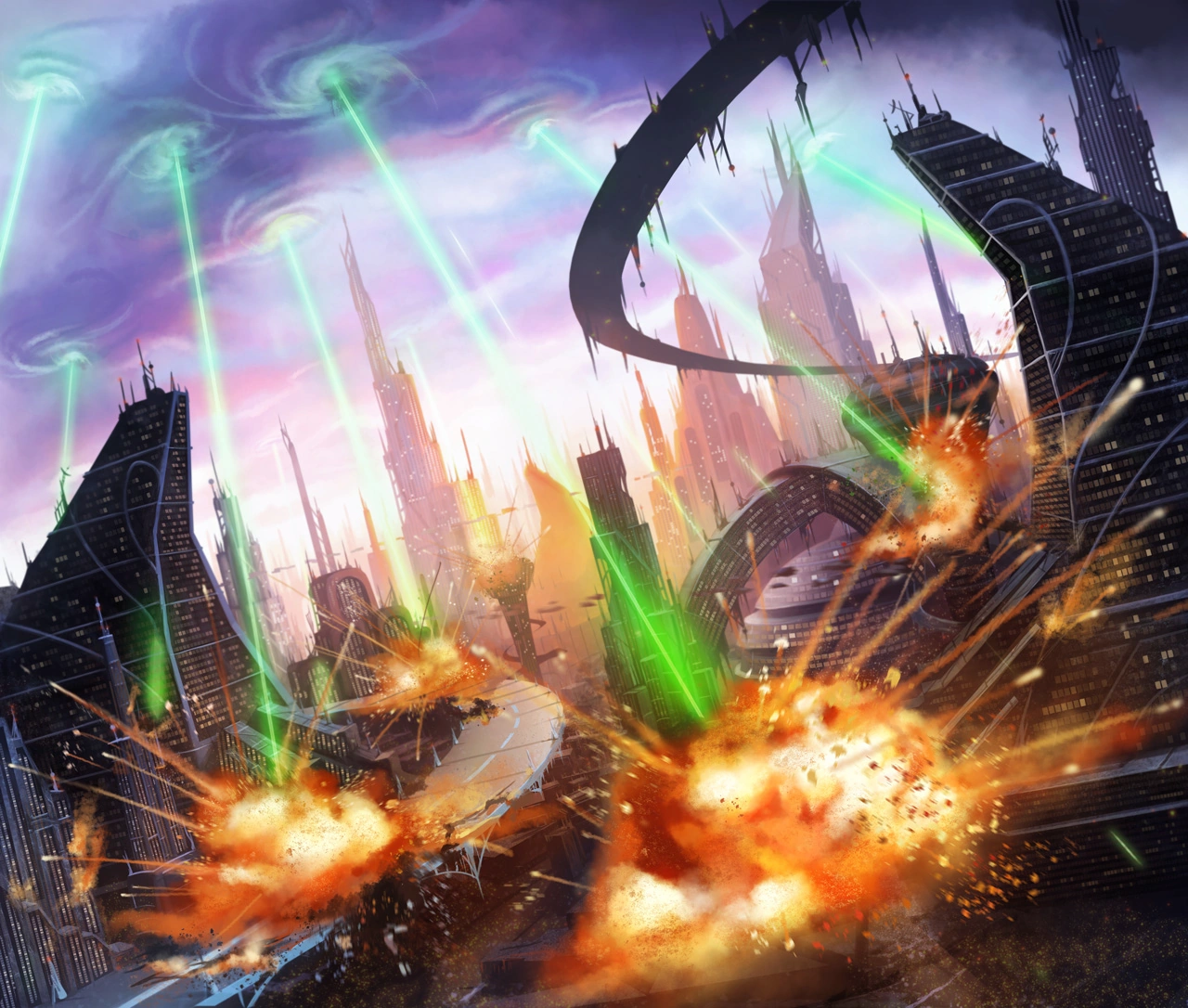
Credit to Alexander Tooth, from wookiepedia

Both these videos raise very good points, and they have contrasting opinions. In the first video we do see that it is argued that a planetary invasion is basically infeasible. Some Operation Barbarossa style mass landing and invasion taking years, decades, or perhaps centuries, to fully pacify a planet through mechanized warfare from above and below. The crux of the argument is that this is a huge waste of time and resources, especially when you presumably have ships in orbit that can hammer your opponent at your leisure. Then if you have no hope of relief and no friendly ships in the area, fighting on serves no purpose. You don't need legions of soldiers, just large landing forces to take and hold the vital aspects of planetary infrastructure and then garrison forces to keep the planet yours.

The second video has a more wide ranging view. It presumes that planetary assaults or invasions are feasible. The main point is that, after all, if you're jetsetting around in space with any sort of casual interstellar travel then the mobilization of resources to invade and crush another world or system of habitats (especially if you rule over multiple star systems and have great automation) is almost trivial. That being said, it makes a very pertinent point that a planet is not necessarily a helpless target. 

It is a point worth considering as any civilization which can do travel casually at interstellar distances is probably not really having to worry about the whole issue of delta-v in a gravity well. That means that, while an opponent who does control the orbitals has an advantage, the people at the bottom of that well are not nearly so defenceless as we might assume through our lens of 21st century technology where an asteroid barreling through our gravity well is a very terrifying prospect. Your vital sites are probably ringed with powerful railguns or missile batteries which can shoot destruction at any ship foolish enough to park in orbit.

In fact with that view, the traditional image of a ship parking itself in orbit and blasting a planet with it's weapons seems silly. No ship could risk parking in orbit without worrying about taking crippling damage or being rendered combat ineffective. The proper image might be a vessel in the age of sail bombarding a land fortification and having to outnumber the guns of the fort to hope to overpower them before it can be rendered ineffective itself. The planet can shoot back.

What you might see instead is ships engaging in what amount to bombing runs, first moving to cripple or take any orbital defences, then moving in unpredictable patterns to try and crush the ground based defences. If that doesn't work, clearing a landing corridor to insert marines who can disable or capture those defenses so the fleet can put itself in a position to command the ultimate high ground and compel a plant's surrender would be your next best bet. In the book Tiamat's Wrath there is an interesting example of this that works very well from both a tactical and a dramatic perspective.

This is actually a point I've considered for some time. I've mused about interstellar warfare before and why it might happen. In my own, as yet unfinished Service to the State science fiction novel, I've thought about how you could make a planetary invasions feasible, so my own view actually falls somewhere between that of the two videos.

Part of that view does come from finding that in universes like those of the Honor Harrington series that if you've countered gravity to the point you're using it in your weapons, the idea you can't make some kind of planetary based weapons system which could cripple or severely damage a ship seems baffling. It does seem to me that there would need to be an invasion, but one aimed at very limited and achievable goals so your fleet could enforce the threat of death from above.

Some blame might come from Robert Heinlein's Starship Troopers which, though an excellent novel I recommend everyone read, did draw it's inspiration pretty heavily from the work of paratroopers in WWII and the island hopping campaign in the Pacific theater. In the Pacific the small Japanese garrisons which held out across numerous little islands with their coastal batteries and then fighting to the last man against the power of the American gun line and the overwhelming firepower of Marine divisions set the course for the campaign. The Japanese might have inflicted casualties, but they had only the small resources of their islands to call upon and no hope of resupply. This has, I think, colored interpretation of how planetary assaults might go. A planet doesn't generally have that problem unless you wreck the infrastructure so thoroughly that further resistance is simply futile.

In Isaac's video he makes a very good point about the resources of a planet, and how future technology might make it possible to basically weaponize an entire planet's population, or make them know no fear. However, even with fantastic automation or fearless soldiers, there is a point where your offensive options and economic support would be so ground down that your ability to resist is functionally irrelevant as the invading power could zap you whenever they felt like it and destroy or immobilize your remaining assets. At that point, it's either guerrilla resistance or surrender.

That's why in my mind I think a planetary invasion might fall somewhere between these extremes of Honor Harrington and Starship Troopers. A planet isn't defenceless unless it has no real orbital defences or ground based weapons, and even with those ships can work to attire them, and then send in the marines to seize and hold them until the fleet in orbit can establish an advantageous position. Unless you know you have a relief fleet coming, there's no reason to keep fighting.

Of course, this is all just speculation and trying to harmonize the plausible with the realistic and make compelling story telling. Future warfare is liable to be so destructive it's unimaginable to today's soldiers or civilians. It does make for interesting reading or musings though.

Monday, 10 February 2020

The Moon is a Harsh Mistress

Another one for the Great 2020 reread!

I originally read this sci-fi classic way back in high school, I loved it then and I certainly love it now! It is a classic story of science fiction, one of Robert Heinlein's best works IMO. A story of politics, life on the moon and the desire of the Loonies, as they affectionately call themselves, for liberation from the Earth based Lunar Authority. By any stretch of the imagination, The Moon is a Harsh Mistress!


The story is told through the eyes of Manuel "Mannie" Garcia O'Kelly-Davis, a freeborn son of Lunar 'settlers' who comes to interact with a suddenly sentient computer Mycroft, or Mike as he likes to be called. He's the head honcho computer who controls the majority of the Lunar complexes and their functions. His sudden self-awareness is unprecedented and only Mannie talks to him, becoming one of his oldest friends.

However, Mannie is unsuspectingly drawn into a larger conspiracy when he attends a political rally which gets raided by the troops of the Lunar Authority. Suddenly caught up in a manhunt, he has no choice but to go into hiding alongside his new revolutionary comrades Wyoming "Wyoh" Knott, and Professor Bernardo de la Paz. When informed by Mike that the moon, which exports hydroponic wheat to Earth - in seven short years famine will be stalked by famine in a resource collapse, they decide that they must free Luna from Earth based tyranny. The revolution has begun!

A revolution framed through the eyes of someone who is not a revolutionary is a clever trick, as he serves as a conduit for the audience to be shown the methods of revolt which will bring Luna freedom. We have an in depth look at how the revolution is planned, and then helmed around the person of "Adam Selene" who is Mike simply manipulating his abilities as the great computer to make himself look like someone else and the ostensible leader of the whole revolt. From organizing cells of dissidents to creating false broadcasts for Earth consumption it is a meticulously well planned operation, with Mike planning things down to the decimal points!

For a brief aside, Mike as a computer and character works so well. As I noted elsewhere, the idea of him simply being plugged in and becoming sentient is a pretty common theme in modern AI thinking, but his inability to completely understand humor or many other human nuances is a pretty good look at how alien and unlike us any actual machine intelligence would probably end up being. As a character it also makes him both relatable and just on the line for being alien. What is even better though is that say unlike Rudi from the Emberverse and Merlin from Safehold, he is not infallible. While he is an immense help to the revolution on Luna and in accomplishing other goals, he has a set of limitations which actually build tension rather than deflate it. It's wonderfully well done and very refreshing compared to many modern takes on the same idea.

Of course, we also get a chance to look at Heinlein's concepts for Lunar society. It is one descended from prisoners imported very much against their will to work the Lunar surface and it was overwhelmingly male. It has led to one where people are unflinchingly polite as crossing a line could easily get you 'eliminated' by your fellows. And you better not think of touching a woman! The men outnumber women still three to one (better than the old days!!) and so anyone who so much as touches a woman against her consent will be mobbed and murdered before he can so much as twitch. It creates a society which depends on group marriages and line marriages to survive. Polyamory is a way of life by necessity. Very true to much of Heinlein's free love ideals. It's a unique frontier society, one that makes an interesting case for itself.

Reputation is important, and men live and die by their reputations. Indeed, holding ones family up is quite important. In economic terms, barter is, outside deals with the Authority, the order of the day. It's basically an unregulated free economy. It is also a remarkably tolerant and integrated one. Mannie is mixed race, and in a later event when he goes to Earth this is contrasted with the more intolerant culture of the North American Directorate, especially in Kentucky. It's a chance for commentary on events of the time, and shows itself off as pretty progressive.

The dialect of the Loonies is also delightful to read. They have numerous loan words from Russian and Chinese, and these are liberally sprinkled in adding a great flavor to the people. It takes some eking out, but once you catch on it is amazing to read!

But of course this being a novel of revolution, politics is pretty front and center. Compared to a more preachy novel like Starship Troopers, this one is fairly tame in expanding on Heinlein's political thought. Here we have an attempt at building an new, almost stateless, society. The politics in the book are very much built around the ideas espoused by Professor de la Paz. In the modern day, the story is somewhat understood as the tale of a libertarian revolution. Interestingly, the story itself precedes the common understanding of modern libertarianism, and the Professor calls himself a "Rational Anarchist" when describing his political theory. It can be best summed up with two quotes:

A rational anarchist believes that concepts such as "state" and "society" and "government" have no existence save as physically exemplified in the acts of self-responsible individuals.

And

I will accept any rules that you feel necessary to your freedom. I am free, no matter what rules surround me. If I find them tolerable, I tolerate them; if I find them too obnoxious, I break them. I am free because I know that I alone am morally responsible for everything I do.

These ideas hew very close to libertarian socialist philosophy (especially radical ideas of minarchism where the state is hardly needed) and in that vein the story is interpreted through numerous different philosophies as representing their ideals. However, anarchy and libertarianism can be a slippery subject. The story itself probably can have its politics boiled down to the acronym TANSTAAFL. There ain't no such thing as a free lunch. Though sometimes erroneously credited to Heinlein, it is a phrase dating back to the 1930s. This can roughly be translated down to, nothing comes for free, or there's always a hidden cost. Which is always going to be a good way to describe revolution.

But these hardly distract from the story. The revolution of course is not bloodless or simple, and it really does turn around in numerous surprising ways. It managed to surprise me a few years later how much I had forgotten about the intrigues of the revolution and the delicate and difficult decisions being made in the messier parts. (Indeed one interesting sub-plot revolves around keeping an eye on Terran scientists so they don't send a message back to Earth). These little details really sucked me into the book, and made rereading it so much more enjoyable.

Despite being written in 1966, three years before the first man would walk on the moon in 1969, it gets a remarkable number of things right. The cities are built underground in caverns to protect them from meteor strikes, the microgravity requires a certain way of walking and landing and communicating on the moon is done through hard landlines between the different settlements. The strain of living in low gravity and then experiencing Earth's higher gravity is also explored quite well. Though he did get some things wrong as science marched on, it managed to be remarkably prescient about many modern theories of living permanently on the moon.

Adding all this into the human element, the people who make up our main cast and supporting cast and the eventual love they come to have for each other, makes the revolution completely heart wrenching in its aftermath. I won't spoil any details, but it doesn't give our characters everything they might have wanted.

It is deservedly known as a science fiction classic. I would honestly recommend this to anyone who loves good science fiction, for it manages to tell an amazing story in a now very familiar location. If you've never read this book before, go pick it up and enjoy it!

Sunday, 25 February 2018

Why We Need Starship Troopers

In 1958 the United States under President Eisenhower decided to suspend US nuclear tests undergoing negotiations for all nuclear powers to suspend nuclear weapons testing. Former naval serviceman and science fiction author Robert Heinlein thought this was a terrible idea, and in his view when nuclear testing continued it proved that the West could not trust the Soviets. In a few weeks he penned what would become one of his most famous novels, Starship Troopers, and in it he "clarified" his military and political views. Since then it has been a science fiction classic and a staple of military science fiction.

However, it has also been controversial for some.

This point arises with the news that there is a planned Starship Troopers reboot in the pipeline. One that, apparently, intends to be more faithful to the original novel. In doing so though, this same publication asks, is Starship Troopers too controversial for the modern world to be adapted?


My answer is, absolutely not.

Monday, 8 July 2013

The Weekly Word #1

Hello readers! Here I am starting a new segment for the blog which I am calling, the Weekly Word. In order to keep myself motivated to blog and keep writing interesting articles I will be posting a segment which tops off the news for the week, any interesting thoughts I might have, my writing updates, and of course weird web stuff.


To start off the week I thought I might catch up with some news from yesterday. Yesterday was Robert Heinlein's birthday! One of the fathers of modern science fiction Heinlein was one of the great men to start off the science fiction genre and use it as a conduit to explore social norms and societal values. He wrote two of my favorite books, Starship Troopers and The Moon Is A Harsh Mistress. I've probably read each of those books at least ten times. Short sweet and packed with fascinating details on possible futures and interesting societies. The man was a great writer and visionary who should be remembered for all time in the literary genre.

Tor does a wonderful article in reflection on him.

On another note if you aren't following Tor on Facebook, I suggest you do so soon! They have a wonderful slew of updates on authors and books, and besides that they have countless fun articles for you to sample! I often post them on my page!

In international sector you've probably heard about the coup in Egpyt by now as the rather undemocratic President Morsi has been captured by the military. In a region which could use less unrest it seems that the country is slipping into a low scale civil war of its own.

It leaves a delicate question for modern friends of democracy to answer. If an elected official is up to no good and trying to subvert the democratic process is it right for him to be overthrown in a coup? To be fair to the Egyptian military however, they only acted when overwhelming domestic pressure against Morsi's policies (in the form of protests all around the country) and then exerted their considerable force on the government and seized the President.

The problem of course is that this sets an interesting example, the military has launched a coup (though some would prefer the term revolution) against a man who was elected fairly. However, supporters point out that Morsi (and his backers the Muslim Brotherhood) was the only man who had anything resembling a political party so there was little doubt who would win.

This is all part of the growing pains of what we hope will turn Egypt into a modern democracy. With the military suspension of the Constitution however and an insurgency forming only time will tell what happens. Though the military kept the majority of its promises last time and allowed for elections and didn't interfere with the process, except to preserve their considerable power as a state within a state. How this will play out for the future of democracy in Egypt again, remains up in the air.


On a more cheery and amusing note, today is the 66th anniversary of the Roswell UFO incident in 1947!

So today is the day when aliens potentially visited Earth for the first time. Now I don't actually believe that personally but hey someday I could be proven wrong!

Either way next time you look up to the sky, wave because you never know, little grey men could be watching you!

Hope you enjoyed the first update readers! I'll make sure to keep 'em coming! Until next time!

Friday, 10 August 2012

Ruminations on Interstellar Travel

Recently I was reading National Geographic and its lengthy issue on space. Of particular interest to me was the colonization of Mars and the approximately thousand year long terraforming process which got me thinking (again) about the future of mankind among the stars.

I have been an avid reader of science fiction since I was young from books like Star Hatchling or the young adult Star Wars novels like the Galaxy of Fear series. I graduated on to reading the works of Isaac Asimov and Robert Heinlein and wonderful novels like Dune, Starship Troopers, or The Moon is a Harsh Mistress. I loved the series and I was eventually reading the Halo novels which were very well done. Since then I've always had heady visions of space colonization and space battles.

Most recently I've been reading the Honor Harrington series which has really captured my interest. The series is extremely technical giving immense details on the technical data of the science behind the universe, and almost as importantly, the immense distances involved in travel among the stars and the vast distances that occupy even a single star system.

It has been immensely helpful for the opening stages of my own science fiction novel. Especially for some pivotal scenes involving space pirates thus far.

Establishing a proper timeline for the story has been a bit trickier, especially because of my thoughts on interstellar travel. Faster than light travel is something that we currently don't possess so making a viable means either relies on technobabble jargon or by extrapolating on currently shaky sciences. Since mankind has yet to travel well beyond earths orbit (in any manned capacity that is) I have come down to using more vague terms for my own science fiction such as 'hyper space' and 'jump drives' to describe the process.

The way I see it to have a decent history for an interstellar star nation one needs to have at least three centuries of colonization, which if you want to set it in something like the year 2600 or so requires mankind to have some decent terraforming technology and an adequete FTL technolgy else you have to rely on generational ships and an increase in earth-like planets (which while not impossible, it is still highly unlikely to have them concentrated in any nice dense array without a little push from the human race in my opinion). Mind you the previous thought is best regulated to 'hard' science fiction, while mine is going to be on the softer side, I am trying to make it as semi-realistic of possible to help with the suspension of disbelief.

You see in my science fiction (the Service to the State series as the name is thus far) I have developed a fairly intricate backstory for the nation of the Commonwealth, its worlds having been settled five hundred years before the current story line and then clawing their way to independence in order to form their own nation. The galaxy shattering events which lead to their independence (various wars and revolutions) all require FTL in a reliable shape so that they can carry out interplanetary war on a realistic scale. It needs to be both relatively easy to aquire and maintain, but difficult enough that it has some drawbacks and disadvantages to keep it from being a sort of easy way out for ships in a jam. I have no real grasp of the advanced sciences required though so I have to avoid the 'info-dumps' of the Honor Harrington series and rely more on characters, events, and conflict rather than the interesting hard sciences to keep people reading!

The problems with mapping a decent timeline this presents are large. Due to many realisations of both scale, and realism I have revised my initial timeline at least three times now. I'm sure I'll be forced to do this more in the future as I attempt to make the story as 'hard' as I can. Thus far though, both the story and the timeline are progressing well. I hope to have a rough draft for the entire story in place by the end of the year.