Showing posts with label Honorverse. Show all posts

Friday, 10 February 2023

What Price Victory?

In the seventh anthology in the Honorverse, David Weber and a host of other excellent authors bring us new stories from various eras in time across the universe Weber hath wrought. In doing so they ask the sobering question What Price Victory? This new anthology gives us five new stories which span a long chronological period across the Honorverse timeline and so necessarily some slight spoilers will follow!


First up, we have the prequel story to the amazing Manitcore Ascendant series Traitor by Timothy Zahn and Thomas Pope. Exploring the background of one of the main antagonists to this series, we are taken back to the early days of the Andermani Empire. Gustav Anderman is still powerful and respected, but getting into his elder years and his eccentricities, in spite of his victories, are becoming difficult for even many of his most loyal followers to ignore. Into this mix a young and fiercely ambitious Cutler Gustavus von Tischendorf is trying to make his mark. However, he feels slighted by the Emperor after the Second Battle of Tomlinson, and when intrigue creeps up on him, he finds himself roped into a conspiracy darker than he can imagine.

Like in their excellent main series, Zahn and Pope are building on their insight into the larger Honorverse and tapping into the rich vein of stories that can be told in Andermani space. The action is focused and tight, centering on the Sorgenfrei Palace on the capital world of Postdam. Some characters from A Call to Inssurection make an early appearance, and their actions may surprise you! What this story does excellently is also show us Gustav Anderman himself. While he's certainly crazy, he remains a very, very dangerous man!

Secondly we have Deception on Gryphon by Jane Lindskold. This one takes us back to the early years of Manticore before the colonization of the third habitable planet in the Manticore Binary system took place in earnest. Stephanie Harrington and her friend Karl, as well as their treecats Lionheart and Survivor are with her parents for a big science conference. They meet, and sort of befriend, a strange geologist who suddenly ends up dead. Was it suicide, or murder?

The story itself is fun because it explores the largely unexplored world of Gryphon. Fans of the Star Kingdom series about Stephanie Harrington and the treecats will definitely enjoy this new short story. The banter between the cats is quite amusing, and how they explore their new location no less so. Lindskold using a murder as a backdrop works well and she manages to bring the story together in a satisfying way.

Third is Jan Kotouč's The Silesian Command which takes place in the opening days of the Second Manticoran-Haven War as Manticore is currently trying to digest the Silesian Confederacy alongside the Anderman Empire. The Royal Navy is overworked, overwhelmed, and stretched very thin, leaving room for opportunists to cause quite bit of damage to the still chaotic former Confederacy.

Evelyn Chandler is working her way through grief after the loss of her daughter, and so much death in the previous war. The new Silesian members are chaotic, corrupt, and not yet resigned to their new roles as subjects of Manticore. Even worse, unscrupulous warlords and pirates are taking advantage of the chaos.

This was probably one of my favorite stories in the whole anthology. Packed with the intrigue, combat, and dilemmas I have come to love the Honorverse for, Kotouč manages to roll together the rich vein of stories in this part of the universe into an excellently self contained story. The characterization is excellent, the tactics of our protagonists and antagonists clever, and overall we get a great look at the wider issues of the local universe at this time.

Next is If Wishes Were Spacecutters by Joelle Presby. This is a little 'slice of life' story from the Protectorate of Grayson. Noah Bedlam is a down on his luck member of Grayson society who is living on social assistance and always just one step away from financial ruin or being run out of social housing. He find himself swept up in the expansion of work in the outbreak of the Second Manticore-Haven War as things go off the rails.

Presby tells a really good story in Grayson society that gives us some expansion and insight into how the 'little people' in Grayson get along. While we've become familiar with the Protector, many of the great Steadholders, and the various armsmen and wives who make up this society we only ever had a few looks at life on the bottom. This was a wonderful exploration of that kind of life, even in the future, and how it can affect peoples choices and outlooks. Presby wrote poverty and social stigma in this society so well! How the various characters bumped into one another and helped drive the plot was quite clever!

Finally we have David Weber's First Victory. This is a story that stretches way back in time, mostly within the Harrington family. It's a touching family drama I think many people can relate to. That said, it is cute to see the younger life of the Harrington clan explored, especially with young Honor and more casual references to greater series events.

This is another excellent addition to the broader universe of the Honor Harrington series. I definitely reccommend it to fans, and more cautiously to casual readers if only because of spoilers! Otherwise, I encourage you to thoroughly immerse yourself in this space opera epic!

Friday, 21 August 2020

Planetary Invasions

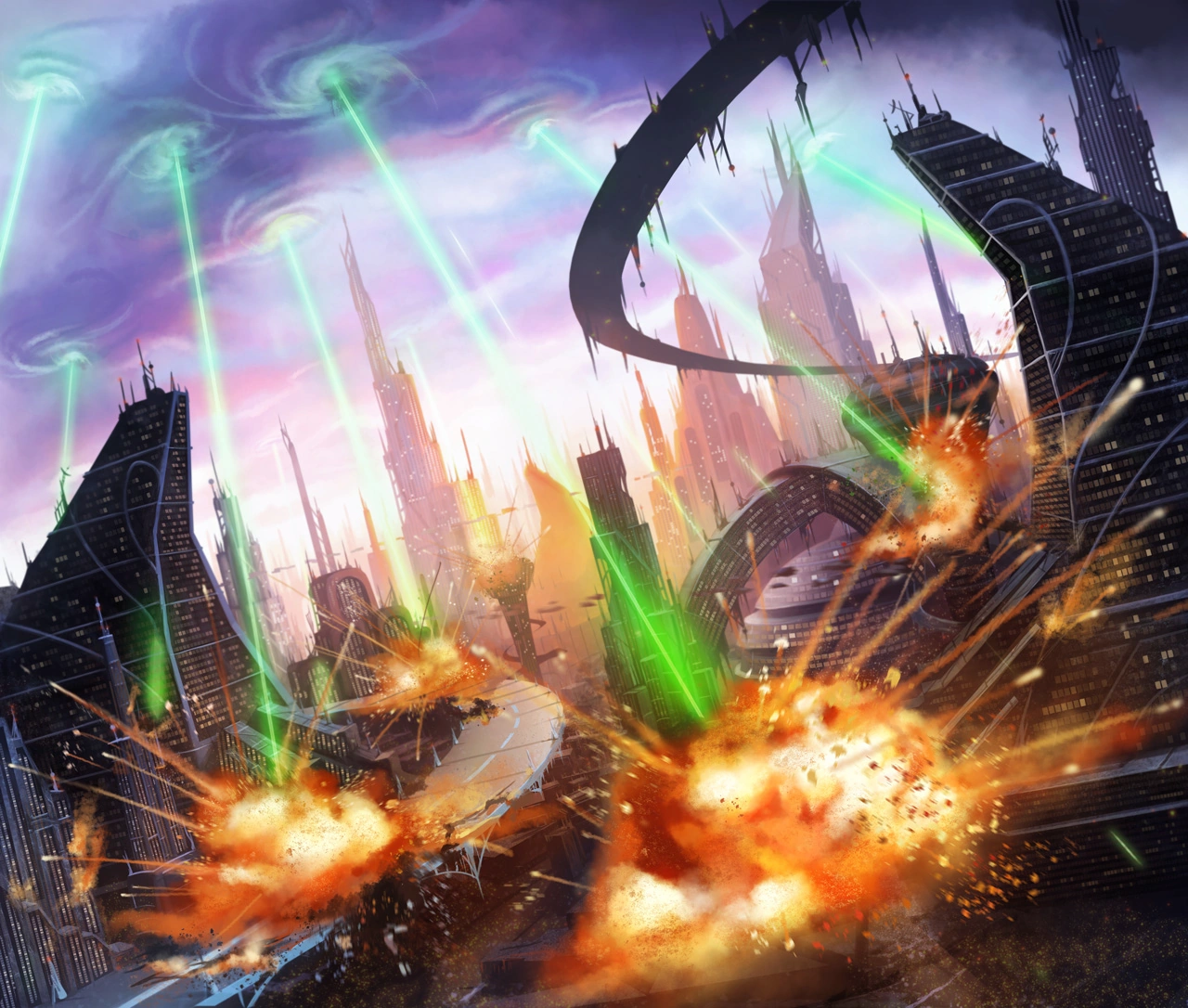
In science fiction the idea of our planet being invaded, or other planets being invaded, is sufficiently old enough to be a trope. It all started back when H. G. Welles imagined Martians slinging themselves towards Earth to mash us with their tripods and death gas. From there it's evolved into many different scenarios some of which still involve us on Earth, to fascinating wars between the stars of other human or alien civilizations. Recently I've been pondering on that after I watched two very interesting videos between people who examined the idea of planetary invasions.

The first is from the excellent channel Space Dock which puts together wonderful work on the spaceships and vehicles of many franchises. They themselves have a drama called the Sojourn coming soon. Definitely check it out. But for our purposes watch their brief video on Planetary Invasions.

In contrast we have one video from Isaac Arthur discussing the subject. It's a longer one and it raises many interesting points. His channel is simply amazing for an in depth look at futuristic science based concepts on how we may do things in the future. It's honestly one of the best futurist channels and series I've ever encountered, sincerely worth checking out if you're interested in that kind of thing.

Credit to Alexander Tooth, from wookiepedia

Both these videos raise very good points, and they have contrasting opinions. In the first video we do see that it is argued that a planetary invasion is basically infeasible. Some Operation Barbarossa style mass landing and invasion taking years, decades, or perhaps centuries, to fully pacify a planet through mechanized warfare from above and below. The crux of the argument is that this is a huge waste of time and resources, especially when you presumably have ships in orbit that can hammer your opponent at your leisure. Then if you have no hope of relief and no friendly ships in the area, fighting on serves no purpose. You don't need legions of soldiers, just large landing forces to take and hold the vital aspects of planetary infrastructure and then garrison forces to keep the planet yours.

The second video has a more wide ranging view. It presumes that planetary assaults or invasions are feasible. The main point is that, after all, if you're jetsetting around in space with any sort of casual interstellar travel then the mobilization of resources to invade and crush another world or system of habitats (especially if you rule over multiple star systems and have great automation) is almost trivial. That being said, it makes a very pertinent point that a planet is not necessarily a helpless target. 

It is a point worth considering as any civilization which can do travel casually at interstellar distances is probably not really having to worry about the whole issue of delta-v in a gravity well. That means that, while an opponent who does control the orbitals has an advantage, the people at the bottom of that well are not nearly so defenceless as we might assume through our lens of 21st century technology where an asteroid barreling through our gravity well is a very terrifying prospect. Your vital sites are probably ringed with powerful railguns or missile batteries which can shoot destruction at any ship foolish enough to park in orbit.


In fact with that view, the traditional image of a ship parking itself in orbit and blasting a planet with it's weapons seems silly. No ship could risk parking in orbit without worrying about taking crippling damage or being rendered combat ineffective. The proper image might be a vessel in the age of sail bombarding a land fortification and having to outnumber the guns of the fort to hope to overpower them before it can be rendered ineffective itself. The planet can shoot back.

What you might see instead is ships engaging in what amount to bombing runs, first moving to cripple or take any orbital defences, then moving in unpredictable patterns to try and crush the ground based defences. If that doesn't work, clearing a landing corridor to insert marines who can disable or capture those defenses so the fleet can put itself in a position to command the ultimate high ground and compel a plant's surrender would be your next best bet. In the book Tiamat's Wrath there is an interesting example of this that works very well from both a tactical and a dramatic perspective.

This is actually a point I've considered for some time. I've mused about interstellar warfare before and why it might happen. In my own, as yet unfinished Service to the State science fiction novel, I've thought about how you could make a planetary invasions feasible, so my own view actually falls somewhere between that of the two videos.

Part of that view does come from finding that in universes like those of the Honor Harrington series that if you've countered gravity to the point you're using it in your weapons, the idea you can't make some kind of planetary based weapons system which could cripple or severely damage a ship seems baffling. It does seem to me that there would need to be an invasion, but one aimed at very limited and achievable goals so your fleet could enforce the threat of death from above.

Some blame might come from Robert Heinlein's Starship Troopers which, though an excellent novel I recommend everyone read, did draw it's inspiration pretty heavily from the work of paratroopers in WWII and the island hopping campaign in the Pacific theater. In the Pacific the small Japanese garrisons which held out across numerous little islands with their coastal batteries and then fighting to the last man against the power of the American gun line and the overwhelming firepower of Marine divisions set the course for the campaign. The Japanese might have inflicted casualties, but they had only the small resources of their islands to call upon and no hope of resupply. This has, I think, colored interpretation of how planetary assaults might go. A planet doesn't generally have that problem unless you wreck the infrastructure so thoroughly that further resistance is simply futile.

In Isaac's video he makes a very good point about the resources of a planet, and how future technology might make it possible to basically weaponize an entire planet's population, or make them know no fear. However, even with fantastic automation or fearless soldiers, there is a point where your offensive options and economic support would be so ground down that your ability to resist is functionally irrelevant as the invading power could zap you whenever they felt like it and destroy or immobilize your remaining assets. At that point, it's either guerrilla resistance or surrender.

That's why in my mind I think a planetary invasion might fall somewhere between these extremes of Honor Harrington and Starship Troopers. A planet isn't defenceless unless it has no real orbital defences or ground based weapons, and even with those ships can work to attire them, and then send in the marines to seize and hold them until the fleet in orbit can establish an advantageous position. Unless you know you have a relief fleet coming, there's no reason to keep fighting.

Of course, this is all just speculation and trying to harmonize the plausible with the realistic and make compelling story telling. Future warfare is liable to be so destructive it's unimaginable to today's soldiers or civilians. It does make for interesting reading or musings though.

Monday, 18 March 2013

Yet Another Writing Update

Greetings readers. For any of you who follow me on Facebook you will no doubt know I refer to Matthew Stienberg: Writer. Now some of you may say 'Well for a writer you sure don't write anything' to which I would first retort 'Well you're reading some of it right now!' but ah you say 'certainly a writer is someone who has published work to his name' and I suppose I ought to retort by adding 'Well I am working on some items at the moment'.

Though I suppose I ought to prove it at least.

Well readers for anyone whose looking forward to what I'm writing I can tell you my current projects are running along smoothly.

Service to the State has currently passed the half-way mark to completion and is progressing nicely (albeit more slowly than I would like) but so far in little spurts and bounds it is growing, though I must say that space assassins can be pretty fun characters to write about.

The few issues that have stalled me currently were some basic world building issues (such as how to handle interplanetary crime) and of course how best to continue on with characterization for both Laurent and Jessica. For Jessica it is essential I not screw up even one motivating factor, it is going to be my first major work afterall, and I really can't afford to mess that up!

Meanwhile the world around it grows and I'm hoping to be putting some OC that I've got planned up on the site as it goes. In the works are a flag for the two main star nations in the story, the Socialist Commonwealth of Tau, and the Republic of Grant.

These two nations are the crux of the universe (not the only ones mind, but certainly the most powerful in their respective sectors) and the struggles they engage in will be defining aspects of how the universe is shaped. It's a war of national pride and competing national ideologies, and sadly ideological wars can be some of the most brutal.

So far I've been dithering about the obligatory bootcamp sequence and how to include it without stumbling into cliche territory, while at the same time working up the aspects of space combat in this universe. So far I've mapped out two space battles and I'm hoping to pen them out in rough soon enough.

On a more random note I've also penned out some ideas in rough for a stand-alone science fiction story. Having been learning about the Russian Revolution lately and being nostalgic for the Moon is a Harsh Mistress, I've put a few random thoughts down on paper and I've been mapping out the basic sketch for the story of a colony of Earth being basically strip mined for its resources and the cruel managers don't give a damn. I also had a few ideas while reading some of the back blurb on the most recent Honor Harrington novel recently, so it got me to thinking about these things.

The general idea revolves around a group of young and old revolutionaries of differing backgrounds, socialists, libertarians, and technocrats, all struggling together to try and overthrow the planetary government and gain political and economic independence. It's only a rough concept and will have to wait until I can devote more time to it before being really fleshed out.

As I also said on my page I have an alternate history scenario that I've written out which is fairly rudimentary and covers some major historical points, and I may put it up on my alternate history board just for kicks. It would be cool to write some stories set in that world, so I wouldn't completely mind keeping such ideas on the shelf for a later date.

So far 2013 has been a slow writing period, but then we still have a year to go!

Wednesday, 5 September 2012

Cover Art

So I was recently reading through the blog and Facebook page of fellow blogger Matthew Quinn, and he has been making some excellent observations and notes regarding the writing industry. Recently he made a number of good points about cover art.

Cover art is essential for any story. Think about it, one may write an excellent story but without a catchy title and some flashy cover art it is all but impossible to grab the attention of potential buyers. Cover art can almost be as important as the story itself. It's been said that first impressions are the most lasting, and if someone does not get a good first impression of your book then they simply won't even pick it up.

I'm going to look at some bits of cover work and examine them to give people an idea of what can be good for cover work and get people's attention, and then examine some terrible cover art which should best be left on the drawing board.

First is Mr. Quinn's upcoming e-book Melon Heads.


At first glance it is simple, yet engrossing. We have a good title which leads potential buyers to question what it is about. The style is eye grabbing and also let's us know this is a work of horror with what must be a rather unique creature set. In one glance we get genre, ideas, and interest. Effective as advertising as it leads to great potential for people to pick it up. I for one am buying this book and I would encourage readers to do so as well.

So for another bit of the horror (or more comedic) genre we have Abraham Lincoln: Vampire Hunter


This of course is the first film poster, but on the most recent mass market paper bound copy I purchased it was also the cover art. At a glance we have a moon lit scene with a shadow shrouded Lincoln with his signature hat at a jaunty angle. We get a view of his signature weapon from the book and a basic idea of what he is doing. Again it is informative, a good visual and gives the reader an idea of what to expect.

Moving on to a more recent mainstream selection we have Stephen King's most recent novel 11-22-63.


Now we know first off that this is a Stephen King novel (his name is larger than the title) and under that we see the image of JFK and a newspaper article proclaiming him slain in Dallas. This of course is not very informative and leaves readers wondering what exactly the book is about. It of course grabs attention and encourages someone to pick it up. The main selling point though is the authors name which will grab any longtime fans immediate attention.

Now here's one by one of my favorite authors. David Weber.


The first book in the grand Honor Harrington series. Simple cover, shows off the science fiction aspects of the story and of course we have the famous authors name. We get a good look at the main character and even some visual ideas of the general uniforms of people in the series.

I've been examining the cover art for various science fiction stories in order to formulate a rough idea of what I think would be an appropriate cover for my Service to the State series. More on that later.

Now for bad cover art we have a culprit none other than SM Stirling.


I've always been rather disgusted with the cover work for the Emberverse series. While it grabs attention it has always been rather tacky and generic, doesn't give you any idea of what is going on in the stories and has some ridiculous elements in it. For instance the two draft horse pulling the bus up there (a bus which, as my friend noticed still has its lights running). The series is a constant repeat offender of this and I sincerely wish Stirling would find a different cover artist.

Yet another is Micheal Z. Williamson


This book is marginally related to his Freehold verse. The title is rather awful, gives you no idea of what is going on and depends on a scantily clad woman to attaract attention. In any respect that is a sign of poor work and a desperate grab at the male audience.

So some good some bad. I think that a writer looking for good cover art should have a snappy visual, an intriguing title and of course a good story behind it. Good cover art should have images directly related to the story at hand, not something eye grabbing just because it looks cool. For instance if your writing a story about a starship captain stranded in space don't have your cover image of a man in a spacesuit standing on an alien planet. Nor should you put a picture of an alien in it just because you think it looks cool. Make the cover art about your story, not just another picture of a scantly clad woman.

So in pondering on cover art for Service to the State and for the first book I have decided I would like to find someone who could attempt to illustrate the male and female leads (Jessica and Laurent) in front of a generic world image. Since there are space battles in the book perhaps have an exploding ship in the background (rule of cool after all dear readers). I think with a snappy title and good visuals that would draw potential readers in.

So with this look at cover art and my thoughts on the subject I once again bid you adieu until next time readers, and return to writing my own stories.