Showing posts with label Firearms. Show all posts

Monday, 18 May 2020

The Problem with Trudeau's Firearms Ban

The recent Order in Council put forth by Justin Trudeau in response to the tragic events in Nova Scotia has caused no small amount of public debate. However, the ban itself is problematic in the way it was implemented, but also because it won't do a single thing to stop another massacre.

Now full disclosure, I like guns and have absolutely no problem with people owning them. I also think that the government is right to try and regulate what kind of weapons can be owned, there really is no reason for an individual to own a weapon which can be made to go fully automatic (which is a terrible waste of ammunition anyway). I am of the personal opinion though, this Order in Council was simply a publicity stunt, however well meaning it might have been. I hope to outline both why the gun debate in Canada is long settled, and why the current ban will do absolutely nothing to prevent another massacre.

Via Tactical-life.com

First though, let me clear something up. There has been a lot of push back from gun owners regarding the ban. Many claiming it infringes on their "right" to own weapons. Important thing to know, in Canada you do not have the right to bear arms. There is no second amendment like law which ensures Canadians have access to weapons, and we are probably better off for it. The law is very clear on that fact, and the Supreme Court has ruled twice, quite comprehensively, on the subject.

The first Supreme Court case to rule comprehensively on the issue was 1993's R. v. Hasselwander it was declared, in a specific rebuttal to an appeal to American ideals: The American authorities should not be considered in this case. Canadians, unlike Americans do not have a constitutional right to bear arms. Indeed, most Canadians prefer the peace of mind and sense of security derived from the knowledge that the possession of automatic weapons is prohibited.

In 2005 in R. v. Wiles it was confirmed that: "Possession and use of firearms is a heavily regulated privilege, and the loss of that privilege does not support a finding of gross disproportionality because it falls short of a punishment “so excessive as to outrage standards of decency” Thus confirming that the ownership of firearms in Canada is indeed a privilege. 

Owning firearms in Canada is very well regulated, and while handguns can be owned under very strict circumstances, it is very rare. There are an estimated 12.7 million firearms in Canada, and by and large, we seem to be very responsible gun owners and our current laws work. Even with a relatively large percent of personally owned weapons, gun crime is very low in this country, even if it has been rising in some urban areas. I would personally say this is a victory for our firearms laws and our own gun culture on the whole.

Hopefully this has been educational regarding both the existing laws, and gun crimes in this country. Now let's talk about why the ban will do no good.

I want to draw attention to the fact that the shooter in Nova Scotia actually did not legally own the firearms he used in the attack. They were in fact smuggled in from the United States. This is not unusual in Canadian crimes. It is estimated 70% of the weapons used in Canadian gun crimes come into the country illegally from the United States. These statistics, I think, bear out that any attempt to ban the ownership of guns in the hands of law abiding Canadians, with whatever intention, is utterly irrelevant in actually preventing the importation of illegal guns into the country.

If the Liberal government truly wants to act in practice to reduce gun crime, they should be working harder to stop the illegal importation of weapons into the country through a bilateral solution. Instead, they have chosen to act in a way which not only comes off as antagonistic, but is also not addressing the root of the problem. What is worse is that 2019 Angus Reid polling found that a majority of gun owners would be receptive to a total assault weapons ban. The optics of the Order in Council are, if anything, terrible, and now are dependent on a broad coalition to actually pass legislation - which since the Liberal government declined to adopt a formal coalition, puts them in hock to other parties.

While the Angus Reid polling does certainly suggest that support for items like handgun and assault weapons bans are high, even in a majority among gun owners, it also points to the fact that for the largest part of the population, this is a settled matter. Both in the courts of law and the courts of public opinion, these are not debates to be had. What has to be pointed out however, is that rather than flashy 'feel good' bans like the current move, we should instead be raising public awareness of what will actually go towards preventing massacres like these from happening again.

There is much more that could be done, like the aforementioned better attempts to crackdown on illegal imports, bilateral agreements with our neighbors, or even fighting to bring back the long gun registry. Raising these issues is much more helpful than a sudden and unexpected ban, and this is the conversation our leaders should be having.

It isn't an outright ban of certain weapons, but well researched and implemented policy which will help address Canadians' fears. So far, we seem to be lacking that from our elected leaders.

Sunday, 24 March 2019

The Waking Fire

This month has been a month of high fantasy for me. However, I have indulged myself by not just limiting myself to the regular fare of swords and sorcerer's, but have gone into the world of magic and flintlocks as well. However, recently I was able to read a book which has been catching my eye for some time now, and I took my first step into steampunk fantasy!

That book of course, was The Waking Fire, by Anthony Ryan.


Welcome to a world of rifles, steam power, electricity, and dragons. The Ironship Trading Syndicate, the largest and most successful company of the Corporate world, runs on drake blood. Controlling the largest sphere of influence on the foreboding continent of Arradsia, they hunt and capture drakes to fuel their society. From ships to long range communications the blood of drakes is a necessity for keeping the world going.

It also gives the Corporate world an advantage over their one great rival, the powerful but fading Corvantine Empire, which seeks to control this precious resource for itself.

Enter Lizzane Lethridge, granddaughter and daughter of famous inventors, and an extremely effective spy and assassin. She is being sent to Arradsia by the Syndicate to take matters in hand as war looms between the Empire and her company. All in pursuit of a mysterious device which may turn the tide.

Then you have Claydon Torcreek, a petty thief who dreams of nothing more than getting out of the slums of the great colony city of Carvenport. He just wants to make enough money to flee his past and bring his friends to safety far away from the ferocious continent of drakes and the grim tribes of Spoiled who inhabit the Interior. Little does he know that destiny has greater plans for him.

Finally, we have Second Lieutenant Corrick Hilemore of the Ironship Protectorate Vessel Viable Opportunity which patrols the worlds oceans to make them safe for commerce. Sent to hunt down pirates, he finds himself caught up in a conspiracy well beyond his pay grade.

Honestly, this book was awesome. It mixes the best parts of Brandon Sanderson and the Mistborn series, with all the things David Weber does right in his many series, and notably Safehold. But, for those slim similarities, it holds its own with a unique style, magic system, and unquestionably epic action and adventure. From high seas hijinks, spy vs. spy action worthy of James Bond, to amazing adventures in the Interior worthy of Indiana Jones or Crocodile Dundee. Honestly, its a blend of never let up action which will keep you engaged and subject to a new series of awesome adventures in each chapter.

The world is, quite frankly, one of the most unique in terms of world building I have come across since Brandon Sanderson. Forget the true and rightful king, it's one nation under copyright. The world our main characters hail from is one which knows no democracy, little true political freedom, and is one where contracts are as binding as oaths. Corporations run and own everything, but the most powerful of course has the most say. Shareholder is a rank of privilege, and the managerial class are as close to nobility as you get. Everyone else is a worker whose trying to scrape their way up the corporate ladder.

Then of course you have the Empire. Backwards, corrupt and decadent, but for all that still the most powerful and potent force not in the Corporate sphere.

With this little cold war going on, the magic system plays a big role. Though yes the powers are color coded for your convenience, you find it nice and simple to keep track of. Each user is not limited to one color of drake blood, and may use all of them. However, many become adept at one or the other, few can master all of them easily. It causes some fascinating action scenes as blood users square off against one another.

Of course, the author doesn't skimp on guns and ships either. The knowledge of weapons and warships reads well, and you can really believe that the people know their stuff, with rifles and pistols being the order of the day, while on the cannons blaze away at armored ships which run off blood burning power, giving them incredible speed. These are all thought out logically and given true advantages and weaknesses, which keeps things constant and quite exciting as you try and figure out who can win in what situations.

In this world though, you do get an idea that things really are shrinking. Though the Interior is vast and dangerous, you get the sense you are seeing the end of an era. Drakes are becoming harder to find and harvest in numbers, and are virtually extinct near the coast. One is brought to mind of the death of the buffalo on the Great Plains as they were hunted to extinction.

For the plot, I really can't say much for risking spoilers. It honestly goes at such a break neck pace with revelation after revelation that you'll be on the edge of your seat as the story progresses. As it goes on you realize nothing is as it seems, and many of the things our characters discover are downright unsettling. Heck, many of the finds later on seem like something straight out of H.P. Lovecraft!

None of the characters gets a short shift in these stories. Each has a good arc which they run with. Lizzane with her secret mission infiltrating Corvantine territory and Clayton with his run into the desolate and dangerous Interior with a crew of Contractors out for the ultimate prize. Perhaps only Corrick doesn't get as fleshed out as he deserves to be, but that's what we have sequels for of course!

If I had to say anything bad, maybe some of the revelations lacked proper foreshadowing, and one or two events were unceremoniously dumped on us, but with nary a slow scene and constant action paving the way forward, how can I complain?

A solid start to what promises to be an overall solid series. It shouldn't be missed!

Monday, 28 January 2013

An Addendum: On Gun Control

I know I've promised my readers here an article on the undead menace (don't worry it's coming) but recent readings and conversations have sparked the necessity of this addendum to my recent article on gun control. Part of it has been from the peculiar American reaction to the idea of a registry and part has been to criticism on how I myself did the article.

First off, I do not blame the United States for gun crime in Canada, I am fully aware that criminals will get access to guns somehow if they are sincerely determined. I am also fully aware just how large the border between our two nations is and just how difficult policing that border is on a regular basis. To clarify, I lay the access of easily obtainable firearms that avoid registration and legal checks on gun merchants operating inside the United States who can (and do) sell firearms to people who are less than angels. That these firearms then find there way to murder scenes in my own country is no one's surprise. My criticism is that by avoiding any sort of national gun registry or system of background checks it is all to easy to for criminals to buy a weapon and then send it across the border to Canada or Mexico. My charge is that this lack of standards merely enable simpler access to firearms for criminals on both a national and an international level in North America.

Secondly I am aware of how controversial the title 'Gun Control' is. However, I do see it as more than a registration of who owns a fire arm and maintain that the system that would be put in place is one which would seek to prevent firearms from falling into the hands of certain individuals who have criminal backgrounds or those who suffer from a mental disorder. To say that this is trying to keep weapons out of the hands of law abiding citiznes is pure madness.

Thirdly I make no apologies for wishing to see the access to semi-automatic rifles and large capacity magazines limited. Nor do I apologize for wishing to see access to military equipment restricted. As I have said, there is no plausible reason that these weapons could be needed in the hands of the average civilian.

However, to counter points by both members of the right, and members of the revolutionary left I add this. There is no chance of a revolution in the First World at any point in the coneceivable future, and barring events of unprecedented cataclysm or political upheaval, there will not be any scenario where forming militia groups would be necessary. The governments of the First World may be outdated and prone to crony capitalism, but there is nothing which would prevent a concentrated effort of the people from dramatically upseting the political balance of any nation in the First World. There is no tyrannical agency that seeks to stop political change and stifle free press. The multifaceted nature of modern politics, information transfer, and ideas merely acts as a natural buffer to all but the most wealthy of idealogues.

I would go into points on the futility of a modern insurgency inside the First World and how the majority of us who inhabit it want no part in organized violence against state actors in our own nations or against our fellow citizens, but that may be for another time, perhaps never. The modern age provides many examples and assets for conducting a peaceful and non-violent revolution.

This my friends is hopefully my final word on the gun control issue for some time.

Friday, 18 January 2013

On Gun Control

Well as promised in my general post I now come to the second piece of writing for the new year. That is of course something which follows up on another devastating tragedy, this time in the US where twenty-seven people were murdered in an outrageous shooting spree. The greater tragedy still is that many of these were children, young children barely above the age of six. Now while this is a tragedy this has predictably sparked yet another round of debate in the US about gun control.

In the right corner we have those who support the 2nd Ammendment (supposedly) and balk at any idea of gun control or regulation and insist on having the right to be armed at all times whenever and wherever they please.

In the left corner we have those who support the sweeping acts to be carried out by President Obama and wish for tighter regulation, even going so far as to enforce a national gun registry. Then there are those who wish to make many firearms illegal and even some who advocate UK style bans.

Now I myself have spoken on this issue at great length on previous occassions. Here though I will basically be stating my frank opinion of the idea of gun control and it's effects.

Like I've stated previously, I have no problem with the idea of gun control, zip, zero, nada. I think that a government must be able to regulate the type of weaponry that is available to its citizens, and how they can legally go about obtaining these weapons. Mind you most of the weapons I would restrict fall under the category of military grade weapons. For example here is what I see as a reasonable restriction on what a person can own.

No person should be able to own:
  • Grenades of any type (explosive, gas, smoke, ect)
  • Military grade combat armor (torso/legs I am however more leniant on helmets simply because they make wonderful collectables)
  • Rocket launchers or RPG's
  • Magazines above 10 rounds
  • Fully automatic assault rifles
  • Certain calibres of ammunition (such as .50 cal)
  • Sub-machine guns or machine pistols
Now of course there are other items that would be on that list but this really covers all the basics I believe.

Does any of this seem unreasonable? I personally do not think so. There are so few reasons people would need any of these items in their daily lives it boggles my mind to think people actively want to collect and maintain literal arsenals of deadly hardware. I've heard people describe them as tools, like hammers, but machine guns (unlike hammers) have the express purpose of killing people. That is not a tool that can be left unregulated.

The government should be able to ask a person for registration, permit, and license for a firearm that they own, and a person failing to provide such a permit should be able to have that firearm confiscated. I believe it is privilege for people to own weapons, not a right. A state must have the ability to be able to insert itself into a situation and not have it's own agents (such as police) outgunned by potential criminals, or in some cases would be 'patriots' who think they know better.

Now that being said I recognize that governemnts are not the perfect saintly figures in authority who know everything, hence why I believe that people have at least the right to the privilege of bearing arms. This means people may own weapons for self-defence, but this is a priviledge enshrined in law which can be taken away should it be abused. However, it is important to note I believe it is a privilege that someone is given by both the government and the governed in the trust they will use that firearm properly. If they abuse that privilege they will have it taken away. I believe in punishing an individual for his act and not a group as a whole. Furthermore if citizens come to the conclusion that certain types of weapons should be allowed to the public (eg specific calibres (below something as destructive as .50) of ammunition) then they should have the right to vote on such a thing. I believe that it is the people's responsibility to be aware of what is going on and if they feel a certain item is not dangerous (and vice versa) then they should be able to openly petition the government for laws and restrictions to be changed.

However, I also believe in direct democracy and as such currently view most governments as being primitive in the terms of technological progress today, so many of my ideas seem to be more difficult when placed in the sphere of current democratic forms.

However in the vein of governments, I do think that if a citizen is unwilling to pass a competency test with a firearm, get a license for that firearm, register that firearm with authorities, and renew his competency test every five or so years, then I do not think they are entitled to own it.

Though here I have to say one thing, many opponents of gun control who hear the words immediately hear the words 'gun confiscation' and scream bloody murder. Though might I add many of these also hear the words socialism and think communism and scream bloody murder.

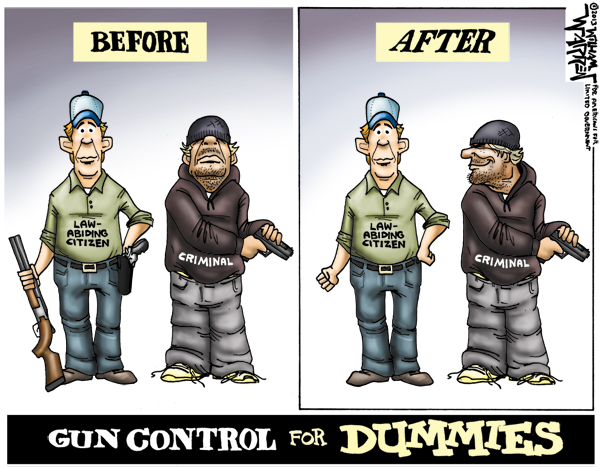
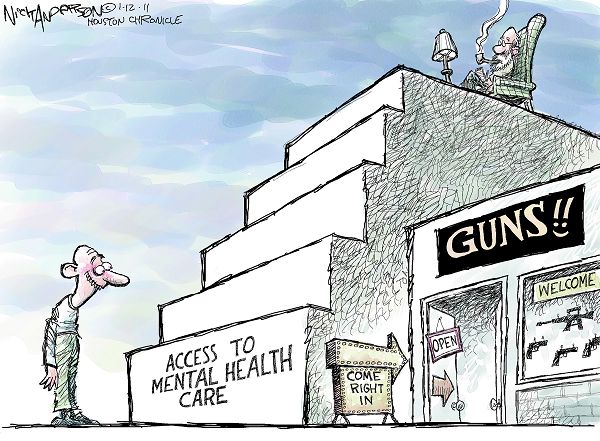
They picture this weird image:


Yet they never consider this tragically true one:


The idea that more guns simply make society more dangerous and making them easily accessable merely helps criminals and delinquents seems foreign to them.

To add something from the most recent tragedy: the strict gun control laws in Conneticut worked and Adam Lanza was turned down from legally purchasing a firearm because of mental health issues, however he obtained his mother's semi-automatic Bushmaster rifle and two pistols which were unsecured in her home and he had easy access to. Had this not been the case then it is certainly probable that Mr. Lanza never would have been able to carry out his shooting. The simple fact is that Conneticut's restrictive gun laws prevented Lanza from obtaining a weapon on his own, but the lack of any regulation requiring his mother to safely secure her own weapons allowed him access to them, and the end result was tragedy.

Had any such restrictions and laws been in place it is conceivable Lanza would not have been able to carry out this attack. However, as I have conceeded before, if Lanza was indeed determined to carry out this attack he most likely would have found a way to either a) legally obtain a weapon from another state or b) buy one on the black market.

I personally believe that the attack shows signs of being premeditated, but the weapons he ended up using were from convenience.

The fact is that unsafe weapons storage is to blame for this tragedy, not any failure of gun control laws and regulations. Does this mean I think weapons should be taken from all law-abiding citizens? No. Does this mean I think that there must be rules and regulations in place on who can buy weapons and how they should be stored? Of course! Depriving a responsible citizen of their weapons makes no sense to me, but the emphasis is on responsible. If a citizen is not going to use their weapon responsibly or be secretive about his aquisition of said weapon he has no business owning it.

However as others have pointed out there are a myriad of problems that must also be addressed before any sort of gun regulation can be implimented in America. States need to actually help inforce federal laws, make an effort to take a stand on closing ridiculous loopholes, and have a national consensus on why they are doing it. Simultaneously background checks and mental health regulations need to be enforced and actual mental health care needs to be accessable. Many of these people are legitimately sick and perhaps, just maybe, if they could get reasonable care they might be disuaded from acting upon their homicidal urges.

Speaking though as a foreigner and someone who lives in a nation with very little gun crime (and a fairly low violent crime rate in general) I am baffled by the nature of American views on weapons. I cannot understand how the right to own deadly weapons is not better regulated or its laws enforced. Cultural attitudes are different and important I understand, but many of the most rabid gun-nuts seem to sincerely believe that the idea of regulation and registry will lead to an outright ban. Speaking as one who lives in a country with some fairly strict gun laws and a registry, we haven't had our rights taken away, our guns aren't being confiscated, and if I so chose (which I probably will someday) I may go and purchase a weapon and have it in my house. Under careful lock and key of course.

The fact is that most of our gun problems are small, and can be pinned directly on the United States. Gangs operating in the cities will frequently simply cross the border and legally (or otherwise) obtain weapons from legitimate firearms dealers, or other gangs who are willing to sell to them. Stopping gun smuggling is actually a big concern of law enforcement here, and it's one we could probably see do much better if the US were willing to enact some substantial legislation of its own. Now that's not to say that if all the guns in the US suddenly disapeared Canada would have no gun crime (although it would drop ridiculously) I do maintain that Canada will have issues with certain weapons (mostly handguns) as long as standards south of the border are lax and allow an easy transfer of illegal weapons north.

I believe that gun control and regulation is important, and essential part of any safe society. I agree that being armed can be a good thing, but that those arms without responsibility and regulation will not protect you.

Those are my two cents for now dear readers, and I hope it's been worthwhile for you.

Friday, 14 September 2012

The Last Pilgrims: By Micheal Bunker, A Review

Recently readers I have finished an entirely new book. It is a book from my favorite genre, the post-apocalyptic sort. It revolves around an interesting post-apocalyptic premise and has a unique view on the post-apocalyptic situation. This week I bring you, The Last Pilgrims by Micheal Bunker.


This book I picked up after seeing it advertised on other sites and having visited the book's website and the author's blog. The book and author presents a unique view point on life and a post-apocalyptic scenario in general. It could count among science-fiction, but the only real science fiction element I would say it has is the quickness of the collapse in the beggining (two-weeks or so) which firmly sets it out of that genre and into the regular post-apocalyptic camp.

I've heard many comparisons of thie book to the Hunger Games, or the new TV show Revolution. To which I say, well there are a few comparisons to be made yes. One of the main characters (Ruth) does use and bow like Katniss, and yes like Revolution it is a world where there really is no modern technology and most people don't use electricity as it is unavailable. Otherwise this book stands out as something completely different in its own right, in a good way!

The story itself centers around an area in West Texas and the community of the Vallenses, an Amish-like plain people who are a thriving religious community in a fallen world. Their model of prosperity however sincerely irritates their large and powerful neighbour, the King of Aztlan, who wants this land for himself. A free independant people of course cannot be tolerated.

The story is really a retelling of the struggles of the ancient Waldensians a group of Evangelical Christians who defied the might of the Catholic Church and suffered horrendous persecution at the hands of its agents before the survivors fled to the New World.

The Good:

Micheal Bunker establishes right off the bat the kind of world we are seeing. His prlogue gives us an excellent synopsis (if not the outright cause) of the collapse and its extremely quick escalation from mere economic downturn, to minor nuclear war. Thus American (nay world) society as we know it is thrust five hundred years into the past with petty kings and lords taking up claims and projecting their power through armies of thugs. This would go ill for the pacifist Vallensian people were it not for the emergence of the Ghost Militia who are dedicated to fighting Aztlan and by extention protecting the Vallenses.

We get a clear look at the local political situation (the world one being understandably sketchy) and see just why the Vallenses are so persecuted. The king of Aztlan hates them as they are a large successful nation who are a) opposed to his rule b) setting a successful example for rebels from his own lands to follow and c) follow a faith that diverges markedly from the corrupt political Church in New Rome. Indeed he rightly fears his people taking this example and rebelling against him. The only reason he has avoided outright war thus far is internal problems, and the dogged persistance of the Ghost Militia killing his raiding parties.

Now though twenty years after the collapse, he is turning his attention to stamping them out completely. Thus our story opens with Jonathan Wall, respected leader of the Vallenses, sending a plea for help to the King of the South States. Unfortunately this is interrupted when a would be assassin just misses his target. Here we greet Phillip, the leader of the Ghost Militia as he saves Wall and brings in the assassin, Gareth, who has a ulterior motive of his own...

Then on we follow a colorful cast of characters, Jonathan's daughter Ruth, a militia rider named Timothy, a Aztlani knight named English, and Jonathan's son David.

Each character brings something unique of their own to the story, Ruth in her growing up experience, and David's internal conflict between his faith's pacifistic nature, and the brutal reality of the war creeping down upon them.

The dialogue is good, well written, but often slightly to mild mannered for my taste. Though it does serve to show how society has fallen down with the disapearence of so much of the modern slang that we know, verses a more eloquent and Biblically reflective speech that would come from a deeply religious society. This is though contrasted with the speech of those from Aztlan and beyond.

The war itself is put in very brutal terms, with heartwrenching atrocities and brutal battles. Though we clearly see that Aztlan is the evil agressor and the Vallensians a normal people caught in the middle of a territorial and religious conflict. The battle scenes though, are spectacular. You feel as though you are right in the middle and Bunker's keen eye for these details gives you an impressive mind's eye view of every fight and each tactic undertaken by the combatants.

The moral, and philisophical issues brought up by the many characters will leave you asking deep questions yourself about how prepared you are in your own life, and of course in your spiritual life.

Micheal Bunker is also something of a philosopher, practioner and writer in the world of prepardness (and if you visit his blog you will see he has a refreshing habit of practicing what he preaches) thus there is a great element of prepardness and self-sufficiency in the novel with some unique and interesting ideas that readers interested in such things may find interesting. There are also a number of health facts and tips that are pleasantly surprising (organic beer anyone?).

We also get lovingly beautiful descriptions of Texas and the landscape. The blue skies, the wonderful countryside, the deadly desert, and of course the Wall ranch which is given loving detail and sounds like a truly wonderful place to live. In fact the author has made me sincerely want to go visit this beautiful area sometime in the future.

The author has an expert way of reeling you into the story and making you care about the troubles of the Vallenses and the epilogue left me feeling both heartbroken, hopeful, and intrigued.

The Bad:

Unfortunately like all novels I read it does not get a complete pass.

Most of my issues with the book were minor, a lack of comprehensive detail and timing is one. The lack of comprehensive detail left me fuzzy on certain aspects of what was going on or how certain characters looked, I was extremely confused as to David's appearance for some time actually, and I found The Mountain was given a mean lack of characterization early on in the novel, which would have saved considerable trouble later on. The major characters, such as John, Phillip, Ruth, Gareth, and Timothy, all recieved adequate page-time for me to epmhasize with them and get an understanding for their motivations and troubles. Characters like The Mountain, and Piggy needed better characterization earlier on so we could get a better view for what they did later in the novel. That and I didn't find a good timeline of when these events started, and when they finally ended.

Also the Duke of El Paso. This is merely a personal pet peeve of mine but he did not make a good villain. Described a short, wearing boots that make him look taller, child like in appearence with a high picthed voice and ridiculous accent, he was a caricature. Thus he made for an extremely irritating character whose redeeming feature was we did not have to see him much. He exuded no sense of menace or threat which made me heave a heavy sigh and wonder what the King of Aztlan, who sounded much more sinister, was up to. It wasn't until we met Sir Jarius Whiteside, Chancellor of Aztlan, that I felt much real respect for the villains themselves. Sure they had clever plots but the offscreen nature of them left me feeling a little underwhelmed by their impact initially until we got about half way through the book.

Then of course there was a minor bit of consistency between the beggining and end of the novel. I found the low tech, and scavenger society of this world fascinating. But earlier on we are told that guns are heavy, difficult to use, and ammo is hard to come by. Then near  the end we have gun battles taking place on the large scale! It was something of a continuity error that left me scratching my head after but if one can put it aside it doesn't harm the book at all.

My one final nit-pick is that I found it to short! Not a criticism per-say but I am hoping for more by Mr. Bunker and hope that as he gets his writing legs under him he will begin writing longer works so I can keep reading longer!

The Verdict:

Overall this book is a wonderful read full of rich characters, an exciting world, excellent survival tips, and a sense of the holy and pure as well, which is immesely refreshing.

I have been impressed by Mr. Bunker's writing thus far and I eagerly await the upcoming sequel Cold Harbor and its continuation of the tale of the Vallenses.

The Last Pilgrims has been an enjoying read which kept me guessing for most of the novel. It was also a very happily unique post-apocalyptic fiction with some (thanfully) tasteful morals and a good message throughout. I would be happy to read it again and certainly will. I encourage readers who are interested in post-apocalyptic fiction to pick it up and read it, you will not be disappointed. I am glad to advertise for Mr. Bunker and let people know about his wonderful and original work.

4 out of 5 stars for this piece of wonderful literature.

Saturday, 28 July 2012

Stopping a Massacre

So inevitably since the Colorado shootings at the latest Batman movie we have been seeing an explosion in arguments about gun control or less restriction on gun control and what have you. Either way idiots from both sides of the playing field have been going head to head claiming their way is the best and they can prevent gun crime. I personally live in a nation where we do have restricted gun access and as recent news has shown the official restrictions on guns do not prevent them from illegally falling into people`s hand nor from people using those guns to kill other people by one iota. I`ve always said that if people want to find a way to kill one another they would whether they had guns or not. Sad to say though that here in Canada or even in gun restrictive Europe, history has shown time and time again that no matter how much you restrict guns, some mad individual will still be able to find one and kill people.

Now on the opposite side of the fence we have the argument from those advocating no gun control are those who say that one man with a gun could have prevented that massacre in the movie theatre. Yes that's right folks, somehow one man with a gun was going to successfully engage an armored target in a dark movie theatre and save lives!

Now disregarding the obvious madness of engaging in a gunfight in a crowded movie theatre let's just review a few things shall we? One is that I am personally an advocate of the average citizens right to bear arms (baring military hardware however) and to defend himself using said firearm. I also have no qualms about having to sign a form with my guns registration and serial number and handing that form over to a government database. If you sincerely have a problem with law enforcement knowing you own a gun I highly doubt you should be trusted with one.

Back to the madness of the theatre business though. I suppose if we ignore the circumstances surrounding the incident one can actually argue that the basic premise (an armed citizen can prevent a massacre) does have some truth to it. Mind you this is something of a very small chance.

To use the theatre massacre as an example, the target was throwing smoke bombs, wearing body armor, could fire indiscriminately, and had surprise on his side, let's just say the chances of a gun user actively hitting and stopping this guy without incuring collateral damage of his own are dramatically slim. But how about if the man had been in a crowded shopping mall with better light and visibility? Well again statistically the chances are extremely small this wouldn't incur just as much collateral damage as a shoot out in a theatre. Can the average person be expected to take a good shot under stressful circumstances surrounded by blood fear and chaos? Not really. That is why we have trained professionals afterall.

Contrary to the ravings of rabid gun supporters the average person is not the most reliable gunfighter. And contrary to anti-gun nuts it means that the average person (even those that practice regularly) is not extremely reliable at shooting past a certain range.

Now I certainly agree with the gun crowd that an armed society (especially one in the West where we are not desperate) is one that is more likely to have a lower crime rate (in relation to violent or random crime at least) but what most of those people forget is that while this weeds out the less confident and more cowardly criminals from occasional acts of bravado, it does leave us with the more dangerous, hardened criminals who are more likely to ambush and kill someone rather than simply attempt to mug them. A stellar trade off? Not really. There are of course a myriad of factors which makes the statement 'An armed society is a peaceful society' quite untrue.

However, an unarmed society is one which is certainly more dangerous to live in. No means of self-defense is inevitably worse than having to deal with the occasional dangerous criminal and leaving ones self at the mercy of petty thugs.

But does this have any bearing on preventing a massacre? In reality no. There is very little one can do to prevent an indivudual from simply buying (legally or otherwise) a weapon and then turning it on his fellow man. No legislation, police force, government, or individual is capable of stopping a man from walking into a theatre and opening fire if he is determined to. The fact that both sides of the debate jump to meaningless conclusions about laws and regulations is really quite stupid. The real focus must be the tragedy and how we can help the victims.

There are a plethora of better ideas for trying to stop potential mass murderers like the ones listed here which have much more substance than the simple 'ban all guns' or 'everyone should carry one' that gets thrown around like so much monkey feces.

We must all remember that right now the most important thing is to pray for those wounded and the families of those who have lost loved ones. Because really if we can't do that, then the whole debate is moot anyways.

Wednesday, 21 March 2012

Enemies Foreign and Domestic: A Review

Enemies Foreign and Domestic is book one in a series of the same name by author and general gun nut Matthew Bracken. The story is set in "America in the near future" following the steps of one Ranya Bardiwell and a certain Brad Fallon (a sort of author expy). The follows them as they attempt to uncover a conspiracy behind a terrorist attack and the subsequent attempt to ban guns.

Terrifying isn't it?

I read this book through a link found on the website SurvivalBlog (a wonderful website for disaster prepardness, if not so much for politics) and began taking a look at it online. The first few events in the book are actually fairly intriguing. The prologue details a horrifying terrorist attack where a sniper fires into a crowded football stadium and the resulting panic and stampede of horrified spectators results in the collapse of the structure in a manner similar to what one sees in soccer riots, which ends in the deaths of over a thousand people in horrifying detail. This event truly did serve to suck me in and captivated me with its sheer horror and the well thought out plan by this terrorist, which we then learn may be part of a sinister conspiracy.

Sadly this turns out to be one of the most exciting and reasonable incidents in the book. We then see a case of monumental stupidity on the part of government and law enforcement officials in the part of contaminating evidence and breaking multiple layers for the proper handling of a crime scene in order to prevent just such contamination. For instance the local police chief accepts the attackers wallet while not wearing gloves and the president actually orders that the shooters weapon be brought to him. This is the kind of action that would get a politician impeached yet it completely passes under the radar of anybody (even the otherwise 'smart' protagonists).

It then follows a short battle in the Senate where a very strange law is passed outlawing 'assault rifles' which is in reality a wide ban on anything that looks remotely threatening. During the proceedings a female senator is attacked by an anti-gun supporter for some reason. Then we join our spectacularly bland and almost author-expy Brad Fallon whose life goal is to build a sail boat and sail away. He's only almost an author expy because he believes in sailing away rather than fighting to save America, otherwise his opinions and goals go hand in hand with the author's(especially his fascination with sailing and guns, he really likes harping on those). He is a bland and rather unremarkable character who spends much of his time fantasizing about bikini clad women, who is then targeted by the FBI to spy on a gun club which is a militia front (composed of men in their sixties no less) because he is seen with them exactly once in a coffee shop. That's some fine police work gentlemen!!

We are also introduced to the ATF agents who are behind the investigation. They are typically evil and in a (not so) suprising twist are masterminding the events behind the stadium massacre in order to get guns banned and make the ATF more powerful than the FBI! To do this they decide to run a dirty war like in Argentina or Brazil by murdering or kidnapping gun store owners and labelling them as militia fanatics. They make rather lackwit villains who are remarkably unintelligent and are constantly reffered to as being men with no discipline and are very trigger happy, and they prove it too. Despite the fact that they openly discuss planting evidence and framing people the rank and file still believe they are fighting 'militia gun nuts' and not blatantly murdering people. That was one of the issues that I could not get over while reading this book. The bad guys know their framing people yet still believe they are fighting the admittedly non-existant militia? Seriously? But I digress.

We then meet Ranya Bardiwell whose father is shot and killed by ATF goons burning down his gun store. The ATF then leave amazingly detailed forensic proof of their involvement in the form of 10mm casings from their guns and distinctive boot prints at the scene. (Also apparently malt liqour is indicative of liberals, these bottles indicate they are the people who threw the molotov cocktails that burnt down the store. I still don't understand that either). Ranya then swears revenge and goes on to attempt to blaze a path of bullets and assasination across Virginia and South Carolina against the Feds.

This is where the book mostly meanders into interesting action sequences followed by various detailed instructions on how to plan political assasinations. Then of course are the anvilicious moments where the author repeatedly reminds us that liberals are hypocritical idiots and there is no such thing as a free country outside America. The main characters repeatedly state that they cannot run anywhere as there will never be anywhere as free as America. There is no detailed reason for this and one is forced to assume that it is mostly because they won't be able to own their beloved guns if they go to Canada or Europe. I sympathise with their plight...not in the slightest. Another point which the author enjoys driving home is that most people are blind sheep (or sheeple as the common term is) who blindly follow the news and do no critical thinking of their own and will instantly cringe at the sight of a gun or attack freedom loving Americans who support the Constitution at the drop of a hat.

Indeed the author enjoys flaunting the superioty of gun owning, libertarian, Constitutionalist, conspiracy theory, and Christian Americans (I add the Christian part tenatively as they talk about faith but rarely even reflect on the moral issues of their actions or pray for that matter). I add conspiracy theory because the author constantly states that the Branch Dividians at Waco were burnt alive on purpose and the Ruby Ridge incident was a government slaughter rather than a colossal f**k up by poorly trained agents. The author explains these through a web server known as "FreeAmericans.com" where various liberty loving Americans gather to discuss how the government is infringing upon their rights and how the FBI, ATF, CIA ect are secret police thugs who intend to take away their rights. Brad Fallon is particularly guilty of this as he is constantly berating regular people for not thinking about these things. Not to mention anyone who is even assumed to be liberal is mercilessly mocked by the main characters. A particularly ridiculous incident is when Ranya comes across a boy researching the Civil War and asks if he is researching 'the War of Norther Agression' much to his confusion while she keeps referring to it as such, then assuming he was only staring at her breasts. I doubt the author actually meant to have a liberal character come off as reasonable and probably smarter than his main character but it reads that way.

In fact the author goes out of his way to make liberals look stupid or foolish. In fact by reading this book we can easily discover the authors prejudices such as:
  • Smoking pot = stupidity
  • Piercings are only worn by liberals or sexual deviants
  • All liberals secretly hate the Constitution and are secretly 'socialists' who know nothing about freedom or good government
  • Illegal immigrants are parasites who barely speak English
  • Illegal immigrants also seek to steal American jobs and support a break away socialist state in the South Western US known as Aztlan
  • People who don't own guns want them banned and constantly look for ways to get them banned
  • The Federal government is mostly staffed with incompitents who don't care about freedom or liberty
  • Lesbians seek to steal children from married couples
  • Muslims are inherently violent and are all crazy
  • Muslims are also mostly hypocrites and hate mongers who want to impose Sharia law on Americans, anyone else is just a terrorist
  • Political correctness only serves to protect Muslin terrorists and Black Nationalists (or a combination of both) and serves to encourage Muslim racism
  • Also any of the above are very willing to engage in rape
Sadly this is just a taste of the racist and ridiculous comments that Mr Bracken enjoys spouting.

The novel is boring, repetetive and filled with card board cut out characters with no depth who seek to drive home the authors flawed ideas about gun ownership and the evils of Muslims and political correctness. Mr Bracken also suffers from a crippling case of 'write what you know' and unfortunately seems to only know how to describe sailing, guns, racism, how evil liberals are, sex, and the idea of America being the best nation on Earth. If you come across any of his other works I assure you that this will become immediately apparent.

Now some will undoubtedly ask why, if this book was so appaling, I bothered to finish it? The answer is quite simple, I got it for free on Kindle and the little I could read of the prologue intrigued me. Once I got deeper in I was horrified by the right-wing reactionary hate that the book preached. It also serves as a perfect example of how not to write what you know and how not to get your ideas across.

From me the book recives a one star out of five.

Thursday, 15 March 2012

Guns and Liberty

I recently attended a presentation offered by a university group of mine called 'LOL' standing for 'Love Of Liberty'. The presentation was offered by Solomon Friedman a pro gun advocate and laywer in Canada. The presentation was called "Firearms: The Foundation Of Freedom". It was a good presentation, mind you much of the content was when Mr. Friedman explained the many redundancies in the Canadian firearms laws.

Now I personally support the individuals right to bear arms (barring military hardware of course, a category which to me includes fully automatic assault rifles simply for the sake of consistency) and for a law abiding member of society to hold them. I have seen very little reason for someone to wish to abuse their right to bear arms nor have I routinely heard of legally registered firearms being used in criminal acts. The presentation did make the valid point that a criminal is not going to get their firearm registered before he kills someone or commits a robbery. Indeed we see murders and muggings commited with knives and crossbows for heavens sake, banning guns does not decrease crime.

The enlightening legal facts presented in the talk were interesting but the presentation itself was, in my opinion, an atypical gun owners argument which was unoriginal, poorly thought out, and offered me very little incentive (especially as a non-gun owner nor would I imagine this having any effect whatsoever on someone in the opposite camp) for any support to allow firearms to be more readily accessable.

You see I do respect Mr. Friedman as he had a wonderful grasp of the law and statistics in crime and other variable facts about how guns did not increase crime but rather did show some evidence for decreasing it, which may be difficult for some people to believe. Though to that I give you one of Mr. Friedman's best arguments, the 'bowl of M&M's argument'. If you are presented with a bowl of M&M's and informed that just one of them is poisoned, are you going to reach in and grab one? You may, but a less reckless person would move on to the next bowl. The same can be said for presenting your average criminal with a town where many people have guns, he will most likely go after those less able to defend themselves rather than those who will.

But the meat and potatoes of Mr. Friedman's presentation did not revolve around those arguments. Luckily for those present I was at least sympathetic to their goals else there may have been more dissention from myself and others. But the mainstay of the presentation revolved around guns preventing tyranny, yes that old libertarian (and rather uniquely American) nugget. Despite gross evidence to the contrary all across history at showing how an armed populace simply does not outright prevent tyranny, Mr. Friedman listed some tyrannical regimes that had disarmed their subjects. The Soviet Union, the PRC (China), Guatemala (with the disarment of the Indians), and of course Nazi Germany and its disarment of Jews. I constantly hate seeing these hollow, misguided, and rather foolish ideas thrown around.

If I may cite two of the examples. The Soviet Union for starters, Friedman's presentation mentioned the twenty million worked to death or killed in the gulags (which is only scratching the surface really) of the Soviet system. The idea that having an armed populace would have prevented such mass arrests or imprisonment forgets two harsh realities. One was the long brutal war fought during WW1 which the Soviets had promised peace for (much to the happiness of the population) and the second is the following Russian Civil War which ravaged the country. There was armed resistance to the Soviet regime many times early on in its inception and throughout its history. People still had hunting rifles, and in some cases even hand guns. But maybe not the majority of the population. Even if they had what chance did they stand against the Red Army and the ruthless regime behind it? To answer that question, none. I shall explain what I see as the foundation for liberty in a moment, but now on to my pet-peeve example.

The almost standard example for the horror of disarming citizens is Nazi Germany. I had hoped against hope that this would not be shown as an example but sadly stereotype and apparently predictability proved me wrong. The example of Nazi Germany is one that explains the Jews were explicitly disarmed and forced to be segregated. Now I must again point to the painful portion of history where we can see what most likely would have happened to an armed Jewish population that did resist the insane Nazi regime. Kristallnacht was an orgy of violence, arson, and murder instigated by the Nazi regime when a Polish Jew shot and killed a Nazi official. The films and personal testimony of that horrible night stand out as a stark reminder of why racism and tyranny should never mix. But they also serve as a window into what would have happened had the Jewish population resisted in such a violent manner. Thanks to the prejudices, and ignorance of the time it would have been an even more wholesale and horrifyingly willing slaughter of the Jewish people in Germany.

Similar was the Warsaw Ghetto Uprising, valiant and heroic though it was, it was sadly and ultimately doomed in the face of an all to willing Waffen SS to exterminate everyone involved. These brave and liberty loving men, women, and children all fought heroically but in the face of elite and vicious SS killers were ultimately doomed going up against a modern military machine.

The reason I hate these arguments is that is spits on the memory of all those slaughtered by tyranny. It says 'Oh if only they had been armed, they could have fought' and in retrospect many did, but they ended up no better than those who did not resist. That kind of ignorance only breeds a sense of reactionary thinking which in some ways is no better than making a freedom fighter or terrorist. I despise that kind of argument as it ignores the stark brutal reality that these people faced. As for the Nazi regime it took the power of an alliance of the entire world to crush, and the Soviet system did eventually rot from the inside, but it was not brought down by armed resistors in any way.

Thus is the premise, even the title of the presentation flawed. A firearm is not the 'foundation of freedom' nor is it a great equalizer in the face of tyranny. I can understand the weird thought that comes to mind in many from the cushy and drastically oversimplified view of the American Revolution, but that forgets the valiant arms of French and Spaniards who drew away the eye of the British preventing the utter collapse of the American rebels. In that naive view I suppose those who believe this can be forgiven, but the idea of applying such to the different regimes around the world is pure folly.

To end this, I shall briefly detail the true foundation of freedom. The foundation of freedom does not, with added emphasis on does not, lay in violence. Instead it lies in, political will, popular will, honest government, checks and balances, and just as importantly a service sworn to the people and state. Political will is the want and desire of the people for fair and honest government, popular will is the desire of the people to excersise the right of democratic ideals in a country. Checks and balances is a government which has been given a set of restrictions on its power and ability to excersise power (like those laid out in the Amercan Constitution, or the Monarchy in the British Parliament). Finally there is the service sworn to the people and state, much as a member of Her Majesties armed forces swears an oath of loyalty to the crown for reasons of political neutrality so to does an American serviceman swear an oath to ensure the same thing, much like any government service member. A neutral army and civil service is an essential check and balance in maintaining a free government, which is one loophole many tyrants have worked into their governments. Hence why the very political militaries of the Middle Eastern dictators continue to support tyrants and why the Libyan armed forces were split allowing them to fight the despot Gadaffi head on (with foreign intervention of course). So while the right to bear arms is important, it in and of itself does not make for the foundation of liberty or a fair and honest government, rather other more political measures are necessary.

While I respect Mr. Friedman and his agenda, I do not respect these lame duck and blatantly false assertions that many of the pro-gun crowd are forced to fall back on. I would insist that they stick to tried and true statistics as Mr. Friedman presented in the presentation regarding crime and others about institutional rights (which we Canadians unfortunately do not have). All in all I support the ideas, but the message is flawed.