In the past few days I've been watching with almost abject disbelief as across the United States people have suddenly begun protesting the existing quarantine and stay at home orders. Among their ranks seem to be many members of the so-called preppers (along with a disturbing numbers of alt-right individuals and those waving the Confederate flag). And many of these protests seem, well, extremely stupid. Especially for people who call themselves preppers.
First thing is first, yes this is a pandemic and its a worryingly virulent one. Not deadly per-se, but worryingly virulent. We have to be extremely thankful that we were able to catch it and set up measures designed to keep the virus from getting worse.
Before moving on, let me state this, people who are able to stay home or are non-essential are absolutely doing the right thing. They are working to stop the spread, bend the curve, and ensure the virus does not afflict the general public more than it already has. It is literally the least one can do to endure this somewhat cozy catastrophe we currently find ourselves in.
Secondly, despite the title of the article, I want it to be clearly known I am not in any way shape or form anti-prepper. In fact, I identify as one. What I'm going to be calling out today is essentially 'survivalism' as over the last few years I have noticed that it has largely taken a turn from an idea of general preparedness to simply embracing an apocalyptic vision of the destruction of society. People should not take that view and then assume everyone who prepares (or preps if you will) is a bunker dwelling wingnut who is counting ammunition waiting for society to collapse.
To give some helpful information to you, I have to thank the folks over at Worst Year Ever Podcast for providing this helpful link to theprepared.com. They have a lot of useful information for you, and the link itself can help you confront the what seems to be daunting task of preparing to help yourself and others in a time of need. Basically, be prepared to be able to help yourself and others in times of emergency or natural disaster.
Moving on though, I've seen at many of these protests people equipped in camouflage gear with rifles prominently displayed. Many of them talking about their rights with such interesting slogans as "my body my choice" or "I want a haircut" and the message boils down to the government can't make you stay at home. What is clear though, is that most of these people either don't take the ongoing pandemic seriously, or they are simply enraged that the government is quarantining them and keeping them from such creature comforts as haircuts, bars, and coffee shops. Now it's important to note that not all these people are survivalists, and many are spoiled and entitled middle-aged white people wanting to force other menial laborers back to work to accommodate their boredom and personal appearance. But for those out parading with guns and talking about rights, or seeming "prepared" it becomes apparent that these people couldn't be less prepared. Or as I saw one Twitter commentor postulate, this was not the apocalypse they were promised.
The survivalist community has its roots in the culture of the 50s, with dire visions of nuclear armageddon on the horizon, mushroom clouds expanding over every city and society collapsing into anarchy as the government is suddenly driven underground. It evolved from there towards fears of things like famine, Malthusian collapse, and economic depression. The most extreme views probably gained traction in the 70s however as fears of nuclear war, oil collapse and societal collapse writ large set in.
This all gave way to perhaps more extremist elements in the 90s during the Clinton years, fears of Y2K, and then the general conspiracy mindset that seemed to crop up in that era with broad distrust of the government in the US at least. Events like Ruby Ridge, Waco, and the Oklahoma City bombing also brought issues like survivalism into the public sphere, and not in a good way. September 11th began a new wave in the 2000s with fears of terrorist attacks and biological weapons. This probably reinforced the negative view of survivalism. It was a view already present, and one which I walked into when I first stumbled onto preppers in 2009 while cruising the internet.
Now, in that vein, with fears of terror attacks, the perceived threat of dirty bombs and high jacked nukes, coupled with my own childhood experiences, this seemed like a very reasonable worldview. Stock up on essentials, prepare and get away from cities.
Even back them though, I was able to pick up on the dark undercurrent I was able to find in survivalist literature. Way back in 2012 I read probably one of the worst books I've read in my entire life which was written by a survivalist. It largely contained really hateful right wing talking points, pretty terrifying racism and anti LGBT attitudes, conspiracy claptrap, and gleeful murder of the enemies of the protagonists. Another book which I only read the opening chapter of talking about a modern Carrington Event had the protagonist murder a police officer in cold blood after refusing to stop for him and the officer drew a weapon in self defense.
Yeah, there's some pretty sick survivalist literature out there.
Even some of the better 'survivalist' literature can often have some dark undertones. I was a pretty avid reader/collector of prepper recommended fiction in the 2010s, and let me say it can be disturbing at times unless you implicitly agree with the views of those who wrote it.
Some common themes were; total breakdown of society, looting and rioting on a spectacular scale, violence breaking out swiftly as social bonds collapse, and tyrannical government taking hold. Violence and rape was a common theme. The 'unprepared' becoming ghoulish criminals almost overnight and large cities falling into orgies of violence and murder where the 'golden horde' would spread out and devastate the countryside was a common theme. In more extreme scenarios like nuclear attack and EMP that might be semi-accurate as modern society is suddenly and rudely thrown into uninformed chaos, but by and large that just isn't true. This view of humans as violent animals was common in books even where society just fell into economic collapse.
Most of this fiction focused too much on almost fetishist description of guns and ammunition, violent confrontations with looters and bandits, and eventually a group and their preferred ideology emerging from the chaos and setting the world right.
There was very little about the more mundane inconveniences. Long lines at stores, no reliable electric power or internet, no barbers, and the problems faced by being isolated together for a long period of time even with friends and loved ones. Not even about the sudden loss of our supplies of toilet paper! These problems it seems, are far more pressing and important than preparing for a shoot out with gun wielding looters.
Indeed, this pandemic perhaps shows how hollow all this fiction is, and that it is more reflective of those who write it rather than society as a whole. As the world has faced massive privation and fear over a fast spreading disease, people have by and large banded together, helped each other out, and obeyed social distancing guidelines. Acts of kindness have been the norm, and people have gotten together and talked, even handing out supplies. My own family were the recipients of clothe masks by a kind neighbor who was making them!
Contrary to what survivalist literature has expected, cities have not devolved into riots, the government has not taken steps to deprive people of basic liberty, and we haven't seen a massive spike in crime. In fact, in my own Canada at least, the reaction has been largely a peaceful process of self isolation and community support and outreach. All across the world much the same is happening, and people are earnestly trying to stop the spread of the disease.
Why then is this upsetting many survivalists? With my comments on their fiction above, and the words of that Twitter comment in mind, you may see why.
People reacting calmly, reasonably, and no massive government overreach flies in the face of their world view. There is no Hobbesian war of all against all, and other than panicked sell outs of toilet paper, people haven't really done anything stupid by and large. This is not what was expected, and those who have been expecting societal collapse seem to have been shocked by that. The people who stockpiled bullets and ammunition are suddenly the poor cousins of those who stockpiled canned food and community good will.
Of course this doesn't speak for all of them. But the extremists, those who seem to have earnestly believed they will be the ones to outlast the 'sheep' in society, they seem to be facing the fact that prepping is more mundane and, dare I say, boring than their fiction led them to believe. There is no tyrannical government plotting to take away their rights, people are not dying in the streets, and calm and measured response proving preferable panicked looting. So instead, they must act as though orders to quarantine, and being inconvenienced from their creature comforts, are what they must fight against.
As I said before, this is stupid. Right now we are riding a very mundane wave of disease, potentially only the first wave, and we are only asked to do the bare minimum to stay healthy. For economic reasons I can understand many people are frustrated they can't work and might not be making money (especially in the United States) but to demand an end to quarantine because you want a haircut? Or to be going around with your ammunition fearing government tyranny because of social distancing orders? That is simple unpreparedness, and it sadly lays bare that many of these survivalists, might not survive the inconvenience.
Stay home, stop the spread.
The internet lair of Matthew Stienberg. A blog where my thoughts, ideas and writings can be seen!
Monday, 4 May 2020
Monday, 27 April 2020
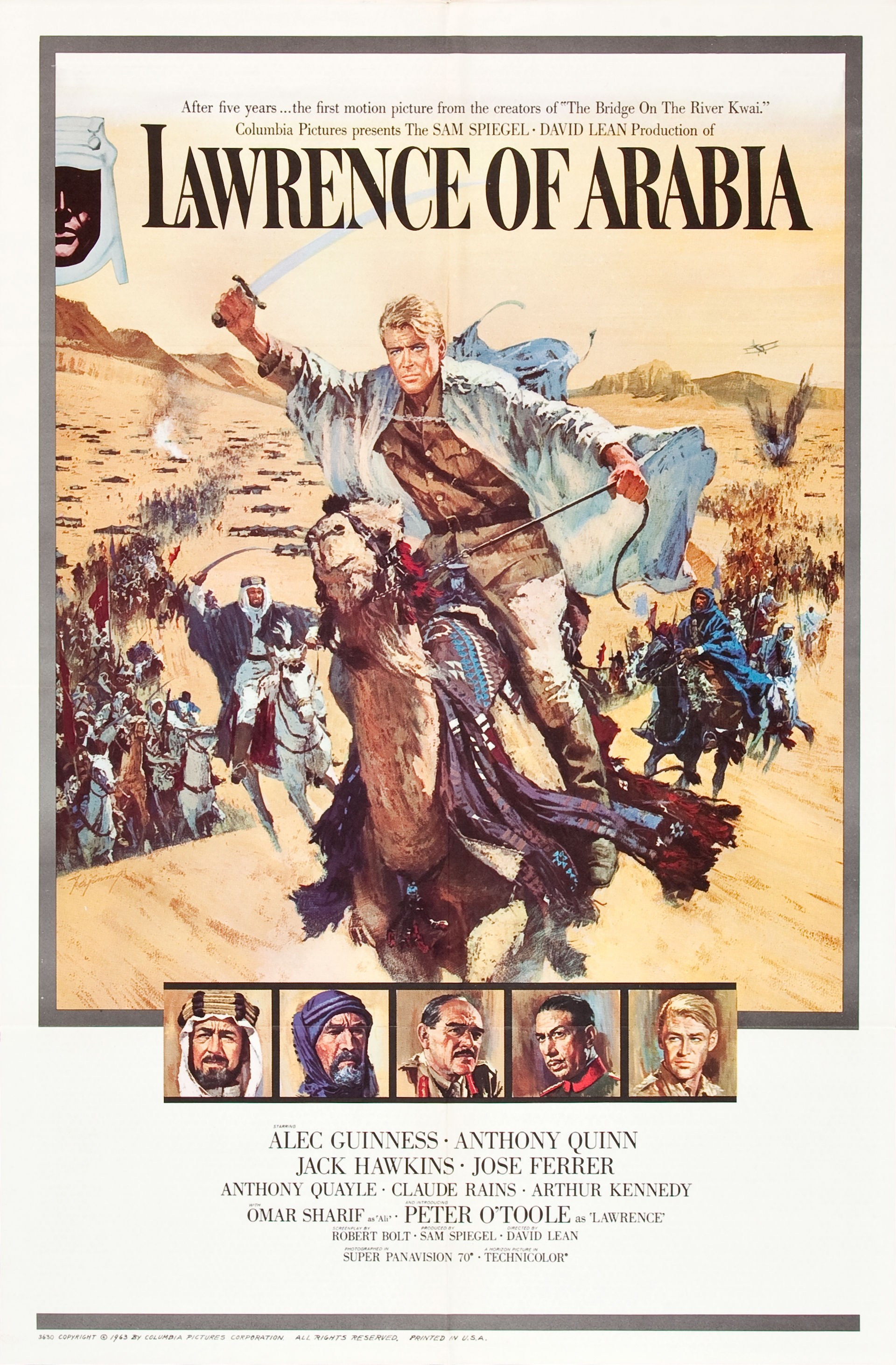
Retro Review: Lawrence of Arabia
In 1916, a man set off across the desert to seek out the peoples of the Arabian peninsula, then in revolt against the Ottoman Empire. In doing so he would live on as a hero and a legend in the English speaking world. That man was Colonel Thomas Edward Lawrence, otherwise known as Lawrence of Arabia. His deeds inspired many stories from both the First World War and then again in its aftermath as tales of his daring-do were embellished by the media and pop culture, particularly by a great song by Sabaton inspired by the title of Lawrence's own book. One of the most famous of course, would come in 1962 with the film bearing his name Lawrence of Arabia.
Now just to get something out of the way, this film is not by a long shot historically accurate. It contains many embellishments and occasionally outright fabrications of both the man himself and the people he worked with. So don't view this as a documentary or factual commentary on Lawrence's life and wartime career. If you want information on that I sincerely recommend a review by History Buffs examining the film, and the excellent work done by the Great War YouTube channel in examining both the war itself and some about Lawrence. Both are great channels that deserve your time and attention.
Without further adieu, let's get to the review.
Filmed in 1962, the movie was directed by David Lean, a great British film director of the time period. It has a quite amazing all-star cast with Peter O'Toole as Lawrence. The man looks so much like Lawrence that it would have been hard to justify not casting him. Then you have Alec Guinness (of Star Wars fame) playing Prince Faisal, both a real character and an amalgamation of other important Middle Eastern leaders, and doing it quite well. Next we have Anthony Quinn (Antonio Rodolfo Quinn Oaxaca) as Auda abu Tayi, an important tribal leader (and real historical figure). Following up you get Jack Hawkins as General Allenby, and he is further famous for his role in what was probably my favorite childhood movie Bridge on the River Kwai, and he delivers a stellar performance here. Then we have Omar Sharif, a famous Middle Eastern actor and of Doctor Zhivago fame, who portrays Sherif Ali, a fictional character who serves as an amalgamation of various other important Muslim characters from the source material. Finally we have Claude Rains as Mr. Dryden, a very cynical and almost sinister character who first helps Lawrence, but really only represents the interests of the British Empire through the Arab Bureau.
A brief note is that yes we do have a few characters in what amounts to blackface playing Arab figures. If you're uncomfortable with that I wouldn't suggest watching this movie as it doesn't really draw attention to that fact, but it certainly doesn't go out of its way to hide it. The movie is a product of its time so it definitely has some questionable choices in how it tells the story, but for all that, it is still a great film, probably one of the best of all time really!
Plans to make a film about Lawrence's life and his wartime exploits had been in the works for years, but they had all fallen through. Plans to make a film in the 1940s were shelved due to various financial difficulties in Hollywood, while in the 50s there were many discussions, but none ever went anywhere. Thankfully the work done on Bridge Over the River Kwai by director David Lean and producer Sam Spiegel. Having worked together before they became interested in another historic collaboration and thankfully decided they would jump on for another one by buying the rights to produce an adaptation of Lawrence's book Seven Pillars of Wisdom in 1960.
Shooting in such exotic locations as Spain, Jordan, and Morocco it managed to capture the desert feeling it was searching for, and thanks to the work done to bring the feeling of being in a visually appealing wasteland to screen, when you watch this movie you really feel transported to another world! It's had visuals homaged and spoofed in films like A New Hope and Space Balls. The city of Seville in Spain was used as a stand in for Cairo, Jerusalem and Damascus, pulling triple duty as a the capital of three modern countries!
The score was composed by Maurice Jarre and performed by the London Philharmonic Orchestra, and was composed and scored in just six weeks! This is a truly phenomenal feat and the movie is well worth seeing for the sound track alone. Though at nearly four hours long it does come with a scored intermission so you can resume watching at a later date!
Visually, this movie is breathtaking. The sheer spectacle invoked which shows the sweeping drama of the Arabian deserts, the heat of battle, and amazing shots done to show off the acting range of Peter O'Toole and Omar Sharif is quite impressive. Wide views of the desert and shots done in large rooms and offices for powerful effect each bring either wonder or quiet dread. That quiet dread is especially important in the political scenes, which all seem to be against Lawrence and his Arab allies, making the pomp and power portrayed in them all the more sharply contrasted with scenes of sprawling Arab camps with some riches but nothing so imposing as what is available to the British officers and politicians.
In shooting the battle scenes we have many amazing views, both of sweeping vistas with hundreds of extras on camel or horseback and then close in shots of the sort of tame 1960s era film carnage. One of the most amazing is filmed of the aftermath of the historically accurate slaughter of a Turkish column as it was retreating from the British after massacring the village of Tafas. This is perhaps one of the most interesting scenes as it shows the films portrayal of Lawrence succumbing to his bloodlust he has been developing since the beginning of his time in Egypt, and he revels in the slaughter of the Turkish column, laying about with his pistol almost indiscriminately, even shooting the corpses of Turkish soldiers. It was amazing work done shooting this scene, and the sheer pageantry of it must be applauded.
O'Toole's portrayal of Lawrence is only based slightly on the historical Lawrence, but he does an amazing job bringing this character to life on the screen. A man fascinated with the culture of the people he was sent to observe, but also a man not used to war. His first great test comes by solving a blood feud on the eve of battle, executing a man he just saved in order to ensure the two tribes do not go to war before they capture Aqaba. The strain of battle and political double dealing takes its toll on Lawrence, but he also begins to believe his own hype and thinks he can deliver miracles which leads to increasingly risky behavior which worries both his British patrons and Arab allies. It all leads to an exhausted and shell shocked veteran ready for wars' end.
His constant companion, Sherif Ali, is well done by Omar Sharif. The character is a proud Arab chieftain who rules his people with an iron fist, but is also a gracious host and skilled warrior. He believes in the vision of Prince Faisal for an Arab Kingdom, but does not trust the Europeans. Believing in Lawrence's abilities he supports and carries his friend (in one case literally) through the war and tries to help him in the peace. In the end though, these two men are from different worlds, making it difficult for them to stay together as the war ends.
These amazing actors, supported by others, craft an intriguing story which is well told on the screen. I was swept away by the battles and intrigue, and Lawrence's struggles and turmoil were gut wrenching to watch as he was swept up in the war. Though the movie is very long, it is very much worth a watch and I would definitely recommend sitting down and taking the time to watch it. Currently available on Netflix, it is absolutely great way to either spend a day or two evenings transported back over a century to the Great War and the world of Lawrence of Arabia.
Tuesday, 21 April 2020
A Game of Thrones
For the first time in nearly a decade, I delved wholeheartedly into the world of Westeros and the Seven Kingdoms. I begin my reread of the (so far) five books making up the A Song of Ice and Fire series. I start with A Game of Thrones.
Originally published in 1996 this book has set off over two decades of well informed speculation, appreciation and adaptation within the world of fantasy. With board games, card games and the wildly successful small screen adaptation that was Game of Thrones the ASOIAF series has gained enormous traction in both overall media and the fantasy genre as a whole.
It all began here though.
I must admit that at first, I was very resistant to picking up the series. My brother originally stumbled upon it while looking for good books to read. I myself was little intrigued, and instead was trying to continue with various books I was personally reading at the time. I picked up A Game of Thrones very hesitantly and walked into it and came away not unduly impressed. I actually put it down until I saw the first episode of the small screen. Then I picked the book up and read through it as quickly as I could.
This is one of the few times I've really gone the opposite way with a show making me read a book series. My opinion on the show and its ending is available for all to see, so I won't elaborate on that but let me just say I'm glad I'm rereading the book series.
Since then I have sucked a few people into the series, and my brother has never let me live down that it was he that got me into reading it. He was right, I was wrong, and that's all I am going to say about that!
But we start in the foreboding world of Westeros, in the realm of the Seven Kingdoms. Beyond the vast icy Wall a threat of ancient legend is rising, and below conspiracies in the halls of King's Landing threaten to topple the realm into civil war at the worst possible moment.
Our principle view of this world comes through the members of House Stark, little Bran, the girls Arya and Sansa, and the matriarch and patriarch Catelyn and Eddard Stark respectively. They tell most of the tale which we become familiar with, and their decisions will ultimately play a great role in the fate of kingdoms.
The outlying viewpoint characters are those of Jon Snow, a Stark yet a bastard boy unloved by the matriarch. Tyrion Lannister, the dwarf of the rival House Lannister, and finally Daenery's Targaryen, the last of the old line of House Targaryen. These tell separate stories across the Narrow Sea in the Free Cities and on the Wall, showing us separate but no less important plot lines in the whole game of thrones which plays out.
Going back and rereading this book I was shocked at how much my memory had been filtered through the television series. There were bits I had outright forgotten, and characters or subplots I didn't even remember. Getting back into the heads of the characters and their struggles was a very welcome journey for me to take.
The mystery still lies thick upon the story, and the plotting and intrigue between the lords and ladies continue to impress me. I will be thrilled to re-explore where different plots go, and what I find myself learning again as the series is brought into a new light for me.
It opened my eyes to different aspects of the story the show missed, and different perceptions of the characters I had not previously thought about in well over a decade. Ned Stark is a very canny operator who is trying to do what is right in light of his wartime experience, his daughters have both been raised in very different circumstances which influence their decisions, and his wife and sons are all very strong and independent characters. That said, his death near the end of the book shocked me when I originally read it, much as it shocked many other first time readers. The story of Daenery's and her rebirth as it were was also one that I thought I knew, but the reality of it compared to the show did again surprise me! It just goes to show you how much can really be lost in an adaptation!
The remainder of the series is part of my 2020 reread, and I intend to say more about this now ongoing fantasy classic as I dive deeper into books I haven't picked up in over a decade. Rest assured though, it is a series which I can happily recommend to anyone.
Originally published in 1996 this book has set off over two decades of well informed speculation, appreciation and adaptation within the world of fantasy. With board games, card games and the wildly successful small screen adaptation that was Game of Thrones the ASOIAF series has gained enormous traction in both overall media and the fantasy genre as a whole.
It all began here though.
A copy of the book which owes my family and friends nothing
I must admit that at first, I was very resistant to picking up the series. My brother originally stumbled upon it while looking for good books to read. I myself was little intrigued, and instead was trying to continue with various books I was personally reading at the time. I picked up A Game of Thrones very hesitantly and walked into it and came away not unduly impressed. I actually put it down until I saw the first episode of the small screen. Then I picked the book up and read through it as quickly as I could.
This is one of the few times I've really gone the opposite way with a show making me read a book series. My opinion on the show and its ending is available for all to see, so I won't elaborate on that but let me just say I'm glad I'm rereading the book series.
Since then I have sucked a few people into the series, and my brother has never let me live down that it was he that got me into reading it. He was right, I was wrong, and that's all I am going to say about that!
But we start in the foreboding world of Westeros, in the realm of the Seven Kingdoms. Beyond the vast icy Wall a threat of ancient legend is rising, and below conspiracies in the halls of King's Landing threaten to topple the realm into civil war at the worst possible moment.
Our principle view of this world comes through the members of House Stark, little Bran, the girls Arya and Sansa, and the matriarch and patriarch Catelyn and Eddard Stark respectively. They tell most of the tale which we become familiar with, and their decisions will ultimately play a great role in the fate of kingdoms.
The outlying viewpoint characters are those of Jon Snow, a Stark yet a bastard boy unloved by the matriarch. Tyrion Lannister, the dwarf of the rival House Lannister, and finally Daenery's Targaryen, the last of the old line of House Targaryen. These tell separate stories across the Narrow Sea in the Free Cities and on the Wall, showing us separate but no less important plot lines in the whole game of thrones which plays out.
Going back and rereading this book I was shocked at how much my memory had been filtered through the television series. There were bits I had outright forgotten, and characters or subplots I didn't even remember. Getting back into the heads of the characters and their struggles was a very welcome journey for me to take.
The mystery still lies thick upon the story, and the plotting and intrigue between the lords and ladies continue to impress me. I will be thrilled to re-explore where different plots go, and what I find myself learning again as the series is brought into a new light for me.
It opened my eyes to different aspects of the story the show missed, and different perceptions of the characters I had not previously thought about in well over a decade. Ned Stark is a very canny operator who is trying to do what is right in light of his wartime experience, his daughters have both been raised in very different circumstances which influence their decisions, and his wife and sons are all very strong and independent characters. That said, his death near the end of the book shocked me when I originally read it, much as it shocked many other first time readers. The story of Daenery's and her rebirth as it were was also one that I thought I knew, but the reality of it compared to the show did again surprise me! It just goes to show you how much can really be lost in an adaptation!
The remainder of the series is part of my 2020 reread, and I intend to say more about this now ongoing fantasy classic as I dive deeper into books I haven't picked up in over a decade. Rest assured though, it is a series which I can happily recommend to anyone.
Wednesday, 8 April 2020
Why an Independent Confederacy Would Be a BAD Thing
As it is now April, and something of a self-proclaimed "Confederate Heritage" month, I would like to illustrate why a world where the Confederate States of America winning its abortive war of independence would be a very bad thing.
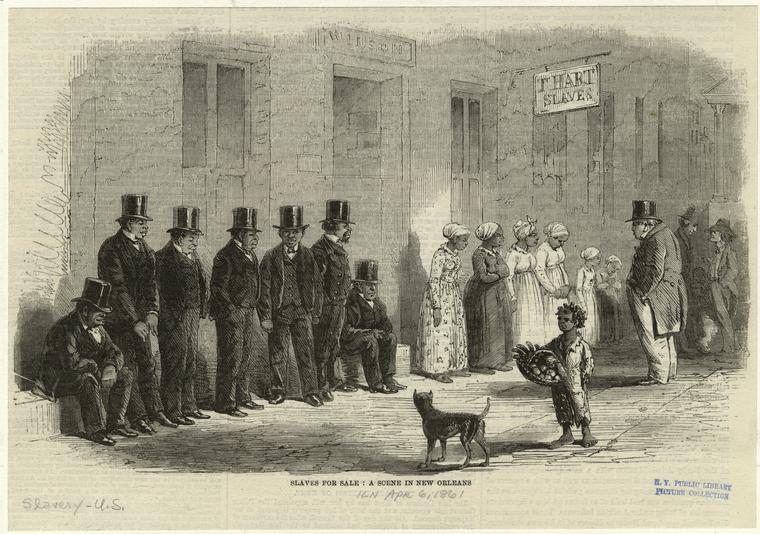
The American Civil War, for those who do not know, was fought from 1861-1865 over the subject of slavery in the United States. Those states which would comprise the Confederate States were all in the deep South, 11 slave holding states whose economies depended on the chattel slavery system which supported the lucrative cotton export business. The secession was indirectly sparked by the election of Abraham Lincoln in 1860 after years of rising tensions after events like the Dredd Scott court case and the political bloodshed of Bleeding Kansas. The bloodiest war in American history followed with over 800,000 dead.
The penultimate result was that the American Union was saved, slavery in the United States (and ultimately, the Western Hemisphere) was ended, and in the immortal words of Lincoln ensured "government for the people by the people shall not perish from the Earth."
However, even in the aftermath of the war a "Lost Cause" ideology began to develop in its wake. This romanticized the conflict, trying to rationalize the deaths of hundreds of thousands of men who fought on the wrong side of the conflict. A romantic view of the Antebellum South developed, a land of graceful belles, honorable men, yeoman farmers and happy slaves working for benevolent masters on colorful plantations. Naturally, this made the South look less dark and more desirable in hindsight, which even gave rise to such romanticism in novels and movies like Gone With the Wind.
In reality, beyond this romantic view, the Confederate States was a country fueled by slavery, powered by a strong central government, and a country with internal divisions between secessionists and Unionists. Fellow blogger Sean Korsgaard did an excellent piece on the biggest misconceptions about the Confederacy, and I encourage you to check it out. Had it succeeded in its attempted rebellion, the world would have been a much poorer place for it.
To begin with the simplest observation, the United States, far from girding the continent, would be balkanized into two nations, and potentially more should some sort of secession fever take hold. Instead of a nation stretching from sea to shining sea, you might end up with something looking like this:
Multiple disparate republics hemmed across the continent and a United States potentially cut off from its Pacific coast. Even with just the two, the United States would suddenly have a potentially hostile neighbor on its southern border, one which had just fought a destructive and bloody war against it with the very real possibility it might do so again.
This opens up two further problems for future history. The first is that the United States might fall into isolationism as it has no reason to look beyond its own borders for fear of a conflict, literally, on the steps of the national capital. Hell, the national capital might not even be Washington anymore in this scenario as it might be moved further away from any prospective frontier in favor of some old spot like Philadelphia. A sore humiliation that would be for the United States.
The second problem would be that, without United States proving it could project unprecedented military power in its own backyard, the powers of Europe might be tempted to play around in the New World. Already in 1861 a combined alliance of Spain, France and Britain, seized Vera Cruz in Mexico to compel the Mexican government to pay its debts. This in turn led to France trying to prop up a puppet monarchy and make Mexico a de-facto colony. Spain too tried to seize hold of its old colony on Dominica, fighting a bloody war to try and hold it. They even spent money on a naval conflict to seize guano rich islands off the coasts of South America. Britain too had interests in places from the San Juan Islands to Hawaii, and could have benefited from a balkanized US. The nascent Confederate States too might attempt to seize Cuba as had been a dream of Southern politicians for decades.
Without the United States to exert pressure on foreign governments to ward off these European encroachments, might these imperial adventures have succeeded? Might we see the Americas once again under the European thumb?
Another, and far more depressing, scenario would see the delayed end of slavery in the United States itself.
The Thirteenth Amendment to the US Constitution was by no means a slam dunk when it was initially proposed in 1863. In order to pass, Lincoln had to exert considerable political capital and personal influence to get it through Congress, while it had previously failed one vote already in June, it needed to overcome a thirteen vote deficiency to pass by the needed two-thirds majority. In a situation where Lincoln most likely has lost the election and has no political favors to spare, Democrats who voted for the amendment might feel no pressure to do so, and those who historically abstained may vote to strike it down. Instead of being passed and ratified in January 1865, a more Democratic inclined Congress may instead let the vote die on the floor, and the Republican Party may be unable to exert any pressure to take the issue up again.
Now, slavery would die out in the North sooner or later, there were only 400,000 enslaved persons in loyal states in 1860, and that number would most likely be halved in the aftermath of the war. But, those slave masters uninclined to give up their property or the institution, may keep people in bondage in the North. This does not mean slavery extends indefinitely, but that it may take perhaps a decade to finally end the practice in the United States. A sad fate for many, and a sad coda to a shattered nation.
Ultimately, both (all?) nations would be poorer with a secession of the Confederate states. Assuming no 'secession fever' then even these two nations would be poorer than the undivided United States. Though a United States which has not fallen into more than two nations will still become a powerhouse, it will not be quite as powerful as it was. Still far more powerful than the nascent Confederate States, but not as strong as it would be otherwise. Would it then fall into the system of alliances which ripped the world apart in 1914, or whatever other global system emerges from 1860 onwards and bring North America into a war to end all wars?
I think it can be argued that a world where the Confederate States managed to gain its independence could be considered a very dark world. One where slavery continues well into the 19th century in the American South and beyond. The Confederacy would seek to expand into places like Cuba and Central America, and other European powers would definitely take advantage of a distracted United States. It's a world where democracy might be regarded as bad idea, the American experiment having failed.
Though many entertaining stories have been written about such a world, from one of my favorites the Shattered Nation series and of course the Southern Victory series by Harry Turtledove, to the classic Bring the Jubilee and even an alternate history by Winston Churchill; I think it is better that this idea is merely a thought experiment rather than a reality. It is interesting to speculate on, but not something I would sincerely want to have happened.
Personally, I'm glad to live in a world where the only true Confederate flag was a white flag.
The American Civil War, for those who do not know, was fought from 1861-1865 over the subject of slavery in the United States. Those states which would comprise the Confederate States were all in the deep South, 11 slave holding states whose economies depended on the chattel slavery system which supported the lucrative cotton export business. The secession was indirectly sparked by the election of Abraham Lincoln in 1860 after years of rising tensions after events like the Dredd Scott court case and the political bloodshed of Bleeding Kansas. The bloodiest war in American history followed with over 800,000 dead.
The penultimate result was that the American Union was saved, slavery in the United States (and ultimately, the Western Hemisphere) was ended, and in the immortal words of Lincoln ensured "government for the people by the people shall not perish from the Earth."
However, even in the aftermath of the war a "Lost Cause" ideology began to develop in its wake. This romanticized the conflict, trying to rationalize the deaths of hundreds of thousands of men who fought on the wrong side of the conflict. A romantic view of the Antebellum South developed, a land of graceful belles, honorable men, yeoman farmers and happy slaves working for benevolent masters on colorful plantations. Naturally, this made the South look less dark and more desirable in hindsight, which even gave rise to such romanticism in novels and movies like Gone With the Wind.
Literally called The Lost Cause, Henry Mosler, 1868
In reality, beyond this romantic view, the Confederate States was a country fueled by slavery, powered by a strong central government, and a country with internal divisions between secessionists and Unionists. Fellow blogger Sean Korsgaard did an excellent piece on the biggest misconceptions about the Confederacy, and I encourage you to check it out. Had it succeeded in its attempted rebellion, the world would have been a much poorer place for it.
To begin with the simplest observation, the United States, far from girding the continent, would be balkanized into two nations, and potentially more should some sort of secession fever take hold. Instead of a nation stretching from sea to shining sea, you might end up with something looking like this:
This opens up two further problems for future history. The first is that the United States might fall into isolationism as it has no reason to look beyond its own borders for fear of a conflict, literally, on the steps of the national capital. Hell, the national capital might not even be Washington anymore in this scenario as it might be moved further away from any prospective frontier in favor of some old spot like Philadelphia. A sore humiliation that would be for the United States.
The second problem would be that, without United States proving it could project unprecedented military power in its own backyard, the powers of Europe might be tempted to play around in the New World. Already in 1861 a combined alliance of Spain, France and Britain, seized Vera Cruz in Mexico to compel the Mexican government to pay its debts. This in turn led to France trying to prop up a puppet monarchy and make Mexico a de-facto colony. Spain too tried to seize hold of its old colony on Dominica, fighting a bloody war to try and hold it. They even spent money on a naval conflict to seize guano rich islands off the coasts of South America. Britain too had interests in places from the San Juan Islands to Hawaii, and could have benefited from a balkanized US. The nascent Confederate States too might attempt to seize Cuba as had been a dream of Southern politicians for decades.
Without the United States to exert pressure on foreign governments to ward off these European encroachments, might these imperial adventures have succeeded? Might we see the Americas once again under the European thumb?
Another, and far more depressing, scenario would see the delayed end of slavery in the United States itself.
The Thirteenth Amendment to the US Constitution was by no means a slam dunk when it was initially proposed in 1863. In order to pass, Lincoln had to exert considerable political capital and personal influence to get it through Congress, while it had previously failed one vote already in June, it needed to overcome a thirteen vote deficiency to pass by the needed two-thirds majority. In a situation where Lincoln most likely has lost the election and has no political favors to spare, Democrats who voted for the amendment might feel no pressure to do so, and those who historically abstained may vote to strike it down. Instead of being passed and ratified in January 1865, a more Democratic inclined Congress may instead let the vote die on the floor, and the Republican Party may be unable to exert any pressure to take the issue up again.
Now, slavery would die out in the North sooner or later, there were only 400,000 enslaved persons in loyal states in 1860, and that number would most likely be halved in the aftermath of the war. But, those slave masters uninclined to give up their property or the institution, may keep people in bondage in the North. This does not mean slavery extends indefinitely, but that it may take perhaps a decade to finally end the practice in the United States. A sad fate for many, and a sad coda to a shattered nation.
Ultimately, both (all?) nations would be poorer with a secession of the Confederate states. Assuming no 'secession fever' then even these two nations would be poorer than the undivided United States. Though a United States which has not fallen into more than two nations will still become a powerhouse, it will not be quite as powerful as it was. Still far more powerful than the nascent Confederate States, but not as strong as it would be otherwise. Would it then fall into the system of alliances which ripped the world apart in 1914, or whatever other global system emerges from 1860 onwards and bring North America into a war to end all wars?
I think it can be argued that a world where the Confederate States managed to gain its independence could be considered a very dark world. One where slavery continues well into the 19th century in the American South and beyond. The Confederacy would seek to expand into places like Cuba and Central America, and other European powers would definitely take advantage of a distracted United States. It's a world where democracy might be regarded as bad idea, the American experiment having failed.
Though many entertaining stories have been written about such a world, from one of my favorites the Shattered Nation series and of course the Southern Victory series by Harry Turtledove, to the classic Bring the Jubilee and even an alternate history by Winston Churchill; I think it is better that this idea is merely a thought experiment rather than a reality. It is interesting to speculate on, but not something I would sincerely want to have happened.
Personally, I'm glad to live in a world where the only true Confederate flag was a white flag.
Monday, 30 March 2020
Freehold and Jennifer Government: The Ideas
Picking up from where I left off in Part 1 of this analysis, I shall expand on why I think that the societies portrayed in both Freehold and Jennifer Government are fundamentally the same. Though first, I will begin on spelling out the inherent differences.
The first, and perhaps most important thing to point out is that each is set in a different genre and telling very different stories. Freehold is a work of science fiction set far in the future telling a refugee and war story fleshing out the authors view of a realistic libertarian society with minimalist government and maximum personal freedom. Jennifer Government on the other hand is a satire set on present day Earth which instead takes rampant consumerism and corporate greed to its absurdist conclusion while also pointing out the de-fanged nature of a minimalist state and the problems that would cause.
Different genres, different aims, and very different stories.
With that in mind though, I do want to explore why these societies are almost twins of one another.
Firstly, the society of Freehold has a very simple ethos "work or starve" which to some might seem reasonable. This will only effect the parasites who leach off the system of course!
Unfortunately, any dispassionate examination of economic reality would lay this brutal all or nothing system bare for the failure it is. It is a very inhumane dog-eat-dog ideology which rests at its core on an unworkable idea. This idea is that everyone has an equal starting point when engaging in economic activity. No one has any innate advantage over another person or everyone is capable of contributing to society equally. This idea is very much in error.
Now, I just want to make clear this is not necessarily a problem with libertarian thought per-say, but a problem with both libertarian and anarcho-capitalist economic thinking. It is fundamentally obvious that not all men are created equal. Some are born poor, some rich, some stronger, taller or weaker, shorter and so on. That divides the playing field at birth.
As an example, someone born into a poor family will very much be handicapped by their lack of access to greater resources or even basic living costs on some hands. Studies have shown that it is extremely difficult for those born into poverty to advance beyond that line, leading to an endless cycle. In some cases and countries this can be overcome, but it does tend to rely on government assistance or grants and loans, whether unemployment insurance or school loans in order to attend higher education.
Someone born into a wealthier family by contrast, has many advantages. They do not need to worry about the struggle for daily needs like food and rent, they have much more access to both higher education and the social circles which allow for social advancement. Whether the option of choosing more prestigious (and better connected) private schools or the simple expedient of not having to rely on loans to even get a higher education, someone born into a wealthy family has an inordinate advantage over someone born poor or even to a middle class family.
In that vein, let me use an example from Freehold. When Kendra arrives on the Freehold, she is sent to a job agent to try and find employment:
The obvious problem here is that, outside easily lost menial labor, Kendra has no real special skills. The implication too is that if she were not attractive she would probably have no choice but to work in backbreaking menial labor which would slowly grind her down. In essence, she has no negotiating power in the system and if she had not gone over the head of her agent and asked for other options she would have been trapped, but the point stands that if she did not have other skills which were deemed useful she would have been stuck with the physical labor.
In comparison, the hapless Hack Nike has both a self-esteem problem and a negotiating problem. He always gets screwed at his quarterly wage negotiations because he won't stick up for himself. A problem with consistently negotiating your wages is that you don't really have the power to properly negotiate if you're bad at that very act or have no one to negotiate on your behalf. Hell, the problems Hack faces are that he then foolishly subcontracts away from the contract he didn't read before he signed!
Problematically we also see that corporations themselves will penalize individual employees in the world of Jennifer Government for things as mad as their replacement at a job might not be as good as them. This of course can be interpreted as satire, and arguably should be, but the process of rewarding or punishing employees based on successes isn't exactly a new idea.
Essentially you do not have freedom of choice in these societies, you have an illusion of freedom. When the alternative is starvation and death perhaps not just for yourself but for your family, then whoever has your paycheck in their hands has you at their mercy and the power imbalance would be absolutely catastrophic.
I'd next like to address the bigger problem in both worlds, lack of government intervention and corporate accountability.
However, it should be noted in each case that the government in each world is, effectively, powerless. While this is part of the driving plot of Jennifer, in Freehold it is a very background case.
As an example, the government adjudicates lawsuits between individuals and presumably corporations. The biggest scandal presented in Freehold is that since there are no government standards, private corporations, three large ones specifically (several smaller are mentioned, but for all intents and purposes that is irrelevant) are ratings firms who rate various products based on their reliability and quality. It turns out one firm has had employees taking bribes to up ratings and as this news leaks consumers boycott the company and it devolves into a mass of lawsuits.
Simple enough right? The lawsuits will be taken care of and the companies guilty will be held responsible. In the real world we're quite aware this doesn't work, but on the Freehold this would be far, far worse. In an ideal world, this kind of whistle blowing would end up seeing a company held responsible for their misdeeds. However, a particular problem (especially in the US) is that the company could just begin handing out SLAPP lawsuits. In brief, a SLAPP lawsuits would be designed to censor and intimidate anyone who wants to harm either a corporation or a very powerful person. It is a pet tactic of Donald Trump and John Oliver has a very detailed piece on the matter which points out why it is so harmful since those handing them out can often afford to drown people in expensive legal action.
Boycotts rarely work in reality, and in a world where 'work or starve' is the ethos, then the consumer would have virtually no power to boycott. The journalists who leaked the stories would be SLAPPed silly, and the employees who took bribes would probably already have their asses covered by management if it weren't management in the first place colluding to get better money in exchange for hyping up products from certain companies, no matter how bad said product was.
This is by no means unrealistic. Whether it is colluding to fix the prices of ebooks, illegally manipulating interest rates for profit, fixing emissions tests to sell vehicles that let out too much poisonous gas, creating fake bank accounts without client consent, among other things, these are just a few examples of the blatantly illegal and manipulative practices carried out by both individual and colluding corporations to the clear detriment of the consumer. More notably, even in a world where we see governments coming down hard on these practices, many of these corporations still exist and can screw over their customers more.
What is worse, is that in Freehold and Jennifer Government, even the mild punishments experienced in real life are impossible. The corporation is only beholden to its bottom line, not the consumer.
In the case of the latter novel, the lack of ability to enforce such accountability is the driving theme. In the former, that lack of accountability means that Freehold would essentially be an oligarchy where the various corporations run wild and no one can do a thing about it.
The Freehold, unlike the United States and affiliate nations in Jennifer, does not even have a government capable of oversight. It doesn't even have a traditional democracy. Instead, it is 'run' by a Citizens Council. To whit:"Citizens pay for the privilege of ruling, getting a small stipend in return and the court fees paid are more generated income. The military and safety patrols charge for any assistance we render on duty and most of the large corporations donate a small percentage to the military as an insurance against our need in industrial accidents. They also use us as testing and advertising for any products we may find useful."
The first, and perhaps most important thing to point out is that each is set in a different genre and telling very different stories. Freehold is a work of science fiction set far in the future telling a refugee and war story fleshing out the authors view of a realistic libertarian society with minimalist government and maximum personal freedom. Jennifer Government on the other hand is a satire set on present day Earth which instead takes rampant consumerism and corporate greed to its absurdist conclusion while also pointing out the de-fanged nature of a minimalist state and the problems that would cause.
Different genres, different aims, and very different stories.
Picture is my own
With that in mind though, I do want to explore why these societies are almost twins of one another.
“The idea of freedom is inspiring. But what does it mean? If
you are free in a political sense but have no food, what's that? The freedom to
starve?” - Angela Davis
Firstly, the society of Freehold has a very simple ethos "work or starve" which to some might seem reasonable. This will only effect the parasites who leach off the system of course!
Unfortunately, any dispassionate examination of economic reality would lay this brutal all or nothing system bare for the failure it is. It is a very inhumane dog-eat-dog ideology which rests at its core on an unworkable idea. This idea is that everyone has an equal starting point when engaging in economic activity. No one has any innate advantage over another person or everyone is capable of contributing to society equally. This idea is very much in error.
Now, I just want to make clear this is not necessarily a problem with libertarian thought per-say, but a problem with both libertarian and anarcho-capitalist economic thinking. It is fundamentally obvious that not all men are created equal. Some are born poor, some rich, some stronger, taller or weaker, shorter and so on. That divides the playing field at birth.
As an example, someone born into a poor family will very much be handicapped by their lack of access to greater resources or even basic living costs on some hands. Studies have shown that it is extremely difficult for those born into poverty to advance beyond that line, leading to an endless cycle. In some cases and countries this can be overcome, but it does tend to rely on government assistance or grants and loans, whether unemployment insurance or school loans in order to attend higher education.
Someone born into a wealthier family by contrast, has many advantages. They do not need to worry about the struggle for daily needs like food and rent, they have much more access to both higher education and the social circles which allow for social advancement. Whether the option of choosing more prestigious (and better connected) private schools or the simple expedient of not having to rely on loans to even get a higher education, someone born into a wealthy family has an inordinate advantage over someone born poor or even to a middle class family.
In that vein, let me use an example from Freehold. When Kendra arrives on the Freehold, she is sent to a job agent to try and find employment:
“I realize there may not be anything in inventory or a related area,” Kendra acknowledged. “But I can do loading, stocking or whatever, until something administrative shows up.”
“The problem is,” Calan explained, “that all the light jobs get snatched up by juveniles looking for spending money, veterans get preference for technical positions and unskilled heavy jobs are rare, with the industrial base we have. If you can lift fifty kilos regularly in this climate, I can find a few, but they don’t pay well.”
“Fifty?” She repeated, shocked. “No, not for very long.”
“That is the detail. I can recommend a couple of prospects that usually aren’t hiring, but will probably make an exception for you. They both offer training. Cavalier Enterprises and Bellefontaine.”
“What would I be doing?”
“Cavalier Enterprises is one of the most respected escort services in Jefferson. They offer dancers, modeling, escorts for business or social functions, massage and exotic sex fantasies. The Bellefontaine is a club that offers erotic dancing and they specialize in dancers with rare or off-world looks.”
Kendra was silent in amazement. A chill shot down her spine and all the way to her left heel. She opened her mouth twice and finally got out, “No.”
“They are both excellent companies,” Calan stated simply. “I occasionally visit the Bellefontaine myself.”
The obvious problem here is that, outside easily lost menial labor, Kendra has no real special skills. The implication too is that if she were not attractive she would probably have no choice but to work in backbreaking menial labor which would slowly grind her down. In essence, she has no negotiating power in the system and if she had not gone over the head of her agent and asked for other options she would have been trapped, but the point stands that if she did not have other skills which were deemed useful she would have been stuck with the physical labor.
In comparison, the hapless Hack Nike has both a self-esteem problem and a negotiating problem. He always gets screwed at his quarterly wage negotiations because he won't stick up for himself. A problem with consistently negotiating your wages is that you don't really have the power to properly negotiate if you're bad at that very act or have no one to negotiate on your behalf. Hell, the problems Hack faces are that he then foolishly subcontracts away from the contract he didn't read before he signed!
Problematically we also see that corporations themselves will penalize individual employees in the world of Jennifer Government for things as mad as their replacement at a job might not be as good as them. This of course can be interpreted as satire, and arguably should be, but the process of rewarding or punishing employees based on successes isn't exactly a new idea.
Essentially you do not have freedom of choice in these societies, you have an illusion of freedom. When the alternative is starvation and death perhaps not just for yourself but for your family, then whoever has your paycheck in their hands has you at their mercy and the power imbalance would be absolutely catastrophic.
I'd next like to address the bigger problem in both worlds, lack of government intervention and corporate accountability.
“Accountability. This is the primary ingredient missing in
politics, corporations and financial institutes.” ― Brandon A. Trean
In the world of Jennifer Government the government is a joke and corporate oversight is a laughable concept. The paraphrase Ayn Rand through Robert Heinlein "I would say that my position is not too far from that of Ayn Rand's; that I would like to see government reduced to no more than internal police and courts, external armed forces — with the other matters handled otherwise. I'm sick of the way government sticks its nose in everything, now." The government only exists to adjudicate disputes and prevent crime, or enforce punishment if you can afford it. Ironically in that world they don't even seem to have a monopoly on military power! The Freehold is much the same. The government exists only to adjudicate, prevent crime, and keep invaders at bay. At least they appear to have the monopoly on force though.
However, it should be noted in each case that the government in each world is, effectively, powerless. While this is part of the driving plot of Jennifer, in Freehold it is a very background case.
As an example, the government adjudicates lawsuits between individuals and presumably corporations. The biggest scandal presented in Freehold is that since there are no government standards, private corporations, three large ones specifically (several smaller are mentioned, but for all intents and purposes that is irrelevant) are ratings firms who rate various products based on their reliability and quality. It turns out one firm has had employees taking bribes to up ratings and as this news leaks consumers boycott the company and it devolves into a mass of lawsuits.
Simple enough right? The lawsuits will be taken care of and the companies guilty will be held responsible. In the real world we're quite aware this doesn't work, but on the Freehold this would be far, far worse. In an ideal world, this kind of whistle blowing would end up seeing a company held responsible for their misdeeds. However, a particular problem (especially in the US) is that the company could just begin handing out SLAPP lawsuits. In brief, a SLAPP lawsuits would be designed to censor and intimidate anyone who wants to harm either a corporation or a very powerful person. It is a pet tactic of Donald Trump and John Oliver has a very detailed piece on the matter which points out why it is so harmful since those handing them out can often afford to drown people in expensive legal action.
Boycotts rarely work in reality, and in a world where 'work or starve' is the ethos, then the consumer would have virtually no power to boycott. The journalists who leaked the stories would be SLAPPed silly, and the employees who took bribes would probably already have their asses covered by management if it weren't management in the first place colluding to get better money in exchange for hyping up products from certain companies, no matter how bad said product was.
This is by no means unrealistic. Whether it is colluding to fix the prices of ebooks, illegally manipulating interest rates for profit, fixing emissions tests to sell vehicles that let out too much poisonous gas, creating fake bank accounts without client consent, among other things, these are just a few examples of the blatantly illegal and manipulative practices carried out by both individual and colluding corporations to the clear detriment of the consumer. More notably, even in a world where we see governments coming down hard on these practices, many of these corporations still exist and can screw over their customers more.
What is worse, is that in Freehold and Jennifer Government, even the mild punishments experienced in real life are impossible. The corporation is only beholden to its bottom line, not the consumer.
In the case of the latter novel, the lack of ability to enforce such accountability is the driving theme. In the former, that lack of accountability means that Freehold would essentially be an oligarchy where the various corporations run wild and no one can do a thing about it.
The Freehold, unlike the United States and affiliate nations in Jennifer, does not even have a government capable of oversight. It doesn't even have a traditional democracy. Instead, it is 'run' by a Citizens Council. To whit:"Citizens pay for the privilege of ruling, getting a small stipend in return and the court fees paid are more generated income. The military and safety patrols charge for any assistance we render on duty and most of the large corporations donate a small percentage to the military as an insurance against our need in industrial accidents. They also use us as testing and advertising for any products we may find useful."
Now while that seems great in theory, I think you can see where this would fall apart rather horribly with where I've been going. It is explicitly stated Citizens do give up their means to wield their political power. However, there is nothing which says they cannot be given gifts to play favorites. Surely bringing out a Citizen for dinner is nothing suspicious, selling them a property at a discount, donating to their District upkeep among other means? There seem to be no restrictions on what a Citizen can receive from private residents of the Freehold, and then who would enforce those restrictions? Petty bribery is practically enshrined in the American system with dark money influencing politics and cushy jobs promised to retiring politicians in exchange for their support. In the Freehold that would be even more pronounced. And you would have no oversight body, Congress, Parliament or Supreme Court, to turn to for redress. They would almost inevitably be in the pockets of these corporations.
Much worse is that then the military has much of its funding (how much is never clear) coming from corporate donations as insurance against natural disasters and presumably social disorder. Would that extend to gifting the officers and certain men who needed to be influenced? Almost certainly. While in a throwaway line it is mentioned everyone on Freehold is armed well enough to overthrow the government if they chose, with the corporations controlling the products and the government, and the military in their pocked to back it up, well you have a recipe for corporate dominance.
Speaking of that dominance, let's discuss monopolies.
"I am not denying that monopolies are terrible things, but I am denying that it is readily easy to dissolve them through legislation of that nature." ― Alan Greenspan
A monopoly is an economic situation where a single company controls access to a specific service completely. However, an oligopoly or a cartel, is where numerous companies control access to a resource and collude on how to distribute it. This can be seen today by the domination of certain industries by a small number of corporations. Two of the most infamous examples are Microsoft, which developed the idea of EEE (embrace, extend, extinguish) in order to try and corner the tech development market. The second is Walt Disney Studious which owns a truly disturbing number of mass media assets which is still being unraveled to this day.
Then we have the problem of oligopolies, where a small number of companies can collude to set prices or at least create an illusion of competition. This is seen in the case of mass media communications, such as four companies controlling over 90% of the cellular communications market in the US. In Canada this can be seen by three companies dominating the supermarket industry, four companies dominating the cellular communications industry, and three dominating the internet providers industry.
In Jennifer Government this is exactly the problem. Two massive corporate oligopolies, US Alliance and Team Advantage, dominate the market. You can either shop with them or you shop with no one and smaller stores simply go out of business. In fact the driving desire to win that competitive game nearly starts a shooting war! But the point is that consumers have an illusion of choice. They are deciding to eat at Burger King or Macdonalds, shop at Walmart or Sears, not go to the small business up the street. It is an either or situation which is being created. It's a terrifyingly real possibility.
On the Freehold you would most likely end up with an oligopoly by default. With no oversight and no method of redress, corporate dominance would just be the way it is.
This is possible because the free market does not necessarily bring the best ideas to the top. There is no invisible hand to guide and self-regulate it. Without a firm hand to stop someone from cornering a market, and many times even in spite of it, you have to work very hard to prevent the moneyed interests from simply dominating it as they see fit.
But all these dangerous signs aside, what about personal freedom?
"To change your mind and to follow him who sets you right is to be nonetheless the free agent that you were before" ― Marcus Aurelius
In both worlds, we find lands of fairly astonishing personal freedom. Drive how you want, be as promiscuous as you desire and no one will shame you if its all in good fun. You can buy any weapon you want, even up to lethal missile systems and weapons of mass destruction (on Freehold at least). Drugs are easily available, you can legally go out and inebriate yourself to whatever level you desire. The worst thing you might do is violate a contract or fail to pay your debts.
But as discussed before, is this freedom?
Some would argue enthusiastically yes! Small government! Privatization is the way! But is it? Privatizing a public service not only has been found to cost the public more, but has yet to be shown to be either more efficient or safer. So arguments put forward by both protagonists (and antagonists) in each story can be very, very detached from reality.
Neither society would have any means, beyond charity, of helping people in need. Whether it is something as simple as community snow removal, or even providing healthcare to the needy, an absence of a government to step in and attempt to provide these services, you would instead find widespread suffering and poverty. The corporation doesn't care.
What happens when personal freedoms begin to get in the way of profits? Could they then coerce or attempt to regulate those freedoms away or make a profit from punishing disobedience? Punish consumers by hiking prices or denying access, or simply invoke their monopoly and put people out in the cold who attempt to pressure them? All real possibilities by non government entities.
Truthfully, Jennifer Government is a very keen expansion on what the Freehold would devolve into. There are no elections, and those who govern are going to become either impotent and irrelevant or simply cronies of a larger for profit driven machine. Dissent is either pointless or a death sentence, and over time the very idea will be foreign with the brutal reality of your society laid out for you. But if enough people, and well armed people at that, become desperate enough, would work or starve make fight or die an option?
The end of these societies might then end up being all out war between those on top, or all out war against those on top from the bottom up.
Either way, these two societies are twins of each other I think, perhaps not in the way their authors imagine. While Freehold is meant to show off a 'realistic' libertarian society, and an interesting one is created to be fair, that very liberty and lack of oversight brings to mind more images of the world of Jennifer Government. Vast corporate dominance of global affairs and no one who can reign them in. The little man on the bottom had best get out of the way.
Saturday, 28 March 2020
Sixteenth Watch
I must admit going forward, I had no idea the United States Coast Guard was a branch of the US Armed Forces. Really! And it was that revelation which really sucked me into the world of Myke Cole's new novel Sixteenth Watch!
I had seen this book sitting on the shelves at my local bookstore and the simple cover art and title really sucked me in. A brief read of the back blurb convinced me I had to buy it. So, I set off once more to the Moon of tomorrow!
Set an indeterminate amount of time into the future, we come to a Lunar surface being rapidly developed by Chinese, American, Russian, and European Helium-3 Mining interests. China and America are in fierce economic and military competition in space. Sabers have been rattled and punches have been thrown, and it seems like the first Lunar war is only just around the corner.
Enter Jane Oliver of the United States Coast Guard, the fifth branch of the United States Armed Services. She and her XO Wen Ho are aboard the Coast Guard Cutter Aries as it runs over Lacus Doloris where American and Chinese miners are running riot, brawling over mining rights and economic losses. Things turn ugly, weapons are drawn, and Jane's husband Tom of the United States Navy is caught in the crossfire.
Three years pass and Jane is back down the well in Yorktown teaching Coast Guard cadets, putting the best class she can forward as her daughter Alice moves to stake her own Helium-3 claim. It is with this revelation that she is approached by her commandant about training the Coast Guard's SAR team to compete in the widely televised Boarding Action, where the elite teams from each branch of the Armed Services and United States security services compete in a zero-gee game to see who can board and clear a boat against an opposing team.
What reason might this be to send Jane back to the Moon? Well, the American Navy is increasingly taking over the 'maritime' enforcement and search and rescue activities on the Lunar surface, putting it on a collision course with its People's Liberation Navy counterpart. Unless the Coast Guard can do something to wrest control of policing duties back from the Navy, then it seems very much as though war on the moon may become inevitable.
As a damn good teacher Jane seems right for the job, and she has the most talented operators in the Coast Guard to work with. Unfortunately, they don't seem to work well together, and Jane has only three months to turn them around in order to beat the United States Marine Corps elite operations team. A task that might be beyond even her considerable resources.
Myke Cole has his character voice down pat. Jane comes off as a multidimensional woman who knows what she wants and how she wants to do it. She's a long time operator in the Coast Guard, space experience, and wonderful strengths and limitations. Her banter with both her long suffering and great XO, Wen, is hilarious and endearing, giving their relationship a lot of important depth. Then her own difficult experiences with losing her husband, fears for her daughter, and the stress of her own job comes across quite well.
Oliver's narrative primarily revolves around dealing with her superiors and subordinates. There's a great degree of latitude too the author allows his main character in that she comes up with a pretty ingenious team building plan to put them all on rather even ground. The supporting cast who are her primary charges, the men and women of SAR-1 are quite fun. The best of the best, but not well functioning as teammates. This forms the primary interactions in the books outside Oliver's occasional meetings with her Marine counterpart, General Demetrius Fraser. Those interactions were always a hoot, and Oliver's banter with both her teammates and Ho all made me laugh out loud at points.
The author himself has served in the Coast Guard, and two tours in Iraq. His experience is undeniable and shines through in the book itself quite well. Even though we don't yet have any SAR operators in space, he makes a quite believable case for them operating by the Coast Guard's rules. The doctrine and actions portrayed are all superbly written and they sucked me into the story in a way I really didn't expect.
His portrayal of the politics of military service really adds to the plot. The cajoling for position between the Navy, the Marines and the Coast Guard over who has jurisdiction on Luna is also engaging. I was impressed at how he managed to make it feel like the characters were threading the needle between following orders and not causing a general bureaucratic free for all between departments when things went sideways. And oh boy do many things go sideways!
This isn't your run of the mill military science fiction, its actually taking the idea in a bold new direction. We do indeed have space navies and space marines, but the latter really plays out more like a police drama in space, interspersed with the occasional terrifying firefight between heavily armed opponents. Without the usual emphasis on weapons systems, space battles and gunfights I had to interpret this story in a very different way. It actually gave me an appreciation for a branch of the armed services I never had even considered before!
One might call it part police procedural and part military thriller.
Sixteenth Watch takes our conception of what we expect to see in space and turns it around on us. The goal isn't knock down, drag out action, its life saving by the book work, and I think that's a great way to tell a story. For military science fiction as you haven't seen it before, definitely check out Myke Cole!
Monday, 23 March 2020
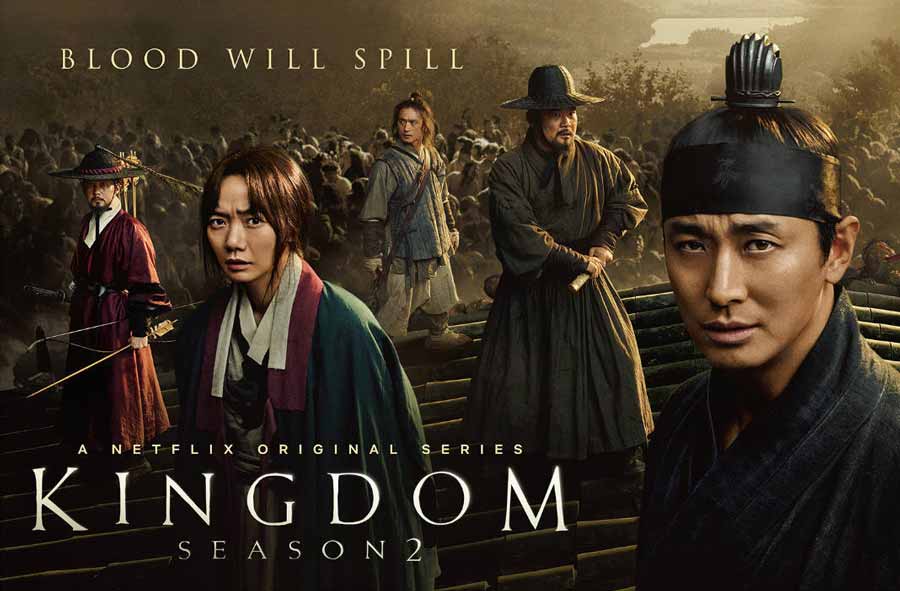
Kingdom (Netflix) Season 2
Last year I was delightfully introduced to a historical drama from Korea. Set against the backdrop of the Joseon Period, Kingdom was an amazing story of a young prince on the run from a conniving minister who sought to supplant him on the throne. In the midst of it all though, a dangerous disease is reanimating the dead into flesh eating monsters who have now overrun the entirety of one province. Can young Prince Yi Chang overcome the odds against him to overthrow the scheming plots of Cho Hak-jo and Queen Yeong-shin jein, or will the tide of the undead sweep over all the realm?
From here out there are SPOILERS so be warned! I will be assuming you have read the first blog post or have at least watched Season 1. If you haven't, drop what you're doing and go watch it now!
As a minor preamble, there was a big change from Season 1 where the series was in the original Korean with English subtitles. I assume that the popularity of the show led to the decision for Netflix to make an English dub for a foreign audience. It makes me curious whether they have put the first season on an English dub option, so more incentive to re-watch! I don't mind subtitles or dubs, but this is just to let any potential viewers who might find them distracting be aware!
Subscribe to:
Posts (Atom)