Showing posts with label Literature. Show all posts

Saturday, 17 October 2020

Mexican Gothic

 A recent release which I picked up because goodreads kept recommending it to me, I was very happily surprised as I found myself suddenly immersed in the world of Mexican Gothic. 

Set in 1950's Mexico, it follows debutante Noemi Taboada, as she answers a seemingly madness filled letter from her cousin Catalina, who has married into the obscure Doyle family. In the letter, Catalina accuses her husband Virgil Doyle of trying to poison her. Catalina's father, wary of scandal, sends his daughter to check on events in the remote province of Hidalgo at the Doyle home of High Place. As Catalina arrives, she realizes things are not quite as they seem.

This is the most recent novel by Silvia Moreno-Garcia. This is a Canadian author who I had not read before, and I am pleasantly surprised by what I have found! Having explored more of her work upon completion of this novel, I am happy I started with this one and will certainly be checking out more of what she does!

Mexican Gothic has everything you could hope for in a good tale of Gothic horror. There's a creepy house, a mysterious family, and dark, twisted secrets. Instead though, they are transplanted to the highlands of Mexico and set against the backdrop of Mexican society and expectations. The very foreign people are almost part of the horror as their entire setting is alien and unsettling, with its many references to both the Mexican Revolution and foreign exploitation of the Mexican people.

Noemi is a fantastic narrator. She is a sassy socialite who likes to bend the rules and frustrate her opposition. That she comes from a world of parties, learning, and language, makes it very difficult for her to adjust to the dark, dreary, rigid ways of the Doyle family of High Place. She's like a beacon of light there, but one which almost instantly strikes friction with those inhabiting the place. She clashes immediately with the family head Virgil, instantly dislikes the patriarch Howard, and the 'mother' of the house Florence has an instant distaste for her smoking habit. The only person she doesn't seem to bring out revulsion in is the black sheep of the family, the shy and nervous Francis.

She isn't one to play a damsel in distress either, and is always thinking to try and get one over on the Doyle's and save her cousin, who seems to be slowly losing her mind. Though Noemi finds herself questioning her own sanity the longer she stays in High Place.

What I really enjoyed was how my initial assumptions were twisted and turned on me, until I came to a stunning and shocking conclusion. In the first few pages I rather foolishly assumed I knew how things would end up, but man did the twist really show me wrong! Very well done and very, very scary! Highly recommend this wonderful new book!

Monday, 30 March 2020

Freehold and Jennifer Government: The Ideas

Picking up from where I left off in Part 1 of this analysis, I shall expand on why I think that the societies portrayed in both Freehold and Jennifer Government are fundamentally the same. Though first, I will begin on spelling out the inherent differences.

The first, and perhaps most important thing to point out is that each is set in a different genre and telling very different stories. Freehold is a work of science fiction set far in the future telling a refugee and war story fleshing out the authors view of a realistic libertarian society with minimalist government and maximum personal freedom. Jennifer Government on the other hand is a satire set on present day Earth which instead takes rampant consumerism and corporate greed to its absurdist conclusion while also pointing out the de-fanged nature of a minimalist state and the problems that would cause.

Different genres, different aims, and very different stories.

Picture is my own

With that in mind though, I do want to explore why these societies are almost twins of one another.

“The idea of freedom is inspiring. But what does it mean? If you are free in a political sense but have no food, what's that? The freedom to starve?” - Angela Davis

Firstly, the society of Freehold has a very simple ethos "work or starve" which to some might seem reasonable. This will only effect the parasites who leach off the system of course!

Unfortunately, any dispassionate examination of economic reality would lay this brutal all or nothing system bare for the failure it is. It is a very inhumane dog-eat-dog ideology which rests at its core on an unworkable idea. This idea is that everyone has an equal starting point when engaging in economic activity. No one has any innate advantage over another person or everyone is capable of contributing to society equally. This idea is very much in error.

Now, I just want to make clear this is not necessarily a problem with libertarian thought per-say, but a problem with both libertarian and anarcho-capitalist economic thinking. It is fundamentally obvious that not all men are created equal. Some are born poor, some rich, some stronger, taller or weaker, shorter and so on. That divides the playing field at birth.

As an example, someone born into a poor family will very much be handicapped by their lack of access to greater resources or even basic living costs on some hands. Studies have shown that it is extremely difficult for those born into poverty to advance beyond that line, leading to an endless cycle. In some cases and countries this can be overcome, but it does tend to rely on government assistance or grants and loans, whether unemployment insurance or school loans in order to attend higher education.

Someone born into a wealthier family by contrast, has many advantages. They do not need to worry about the struggle for daily needs like food and rent, they have much more access to both higher education and the social circles which allow for social advancement. Whether the option of choosing more prestigious (and better connected) private schools or the simple expedient of not having to rely on loans to even get a higher education, someone born into a wealthy family has an inordinate advantage over someone born poor or even to a middle class family.

In that vein, let me use an example from Freehold. When Kendra arrives on the Freehold, she is sent to a job agent to try and find employment:

“I realize there may not be anything in inventory or a related area,” Kendra acknowledged. “But I can do loading, stocking or whatever, until something administrative shows up.”
“The problem is,” Calan explained, “that all the light jobs get snatched up by juveniles looking for spending money, veterans get preference for technical positions and unskilled heavy jobs are rare, with the industrial base we have. If you can lift fifty kilos regularly in this climate, I can find a few, but they don’t pay well.”
“Fifty?” She repeated, shocked. “No, not for very long.”
“That is the detail. I can recommend a couple of prospects that usually aren’t hiring, but will probably make an exception for you. They both offer training. Cavalier Enterprises and Bellefontaine.”
“What would I be doing?”
“Cavalier Enterprises is one of the most respected escort services in Jefferson. They offer dancers, modeling, escorts for business or social functions, massage and exotic sex fantasies. The Bellefontaine is a club that offers erotic dancing and they specialize in dancers with rare or off-world looks.”
Kendra was silent in amazement. A chill shot down her spine and all the way to her left heel. She opened her mouth twice and finally got out, “No.”
“They are both excellent companies,” Calan stated simply. “I occasionally visit the Bellefontaine myself.”

The obvious problem here is that, outside easily lost menial labor, Kendra has no real special skills. The implication too is that if she were not attractive she would probably have no choice but to work in backbreaking menial labor which would slowly grind her down. In essence, she has no negotiating power in the system and if she had not gone over the head of her agent and asked for other options she would have been trapped, but the point stands that if she did not have other skills which were deemed useful she would have been stuck with the physical labor.

In comparison, the hapless Hack Nike has both a self-esteem problem and a negotiating problem. He always gets screwed at his quarterly wage negotiations because he won't stick up for himself. A problem with consistently negotiating your wages is that you don't really have the power to properly negotiate if you're bad at that very act or have no one to negotiate on your behalf. Hell, the problems Hack faces are that he then foolishly subcontracts away from the contract he didn't read before he signed!

Problematically we also see that corporations themselves will penalize individual employees in the world of Jennifer Government for things as mad as their replacement at a job might not be as good as them. This of course can be interpreted as satire, and arguably should be, but the process of rewarding or punishing employees based on successes isn't exactly a new idea.

Essentially you do not have freedom of choice in these societies, you have an illusion of freedom. When the alternative is starvation and death perhaps not just for yourself but for your family, then whoever has your paycheck in their hands has you at their mercy and the power imbalance would be absolutely catastrophic.

I'd next like to address the bigger problem in both worlds, lack of government intervention and corporate accountability.

“Accountability. This is the primary ingredient missing in politics, corporations and financial institutes.” ― Brandon A. Trean


In the world of Jennifer Government the government is a joke and corporate oversight is a laughable concept. The paraphrase Ayn Rand through Robert Heinlein "I would say that my position is not too far from that of Ayn Rand's; that I would like to see government reduced to no more than internal police and courts, external armed forces — with the other matters handled otherwise. I'm sick of the way government sticks its nose in everything, now." The government only exists to adjudicate disputes and prevent crime, or enforce punishment if you can afford it. Ironically in that world they don't even seem to have a monopoly on military power! The Freehold is much the same. The government exists only to adjudicate, prevent crime, and keep invaders at bay. At least they appear to have the monopoly on force though.

However, it should be noted in each case that the government in each world is, effectively, powerless. While this is part of the driving plot of Jennifer, in Freehold it is a very background case.

As an example, the government adjudicates lawsuits between individuals and presumably corporations. The biggest scandal presented in Freehold is that since there are no government standards, private corporations, three large ones specifically (several smaller are mentioned, but for all intents and purposes that is irrelevant) are ratings firms who rate various products based on their reliability and quality. It turns out one firm has had employees taking bribes to up ratings and as this news leaks consumers boycott the company and it devolves into a mass of lawsuits.

Simple enough right? The lawsuits will be taken care of and the companies guilty will be held responsible. In the real world we're quite aware this doesn't work, but on the Freehold this would be far, far worse. In an ideal world, this kind of whistle blowing would end up seeing a company held responsible for their misdeeds. However, a particular problem (especially in the US) is that the company could just begin handing out SLAPP lawsuits. In brief, a SLAPP lawsuits would be designed to censor and intimidate anyone who wants to harm either a corporation or a very powerful person. It is a pet tactic of Donald Trump and John Oliver has a very detailed piece on the matter which points out why it is so harmful since those handing them out can often afford to drown people in expensive legal action.

Boycotts rarely work in reality, and in a world where 'work or starve' is the ethos, then the consumer would have virtually no power to boycott. The journalists who leaked the stories would be SLAPPed silly, and the employees who took bribes would probably already have their asses covered by management if it weren't management in the first place colluding to get better money in exchange for hyping up products from certain companies, no matter how bad said product was.

This is by no means unrealistic. Whether it is colluding to fix the prices of ebooks, illegally manipulating interest rates for profit, fixing emissions tests to sell vehicles that let out too much poisonous gas, creating fake bank accounts without client consent, among other things, these are just a few examples of the blatantly illegal and manipulative practices carried out by both individual and colluding corporations to the clear detriment of the consumer. More notably, even in a world where we see governments coming down hard on these practices, many of these corporations still exist and can screw over their customers more.

What is worse, is that in Freehold and Jennifer Government, even the mild punishments experienced in real life are impossible. The corporation is only beholden to its bottom line, not the consumer.

In the case of the latter novel, the lack of ability to enforce such accountability is the driving theme. In the former, that lack of accountability means that Freehold would essentially be an oligarchy where the various corporations run wild and no one can do a thing about it.

The Freehold, unlike the United States and affiliate nations in Jennifer, does not even have a government capable of oversight. It doesn't even have a traditional democracy. Instead, it is 'run' by a Citizens Council. To whit:"Citizens pay for the privilege of ruling, getting a small stipend in return and the court fees paid are more generated income. The military and safety patrols charge for any assistance we render on duty and most of the large corporations donate a small percentage to the military as an insurance against our need in industrial accidents. They also use us as testing and advertising for any products we may find useful."

Now while that seems great in theory, I think you can see where this would fall apart rather horribly with where I've been going. It is explicitly stated Citizens do give up their means to wield their political power. However, there is nothing which says they cannot be given gifts to play favorites. Surely bringing out a Citizen for dinner is nothing suspicious, selling them a property at a discount, donating to their District upkeep among other means? There seem to be no restrictions on what a Citizen can receive from private residents of the Freehold, and then who would enforce those restrictions? Petty bribery is practically enshrined in the American system with dark money influencing politics and cushy jobs promised to retiring politicians in exchange for their support. In the Freehold that would be even more pronounced. And you would have no oversight body, Congress, Parliament or Supreme Court, to turn to for redress. They would almost inevitably be in the pockets of these corporations.

Much worse is that then the military has much of its funding (how much is never clear) coming from corporate donations as insurance against natural disasters and presumably social disorder. Would that extend to gifting the officers and certain men who needed to be influenced? Almost certainly. While in a throwaway line it is mentioned everyone on Freehold is armed well enough to overthrow the government if they chose, with the corporations controlling the products and the government, and the military in their pocked to back it up, well you have a recipe for corporate dominance.

Speaking of that dominance, let's discuss monopolies.


"I am not denying that monopolies are terrible things, but I am denying that it is readily easy to dissolve them through legislation of that nature." ― Alan Greenspan

A monopoly is an economic situation where a single company controls access to a specific service completely. However, an oligopoly or a cartel, is where numerous companies control access to a resource and collude on how to distribute it. This can be seen today by the domination of certain industries by a small number of corporations. Two of the most infamous examples are Microsoft, which developed the idea of EEE (embrace, extend, extinguish) in order to try and corner the tech development market. The second is Walt Disney Studious which owns a truly disturbing number of mass media assets which is still being unraveled to this day.

Then we have the problem of oligopolies, where a small number of companies can collude to set prices or at least create an illusion of competition. This is seen in the case of mass media communications, such as four companies controlling over 90% of the cellular communications market in the US. In Canada this can be seen by three companies dominating the supermarket industry, four companies dominating the cellular communications industry, and three dominating the internet providers industry.

In Jennifer Government this is exactly the problem. Two massive corporate oligopolies, US Alliance and Team Advantage, dominate the market. You can either shop with them or you shop with no one and smaller stores simply go out of business. In fact the driving desire to win that competitive game nearly starts a shooting war! But the point is that consumers have an illusion of choice. They are deciding to eat at Burger King or Macdonalds, shop at Walmart or Sears, not go to the small business up the street. It is an either or situation which is being created. It's a terrifyingly real possibility.

On the Freehold you would most likely end up with an oligopoly by default. With no oversight and no method of redress, corporate dominance would just be the way it is.

This is possible because the free market does not necessarily bring the best ideas to the top. There is no invisible hand to guide and self-regulate it. Without a firm hand to stop someone from cornering a market, and many times even in spite of it, you have to work very hard to prevent the moneyed interests from simply dominating it as they see fit.

But all these dangerous signs aside, what about personal freedom?

"To change your mind and to follow him who sets you right is to be nonetheless the free agent that you were before" ― Marcus Aurelius 

In both worlds, we find lands of fairly astonishing personal freedom. Drive how you want, be as promiscuous as you desire and no one will shame you if its all in good fun. You can buy any weapon you want, even up to lethal missile systems and weapons of mass destruction (on Freehold at least). Drugs are easily available, you can legally go out and inebriate yourself to whatever level you desire. The worst thing you might do is violate a contract or fail to pay your debts.

But as discussed before, is this freedom?

Some would argue enthusiastically yes! Small government! Privatization is the way! But is it? Privatizing a public service not only has been found to cost the public more, but has yet to be shown to be either more efficient or safer. So arguments put forward by both protagonists (and antagonists) in each story can be very, very detached from reality.

Neither society would have any means, beyond charity, of helping people in need. Whether it is something as simple as community snow removal, or even providing healthcare to the needy, an absence of a government to step in and attempt to provide these services, you would instead find widespread suffering and poverty. The corporation doesn't care.

What happens when personal freedoms begin to get in the way of profits? Could they then coerce or attempt to regulate those freedoms away or make a profit from punishing disobedience? Punish consumers by hiking prices or denying access, or simply invoke their monopoly and put people out in the cold who attempt to pressure them? All real possibilities by non government entities.

Truthfully, Jennifer Government is a very keen expansion on what the Freehold would devolve into. There are no elections, and those who govern are going to become either impotent and irrelevant or simply cronies of a larger for profit driven machine. Dissent is either pointless or a death sentence, and over time the very idea will be foreign with the brutal reality of your society laid out for you. But if enough people, and well armed people at that, become desperate enough, would work or starve make fight or die an option?

The end of these societies might then end up being all out war between those on top, or all out war against those on top from the bottom up.

Either way, these two societies are twins of each other I think, perhaps not in the way their authors imagine. While Freehold is meant to show off a 'realistic' libertarian society, and an interesting one is created to be fair, that very liberty and lack of oversight brings to mind more images of the world of Jennifer Government. Vast corporate dominance of global affairs and no one who can reign them in. The little man on the bottom had best get out of the way.

Monday, 16 March 2020

Freehold and Jennifer Government: The Stories

As part of my Great 2020 Re-read I took it upon myself to go back to two novels of varying seriousness. One was a novel I picked up a decade ago, Michael Z. Williamson's Freehold which is a guilty pleasure of mine, and the other is Jennifer Government by Max Barry. One is an interesting story of an alternate society in the far future, while another is a satirical look at a society in the near future. Both are ironically, fundamentally the same society.

That though is a rather simplistic explanation with a broad brush. On the surface they are extremely different, with different cultures, naming conventions, and even different planets. The ideology that unites them however, is fundamentally the same.

First though, let us introduce our two focus cases. First up is the novel I originally read, Freehold.


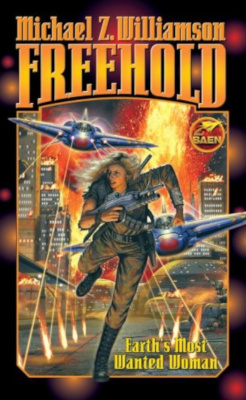
This was the debut novel by Michael Z. Williamson, for Baen Books. Published in 2004 it was his first full length novel and though it shows at points, it is still an exciting read. My original review still does stand, though I've soured more on some aspects of the story over the years.

Set roughly in the 26th century, it tells the story of Kendra Pacelli as she flees unjust charges of embezzlement in the military on the UN dominated Earth to the only independent planet in human colonized space, the Freehold of Grainne. Self described as "the first truly free society in human history" it is set up as a libertarian paradise (more on that in Part 2) and is meant to be a contrast to the bureaucratic nightmare of Earth. You can do almost anything you want, so long as you are willing to accept the consequences for your actions. Own any weapons you like, drive however erratically you like, love who you like, and sign whatever contract you feel free to. No one is forcing you after all!

Kendra experiences quite a lot of culture shock, but eventually adjusts to her life in the new colony.

When political friction between Grainne and Earth forces her to move into the military, we spend a huge portion of the second act looking in depth at military training on Freehold. It is brutal, harsh, and very difficult. Kendra passes and officially joins the Freehold Military Forces. As she was in logistics in her old military life, she fits right in to logistics in her new one. Getting into the groove of her new job, she again gets caught up with Earth/Grainne tensions as 100,000 malcontents are shipped into the Freehold to stir up trouble. They succeed masterfully, and the UN government declares they are going to annex the Freehold for their own good.

Of course, this leads to war and the UN invades. Needless to say though, that for all the well portrayed horrors of war, the Freehold wins by some pretty far reaching deus ex machina which probably could have been better concentrated on with both a wider cast of characters and some further research. The war largely did depend on a very 20th/21st century understanding of strategic warfare and combat to be believable.

That said, it is a guilty pleasure read, and I fully acknowledge it. Worth a bit of a read if you find the idea interesting.

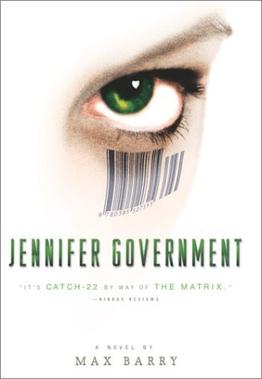
Now this next book, I actually have only very fuzzy recollections of where I picked it up. However, I do recall it being uproariously funny and I definitely read it shortly after reading Freehold. That book is Jennifer Government. Written in 2003, it is an excellent satire of rampant consumerism and corporatism, and turns on its head the idea that a dystopian future requires a totalitarian government!


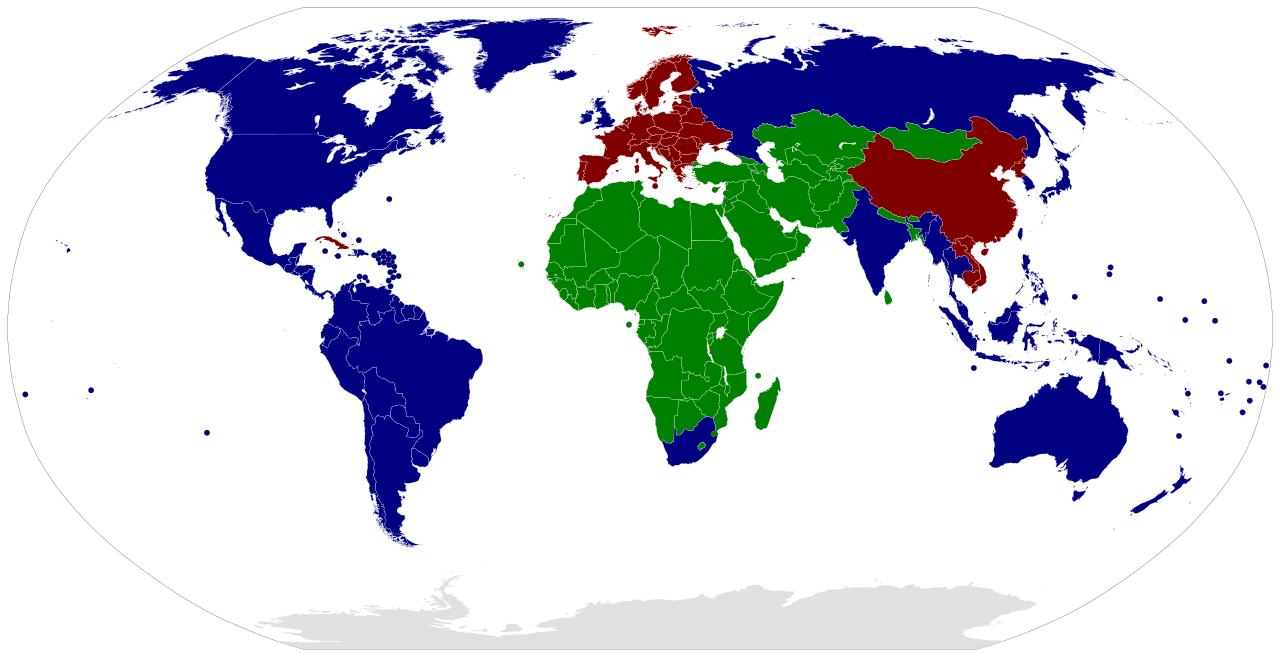
The story begins twenty minutes in the future where much of the world has become the US. Or literally, the United States has expanded into much of the world through corporate purchase. These countries have become part of the US led trade bloc, having gradually given away their sovereignty to become part of the largest, freest system in the world! There is minimal government, no elections, and you're free to do whatever you can afford! Just make sure you read that contract! People have done away with surnames, and you know yourself by the company you work for!

The world of Jennifer Government Blue = US led countries Red = non-US trade blocs Green = fragmented markets
By user Sannita, Wikimedia Commons

Enter one Hack Nike, who works as a middle merchandiser for Nike. One day his water cooler
malfunctions so he travels to the floor above him to try out the one there. It is here he meets John Nike and John Nike. They offer him a fast trace to advancement, he can help them whip up sales for a new line of shoes being sold, and all he has to do is kill some kids! Too bad he didn't read the contract before he signed it!

With all the madness going on enter Buy Mistui, who is unfortunately witness to one of the shootings. Helped out by the barcode tatooed agent Jennifer Government, they both end up on the path of a sociopathic businessman as another cast of colorful characters are sucked into the mayhem. From a militarized NRA gunning for Government agents, companies trying to crash each others servers, to shootouts on the Burger King floor, its a total madhouse as sales come before lives!

Written in 2003 it has some pre-internet vibes which do date the story. But it does really capture consumerism gone mad as corporations have license to do whatever they want since unless you have money, you can't really bring them to task since the government has no right to tax in order to set a budget.

This really complicates the life of Jennifer as she has difficulty going after the bad guys when they do bad things. She's being constantly asked where the money is going to come from, whether she could do things to cause less collateral damage (and therefore expose the government to lawsuits) and if she's sure she can even bring the executives to justice if she has the evidence. Money doesn't grow on trees after all. Meanwhile, if you have the cash the Police can investigate crimes or prevent them preemptively, but it will still cost you. And if there's an emergency, have your credit card number ready so you can pay in advance before they respond!

Other than the murder investigation, the main conflict is between two major loyalty programs taken to its logical extreme. US Alliance and Team Advantage compete against one another to have the biggest consumer base on the block, and John Nike is determined that his side, US Alliance, is going to win big. He is going to wipe out the competition.

As this is written as a satire the humor comes from the over the top situations and unlikely circumstances our many poor characters find themselves in or the ridiculous extremes they will go to in order to get the win. I had quite a few laugh out loud moments, especially as one poor side character Billy Bechtel kept running across Jennifer Government in the worst ways possible. All the poor man wants to do is go skiing! The outlandish desire for consumerism people showed was pretty funny. Late in the novel Jennifer and her partner Calvin are running through a riot and Calvin keeps getting distracted by the good deals he sees.

Its a funny story with a very satisfying conclusion and I genuinely want a laugh about our society and consumerism. Really takes the piss out in an enjoyable way. If you want a laugh in this mad modern world, very worth a read.

With the stories out of the way; why do I think they portray the same society? In worlds where the market is unchecked and money talks, what do you think would happen? Stay tuned for Part 2 as I launch into a much more long winded explanation!

Wednesday, 18 December 2013

Throne of the Crescent Moon

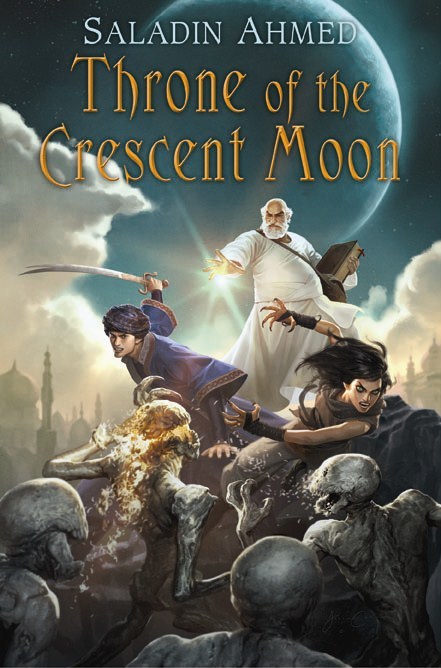
Hello readers, I come back to you now with another review. This time I send us off to exotic lands of deserts and djinn, ghuls and dervishes. This week I bring you a review of Saladin Ahmed's, Throne of the Crescent Moon!


This is a refreshing and interesting fantasy book since it departs from what we would view as traditional fantasy in a number of what I consider to be very unique circumstances. The first is that rather being set in anything even resembling a facsimile of Medieval Europe, we instead get something that is much more like a fantasy Asia all mixed into one! We have a Khalif who sits on the Crescent Moon Throne of the great city of Dhamsawaat, an ancient society which is a sort of Ancient Egypt, and the surrounding societies all seem to resemble things like the Muslim Kingdoms of India or the Pacific. It's a fresh and as far as I'm aware, virtually unique look at a sort of pseudo-Islamic world in fantasy.


The book itself is written by a man named Saladin Ahmed, a man who is both a poet and a writer who has an extensive background in Islamic history and culture. This offers something very new to fantasy, and as far as I'm aware, something that hasn't been explored in depth. The novel has a very 'Thousand and One Nights' feel to it, and is really quite interesting in that sense. It gives you a look into a society that would be familiar to some, yet totally alien to others. It's actually quite like how I would imagine a foreigner reading our High Fantasy really.

It also offers up some rather unusual characters. For one thing the main character is a fat elderly gentleman in his late forties who is somewhat impious and becoming the last of a dwindling order of ghul hunters. His assistant is a pious dervish wielding a double bladed sword to cleave right from wrong and they eventually ally themselves with a tribeswoman with the ability to morph herself into a holy lion that can crush the forces of evil with her angel granted powers.

Not exactly your traditional fantasy  characters.

Their enemies too are a manjackal and a sorcerer who summons ghuls (or ghouls to those of you familiar with my Undead Menace article) to do his bidding.

Still some recognizable fantasy elements all skillfully blended together with new cultural ideas and locales. There's even a political subplot dealing with potential revolutionaries fighting against what they see as the despotic rule of the current Khalif, all for a juicy flavor of political intrigue and high fantasy action.

The characters themselves, Doctor Adoulla Mahkslood, Raseed ben Raseed, and Zamia are all fairly interesting characters. They each have some fairly good character building moments, periods of internal conflict, and issues with one another that serve to make them real and three dimensional rather than your standard do no wrong good guys, hell many of them even exhibit some good old fashion prejudice to those who aren't like them! For instance we have Adoulla and Raseed, two evil fighting partners with completely different views of the world, you have the old veteran Adoulla who has spent his entire life fighting and hunting monsters and is beginning to tire of it all, despite the fact that if he dies there is likely no one else who can carry on his orders knowledge and fight. He is also morally gray and fairly impious, and this clashes well with his young and eager protege who is from a religious order which dedicates itself to a lifelong struggle of virtuous justice. Raseed is very black and white in his worldview which tempers his reactions to any situation in an almost predictable way, but it also gets him into trouble as the story progresses.

As a cool aside, Raseed's sword is based on Iman Ali's sword from Muslim history.


Story wise the plot flows seamlessly from one scene to the next with very little pause in the running action and dialogue. You are driven from the beginning of the Doctor's quest, on a seemingly unrelated matter, into events that shake the very foundation of the city of Dhamsawaat itself! The story is wonderful and relentless in its telling and you really get a feel for each of the individual characters.

We also are treated to some wonderfully exotic action scenes featuring magic, sword fighting, and not a little bit of desperate cleverness on the part of the heroes. It also does a wonderful job of portraying magic that comes with a cost, whether in a persons personality, soul or body. Every spell cast has an immediate physical reaction both against those whom it is cast against, and those who cast it, making the act of calling upon magical forces seem very real and very challenging.

The setting itself  is also exotic and described in some detail giving it a very neat flavor. However, it isn't described as well as one might like. While I got a decent feel for how the city of Dhamsawaat was laid out, I couldn't be sure of everything that was in it and some details of the surrounding area and peoples seemed mildly to vague for how involved they were in the story. Some key locations could also have used a bit more description or even mention early on. For instance, the Khalif's palace is supposed to be the largest structure in all Dhamsawaat but it gets very little mention until directly near the end of the novel. Then one place called Angel's Square gets only cursory description despite being called breath taking and awe inspiring to those who enter it, I really don't have any mental picture of how it's laid out or what it would look like. Similarily Adoulla's house is something which seemed to be introduced a little too late with little preamble for all the meaning it had to Adoulla, something which I think could have been rectified by having Adoulla thinking wistfully about his house and commenting on its value to him earlier in the story.

The pacing of the novel is also quite fast with no real breaks being taken from character to character and all the action seeming to come at once with little suspense in between. We get some periods of calm, but they always feel like we're being whisked away with each character before we can catch our breaths.

That's not a net negative in itself but merely a matter of pacing which I think ought to be addressed in the sequel.

All in all the novel is a good read and is a fascinating insight into a world which is different from ours and the exciting conclusion left us with a load of problems for the heroes to face in the coming future. I felt excited to learn what challenges might crop up in the future and just what new crisis could emerge on the horizon for our heroes.

I've deliberately left the novels plot unspoiled as I think people really ought to read it for themselves so they can get a feel for the world and how it meshes itself out. The novel may feel a bit unpolished and perhaps a bit unrefined but it is well worth the read as Ahmed is really a writer to watch out for in the future!

If I had to give it a rating I'd say 3.5 stars out of 5 would do it for this book.

Until next time readers!

Wednesday, 30 October 2013

The War of the Worlds

Well readers I recently heard the CBC's presentation of the classic H.G Wells radio broadcast, War of the Worlds. I have to say that despite the medium of the message being the radio and the spoken word, it was thrilling! Contrary to flashy images on the screen, chiseled actors portraying grim heroes and big CGI budgets giving me a towering Martian tripod to stare at, my imagination proved to be a far more tantalizing mode for seeing the Martian invasion of the United States.

The narration, sound effects, and back and forth mode of depicting and showing the Martian attacks and landings in a narrative was fabulous! I could see B-17 bombers flying a doomed sortie at the Martian walkers, sat in horrified wonder as the brave artillery troops shot vainly at the advancing Martian war machines, felt the panic of the forlorn news caster in New York as the tripods arrived and the 'Black Smoke' descended upon the city choking thousands to death.

The vintage feel of the preformance didn't matter to me and made it all the more exciting! For a Halloween presentation I don't think you could have found something better! It was a wonderful treat to have on this pre-Halloween evening.

I can only imagine the shock and confusion some poor Americans must have felt when this first came over the radio and all the calls local police and civil service stations must have received as annoyed/panicked people called in to see if it was real or not!

This is a great historic repeat of the original broadcast long ago on October 30th 1938, made in a less jovial atmosphere as fears of a new war across the world spread, fears that would sadly be proven right. It was a scary thing for a new generation fueled by a new media source in the form of the radio.

I'm quite glad to have been able to listen to it and very pleased to have seen so many other versions of it, but I am even more pleased to say; now I've heard everything too!

Saturday, 23 March 2013

Gorn (or the Etiquette of Blood and Gore)

Readers let it be known I am no stranger to the concept of blood and gore in stories, nor am I opposed to it. Sometimes though we just have to find a better way to use it. Today I talk about gorn (and boy is the page image for that accurate).

Now of course I'm not referring to the alien from Star Trek.

This alien for those of you who are wondering
No today I instead talk about (as quoted from TVtropes) the 'extreme and sadistic violence, to the point of prurience. A portmanteau of "gore" and "porn". The term can refer to just an extremely graphic scene of bloodshed, or the entire sub-genre of torture films in the spirit of Saw'. And of course if that's not explanitory enough for you, let's just say that it's blood and gore for blood and gores sake.

Now that's not to say that the application of gore is a bad thing, in fact some of the best video games and horror movies use bloody murder to captivate/horrify their audiences and wratchet up the action in the game/film. In fact in some cases it can be downright hilarious! That is, if it is used tastefully and applied well.

Some video games just tend to suffer from over the top gore with blood dripping from the screen, these aren't even necessarily horror games, but action games which have ridiculous ammounts of blood and guts just seemingly for the sake of it! It can be fun, but after a while it is just boring, and incredibly juvenile. You won't see much evolution in gameplay terms as long as developers concentrate on this!

I'm no stranger to liberal gore, some of my favorite video games include the Dead Space series, Gears of War, and Resident Evil. Now none of these games is exactly light on violence. In fact Gears of War is billed as being a violent action game with some of the over the top violence being the selling point. I mean when your using a chainsaw bayonet to saw through a Locust Drone while screaming 'yeeeeaaaaah!' along with the character on the screen you can't exactly claim you aren't enjoying it.

Case in Point, vis Destructoid
Now this is a game which is sold on over the top action along with a mediocre story. Here's the thing though, the weapons and violence sell it. They are larger than life and improbable, which combined with good gameplay mechanics and interesting hammy characters we have something that sells quite well.

Looking at Dead Space, you have something which is basically zombies in space. They have scything talons and go around infecting people by driving a proboscus into the player characters head or removing his limbs from his torso in various gory and creative ways. These are all items that are expected in a zombie style game, and as watchers/players of that particular genre we now expect that people will be messily devoured and zombie heads will explode through high velocity lead poisoning (or plasma cutter related work injuries) and that is pretty much what we watch the genre for. The Walking Dead would not be what it is without the proper application of zombies eating people and zombies being killed by people. Done in proper context and shown well it is what viewers enjoy.

However, few people want to see a show or game where the zombies win and eat everyone, or all the main characters are messily devoured in pointless ways. Admittedly some people were rooting for the zombies in Land of the Dead (I wasn't) but no one really wanted to see them win!! What they wanted to see was the plucky human characters defeat the evil villains and if the zombies helped do that, great! If not, well, putting a bullet in their brains isn't a terrible idea.

The reason you can't have a zombie as a sympathetic character (most of the time) is that they are human eating machines, and as such are beyond the sympathy of people. You don't want to see them messily devour someone who might be innocent, and you don't want them to win in the end. In fact I've only ever read one series which did this well, is The Rising by Brian Keene.

The thing is though, that mindless gore will be a given when a zombie is the main character, just like if the main character in a movie is a slasher. We will have to sit through ages of the villain/monster killing people, now this can be done well by being downplayed in favor of the horror of this person winning, or it can be done poorly by dragging out the horrible torture for ages.

A point in case of this being done well is actually the first Saw. I personally may not have liked it, but, I will concede that it was not especially gory and used the terror it created in a decent fashion for reeling the audience into the characters awful dilemma. The sequels however, instead turned up the gore and violence and had people dying for no other reason than for us to see them brutally murdered on screen. Another movie which invokes this trope, is Hostel which is literally a movie with no point other than seeing young tourists having sex, then being kidnapped to be tortured to death by foreign rich people. The ludicrous ammount of gore and its ridiculous use (I mean blow torch to the eye?) makes people want to vomit. Literally none of this adds to the movie, and its more disturbing than scary, and not in a good way. It doesn't leave you asking anything about the movie, instead merely wondering who the hell would come up with this plot?

It's hard for people (most people) to sit through a film where teenagers are being slaughtered left and right with no reason. Some movies today will spend mindless ammounts on gore budgets just to get realistic looking slit jugulars or ripped out rib cages. In fact some movies have decided to just ditch the concept of plot or characterization altogether in order to show scantily clad co-eds being ripped apart or hacked up in order to appeal to the lowest denominator in advertising.

This film being a recent offender
You see gore isn't what people expect from a horror movie. What they expect is to be scared or terrified, and in truly well done cases ask fundamental questions about their own humanity and what constitutes a monster. Yes they expect blood, yes they expect murder, but what they don't expect is for the set to be drenched in so much blood you could fill a swimming pool. Sometimes just finding a dead and mutilated body is much better than having to watch that character be mutilated and then have their friends stumble upon the scene moments later. It just saves time and can increase terror.

The fact of the matter is that lots of horror today suffers from a lack of substance and a ridiculous infusion of severed heads and spurts of blood flying around for no reason I could point out. Even in video games (like Left 4 Dead) the gore begins to become an impediment when you can't even see the screen properly through the layers of blood. In fact one of the reasons the Resident Evil series has suffered recently is the fact that it has become self aware of the gory nature of the transformations and monsters and is just playing them up for kicks! This is in no way interesting, and really doesn't appeal to most players who are looking for an exciting horror survival (or maybe in the far future an actualy horror!) game with puzzles.

Crime dramas today are also becoming dependent on gory murder rather than the idea of solving crime. Thankfully however, some shows are coming out which deal less with us following demented serial killers as they butcher people in 'creative' ways (such as in the ever sinking Criminal Minds series) or the psuedo-science and ripped open bodies as seen on CSI, and instead lead us to the enjoyable 'murder as a framing device' plots of great crime dramas and character driven stories such as Castle (which in my opinion is probably the best crime drama on TV right now).

Literature isn't immune from this either. Some series take the gory horror to a ridiculous level. Many modern Lovecraft books begin having freakish monsters messily and slowly disembowling their victims for no real reason. Some novels (like some particular moments in the Sword of Truth series) just have long torture sequences (committed by the heroes no less) and use them for what might have been a metaphor about war, but it is lost in the ensuing random 'heroic' violence that follows.

In fact much of the literary genre of horror has also come to try and depend on gory monster attacks rather than the physical horror of such monsters, or being alone, isolated and under attack by otherworldly creatures! The Slenderman mythos is so scary not because of any gore which might be in it (and there rarely is any) but because of the sense this tall suited blank faced creature can chase you down anywhere and then...well what exactly he does do when he catches you is left to the reader, and that makes it all the more scary!! No gore necessary but maximum scare fest!

It's the unknown or monstrous that usually scares people, not the sight of someone being dismembered or a college co-ed having her still beating heart ripped out and force fed to her. While those images are disturbing I wouldn't call them terrifying in and of themselves. I mean I've seen uncensored battlefield casualty photos which are gorier than these films and while it makes me feel sick it doesn't make me particularly scared.

What writers (and more importantly, executives) need to learn is that you can't just appeal to the common denominator base that looks for bloody gore and sex while expecting to win out in the box office. People tend to quickly tire of that kind of thing, and it ends up with the same repetetive, boring, predictable, and idiotic, plots that people really only go to see from boredom. Just putting bloody murder onto a screen and expecting it to sell is not an incredibly successfull business plan (hell even the classic 'sex sells' mantra fails if you underestimate your audiences intelligence).

What horror and action writers should learn is that you can't abandon plot for silly gimmicks and expect to be wildly successfull in your careers. Hopefully this can end with a thrilling psychological horror movie coming out that serves to scare me because it's actually scary, and not because the script says its scary by decapitating some teenagers.

Now here's a picture of a zombie getting it's head blown off.


Until next time readers!

Monday, 19 November 2012

Branching into Amazon

So despite the fact that I as yet have nothing to author up to the Kindle (yes, yes I know lame pun) I have still decided to start an Amazon account. I am currently doing very little save for reviewing books and looking for things I might review in the future.

In fact if readers had any ideas for books I could review I'd be glad to do it. Though for now I'm content to do such on my own.

I'm running through the books on my shelf for things I've read and I'm trying to give at least a short blurb to them all so I can be seen out here on the web. It's actually quite fun to do in my spare time, and it can be good practice for expanding into blog posts later on.

In the meantime readers if you want to see some of my modest reviews (including one on my least favorite book ever) please look me up as MDStien on Amazon. I'll be steadily doing more and more so keep your eyes peeled, I may just review a book you like/hate.

Keep on reading people, keep on reading.

Friday, 10 August 2012

Ruminations on Interstellar Travel

Recently I was reading National Geographic and its lengthy issue on space. Of particular interest to me was the colonization of Mars and the approximately thousand year long terraforming process which got me thinking (again) about the future of mankind among the stars.

I have been an avid reader of science fiction since I was young from books like Star Hatchling or the young adult Star Wars novels like the Galaxy of Fear series. I graduated on to reading the works of Isaac Asimov and Robert Heinlein and wonderful novels like Dune, Starship Troopers, or The Moon is a Harsh Mistress. I loved the series and I was eventually reading the Halo novels which were very well done. Since then I've always had heady visions of space colonization and space battles.

Most recently I've been reading the Honor Harrington series which has really captured my interest. The series is extremely technical giving immense details on the technical data of the science behind the universe, and almost as importantly, the immense distances involved in travel among the stars and the vast distances that occupy even a single star system.

It has been immensely helpful for the opening stages of my own science fiction novel. Especially for some pivotal scenes involving space pirates thus far.

Establishing a proper timeline for the story has been a bit trickier, especially because of my thoughts on interstellar travel. Faster than light travel is something that we currently don't possess so making a viable means either relies on technobabble jargon or by extrapolating on currently shaky sciences. Since mankind has yet to travel well beyond earths orbit (in any manned capacity that is) I have come down to using more vague terms for my own science fiction such as 'hyper space' and 'jump drives' to describe the process.

The way I see it to have a decent history for an interstellar star nation one needs to have at least three centuries of colonization, which if you want to set it in something like the year 2600 or so requires mankind to have some decent terraforming technology and an adequete FTL technolgy else you have to rely on generational ships and an increase in earth-like planets (which while not impossible, it is still highly unlikely to have them concentrated in any nice dense array without a little push from the human race in my opinion). Mind you the previous thought is best regulated to 'hard' science fiction, while mine is going to be on the softer side, I am trying to make it as semi-realistic of possible to help with the suspension of disbelief.

You see in my science fiction (the Service to the State series as the name is thus far) I have developed a fairly intricate backstory for the nation of the Commonwealth, its worlds having been settled five hundred years before the current story line and then clawing their way to independence in order to form their own nation. The galaxy shattering events which lead to their independence (various wars and revolutions) all require FTL in a reliable shape so that they can carry out interplanetary war on a realistic scale. It needs to be both relatively easy to aquire and maintain, but difficult enough that it has some drawbacks and disadvantages to keep it from being a sort of easy way out for ships in a jam. I have no real grasp of the advanced sciences required though so I have to avoid the 'info-dumps' of the Honor Harrington series and rely more on characters, events, and conflict rather than the interesting hard sciences to keep people reading!

The problems with mapping a decent timeline this presents are large. Due to many realisations of both scale, and realism I have revised my initial timeline at least three times now. I'm sure I'll be forced to do this more in the future as I attempt to make the story as 'hard' as I can. Thus far though, both the story and the timeline are progressing well. I hope to have a rough draft for the entire story in place by the end of the year.

Tuesday, 17 April 2012

The Hunger Games: A Review

*Warning for those who haven't read the books or seen the film, spoilers ahoy*

Having just seen the Hunger Games I am very pleased to say I enjoyed it. Though having read the books I may be biased and will most likely have a slight slant towards them. Moving on.

The film takes place in a future country that encompasses North America known as Panem. The film opens with a brief description of the Hunger Games. After a rebellion against the Capitol many years ago the rebelling districts were defeated and forced to sign the Treaty of Treason which stipulated 'each district shall give two tributes each, one boy and one girl between the ages of 12 and 18 to compete to the death in the annual hunger games'. Now this was a move meant to keep the districts in line and for the past few years has worked very well. Though one thing I must critique about the films is that it did leave out the detail about how the hunger games are meant to keep the districts fed. The winning district receives a surplus food supply which brings them above starvation levels for a year. Cunning and brutal indeed, and a point that should have been included.

But with the film we begin with a touching scene of Katniss and her sister Primrose in their little shack in District 12. It is a highly rural and run down region reminding me of a sort of impoverished Civil War era town. Ironically this brought back echoes of Firefly on the Outer Worlds where things are rather impoverished, ramshackle, and wild west like. At least that was the vibe I got. In fact the soundtrack was very reminiscient of Firefly as well with all the guitar, violin and western themed tracks. Most likely unintentional but a nice touch.

The scene is then set with Katniss going beyond an inoperative electric fence where she hunts game with her bow and we are introduced to her friend Gale. They banter on about things and such until it is time for the Reaping in which children are chosen in the hunger games. Against all odds Prim's name is picked, so in a historic moment Katniss volunteers for the games. Thus setting the chain of events in motion. The film that follows is very good and though it deviates from the book it actually adds rather than subtracts from the experience. For instance we actually get to see their mentor Haymitch in action trying to win them sponsors and helping them out. I liked this very much as it helped to ensure the film didn't drag in places. Seeing the game planners was also a fun twist as we get to watch their reactions and plans, like twisted producers of a show staging events for a futuristic gladitorial fight. Though there was a good scene where the human side of these immoral people does come out. Getting to see characters watching the games was also a plus and seeing other peoples reactions to the events going on was fabulous. One instance after Rue's death where the riot kicks off in District 11 was particularly thrilling! I was glad that was done. So now on to categories.

The Good:

The film was well represented and the acting was good. Jennifer Lawrence plays a mean Katniss and sets up the quiet, rebellious and socially awkward 17 year old as an interesting character with a fierce desire to protect her sister and to win. She plays the part of an unwilling combatant well and her grief over both Rue's death and being forced to kill was done well on her part and she came across as a sympathetic character as well as promising to portray a troubled one in the future. Woody Harrelson plays the mean and cynical drunk Haymitch and off the bat delivers a stellar preformance for a drunkard and mentor. The actors of Gale and Peeta are also well done and quite thankfully Peeta and Gale stay in the background as periphery characters.

There is the implied love triangle which was well done and properly regulated to the background. This made me so happy I could have cried! One of my biggest fears going into this movie was that they would try to play up the love triangle just to reach out to the teen audience. That was mercifully averted however and we instead got some good tension and wonderful character interactions. I hope that they continue this trend and keep the film about Katniss and her struggles, as well as Panem's struggles as a whole instead of teenage love angst.

The Capitol itself was also well portrayed both in its brutality and for its weird and wacky culture. The shock that Katniss and Peeta have towards seeing the grandoise and frankly ridiculous nature of the people living there is well represented. The zany, weird and overdone fashions of the citizens were well done with the riot of colors fashions, sounds and ideas. Even a set of painted poodles!

The Games themselves were spectacular with the violence being toned down due to the PG rating and the fight scenes presented well. The tension and mistrust that we could see with the others was wonderful and the viciousness of the Careers was well done indeed and it made me happy to see them done right. Cato was especically fabulous with his blood lust and anger issues being portrayed as both a hindrance and the defining traits of his character.

The Bad:

There are some downsides. Despite the nature of the game I found a long segment did drag on. The opening was...well quick and violent and it managed to present some rather graphic scenes too. But from that point it seemed to drag with nothing really going on and Katniss just running around. I found they probably could have done something to this scene, I was even bored by the time the fire started driving her back towards the center of the arena. Worse, I wasn't even excited by the fire! I didn't really get back into the movie until a scene after that. I think the writers and producers should have added to that bit, with either some spoken dialogue or some internal narration. Indeed one of the problems with films of books is that it deprives us of a characters thought process and intentions unless they clearly portray them with their words or expression and actions. This comes across alright in the film, though since I have read the books I admit it was probably easier for me to follow but otherwise I might have been lost as to what the hell Katniss was doing for that particular stretch of time.

Another thing is the rating. PG seems like a rating far to low for this film. It limits what the director and writers can do as it makes a series like the Hunger Games, which is intensely violent and brutal especially as it goes on, tone itself down and takes away from it somewhat. I'm certainly not advocating the gory deaths of children onscreen, but the fact is some of the violence could have been better portrayed and was even more deserving of a PG-13 rating at least. It seemed like it was lowered to pander to the younger audience of the film, but PG-13 would have been fine and would have allowed more leway with the violence and blood than was already portrayed, which would have worked wonders to show just how brutal the games really are. Otherwise the constant flipping camera angles for death is just really irritating.

Speaking of camera angles, shaky cam. I have no idea why directors keep doing this. It makes the actions sequences all blurry so we can't see what the characters are doing and we have no idea of the exact actions people are taking. This was bad enough in the actions scenes where I was sometimes wondering who was Katniss and who was the bad guy, but it was particularly jarring and obnoxious when in the opening of the film as they were showcasing District 12 that they had this shaky cam effect for looking at static objects or people, even a man eating chicken at one point! It was sloppy and unnecessary and really detracted from the film for me. I can somewhat understand them in the fight scenes with the PG rating (makes it harder for kids to see whats going on, blocks some of the violence) but it really just shows how the low rating was dragging the film down.

Then there were some characters that weren't adressed properly. Haymitch for instance had great scenes and great lines, but I didn't get a feeling of purpose to his character that I got in the book. He also didn't really seem to connect with Katniss at, all as he does in the books. Instead he seems more distant, and not extremely insistent on how she goes about doing what she does for the audience to love her. Similarly the antagonist (President Snow) isn't portrayed as antagonistic enough. He isn't overtly evil nor is he really evil in a subtle way until the end. He does react badly and say some dark things but otherwise didn't carry the film as he was intended. Donald Sutherland did a marvelous job but sadly he wasn't given much to work with.

The movie also ended to abrubtly. It didn't deal with the lingering issues Katniss and Peeta felt, save for one brief piece of dialogue. Katniss needed to have some sort of breakdown and begin her Post Traumatic Stress experiences, which she doesn't seem to portray at all. So they had better deal with that well in the next movie. Snow's appearance at the end is rather insignificant as he just strokes his beard in a sort of 'Hmmm' way before walking out. A piece of dialgoue as simple as 'We will have to keep an eye on her' to an aide or showing him making plans of some sort would have been well done. But otherwise it just seems rather anticilmatic.

Then I have one minor nitpick. Though the CGI was well done and it did offer us some gorgeous visuals, they did skimp on the hovercraft. They were either displayed indirectly or not at all. That was a bit disapointing as you didn't really get a feel from their presence or any sort of vibe about them at all. They were supposed to be floating symbols of the Capitols power, and the scene where it is implied one is hovering overhead in the riot is particularly odd as we see its effects but not it. I just found it rather weak.

The Verdict:

The film is overall a well done adaptation of a stellar novel and will hopefully expand into a good series. Though well acted and well played it has some lacking qualities in camera shots and visuals in general, There are some loose ends on characterization that really need to be tied up and many points that could be fixed in regards to character interaction. It also suffers from its low rating thanks to attempts at pandering. Otherwise it is a stellar film which I have to say is one I would certainly watch again and encourage others to do so as well.

6.5 out of 10.

Tuesday, 10 April 2012

Constructing a Villain

Recently I have been giving some thought about making proper villains. A villain is a must for a story wheather it is an evil warlord, a school yard bully, or even nature itself as done in some stories. The central goal remains the same however. It is an adversary for the hero to overcome and help drive the plot/ So for the writer designing a good villain is a must. This is just as important, if some cases even more so as a villain must have clear and consistent motivations. I find that nothing kills a story more than a poorly characrterized and motivated villain. Especially a villain that is evil 'just because' or is carrying the villain ball so to speak. A character that does something evil just for the sake of doing it is rather uninteresting, especially in a story which is trying to take itself seriously.

For instance. I once experimented with a character in an RPG who was an evil warlord. I made him as stereotypically evil as possible. In the fluid story telling of this RP he grew from a bit villain into the main antagonist of the series. He would do evil things at first just becsuse they were evil, since the setting (a veeery future Star Wars Galaxy) didn't take itself seriously about half of the time it tended to work out, but in the series most recent reincarnation it has taken a darker and more gritty tone so I had
to change some fundamental characteristics.

Starting off as a sort of gag character who had a vague revenge plot against the central hero for killing his father. He then served as the foil and main antagonist to a secondary character and his back story got fleshed out as a rim warlord whose home had been destroyed in the ancient war. He worked his way up in the world and became a capable commander eventually working his way up to the main story. He then became a greater threat in the plot and began surpassing other villains in evil strangely. As he evolved he became more serious, still retaining some of his gag quirks and had a growing insanity issue that became central to the story line. He finally evolved into a near godlike character who after a long and complicated series of events had captured near half the Galaxy and was engaged in a fight with another villain over the fate of reality itself while the heroes raced around attempting to stop it.

All in all it was a very satisfying evolution for the character and the storyline in general. He went from being a gag character to the stories main antagonist. It was my first go at story telling from a villains point of view and trying to characterize one as well and it was a rather fun learning experience. Though it wasn't a professional project and something just for fun I found it good to work on and I became really attached to the character and as he became more important I wanted to keep him involved and try to make him more villainous. I found that my attachment to him was important and that I was glad to keep trying to make him more serious, interesting, fleshed out, and more depth in his personality. I learned that with a villain you must make him for a reason. You need to have a reason for him to be opposing your hero, a backstory that makes him who he is and what his motivations are. Sure you can have Warlord Grog rampaging around the countryside raping and pillaging with the young knight go and defeat him in single combat and it works. Is it relatively simple? Yes. But is it extremely engaging? Not really. And for instance you can't have a corporate boss go around murdering people because he wants to, it raises a host of probability problems and practical issues.

To use two fictional examples of the 'evil warlord' stereotype. Sauron from the Lord of the Rings, and Norman Arminger from the Emberverse series.

Sauron: Sauron is the ancient lieutenant of the great evil fallen angel Morgoth. He was compelled by a love of order to try and bind the world by force and wished to control the world out of a misguided noble sense of what he thought was order but was instead consumed by his lust for power and control and fell into evil. His lust for power is eventually what destroyed him.

Norman Arminger: Former history teacher who was a SCA nut who takes advantage of the event known as the Change to cosntruct a pseudo-Norman kingdom in former Oregon. He is a sadist who loves power and displays of power for its own sake, is short tempered, but intelligent. He enlists an army of gang members and SCA fellows like himself. They carve out a kingdom which Norminger rules with an iron fist. He makes many mistakes due to arrogance ends up being toppled by the very society he created.

Despite these brief descriptions, I find Sauron to be a better character. He has little time on screen but his menace and threat are clearly felt, as is his motivation which is deep and complicated. Arminger, who has more screen time comes off as less interesting, his arrogance and general 'evil because I can' attitude isn't compelling and his actions reek of stock villain ideas. Mind you there are other factors that make him less interesting, but his own character makes him dull because of this.

So it can be seen that creating a villain is up to the author to give a story a sense of scale, danger, and a good character. I will continue this more in part two coming soon.

Monday, 26 March 2012

Freehold by Micheal Z Williamson: A Review

Though it may seem that this blog is becoming something of a review site I am mostly reading books that are interesting and don't exactly conform to my own political views which makes them both interesting reads, and important learning material for an author. It can help an author avoid littering their work with his or her own political beliefs. And while Freehold is an author tract, it doesn't exactly read like one, which is why im comparison to my previous review of the book "Enemies Foreign and Domestic" this stands out as a superb example of how one can avoid serious author tract and write well at the same time. So I feel that it is important to follow up a resoundingly bad novel with a, while not A grade material, a novel that is still miles ahead of the previous work I read. So without further preamble I present to you Freehold.

The Story:

Set in the 26th Century we are treated to the view of Earth after it has been united under the administration of the UN as a one world government. We have a brief, well done and to the point opening describing the main character Kendra Pacelli and her mundane and mainly bureaucratic role in the UN Protection Forces. As the novel begins she has just returned from Mtali (a world divided by a multi-sided civil war) and is returning to her mundane job in the megacenter of Minneapolis. However, she is alerted by a guard and former lover that she is going to be arrested and interrogated regarding a scheme which involved selling millions of dollars worth of war material to the competing sides on Mtali. Kendra, having been involved with the logistics unit which the material was from is going to be rounded up with many others. She flees and in the midst of the investigation decides to run to the only planet where the UN cannot reach her, the Freehold of Grainne. After forcing her way into the embassy she is granted asylum and sent to Freehold where she becomes immersed in the society and deals with both her own struggles of getting used to Freehold and with the looming threat of the UN coming after her and the Freehold itself.

The Good:

The story is reasonably well paced and only drags at some inopportune moments. The characters are well fleshed out and believable and rarely the type of cardboard cut out caricature's that ideological rants usually present (Atlas Shrugged, Enemies Foreign and Domestic) people as. Rob Mckay, the books main love interest, is an interesting example. He is a typical Freehold man who is polite but extremely forward in his approach and has some grope happy moments but is otherwise an ok guy. He is a military veteran and has many friends because he 'saved their ass on Mtali' which shows a connection between society and the military in a pleasant way, Kendra herself has to go through almost 400 pages of a learning curve when she gets to the Freehold and never does get quite used to it and the culture shock is written well and very believable. It is attacked from all angles and it shows you how really alien this society would be. I liked that Williamson emphasized this fact instead of, as many authors do, simply assume that society will always be familiar and much like the 21st Century Western World (or mostly America) as we know it. It made for good friction between the characters and for excellent plot points.

As for its ideological tract the novel is not in your face about it. Naturally the society is portrayed as superior to Earth's for a variety of reasons. But it strikes you as a (somewhat) believable society that is fun to read about and interesting to examine, and might be one that a few people would want to live in. I'm not one of those people, but to each his own.

Then we have the character dialogue which is well done and thankfully actively focuses on the plot as much as it does the ideological talking points. Each character is fleshed out and given some screen time to establish their ideas and views on a particular situation. There is even one heartbreaking scene which shows a soldier from the UN with similar values to Kendra later on in the novel who you can actually feel sorry for and emphasize with, a rarity in most idelogical rants.

Then we have the brilliantly written battle scenes. Williamson puts you right in the thick of the fray and makes each individual firefight a gripping experience and has a well done great big battle near the end. I literally could not put the book down during this point and stayed up a considerable portion of the night finishing it. So points to him there for sure. War is described in the most brutal and unflattering of terms so I enjoy the fact it is not glorified and the intellectual honesty of the author on that front.

The Bad:

Unfortunately the book doesn't get a complete pass. While I understand this was his first novel there were some bits that were completely uncessesary. For instance the middle of the book consists of what seems to be the obligatory boot camp montage in great detail for over a dozen chapters. It was well done but it still seemed needlessly detailed and stretched out. If this were a book completely dedicated to military science fiction (ala Starship Troopers) then I would be more understanding, but it is not and thus the scenes were long, somewhat boring and had effectively little to do with the plot at large. I was irked by these after the swift beggining and pace up till that point. It is stated that this intense training is different from the UN, but this could have been shorter. Similarily with the obligatory sex scenes that seemed to pop up out of no where. Kendra is seduced inside a week by Rob and is having threesomes with another character, Marta, by the end of the first quarter. Kendra has had sex before but is portrayed both as unused to lesbianism and as a practicing Catholic to boot. They seemed more devoted to just pointless sex for emphasising the 'free love' ideology of the Freehold rather than anything else.

Speaking of Marta, this character seems to embody the worst about Freehold society. She is completely intolerant of any society other than her own, has a moral superiority complex, and is extremely naive. Marta, like many Freeholders, is completely convinced of of the moral superiority of her society and many times she seems to stop just short of reffering to other cultures as barbaric. Many other Freeholders hold a notion of themselves as being superior to other cultures and lay ridiculous criticisms on the representatives of other worlds. As author tract goes this is insulting to the reader and is especially annoying when the Freeholders criticize societies for not coming to their aid when they explicitly mention that other planets have no ability to intervene militarily. So any criticism seems hollow at best and petty at worst.

And unfortunately the UN is portrayed as evil almost exclusively for the sake of being evil and antagonistic towards anyone else with values other than their own. While I can agree on the point that too much berueacracy is a bad thing, and to much political correctness would have horrible effects on society I just can't find the incredibly polite, sexually sensitive, and almost pacifist (since most UN soldiers and people respond with horror to the idea of killing people) society as one willing to engage in the kind of imperialism that the UN attempts to enforce. They made for poor villains but it still gave a narrowly defined enemy for the reader to wish defeated. The other villain of the series, Tom Calan is just as poorly characterized and ironically highlights the extreme mercenary attitude that would most likely be prevalent in Freehold society. That of an extremely cuthroat and the ability to hold a grudge. He is simply badly portrayed and is genuinely uninteresting to read about, much like any unsypathetic secondary character.

I could go into other critiques of the Freehold system and various political ideas but that is not really applicable here.

In the end the book is a good read and I did enjoy it minor issues aside. It is good science fiction even with the ideological motivation. Libertarian science fiction would probably describe it best. Although jarring at points it is still a good read and I recommend it to anyone looking for a bit of easily read escapist science fiction. All in all I give it three point five stars out of five.

An aside:
The best part is one does not even have to buy the book as it was published by Baen and can be read for free online or downloaded as a PDF and is available here:
http://www.baenebooks.com/p-162-freehold.aspx

Wednesday, 21 March 2012

Enemies Foreign and Domestic: A Review

Enemies Foreign and Domestic is book one in a series of the same name by author and general gun nut Matthew Bracken. The story is set in "America in the near future" following the steps of one Ranya Bardiwell and a certain Brad Fallon (a sort of author expy). The follows them as they attempt to uncover a conspiracy behind a terrorist attack and the subsequent attempt to ban guns.

Terrifying isn't it?

I read this book through a link found on the website SurvivalBlog (a wonderful website for disaster prepardness, if not so much for politics) and began taking a look at it online. The first few events in the book are actually fairly intriguing. The prologue details a horrifying terrorist attack where a sniper fires into a crowded football stadium and the resulting panic and stampede of horrified spectators results in the collapse of the structure in a manner similar to what one sees in soccer riots, which ends in the deaths of over a thousand people in horrifying detail. This event truly did serve to suck me in and captivated me with its sheer horror and the well thought out plan by this terrorist, which we then learn may be part of a sinister conspiracy.

Sadly this turns out to be one of the most exciting and reasonable incidents in the book. We then see a case of monumental stupidity on the part of government and law enforcement officials in the part of contaminating evidence and breaking multiple layers for the proper handling of a crime scene in order to prevent just such contamination. For instance the local police chief accepts the attackers wallet while not wearing gloves and the president actually orders that the shooters weapon be brought to him. This is the kind of action that would get a politician impeached yet it completely passes under the radar of anybody (even the otherwise 'smart' protagonists).

It then follows a short battle in the Senate where a very strange law is passed outlawing 'assault rifles' which is in reality a wide ban on anything that looks remotely threatening. During the proceedings a female senator is attacked by an anti-gun supporter for some reason. Then we join our spectacularly bland and almost author-expy Brad Fallon whose life goal is to build a sail boat and sail away. He's only almost an author expy because he believes in sailing away rather than fighting to save America, otherwise his opinions and goals go hand in hand with the author's(especially his fascination with sailing and guns, he really likes harping on those). He is a bland and rather unremarkable character who spends much of his time fantasizing about bikini clad women, who is then targeted by the FBI to spy on a gun club which is a militia front (composed of men in their sixties no less) because he is seen with them exactly once in a coffee shop. That's some fine police work gentlemen!!

We are also introduced to the ATF agents who are behind the investigation. They are typically evil and in a (not so) suprising twist are masterminding the events behind the stadium massacre in order to get guns banned and make the ATF more powerful than the FBI! To do this they decide to run a dirty war like in Argentina or Brazil by murdering or kidnapping gun store owners and labelling them as militia fanatics. They make rather lackwit villains who are remarkably unintelligent and are constantly reffered to as being men with no discipline and are very trigger happy, and they prove it too. Despite the fact that they openly discuss planting evidence and framing people the rank and file still believe they are fighting 'militia gun nuts' and not blatantly murdering people. That was one of the issues that I could not get over while reading this book. The bad guys know their framing people yet still believe they are fighting the admittedly non-existant militia? Seriously? But I digress.

We then meet Ranya Bardiwell whose father is shot and killed by ATF goons burning down his gun store. The ATF then leave amazingly detailed forensic proof of their involvement in the form of 10mm casings from their guns and distinctive boot prints at the scene. (Also apparently malt liqour is indicative of liberals, these bottles indicate they are the people who threw the molotov cocktails that burnt down the store. I still don't understand that either). Ranya then swears revenge and goes on to attempt to blaze a path of bullets and assasination across Virginia and South Carolina against the Feds.

This is where the book mostly meanders into interesting action sequences followed by various detailed instructions on how to plan political assasinations. Then of course are the anvilicious moments where the author repeatedly reminds us that liberals are hypocritical idiots and there is no such thing as a free country outside America. The main characters repeatedly state that they cannot run anywhere as there will never be anywhere as free as America. There is no detailed reason for this and one is forced to assume that it is mostly because they won't be able to own their beloved guns if they go to Canada or Europe. I sympathise with their plight...not in the slightest. Another point which the author enjoys driving home is that most people are blind sheep (or sheeple as the common term is) who blindly follow the news and do no critical thinking of their own and will instantly cringe at the sight of a gun or attack freedom loving Americans who support the Constitution at the drop of a hat.

Indeed the author enjoys flaunting the superioty of gun owning, libertarian, Constitutionalist, conspiracy theory, and Christian Americans (I add the Christian part tenatively as they talk about faith but rarely even reflect on the moral issues of their actions or pray for that matter). I add conspiracy theory because the author constantly states that the Branch Dividians at Waco were burnt alive on purpose and the Ruby Ridge incident was a government slaughter rather than a colossal f**k up by poorly trained agents. The author explains these through a web server known as "FreeAmericans.com" where various liberty loving Americans gather to discuss how the government is infringing upon their rights and how the FBI, ATF, CIA ect are secret police thugs who intend to take away their rights. Brad Fallon is particularly guilty of this as he is constantly berating regular people for not thinking about these things. Not to mention anyone who is even assumed to be liberal is mercilessly mocked by the main characters. A particularly ridiculous incident is when Ranya comes across a boy researching the Civil War and asks if he is researching 'the War of Norther Agression' much to his confusion while she keeps referring to it as such, then assuming he was only staring at her breasts. I doubt the author actually meant to have a liberal character come off as reasonable and probably smarter than his main character but it reads that way.

In fact the author goes out of his way to make liberals look stupid or foolish. In fact by reading this book we can easily discover the authors prejudices such as:
  • Smoking pot = stupidity
  • Piercings are only worn by liberals or sexual deviants
  • All liberals secretly hate the Constitution and are secretly 'socialists' who know nothing about freedom or good government
  • Illegal immigrants are parasites who barely speak English
  • Illegal immigrants also seek to steal American jobs and support a break away socialist state in the South Western US known as Aztlan
  • People who don't own guns want them banned and constantly look for ways to get them banned
  • The Federal government is mostly staffed with incompitents who don't care about freedom or liberty
  • Lesbians seek to steal children from married couples
  • Muslims are inherently violent and are all crazy
  • Muslims are also mostly hypocrites and hate mongers who want to impose Sharia law on Americans, anyone else is just a terrorist
  • Political correctness only serves to protect Muslin terrorists and Black Nationalists (or a combination of both) and serves to encourage Muslim racism
  • Also any of the above are very willing to engage in rape
Sadly this is just a taste of the racist and ridiculous comments that Mr Bracken enjoys spouting.

The novel is boring, repetetive and filled with card board cut out characters with no depth who seek to drive home the authors flawed ideas about gun ownership and the evils of Muslims and political correctness. Mr Bracken also suffers from a crippling case of 'write what you know' and unfortunately seems to only know how to describe sailing, guns, racism, how evil liberals are, sex, and the idea of America being the best nation on Earth. If you come across any of his other works I assure you that this will become immediately apparent.

Now some will undoubtedly ask why, if this book was so appaling, I bothered to finish it? The answer is quite simple, I got it for free on Kindle and the little I could read of the prologue intrigued me. Once I got deeper in I was horrified by the right-wing reactionary hate that the book preached. It also serves as a perfect example of how not to write what you know and how not to get your ideas across.

From me the book recives a one star out of five.