Wednesday, 11 March 2020

Caliban's War

As another part of the Great 2020 reread, I come to the second book in The Expanse series, Caliban's War. I originally read this roughly two months after I had read the first book, largely because it had taken me a surprisingly long time to make the time to read it. However, diving in I was not 100% sure what to expect with it, but again found myself pleasantly surprised.

If you miss the symbolism in this title I will be genuinely surprised! As a general warning, there will be major spoilers for Leviathan Wakes below. If you haven't read the first book in this series, drop everything you're doing and go read it!


Picking up 18 months after the events of the original novel, humanity is struggling to cope with the realization they are not alone in the universe after the Eros Incident. Venus is a churning hive of alien activity doing god knows what, while the fragile coalition between the governments of Earth and Mars has shattered from a cold war into a semi warm war which threatens to engulf the Solar System in flames once more.

Enter Gunnery Sergeant Roberta "Bobbie" Draper of the Martian Marine Corps, 2nd Marine Expeditionary Force. She and her squad are on patrol on Ganymede, the breadbasket of the Outer Planets and one of the safest moons in the Jovian System. Suddenly the find themselves rushed by their UN counterparts, only to discover both sides are under attack by some kind of horrible monster. Her communications jammed, she has no way to signal the orbiting fleets that there has been no kind of attack and hostilities commence unleashing absolute hell on Ganymede.

Praxidike Meng, a scientist on Ganymede, finds that in the chaos someone has taken his daughter. Desperate to find out what has happened to her as the warfare and collapse of civilized society on his home moon threatens to engulf him, he has no choice but to turn to the one man who may be able to help him, but this man has started wars with his honesty before.

Watching all of this is Deputy Undersecretary of the United Nations Chrisjen Avasarala, a capable take no crap politician in the byzantine factionalism of the United Nations Secretariat which governs Earth and its colonies in the Solar System. As she's watched the familiar pattern of Earth-Mars-Belt relations has crumbled. Now she has to deal with a resurgent OPA, an Earth-Mars Cold War threatening to go hot, and above all, the alien life forms on Venus. In her attempt to keep a lid on things, she finds herself drawn into political schemes beyond her wildest dreams.

Finally, the crew of the rogue gunship Rocinante are back! Their captain, James Holden, has been playing policeman for the OPA for over a year and followed the orders of Frederick Johnson, but he yearns for more work, for something beyond the gun for hire role. He might get his chance as a humanitarian disaster, a missing girl and a mean politician cajole him into another solar mystery.

Aside from the first installment, this book is probably one of my favorites in the whole Expanse series. I have reread it, or even sections of it, three times now. It introduces two of the strongest female characters in the series, and manages to ratchet up the tension just as brilliantly as the first book did as each chapter progresses. From fighting monsters and disbelieving superiors, to watching the slow collapse of the artificial ecosystem that is the moon of Ganymede, we are treated to the horrors of war, human greed, and tribalism.

The novel goes to decent lengths to outline why humanity, poised with the greatest and possibly most existential threat to its existence, would rather fight itself than deal with the problem at hand. Shadowy and short sighted forces would rather re-fight old wars than bring about lasting change in the Solar System. This leads to many bad decisions, and many bad actors trying to profit from human misery on an interplanetary scale.

Despite not being explicitly a war story, it goes to not inconsiderable lengths to look at what war can do to people and communities. The fighting on Ganymede causes widespread destruction and even brings out the worst in many people. For all that, it handles scenes of space combat superbly and displays some of the best short ship to ship battle sequences I've read. The first fights to the later big fleet actions flow beautifully across the pages and I was quite pleased with the way they played out.

Growth in our characters and their interactions are wonderful. The relationship forged between Bobbie and Avasarala, and eventually Bobbie and the crew of the Rocinante are wonderful to watch. I enjoyed their dynamics and the clever plot which got the ball rolling, and the execution of the finale was spectacular.

A well done sequel in a well done science fiction series. Definitely pick it up!

Thursday, 27 February 2020

The Super Soldier Conundrum

Recently I read an article regarding the very unhealthy obsession Western media has had for the Spartan mythos. While it does concentrate on the modern far right's unhealthy obsession with what has always been a deeply problematic image, it did get me thinking about one other aspect of the Spartan image. The super soldier.

Now, perhaps the most well understood modern reference to the super soldier is the men and woman of the SPARTAN program from the Halo franchise. I admit, I grew up on those video games and surrounding media, and found them cool, as any young adult uninformed about the horrors of war would. What did help was that the novels by Eric Nylund, especially Fall of Reach, went to great lengths to describe the blatant immorality and cruelty in the creation of the SPARTAN program. Essentially kidnapping and torturing children to create a group of well trained and augmented soldiers superior to any individual soldier produced via natural training.

Naturally though, this does raise the question of what purpose an augmented super soldier actually serves? Especially in a science fiction setting where a warship in orbit is probably far more useful than an augmented super soldier on the ground in most situations. Sure a squad of elite super soldiers faster and more deadly than a platoon of regular men may be useful in a surgical strike, but would they actually be worth more in an age of nuclear arms and guided missiles? The obvious rejoinder would be that even today special forces serve a purpose, for surgical strikes and to help gain information, but they are not war winners by themselves. Even a group with exponentially more ability than the modern SAS or Navy Seals would be of questionable utility in many respects vs slightly more augmented regular soldiers.

To be honest, creating a super soldier program makes very little sense. It offers no innate advantage over regular special forces outside specific context, and the costs/morality is something which is horrific to consider. Unless you are engaged in infinite war, like the Space Marines in Warhammer 40k, then you really don't have a use for them. And even if you do construct them, what on earth do you do with them in peace time?

My own, as yet unpublished novella Integration, deals with this idea. Could a super soldier really reintegrate into society peacefully? Can they even be seen as anything other than a threat by the government which created them? Would someone indoctrinated into military service be able to just hop back into civilian society without issues?

Ultimately, this is really an answer for fiction to think about. Well, so far at least...

Wednesday, 19 February 2020

2312

Another one not for the re-read, but this is yet again a great science fiction work! Perhaps unsurprisingly, it is another by Kim Stanley Robinson. I take you to the future, three centuries from when it was penned. The exciting world of 2312.


We start our primer to the 24th century on Mercury. There the great mobile city of Terminator crawls ahead of the ever pursuing sun, allowing for the permanent colonization of the planet. Enter our protagonist Swan Er Hong, an artist on the planet out doing a 'sun walk' a journey of staying just ahead of the deadly star. Her famous grandmother, Alex, the Lion of Venus, has just died. Swan is gathering in the city with her family and friends, when she meets with a representative from the Saturnian league a 'toad faced' fellow named Fitz Wahram who was also a friend of Alex's. Even before the funeral is complete however, things get strange. An inspector from Interplan (think the Space Police) Jean Genette, comes asking if Alex had any enemies.

Little does Swan know, but her grandmother was involved in a Solar System spanning plan. It centered around the Mondragon Accords, which were to develop a semi-planned economy for Earth and all the settled planets, moons, and terrariums which act as floating habitats for humanity in the void. All of these are looked over by qubes, small quantum computers with advanced AI in them. The AI though, are not truly self-aware. But if that is the case, why was Alex so intent on keeping her work away from the artificial eyes of qubes? And why did she keep so much hidden from Swan and the qube implanted in her head, Pauline?

This sparks a long journey around the Solar System, from the mobile city of Terminator on Mercury, to the great ridge covered moon of Saturn, Iapetus. We take a floating tour of where humanity has advanced to in the 24th century and get to bask in how far we have come, but also how far we have fallen.

We see that Earth is still a place of extreme inequality, and great desperation. The sea level has risen by 11 meters in the past few centuries, flooding great metropolises like New York, and sending entire coastlines to the bottom of the ocean. The only ice sheets left are in Antarctica and Greenland. Meanwhile the ravages of global warming have led to mass extinctions, great desertification, and billions dependent on food grown in the many thousands of terrariums and then shipped down the orbital elevators to feed Earth's masses.

Meanwhile, in space those living on the terrariums have lives of great luxury. They have access to quality healthcare, need to worry little about their material health, and can afford to undergo many progressive gene therapies to live long and happy lives measuring over a century, or in some cases two and maybe more! Mars has been terraformed, and Venus is well on its way to being turned into another Earth, but one with a substantially higher gravity. The moons of Jupiter and Saturn are being colonized and terraformed, and the future outside of Earth seems very bright.


Naturally, this sparks resentment from peoples on Earth. They feel left behind or resentful of spacers, and that they live in luxury while the majority of humanity does poorly. The spacers then feel that the Earthers are ungrateful, backwards and unwilling to work to solve their own problems.

This is one of the central conflicts of the story as Swan and Wahram go back and forth between the habitats of the Solar system and Earth, trying to continue the secret project that Alex's grandmother was working on. But the issue of the qubes also looms large throughout the entire story.

Exploring the Earth and the settled solar system in this story makes for an engaging read, and that we do it through the eyes of two characters who alternately detest and desire one another, is pretty fun.

Swan is a very headstrong, antisocial, and - even by the standards of the 24th century - heavily augmented woman. She has undergone numerous gene therapies, had a qube directly transplanted into her head, and even eaten lifeforms found on the oceans of the moon Enceladus. With all this, she has trouble with people, and a difficult past which continuously haunts her, giving her trouble beyond her comfort zone. It also makes her short tempered, and not extremely understanding of the motivations of others. This proves quite capable of biting her in the ass on occasion.

In contrast we have Wahram, who is slow, methodical, and not nearly as ready to jump into extreme situations. He has lived for years around Saturn, working as necessary, and supporting a small family creche he is apart of. His friendship with Alex was because he believed in her vision of the Mondragon Accords unifying humanity through an interdependent economic system, and using the terrariums to help keep species that had gone extinct on Earth alive. Whether Swan can live up to that vision is anybody's guess.

The relationships of these two is central to the plot, making for a kind of cute read.

Our supporting cast is fairly small. Mqaret, Swan's grandfather, plays a the role of an elder father figure to Swan, helping her in the background. Jean Genette, the Interplan inspector who is galavanting about the Solar system on his mission to find out if Alex's fears of the qubes has any basis, and finally Kiran, a boy who rescues Swan from the slums of New York for rescuing her, and he is inadvertently thrown into the chaotic workings of the governing body of Venus, the Venusian Working Group.

Each character has an important role to play in the overall plot, and they do each help round things out to a satisfying conclusion in the end.

The plot itself is not what one would call, action packed. It is more driven by drama, emotional soul searching, and trying to piece out whether any of the main casts fears are actually there at all. It does make for some interesting overarching mysteries. We do have some very fun action sequences though, and bits of adventuring and derring do which would not look out of place on older classics. The scenarios will look very familiar to other sci-fi lovers!

This story though, is largely one which revolves around an interplanetary adventure and romance. It manages to tell both stories quite well I think, and I did not find myself getting bored, even if I admittedly skimmed a few more emotional soul searching internal dialogues. The interactions between the lead characters were always fun, and made for good ways to build both tension and the world around them. With the secondary characters fleshing things out, an amazing story came to light as I progressed through their adventures.

The way the story is set, with chapter headings telling you who we will be seeing and then extracts from in universe documents giving important context and background, the reader will never feel totally lost.

What really sucks you in is the amazing work done on building this vision of the lead up to the year 2312, how the Solar system works, and an honest examination of how, despite all the progress, humanity has not achieved utopia. This was a futuristic setting which I couldn't get enough of. It was familiar enough that I could grasp much of what was going on, while being alien enough that I had a little trouble wrapping my head around many of the concepts in it. That said, it was amazingly conceived and I loved all the detail that went into crafting such a complex and nuanced future, but one not so alien as to be impenetrable. It presented problems, and was bold enough not to decide on easy solutions.

Anyone who earnestly enjoys good science fiction would also be sucked into this world I think, and I believe you too will be happily drawn into the world of 2312. Please enjoy this one!

Monday, 10 February 2020

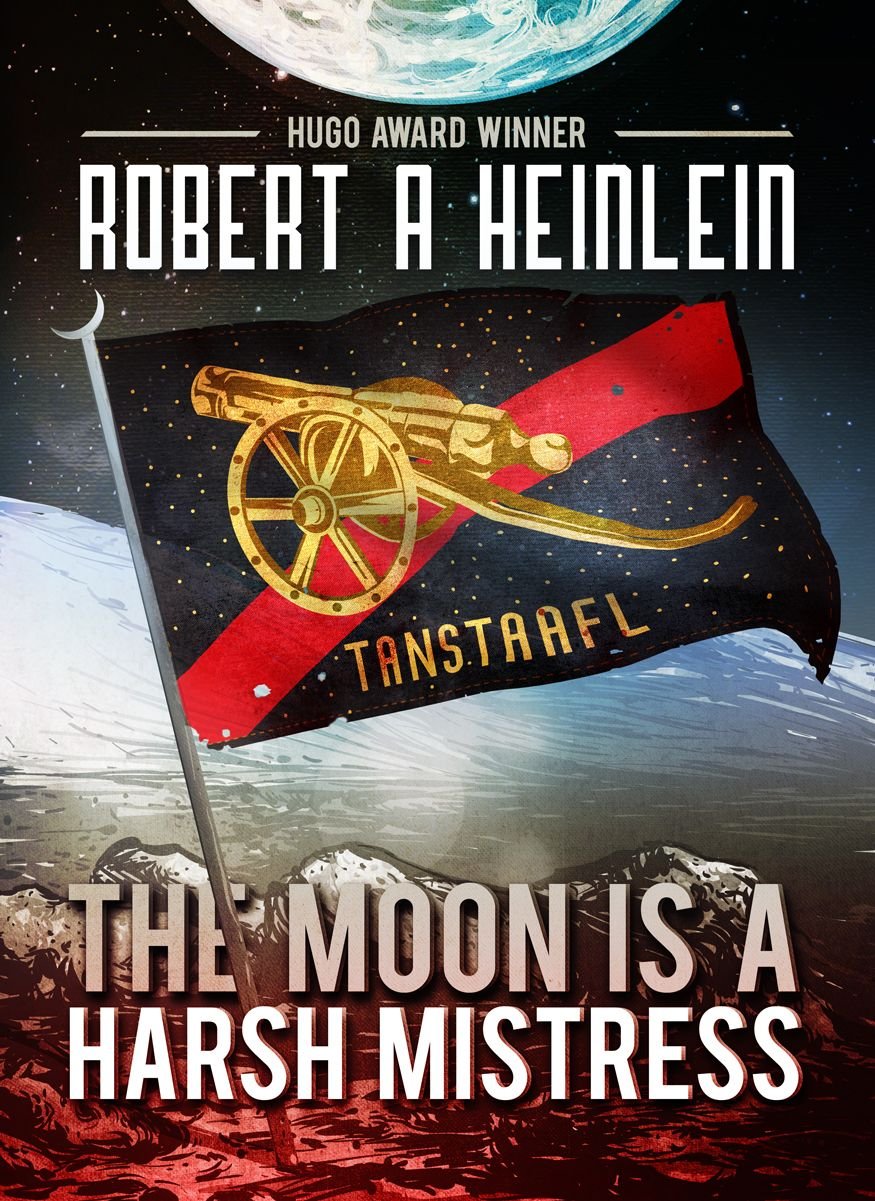
The Moon is a Harsh Mistress

Another one for the Great 2020 reread!

I originally read this sci-fi classic way back in high school, I loved it then and I certainly love it now! It is a classic story of science fiction, one of Robert Heinlein's best works IMO. A story of politics, life on the moon and the desire of the Loonies, as they affectionately call themselves, for liberation from the Earth based Lunar Authority. By any stretch of the imagination, The Moon is a Harsh Mistress!


The story is told through the eyes of Manuel "Mannie" Garcia O'Kelly-Davis, a freeborn son of Lunar 'settlers' who comes to interact with a suddenly sentient computer Mycroft, or Mike as he likes to be called. He's the head honcho computer who controls the majority of the Lunar complexes and their functions. His sudden self-awareness is unprecedented and only Mannie talks to him, becoming one of his oldest friends.

However, Mannie is unsuspectingly drawn into a larger conspiracy when he attends a political rally which gets raided by the troops of the Lunar Authority. Suddenly caught up in a manhunt, he has no choice but to go into hiding alongside his new revolutionary comrades Wyoming "Wyoh" Knott, and Professor Bernardo de la Paz. When informed by Mike that the moon, which exports hydroponic wheat to Earth - in seven short years famine will be stalked by famine in a resource collapse, they decide that they must free Luna from Earth based tyranny. The revolution has begun!

A revolution framed through the eyes of someone who is not a revolutionary is a clever trick, as he serves as a conduit for the audience to be shown the methods of revolt which will bring Luna freedom. We have an in depth look at how the revolution is planned, and then helmed around the person of "Adam Selene" who is Mike simply manipulating his abilities as the great computer to make himself look like someone else and the ostensible leader of the whole revolt. From organizing cells of dissidents to creating false broadcasts for Earth consumption it is a meticulously well planned operation, with Mike planning things down to the decimal points!

For a brief aside, Mike as a computer and character works so well. As I noted elsewhere, the idea of him simply being plugged in and becoming sentient is a pretty common theme in modern AI thinking, but his inability to completely understand humor or many other human nuances is a pretty good look at how alien and unlike us any actual machine intelligence would probably end up being. As a character it also makes him both relatable and just on the line for being alien. What is even better though is that say unlike Rudi from the Emberverse and Merlin from Safehold, he is not infallible. While he is an immense help to the revolution on Luna and in accomplishing other goals, he has a set of limitations which actually build tension rather than deflate it. It's wonderfully well done and very refreshing compared to many modern takes on the same idea.

Of course, we also get a chance to look at Heinlein's concepts for Lunar society. It is one descended from prisoners imported very much against their will to work the Lunar surface and it was overwhelmingly male. It has led to one where people are unflinchingly polite as crossing a line could easily get you 'eliminated' by your fellows. And you better not think of touching a woman! The men outnumber women still three to one (better than the old days!!) and so anyone who so much as touches a woman against her consent will be mobbed and murdered before he can so much as twitch. It creates a society which depends on group marriages and line marriages to survive. Polyamory is a way of life by necessity. Very true to much of Heinlein's free love ideals. It's a unique frontier society, one that makes an interesting case for itself.

Reputation is important, and men live and die by their reputations. Indeed, holding ones family up is quite important. In economic terms, barter is, outside deals with the Authority, the order of the day. It's basically an unregulated free economy. It is also a remarkably tolerant and integrated one. Mannie is mixed race, and in a later event when he goes to Earth this is contrasted with the more intolerant culture of the North American Directorate, especially in Kentucky. It's a chance for commentary on events of the time, and shows itself off as pretty progressive.

The dialect of the Loonies is also delightful to read. They have numerous loan words from Russian and Chinese, and these are liberally sprinkled in adding a great flavor to the people. It takes some eking out, but once you catch on it is amazing to read!

But of course this being a novel of revolution, politics is pretty front and center. Compared to a more preachy novel like Starship Troopers, this one is fairly tame in expanding on Heinlein's political thought. Here we have an attempt at building an new, almost stateless, society. The politics in the book are very much built around the ideas espoused by Professor de la Paz. In the modern day, the story is somewhat understood as the tale of a libertarian revolution. Interestingly, the story itself precedes the common understanding of modern libertarianism, and the Professor calls himself a "Rational Anarchist" when describing his political theory. It can be best summed up with two quotes:

A rational anarchist believes that concepts such as "state" and "society" and "government" have no existence save as physically exemplified in the acts of self-responsible individuals.

And

I will accept any rules that you feel necessary to your freedom. I am free, no matter what rules surround me. If I find them tolerable, I tolerate them; if I find them too obnoxious, I break them. I am free because I know that I alone am morally responsible for everything I do.

These ideas hew very close to libertarian socialist philosophy (especially radical ideas of minarchism where the state is hardly needed) and in that vein the story is interpreted through numerous different philosophies as representing their ideals. However, anarchy and libertarianism can be a slippery subject. The story itself probably can have its politics boiled down to the acronym TANSTAAFL. There ain't no such thing as a free lunch. Though sometimes erroneously credited to Heinlein, it is a phrase dating back to the 1930s. This can roughly be translated down to, nothing comes for free, or there's always a hidden cost. Which is always going to be a good way to describe revolution.

But these hardly distract from the story. The revolution of course is not bloodless or simple, and it really does turn around in numerous surprising ways. It managed to surprise me a few years later how much I had forgotten about the intrigues of the revolution and the delicate and difficult decisions being made in the messier parts. (Indeed one interesting sub-plot revolves around keeping an eye on Terran scientists so they don't send a message back to Earth). These little details really sucked me into the book, and made rereading it so much more enjoyable.

Despite being written in 1966, three years before the first man would walk on the moon in 1969, it gets a remarkable number of things right. The cities are built underground in caverns to protect them from meteor strikes, the microgravity requires a certain way of walking and landing and communicating on the moon is done through hard landlines between the different settlements. The strain of living in low gravity and then experiencing Earth's higher gravity is also explored quite well. Though he did get some things wrong as science marched on, it managed to be remarkably prescient about many modern theories of living permanently on the moon.

Adding all this into the human element, the people who make up our main cast and supporting cast and the eventual love they come to have for each other, makes the revolution completely heart wrenching in its aftermath. I won't spoil any details, but it doesn't give our characters everything they might have wanted.

It is deservedly known as a science fiction classic. I would honestly recommend this to anyone who loves good science fiction, for it manages to tell an amazing story in a now very familiar location. If you've never read this book before, go pick it up and enjoy it!

Friday, 31 January 2020

Things Science Fiction Takes for Granted

I've been on a bit of a sci-fi kick recently, if not in reading in what I've been researching in my spare time. I've noticed we take a few things for granted when it comes to reading or writing sci-fi, no matter what type it is. In brief, I'm going to list out the things we don't even bat an eye at.

1) FTL, Faster Than Light Travel

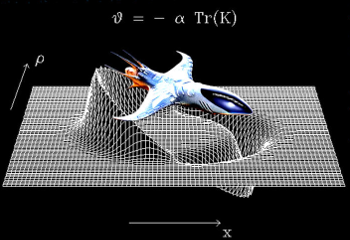
This seems perhaps an obvious one, space opera tends to be impossible without some measurable means of transiting the stars in a reasonable time frame, but it is one that, until recently, was even theoretically impossible. With the cultural popularity and theoretical applications of the Alcubierre Drive, it seems that we can justifiably speculate on how an FTL civilization would function. However, before this, when breaking the light speed barrier was beyond the realm of plausibility, we had to simply invent it as science fiction.


I don't think too much needs to be said about this one, as its premise is quite simple and the scope for storytelling it grants is pretty broad. That said, I don't think that writers should fall into the trap that you can only tell good space opera with FTL. The solar system is vast enough that we can tell many stories inside of it, without ever having to leave the heliosphere. That space is big is an understatement, and so we can do much to fill up the void between planets.

2) Artificial Gravity

This one is also a standard feature, but the one that seems least likely to ever be feasible within the realm of known physics. Gravity as we know it is generated by the spin of an object exerting force on the items upon it, essentially pulling on them. To do that you need something which can artificially replicate that force. In most science fiction though we seem to see artificial gravity being a standard applied everywhere. The mechanics of this are usually poorly explained, and well beyond the scope of our physics. Thus, one is forced to conclude that this is an unfeasible prospect based on our current understanding of modern science.

However, we can generate artificial gravity through things like centrifugal force, or simple thrust. The books in The Expanse series (and television series) show this through both aspects, and it is fascinating to watch the differences in gravity and problems it creates for our characters when they must do without it on occasion. Knowing that this is a plausible thing too, might change many people's perspective on what is 'realistic' and 'unrealistic' in science fiction.

I personally look forward to the day when we have a rotating habitat in orbit around Earth to start to get some hard data on this.

3) Interplanetary Colonization

One thing that is practically taken as gospel in almost every piece of science fiction is the idea that humanity will spread to the stars and plant our flags on other worlds and terraform them to suit our needs. Now, we have a history here on Earth of spreading across the continents, from the early Polynesian peoples to the Age of Discovery when Europeans began planting flags all over the world. It would make sense then that we would seek to expand that process to the final frontier. But does it really?

For one thing, space is big. Really, really, big. It would take centuries to travel to even some of the closest stars near to our solar system without FTL. Even travelling between the various planets in the solar system at the moment would take months or years with current technology. Even with some future technology it would take a long time to reach some place like Proxima Centauri, our closest star.

Even then, once we got to another solar system, would we even be able to colonize it? Kim Stanley Robinson's Aurora has some interesting answers on that. However, even assuming that we could terrform another planet, it would take a long time, centuries or millennia. So why not just build some islands in space?


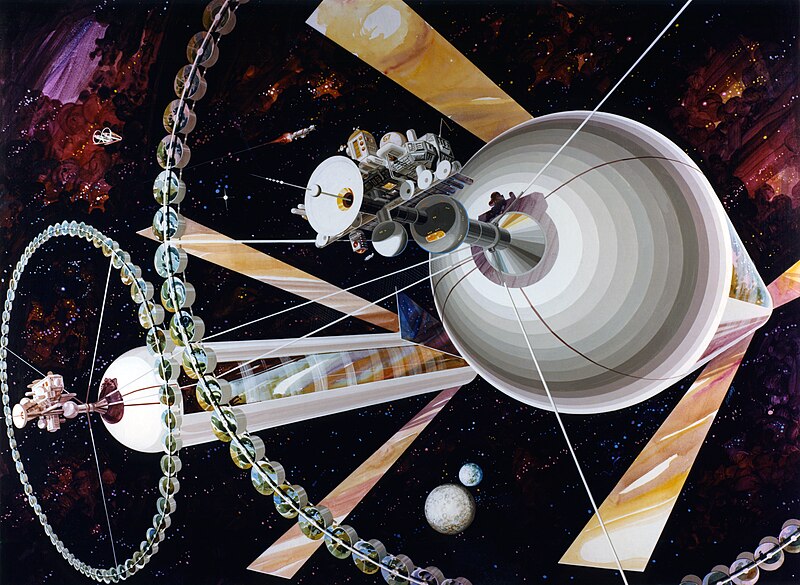
This brings you to the idea of the O'Neill Cylinder! At its simplest this is a large tube, either built independently or into a hollowed out asteroid, and spun up to provide gravity. Something like the terrarium from 2312.  The idea was originally floated in the book The High Frontier by physicist Gerard K. O'Neill, which talked of building rotating habitats in Earth/Moon orbit, or at the stable Lagrange points in Earth's orbit. These can be of varying sizes, but the advantages are you can create and settle them however you like! Want an arctic like location? No problem! Eternal tropics? No problem! All you need to do is create a cylinder with a certain diameter and length, spin it up and light it and voila!

And O'Neill's design isn't even necessarily the only one. You could build even larger, potentially with the truly massive McKendree Cylinder. Unlike O'Neill's more modest island in space, here you would practically be building a continent in space. Measuring 460 km in radius and 4600 km in length per the original proposal, you could have a living area inside with the same land area as Russia! You could even build it bigger with stronger future materials!

Building something like this turns into decades, or maybe a century, of work. Something far removed from the travel times between the stars or the length of time it might take to terraform somewhere like Mars. We could have continent sized living space in the future, yet this seems to get overlooked fairly easily. Perhaps we should start thinking of those types of stories more. You don't even need to leave the Solar system to have an 'interplanetary' adventure!

4) AI

Artificial Intelligence, or the reasonable facsimile thereof, has been an expectation of science fiction since at least the 1950s. Presumably most well known is Robert Heinlein's "Mycroft" who was birthed when an engineer on the moon progressively plugged in more and more computers until they gain sentience as one single being. Sadly, to some people the idea hasn't advanced much beyond that.

There is a strange belief in what is known as "The Singularity" in which computers will advance so quickly and so fast that just one day they will "wake up" and AI will be born. Now there's a few problems with this idea. Firstly that our rapid advancement in technology and efficiency is nowhere near as rapid as proponents even 20 years ago predicted. Futurist Ray Kurzweil predicted in his 1999 book The Singularity is Near that by 2010 we would have a computer capable of emulating human intelligence, and by 2020 such computers would be available for "one-thousand dollars" to us. Well, it's 2020 and barring some massive change no such computer is on the horizon.

Largely the idea is a vast misunderstanding of Moore's Law, which even the observer himself said was not a hard fast law, but an observation. It is even clear today that the rapid increase of processing power in computing is reaching a state of diminishing returns. Exponential growth cannot continue forever.


Even overlooking the issue of the Singularity, what would an AI actually look like? Would it have human level intelligence? Maybe, but would we recognize that intelligence? That last question is probably the most important when considering the issue of AI, would we even recognize it for what it was if we had it? Let me be clear, creating an 'artificial brain' which can solve complex problems is already within our grasp, whether it be made to play games of go or jeopardy. However, one which will be able to complexly interact with and communicate/reason with its human creators will take time and we might not even realize it was self aware as it wouldn't have the same desires/fears/ambitions as we do.

This is why I personally tend to dismiss out of hand fears of 'god like' AI destroying either humanity or the planet. In fact, I think AI will probably be far 'simpler' than we imagine when/if it does show up. For now though, its a highly theoretical concept with some wild out there ideas which fiction has almost done a disservice to.

5) Space Capitalism

So this is an important one. In many, many future scenarios it is hundreds or thousands of years in the future and everyone is either still working a 9-5 job, or working towards getting a pension or government benefits. Now, this makes sense since it would take a lot to put readers in a frame of mind where they grasp a post-capitalist society. However, is this the best way to try and imagine the future?

There have been many attempts to imagine a post-capitalist society in science fiction. Whether it was Gene Roddenberry's post-scarcity Federation of Planets, or the Mondragon Accords put forward by Kim Stanley Robinson. Now, each of these do depend on future technologies to be feasible (the magic replicators in the former and quantum computing in the latter) and it isn't far fetched to believe that our future economic systems will be driven by post-scarcity concerns or technological advances.

One future technology with the potential to upend the current economic order as we understand it is fusion power. An expected massive leap in power production and orders of magnitude more efficient and safer than our current atomic power generation. This could, almost overnight, upend our way of producing power as we know it and put the current hydrocarbon power generation methods the world largely depends on in decline. That would change some key economic inter-dependencies, such as on foreign oil or even the whole natural gas industry.

Now some of this does depend on the idea of a 'post-scarcity' society. It should be understood that 'post-scarcity' does not mean that we have everything, it just means that obtaining resources and a high standard of living is not impossible for the average person as goods are produced cheaply and available to all. This would though, arguably eliminate the need for traditional capitalism as we know it and lead to something close to the UBI (Universal Basic Income) that has been mooted around the last few years. Even just the UBI would undermine our understanding of politics and economics as it stands.

The future though, might not be more egalitarian but more corporate. With men like Elon Musk and Jeff Bezos driving the current future of space travel, it seems like we're possibly going to have shares be more important in the near future than any sort of workers cooperative in space.

However, the ideas for a post-capitalist future are many, and even here I can only list some ideas for why writers ought to be imagining a post-profit driven society.

----

These of course, are just a few things that science fiction is often using as a standard for the genre. They aren't the only big tropes, but I think they are at least the top five. What do you think, and what would you like to see more of in science fiction?

Tuesday, 28 January 2020

Battle for the Wastelands

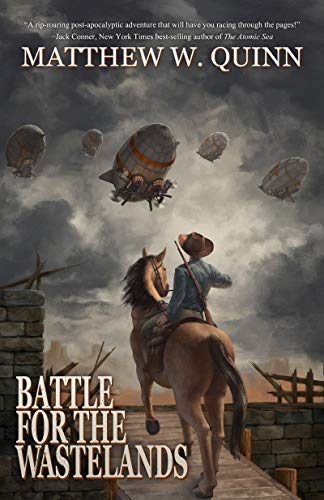
Recently I got to read a book I have wanted to read for a long time. Fellow blogger and writer Matthew Quinn had talked about his full length novel Battle for the Wastelands for many years. After a long process of submissions, Mr. Quinn finally went the self publishing route and made his novel available to the public! Here's my full review of Battle.


Set in an indeterminate period after a post apocalyptic event, we find our protagonist Andrew Sutter, traversing the wastes along the Iron Desert within the fertile Basin. His home. Carroll Town, is ruled over by the despotic and terrifying Flesh Eating Legion under the command of rebel turned warlord Jasper Clark. With a terrible drought afflicting them, a heavy tribute is demanded, sparking a minor rebellion and when Andrew takes up arms, he finds he might not know what true battle holds.

Meanwhile, the ruthless warlord Grendel, first lord of the Northlands, is struggling to hold his fledgling empire together. Though he has largely crushed all his foes, his underlings are now clashing with one another. It threatens to split his tenuous hold on the Basin lands into splinters and destroy everything he has built. Within his new realm he has friends and enemies. One being his concubine and former woman of the ruling Merrill family, Catalina, who seeks a way to plot against him. The other is Alonzo Merrill, leader of a ragtag rebel army opposing Grendel and his cronies, but fighting a losing war along the Southern Wall, a series of fortifications designed to drive the remainder into the desert.

Can the rebels manage to beat the first lord of the Northlands? Or will they be swallowed up by the progress of empire?

I definitely found that the novel was fast paced, which was good for the amount of information you receive when reading it. It starts off with a brief introduction into the Iron Desert and Caroll Town, but then its hard fighting and lots of dying!

Andrew is, without a doubt, our main viewpoint character. He is the audience surrogate seeing the issues of the world at large. Young, headstrong, and very unsure of himself he finds himself thrust into a war he barely understands until it gets personal. Seeing the despotism of Grendel's empire up close, he throws himself whole heart into fighting it.

While I enjoyed Andrew, I actually don't think he was the most interesting character in the book. His young naivety and limited scope for viewing the problems in the Basin as a whole, made him have only a one track mind. That is, the specific struggle against the Flesh Eating Legion under Jasper Clark. This was an engaging story, with a great cast of supporting characters (who had a terrifying life expectancy) that kept me hooked.

Many of Andrew's scenes were where the action in the story shone through, and it starts off bloody. It then gets up close and personal. Largely, this is where the meat of the story excels, with it being well described and satisfyingly bloody. From knife to bayonet wounds, to the after effect of mortar bombardments, you aren't left in the dark about the horrors of combat. Though after a point, some of the description did feel perfunctory, especially in the first third where it didn't come off as quite as strong.

The use of old vs. new style weapons was pretty clever. The dirigibles flying around give any enemy a massive advantage in both scouting and firepower, but there are ways to defeat this. The most obvious course is to have a dirigible of your own, but there are other ways. I think one of my favorite visuals from the book is when Andrew and other Merrill troops are waiting behind a rise in a hill, all rifles aimed skyward with a 'balloon popper' cannon to try and blow a patrolling dirigible out of the sky if it spots them. Coupled with the rarity of Old World weapons (automatic rifles and machine guns) you get some pretty awesome steampunk action with bolt action rifles going against SAW weapons on occasion and all the imbalances that creates.

Perhaps the most interesting aspect though, is the politicking in the villain camp. While the good guys are (largely) united in purpose, the bad guys are quickly devolving into fighting amongst themselves. Grendel is after all, a warlord, and the people he works with or conquered were also warlords. And much of Grendel's time is now spent dealing with his uppity subordinates.

In the neo-fuedal future setting of the world, this works quite well. This is why I really appreciated Grendel as a character. All of Grendel's scenes are deliciously Machiavellian as we see the tyrant plotting and outsmarting opponents while trying to crack the problem of how to pass on his empire to his heirs. His son Falki (who will be starring in an upcoming novella) is something of a pain in the ass for the tyrant. Though Falki is clever in his own right, he is still a boy used to immature outbursts and doesn't quite understand the fine art of terror and politics the way Grendel does. The two competing view points between the two makes for some nice tension in Grendel's plot, and it makes me look forward to how they will play out in the future.

Grendel of course, keeps a bevy of concubines, and they too have their own politics. Trying to get their sons higher in the line of succession, and in Catalina's case, trying to get him to remember his Merrill heritage rather than the role Grendel is trying to set for him. Of course, Grendel is not entirely blind to that either. Catalina will hopefully be a major character in the future, and I look forward to seeing her use her position to her advantage as well as she possibly can.

In these scenes we also get useful world building. We learn how Grendel runs his empire, the various (and myriad) factions he employs, and even delightful little details like union/guild systems which can do things like go on strike! It makes for some fascinating interplay, and at the end of the novel seems to be setting the scene for intrigues and struggles for the good guys! I really look forward to seeing more of that in the future.

The one place where I think the world building did not shine though was establishing the overall setting. I had actually believed this was a future Earth, and while I couldn't match the geography in my head, things began to break apart as I read more. The exact nature of the Old World is left mysterious, and with little tell for how it fell apart or what technology was left behind. Much of this was based off of the world 'moving on' in the Dark Tower series, but I think that more explicit calling to the different nature of this world and then a smidge more info or theories about the Old World would have helped ground the setting.

Enjoyable little nods to the Old World abounded, one scene where Andrew is wandering through the Iron Desert and finds the remains of an abandoned house was a fun aside. The weapons and their rarity/effectiveness was a fun jump in any action scene. I did find myself hoping that other Old World tech which wasn't just weapons would come around, and maybe that will be a future plot point. Fingers crossed.

If I had to make one criticism of the novel, it was that I found the first act to not be as strong as it might have been. Andrew's early arc is well established, but we wait a while for anything to come involving Grendel or the Flesh Eating Legion (which itself could probably have been fleshed out more too) and their overall place in this world. Once we get past the initial Caroll Town arc though, the story picks up, snagging your attention and never letting go. The second and third acts I breezed through as I had time.

As a story though, it makes a valid argument for steampunk not being dead or unusable as a genre. Dirigibles, trains, telegraphs and machine guns are all intelligently and compellingly used. The Western look and feel is never wasted, and the clever plots and compelling characters are well put together. If you're looking for some great action and a really, really fascinating villain, I cannot recommend Battle for the Wastelands enough. And with a novella coming out in the near future, you won't be waiting for more from this fascinating world! Check it out!

Friday, 17 January 2020

Ottawa Underground Legend


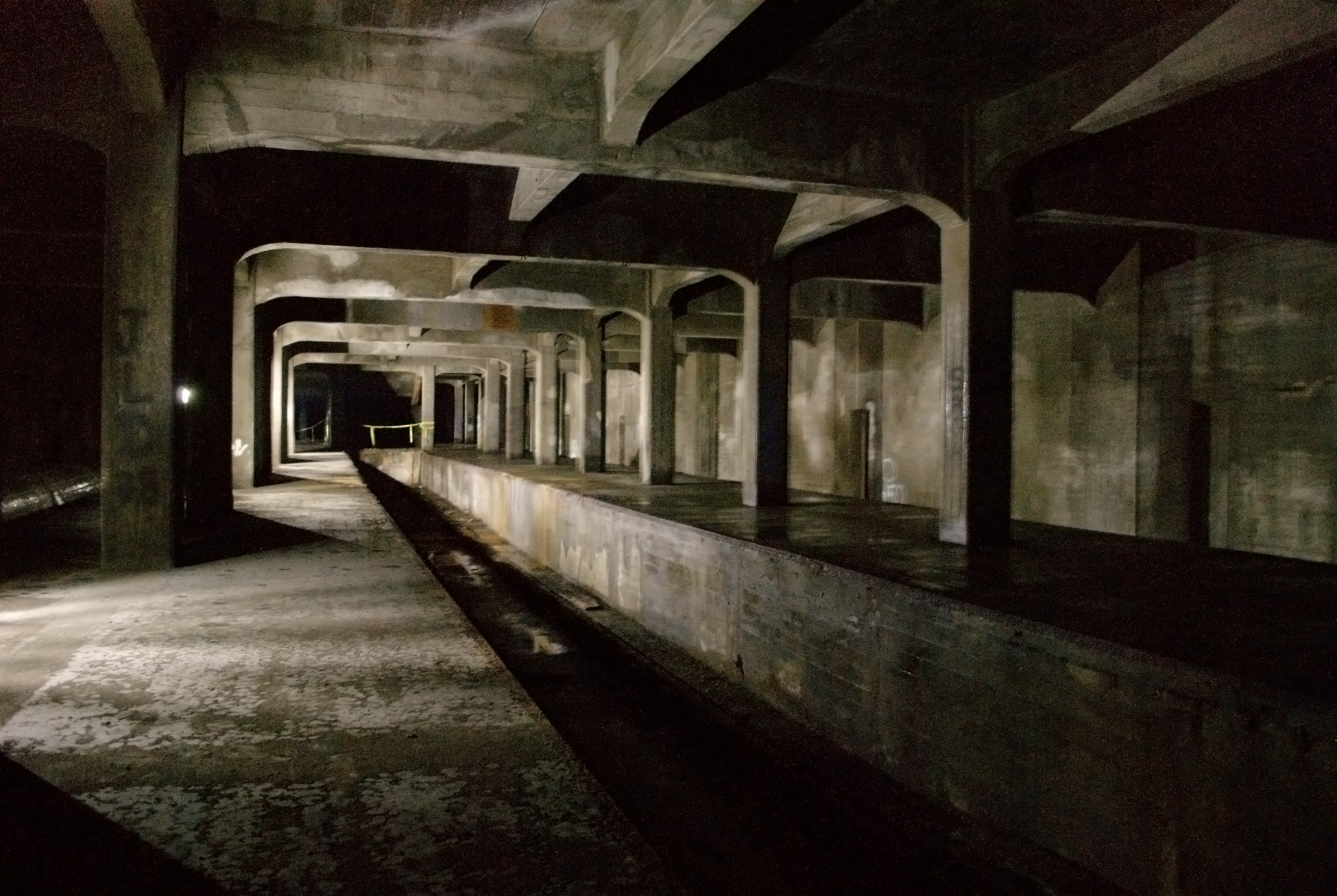
Some urban legends have more truth to them than we think. My own city, I discovered recently, has a few as well. Way back in 2012, there were reports of an abandoned rail tunnel, complete with train, compiled by an enterprising journalist of the Ottawa Citizen. He looked into rumors that someone had found an entire train just abandoned beneath the earth. So he went digging.

Bar side tales told that there was an abandoned train tunnel in the depths of Ottawa. Perhaps from an original attempt to get the city an underground rail system for its street cars, or maybe it was from an old brewery. For the latter, it was out of use since 1967, and no one had seen it since.

That was, potentially, until 2015 when some workers literally fell through the floor into the old tunnel. Needless to say, they were quite surprised and no one could figure out why it had been hidden. Mapping it out on old municipal maps, the rail line was discovered to extend perhaps as far as Carp and Rockland either way.

Now, its not clear from this latter article whether the tunnel in question refers to the conclusions of the 2012 Citizen article that the 'abandoned subway' is a part of the old brewery tunnel, or whether this is a completely different small rail system. There has been precious little follow up journalism on the subject, and it seems that it may well fall into the topic of urban folklore once more.

However, the fact that one has just happened to turn up is both fascinating and perhaps a little alarming. It should make us pause at just how many secrets cities, even small ones of only over a million, can hold after so many years. What else could be lying just beneath our feet?

A special shout out to Voices in the Attic for originally sharing and bringing this to my attention. They've got a great spooky Twitter feed to follow too. Definitely check these guys out!