Showing posts with label Robots. Show all posts

Wednesday, 29 June 2022

Robosoldiers

In this exciting new anthology from Baen, we are examining the non biological soldiers of the future. This isn't as crazy as one might imagine. Older than we think, the first UAV was the "Aerial Target" flown in 1917, while a robot for antitank purposes was deployed by the Wehrmacht in 1942. Drones and robots are becoming more common on the battlefield every year. From little bomb disposal bots, to enormous fixed winged unmanned aerial vehicles. What might the future of autonomous warfare hold? These authors intend to stretch our imaginations and find out! Real thanks to Sean Korsgaard for tipping me off on the release date so I could snag it!

It's a collection of thirteen stories that I'm looking at, so here's a brief primer on each and my own thoughts. There's some gems in here and ones which expanded my own thinking about the way we might see robots in future wars. Here are the Robosoldiers, thank you for your servos!

Higher Ground (M. T. Reiten): In the sequel to Afghan War I the US is back, but this time with mobile autonomous Guardian soldiers. Clever, but not especially bright in some cases. It's a really well contained story that sets up a tactical problem, the limits of a system, and how even mundane robots could be used to deadly effect in the future.

Today I Go Home (Martin L. Shoemaker): A mechanical warrior has been found deep in the jungles of Central America along the border of Belize and Guatemala. An expat technician is called home so he can help end the threat of a now rampaging machine which kills anyone who comes near. Can he overcome old grudges and find a way to save his country from chaos? 

I enjoyed this one because it was a fairly close knit story of a technician and not a soldier. Some clever use of machine learning and programs as well, which added to an overall mystery element in a way which built some very well plotted tension.

All Is One (Doug Beason): A clever take on the future of Space Force and the potential for space based satellite surveillance. It's a bit of an "AI doesn't understand humans and that's dangerous" story which is always good to counter the 'uber AI' narrative it's proponents tell. It has a clever conclusion, but might have been on the weaker side, if only because it was constrained by the short story aspect which didn't give it enough room to make the story really eerie. I loved the subtext around the dangers of constant surveillance however, and it's something too few people think about.

Edge Case (Richard Fox): With the advent of telemetry and better sensors, a bomb-disposable bot is now the best way to save lives when an explosive is involved. This was a very clever story with an interesting twist on a bomb disposal plot with an extremely clever ending that had me yelping with surprise! Genuinely good writing and an impressive grasp of the mystery genre as well. Cannot praise this one highly enough for how it really used tropes well and did an amazing job challenging my own ideas on how one could write a story like this!

Manchurian (Sean Patrick Hazlett): A very fun story about special forces operators, a resurgent and depraved series of human experiments, and a title with a play on words which left me rather shocked by it's ending. A special forces soldier uses the terrifying weapons at his disposal to fight off a Chinese encroachment, only to realize that the enemy has weapons far deadlier than he can imagine. Not my favorite story in the anthology, if only because I'm poorly disposed towards nanite swarms in fiction, but it was a good story to subvert my expectations!

Resilience (Monalisa Foster): Honestly, this was one of the cleverest and most beautiful stories in the whole anthology. PTSD is a very poorly represented aspect of a soldier's life in fiction, often only portrayed in the negative and destructive sense, but one which is real and hard hitting. Sergeant Karlie Engel has survived a traumatic event and is running through a course of therapy with a neural implant which is supposed to help calm her racing thoughts and dampen her triggers, but what happens when that course of therapy isn't working? 

Really emotional and quite exciting in how it manages to tie things up at the end.

The Rules of the Game (Phillip E. Pournelle): The two global superpowers are once again facing off over Taiwan, and the US and China are both using advanced AI and computer learning models to predict, preempt, and overcome their opponents strategies. On one side, an advanced battle computer trying to predict and map all American moves, on the other a series of plans and machines designed to frustrate those predictions. It's a really good examination of the issues within AI learning and the weaknesses of depending on such a system can have. Interesting run at overcoming the potential advantages another side might have in using this system, while also making a poignant point about the problems in rigid ideology.

My Dog Skipper 2.0 (Weston Ochse): Can you really bring back your best friend? When a military experiment between a man and his dog, unknowingly, goes wrong, a Frankenstein's monster style situation erupts. It was an interesting take on the 'man and his dog' story, but was almost one better relegated to a horror anthology than a military anthology!

Uncovered Data (David Drake): A short, but slightly confusing interrogation story. I admit I couldn't quite piece this one together other than there was an interrogator, he was interrogating someone, and there was a kind of psychic uplink? Otherwise, I don't really know how robots were involved in this one.

The Handyman (T. C. McCarthy): Jed has signed a twenty year contract as a maintenance man on a Lunar base for the United States Marine Corps, mostly automated. Easy money he thinks, until the Russians attack. Then it's up and running to make sure his goose isn't cooked by Russian combat units, and that he has enough Jim Bean to see him through this hard run across the Lunar surface. An excellent read with lots of action in a pulse pounding story. Loved how this one just ran with 'hillbilly berates robot soldier' and made it laugh out loud fun.

The Pinocchio Gambit (Brad R. Torgersen): In a secret war over robotic systems, a system man must become an interrogator must try and feel out whether a Chinese defector is an ally or an enemy. Extremely well written look at shifting allegiances, spy games, and the potential for spy games to get very lethal very fast. 

Nightingale (Stephen Lawson): This was a real winner. When an engineer is kidnapped by a nefarious agent for personal gain, a rogue rescue team has to used its many robotic assets to get him out. I loved this one because it was a James Bond style story tied up with really cool robots that fight little battles of their own. There was a very cleverly integrated human element too, with a little love triangle that made you, somewhat, doubt the good intentions of everyone involved. Fast paced action all the way through and it wired years of backstory and forefront action into a very small package.

Operation Meltwater (Philip Kramer): What happens when an experimental probe for NASA's exploration of Enceladus gets checked out by some snoopy Russians? An action packed comedy of errors and discovery where a scientist finds himself in way over his head. 

This was one of my favorite stories in the anthology because it took a regular scientist and put him in a few amusing 'fish out of water' situations. From his confronting of a few irregular personnel assigned to the project, to his own ingenious grasp of his own project to make a third option, it was a rather heartwarming, and exciting, conclusion to the anthology. I definitely enjoyed his hard bitten pessimism coupled with a lot of weird stuff happening around him.

---

Like any anthology, it won't work for everyone, and some stories are hit or miss depending on your preferences. I thoroughly enjoyed the work though and a lot of good authors have some fantastic short work on display here. Genuinely loved the combination of heart, artificial soul, technological know how and gunplay which covered this anthology. Great read for anyone who loves science fiction and robots!

Monday, 10 February 2020

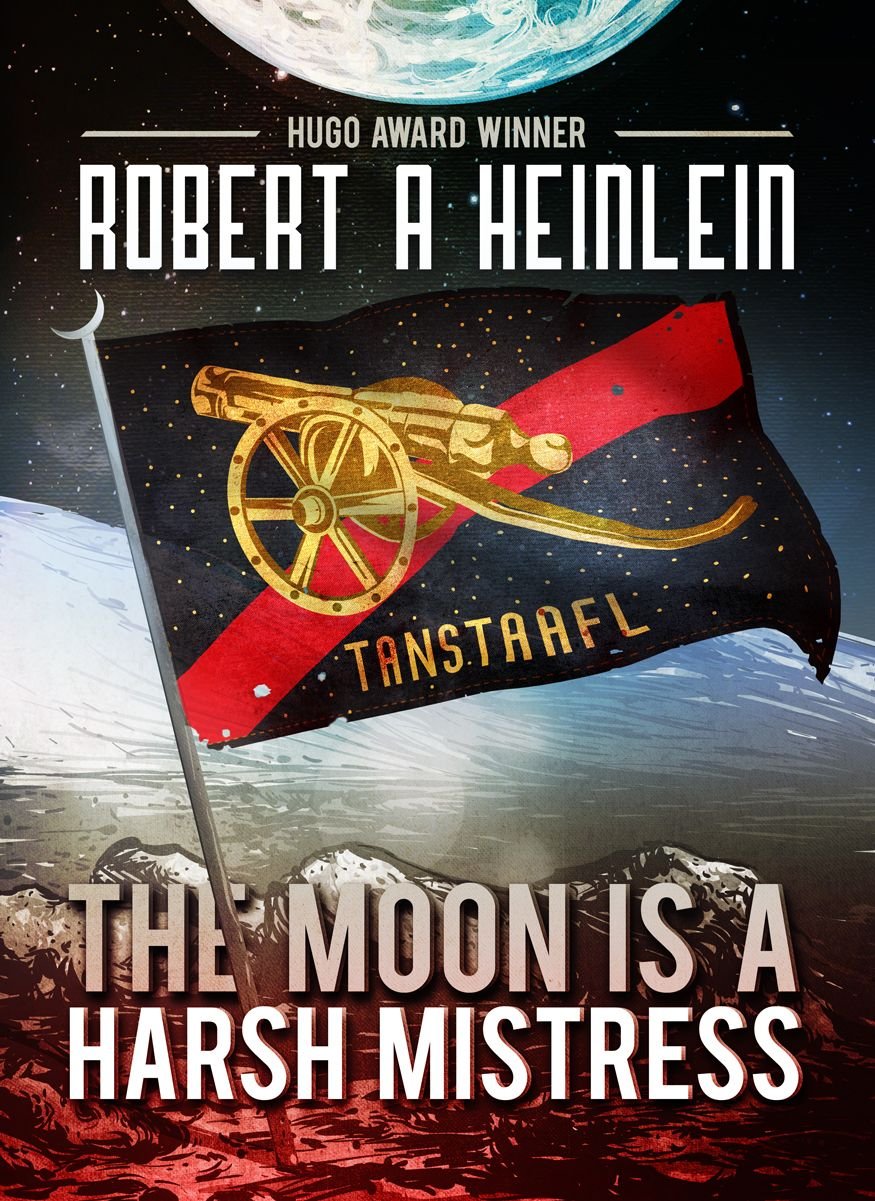
The Moon is a Harsh Mistress

Another one for the Great 2020 reread!

I originally read this sci-fi classic way back in high school, I loved it then and I certainly love it now! It is a classic story of science fiction, one of Robert Heinlein's best works IMO. A story of politics, life on the moon and the desire of the Loonies, as they affectionately call themselves, for liberation from the Earth based Lunar Authority. By any stretch of the imagination, The Moon is a Harsh Mistress!


The story is told through the eyes of Manuel "Mannie" Garcia O'Kelly-Davis, a freeborn son of Lunar 'settlers' who comes to interact with a suddenly sentient computer Mycroft, or Mike as he likes to be called. He's the head honcho computer who controls the majority of the Lunar complexes and their functions. His sudden self-awareness is unprecedented and only Mannie talks to him, becoming one of his oldest friends.

However, Mannie is unsuspectingly drawn into a larger conspiracy when he attends a political rally which gets raided by the troops of the Lunar Authority. Suddenly caught up in a manhunt, he has no choice but to go into hiding alongside his new revolutionary comrades Wyoming "Wyoh" Knott, and Professor Bernardo de la Paz. When informed by Mike that the moon, which exports hydroponic wheat to Earth - in seven short years famine will be stalked by famine in a resource collapse, they decide that they must free Luna from Earth based tyranny. The revolution has begun!

A revolution framed through the eyes of someone who is not a revolutionary is a clever trick, as he serves as a conduit for the audience to be shown the methods of revolt which will bring Luna freedom. We have an in depth look at how the revolution is planned, and then helmed around the person of "Adam Selene" who is Mike simply manipulating his abilities as the great computer to make himself look like someone else and the ostensible leader of the whole revolt. From organizing cells of dissidents to creating false broadcasts for Earth consumption it is a meticulously well planned operation, with Mike planning things down to the decimal points!

For a brief aside, Mike as a computer and character works so well. As I noted elsewhere, the idea of him simply being plugged in and becoming sentient is a pretty common theme in modern AI thinking, but his inability to completely understand humor or many other human nuances is a pretty good look at how alien and unlike us any actual machine intelligence would probably end up being. As a character it also makes him both relatable and just on the line for being alien. What is even better though is that say unlike Rudi from the Emberverse and Merlin from Safehold, he is not infallible. While he is an immense help to the revolution on Luna and in accomplishing other goals, he has a set of limitations which actually build tension rather than deflate it. It's wonderfully well done and very refreshing compared to many modern takes on the same idea.

Of course, we also get a chance to look at Heinlein's concepts for Lunar society. It is one descended from prisoners imported very much against their will to work the Lunar surface and it was overwhelmingly male. It has led to one where people are unflinchingly polite as crossing a line could easily get you 'eliminated' by your fellows. And you better not think of touching a woman! The men outnumber women still three to one (better than the old days!!) and so anyone who so much as touches a woman against her consent will be mobbed and murdered before he can so much as twitch. It creates a society which depends on group marriages and line marriages to survive. Polyamory is a way of life by necessity. Very true to much of Heinlein's free love ideals. It's a unique frontier society, one that makes an interesting case for itself.

Reputation is important, and men live and die by their reputations. Indeed, holding ones family up is quite important. In economic terms, barter is, outside deals with the Authority, the order of the day. It's basically an unregulated free economy. It is also a remarkably tolerant and integrated one. Mannie is mixed race, and in a later event when he goes to Earth this is contrasted with the more intolerant culture of the North American Directorate, especially in Kentucky. It's a chance for commentary on events of the time, and shows itself off as pretty progressive.

The dialect of the Loonies is also delightful to read. They have numerous loan words from Russian and Chinese, and these are liberally sprinkled in adding a great flavor to the people. It takes some eking out, but once you catch on it is amazing to read!

But of course this being a novel of revolution, politics is pretty front and center. Compared to a more preachy novel like Starship Troopers, this one is fairly tame in expanding on Heinlein's political thought. Here we have an attempt at building an new, almost stateless, society. The politics in the book are very much built around the ideas espoused by Professor de la Paz. In the modern day, the story is somewhat understood as the tale of a libertarian revolution. Interestingly, the story itself precedes the common understanding of modern libertarianism, and the Professor calls himself a "Rational Anarchist" when describing his political theory. It can be best summed up with two quotes:

A rational anarchist believes that concepts such as "state" and "society" and "government" have no existence save as physically exemplified in the acts of self-responsible individuals.

And

I will accept any rules that you feel necessary to your freedom. I am free, no matter what rules surround me. If I find them tolerable, I tolerate them; if I find them too obnoxious, I break them. I am free because I know that I alone am morally responsible for everything I do.

These ideas hew very close to libertarian socialist philosophy (especially radical ideas of minarchism where the state is hardly needed) and in that vein the story is interpreted through numerous different philosophies as representing their ideals. However, anarchy and libertarianism can be a slippery subject. The story itself probably can have its politics boiled down to the acronym TANSTAAFL. There ain't no such thing as a free lunch. Though sometimes erroneously credited to Heinlein, it is a phrase dating back to the 1930s. This can roughly be translated down to, nothing comes for free, or there's always a hidden cost. Which is always going to be a good way to describe revolution.

But these hardly distract from the story. The revolution of course is not bloodless or simple, and it really does turn around in numerous surprising ways. It managed to surprise me a few years later how much I had forgotten about the intrigues of the revolution and the delicate and difficult decisions being made in the messier parts. (Indeed one interesting sub-plot revolves around keeping an eye on Terran scientists so they don't send a message back to Earth). These little details really sucked me into the book, and made rereading it so much more enjoyable.

Despite being written in 1966, three years before the first man would walk on the moon in 1969, it gets a remarkable number of things right. The cities are built underground in caverns to protect them from meteor strikes, the microgravity requires a certain way of walking and landing and communicating on the moon is done through hard landlines between the different settlements. The strain of living in low gravity and then experiencing Earth's higher gravity is also explored quite well. Though he did get some things wrong as science marched on, it managed to be remarkably prescient about many modern theories of living permanently on the moon.

Adding all this into the human element, the people who make up our main cast and supporting cast and the eventual love they come to have for each other, makes the revolution completely heart wrenching in its aftermath. I won't spoil any details, but it doesn't give our characters everything they might have wanted.

It is deservedly known as a science fiction classic. I would honestly recommend this to anyone who loves good science fiction, for it manages to tell an amazing story in a now very familiar location. If you've never read this book before, go pick it up and enjoy it!

Tuesday, 24 September 2013

The Weekly Word #6

Oh ye of little faith, here comes the Weekly Word number 6!


My slow writing aside, due to school and other things out there, I have got some wonderful tidbits in store for everyone this week. After two weeks of rather depressing news going around this time I have some great pop-culture links to share!

First and fore mostly I would like to again (if you followed me on Facebook you would already know) share the news that Firefly will be continued in comic format by Dark Horse comics! Yes over a decade of waiting has paid off for the erstwhile Browncoat fans who have eagerly awaited the day when the series would continue in some form or another, but now the wait is over!

Here is an article detailing this wonderful new turn of events.

Now of course some will be disappointed since it is not live action, and of course that the film Serenity is canon so some of your favorite characters are still six feet under. I for one am tentatively excited by this turn of events, mostly because numerous fan fics and fan theories have been floating around for years! Finally though we may get some long awaited closure from our favorite sci-fi series.


Though speaking of Firefly, and of course one of my favorite actors Nathan Fillion, I am also happy to say that the sixth season of Castle premiered last night and we finally found out the answer to the burning cliff hanger we were left with over the summer months! Only to be given a new burning cliff hanger to start the series off! We will have to find out what happens next Monday and how the saga of one of the best police partnerships on TV continues!


In other news the new trailer for Robocop is out. We are seeing a whole new version of the franchise with this re-boot and one this is extraordinary in its look at the Robocop world, though according to Cracked it seems to be a little simplistic in it's set up.

Though of course we'll just have to wait and see won't we?

But here is the new trailer for your viewing pleasure!


In other, just as cheery news, it seems the horrible sensation which has been the Atlas Shrugged film trilogy is so desperate they have been forced to go to Kickstarter in order to obtain the funds to finish off a trilogy so bad the books fans don't even like it! Last year I talked about Part II of the terrible trilogy and commented on how this part seemed competently strung together, unlike the first film.

However, many people who have seen the film (well the two I know of) have panned it as being awful, just awful. In a delicious irony the free market agrees and finds the disgusting ideology the film champions unpalatable. This of course sticks in the craw of many of the ideologies most ardent defenders who insist it is a good film and is a wonderful parable of our times.

The remaining 99.99 percent of humanity disagrees.

In their effort to keep ideological purity alive for this sad series the producers have gone to kickstarters with a modest goal to reach of a quarter of a million dollars, and has made a respectable 96,000 so far. Seems to have some rich backers with plenty of cash to throw around for sure. Though I'm sure that like the rest of the films it will flop spectacularly, and it may even end up driving the makers into debt.

It seems the film is to be recast, again, as they have either let the actors go, or the actors have quit. It is admirable that the producers decide to keep going really. The producers have also thanked those who have hated on the movie for helping generate publicity, firmly believing that even bad publicity is good publicity. Unless it of course means that no one will watch your movie of course!

While I salute their commitment to their ideological goal I will of course disparage the series and ideology until the day I die.

On the plus side if the world ends the 1000+ page book makes great kindling or toilet paper!

Well that's my rant for this week readers! Until next time!