Thursday, 17 February 2022

The Trent War at Sea

Recently, I did publish an article about what I called "the Cuban missile crisis of the Victorian era" otherwise known as the Trent Affair. In a nutshell, in 1861 the United States and Great Britain nearly went to war right in the middle of the American Civil War. I explored more of the details of that potential conflict there, but I have one little detail I would like to explore more in depth here. And that is the naval war.


With the war ostensibly starting over a ship seized at sea, it seems only logical to examine how the war might be fought on that front. I won't be going too deep into the ideas of battles between ships, fleet strengths, and other issues, which I touched upon briefly in my last article. And I've done some musing on what battles might look like and who would win, but that is a far more detailed analysis than I aim to provide here. Instead I want to examine what the United States had felt would be its most effective weapon, commerce raiding.

History buffs who know about either the War of 1812 or have read about German naval activity in WWI and WWII are no doubt familiar with those campaigns, but for anyone curious, in a nutshell here's why these tactics are adopted. A naval power with a battlefleet inferior to its opponent, like the US in 1812 or the Germans in either world war, will often decide to strike at their opponents commerce in order to take ships out of the line of battle that would otherwise be used against their own navy. This is not a war winning strategy, but it can have very powerful effects economically. Insurance for British shipping rose precipitously in each of these wars, and it caused millions lost in both money and supplies, with raiders making some areas incredibly unsafe for any neutral ships.

In a world where steam powered warships will be chasing sail powered merchant vessels, this will undoubtedly be even more disastrous!

We don't need to look to far to come across an apt historical comparison for how this campaign might look, the American Civil War had its own commerce raiders from the Confederate side. The most famous was the CSS Alabama whose global cruises captured 66 ships, sunk a Union warship, and caused over 6 million in damages. And that was merely one raider, which means we could expect the Union to do even more damage British commerce than the Alabama did to Union commerce right?

Surprisingly, probably not.

To be clear, I'm not making an argument that the US navy could not hurt British commerce, far from it, but merely that there would be large impediments to their ability to do so.

For starters, in no scenario in the hypothetical war does the United States Navy have freedom of action. Its vessels will, within a few weeks, be largely bottle up in harbor by a Royal Navy blockade. This happened in the War of 1812, and would happen here by and large. Like the Confederates proved, many would be able to run the blockade, but the American squadrons would, in few cases, want to seek action with their British counterparts. That means that it would be individual raiders running the blockade to attack British commerce.

Secondly, allow me to illustrate something. Here is a map of the routes taken by Alabama and some ports of call she utilized to keep her world cruise going:


Sharp eyed geographers will note that almost all the ports of call utilized by the raider are British ports of call, which would make them inaccessible to Union warships. This means they will have to take on supplies in neutral ports which are few and far between. 

Thirdly, the reason for that, is that the Royal Navy had peacetime stations all around the world to protect its empire and its maritime trade routes. Every major crossing from the Cape of Good Hope to Cape Horn could see a British warship patrolling it. These stations were given modest reinforcements during the crisis historically (but by no means major ones) and would possibly have received more as the war went on.

To illustrate why this is a problem, allow me to quote Rafael Semmes in his cruise from the Alabama on why he was successful for so long:

The time had now arrived for me to stretch over to the Cape of Good Hope. I had been three months near the equator, and on the coast of Brazil, and it was about time that some of Mr. Welles’ ships of war, in pursuance of the tactics of that slow old gentleman, should be making their appearance on the coast in pursuit of me. I was more than ever astonished at the culpable neglect or want of sagacity of the head of the Federal Navy Department, when I arrived on the coast of Brazil, and found no Federal ship of war there. Ever since I had left the island of Jamaica, early in January, I had been working my way, gradually, to my present cruising ground. My ship had been constantly reported, and any one of his clerks could have plotted my track, from these reports, so as to show him, past all peradventure, where I was bound…the old gentleman does not seem once to have thought of so simple a policy as stationing a ship anywhere. The reader who has followed the Alabama in her career thus far, has seen how many vital points he left unguarded. His plan seemed to be, first to wait until he heard of the Alabama being somewhere, and then to send off a number of cruisers, post-haste, in pursuit of her, as though he expected her to stand still, and wait for her pursuers! This method of his left the game entirely in my own hands

Essentially, because the Union had pulled back its smaller peacetime presence to blockade the Confederacy it did not have enough ships to hand to station them at any point where they might block a Confederate raider. The Royal Navy by contrast has, and will continue to have, these peace time stations all over the world. This combination of port facilities in British hands and a larger global naval presence means that any Union commerce raiders would face daunting odds at making their presence felt. There is no doubt they would cause problems, but these would not be ones which are insurmountable.

Though I can already hear the question, why would the United States not just swamp the British with hordes of privateers? To answer that question one must, ironically, be familiar with the end of the Crimean War and the Declaration of Paris. 

In an oddity, the negotiations there set down the decree that European nations would no longer be willing to indulge private navy's or the commissioning of commerce raiders. The United States, being aware of its smaller navy and the potential for action against Britain, declined to sign. Enter the Civil War, and the United States realizes that by not being a signer of the Declaration, the European powers would have no reason to respect their wishes and a fleet of Confederate privateers might pummel their global shipping. Quickly, they declared they would abide by the Declaration and so the ports of Europe closed themselves to prizes from Confederate raiders, which resulted in the Confederacy being unable to profit from their raids, and so had to burn them.

If the United States found itself at war with Britain, they would face a similar problem. Privateers would find themselves shut out of European ports, or prize vessels simply seized and returned to their owners (as happened to the CSS Tuscaloosa). This would dent and deny the US any monetary prize for their work. No private raiders, but plenty of commissioned warships with commissioned crews converted from merchant steamers.

Finally, the British have a system that they would turn to in 1812 and both world wars, convoys. This is a slower system to be sure, but in 1812 it meant that ships in convoy were rarely lost, it denied the American raiders any easy prey, and it would get supplies to the war front in a reliable manner. Such a system would assuredly be turned to in any American war. I certainly imagine that the British Admiralty may hesitate to do so for a while, believing steam merchantmen can outrun their pursuers, but pressure will eventually make this a necessity.

The American merchant fleet, on the other hand, will have no such luck. Much like historically, where it re-flagged en masse to escape Confederate predations, it would find itself either captured, re-flagged, or simply swept from the seas.

Much like the Confederates in the historical civil war, the Germans in the world wars, or even the Americans in 1812, this would not be a war winning strategy in any hypothetical Trent War. Much worse for the US than 1812 is that the Royal Navy would not be distracted by a conflict with France, and so be able to devote its attentions to the US. The war at sea would be hard fought, and cost many lives and ships, but the commerce war would be lost on the first day. 

Sunday, 13 February 2022

The Revelations: My Apocalyptic Journey

Years ago now I was attending church, and doing what I usually did, poking my nose through the little Church library. I stumbled across books regarding the Book of Revelation and the foretold End of Days. They purported to tell me how I would know the world is coming to an end, how I as a Christian could see the signs, and what to expect as the End Times rolled nearer. I lapped these up, and then moved on to the controversial evangelical fiction series Left Behind.

Since then I've become a bit less convinced in these prophesies. 

I recently read a fascinating article from Current Affairs on 'Christian Horror and the end of the world' which tells the long story of attempts by the evangelical bent of Christianity to provoke a conversion experience by telling them of the horrors that await them in the Apocalypse. It also highlights the very troubling trend undertaken in making these more accessible for 'entertainment' to the public, the outright demonization of anyone who doesn't agree with these very narrow denominational views and an adherence to a very questionable idea of Biblical prophecy.

My own interactions with these ideas has also been uniquely American. For decades now there has been a cottage industry of American evangelists and theologians trying to reinterpret the Bible to, somehow, include the United States in prophecy or claim that the United States had a covenant with God. Neither of those things is true, but it hasn't stopped people from trying to claim it so. As such, whenever I read books about the End Times, the United States always loomed large in the authors thinking.

I can't say specifically what got me going down that path towards interest in the apocalypse, I was a pre-teen turning teenager when I began engaging with the ideas of the Christian End Times so perhaps my own changing life had something to do with it. However, I began reading about all the terrible things in the Book of Revelation, then reading Revelation itself. 

It's some pretty grim stuff, plagues, war, slaughter, and a one world government (if some of this sounds similar to contemporary conspiracy theory, take a few guesses about what has inspired some if it). Quite naturally, I began to be concerned. I read the Left Behind series next, wanting to soak in some - what I assumed - well informed fiction on the subject. The books aren't out and out awful, but they're not good either. If you're a teenager just getting into exploring your religion, this is probably not the best way to explore the End Times.

The fictional journey through the Book of Revelation is told primarily through two dimensional characters with some very lame attempts at Christian ideology or feel good conversion stories sprinkled throughout. Many of them come off as talking down to everyone else in the world. The cast is almost all American, and trips to the other parts of the world are inexpertly told and kinda troubling overall. It explores the years of the Tribulations, and the establishment of a one world government by the Antichrist and the eventual triumph of Jesus over the powers of evil. Yes, knowing the end does drain all the tension from the books.

Finishing the series by about the time I was sixteen, I began to wonder about all the prophesies. Was I living in the End Times? It certainly seemed that way! Wars, rumors of war, economic collapse, chronic fear of "the other" after 9/11, and not really having a firm grasp in Christian theology or the context in which Revelation was written made me fearful. Conversations with fellow Christians became worried about, is the end near, are we doing enough?

However, as time wore on, I became a little less worried. Partially thanks to Matthew 24:36 and Mark 13:32, as touchstones for how misguided the evangelicals warning of the imminent end times were.

With that though, I also realized many of the more firm predictions for how the end of the world would come about were a bit dated. One book I read was certain that Saddam Hussein was the Antichrist who was rebuilding Babylon to bring about the end times and described his time in power as the result of 'Satanic protection' from harm. Considering he was overthrown and executed only a few years before I began my journey into the End Times readings, I was understandably skeptical of further assurances from this writer.

If you go back far enough, many of the assurances or predictions from people seeking to capitalize on the End Times do depend on the enemy of the day. The Russians were fated to bring about the End Times, Gorbachev was the Antichrist, Al Qaeda and Islam would birth the Antichrist, ect. It's a lot of the here and now trying to be shoehorned into Biblical eschatology. Even the contemporary QAnon cult draws on much of the language and prophetic visions we see in Christian eschatology.

By the time I reached twenty there were other weird end of the world theories running around. The Mayan calendar and the 2012 end of the world date was one, and the zombie apocalypse infecting the whole post-apocalyptic fiction genre was also weighing heavily on peoples minds. The end of the world was trendy, and I was beginning to think that the evangelical view of the End Times was less than accurate.

Now I no longer believe in the literal End Times. I believe Jesus is coming back, but I don't quite think the apocalyptic visions promised by Left Behind or may other Christian apocalyptic visionaries are true or accurate. I've moved on from that fear, and I think it isn't a good fear for Christians to engage in. With very real issues facing the Earth like climate change, peak oil, and the horrible potential for nuclear war, we have much bigger things on our plates. The end of the world as we know it can be fun to explore or write about, but is not a theological or evangelical pursuit worth chasing. There are better messages to spread.

Friday, 21 January 2022

The Romanov Rescue

As a setting for alternate history, WWI is criminally underutilized. This was The Great War, the fall of empires, and the molding of an entirely new world! There are heaps of unexplored changes which could be explored! So I was quite excited to jump into what counts as a technothriller from the early 20th century set in the waning days of the Great War in 1918. Could the formation of the Soviet Union have been prevented, even at such a late stage? The Romanov Rescue, seeks to tell that tale!

Written by three authors, Tom Kratman, Justin Watson, and Kacey Ezell, it was very much a group effort piece. It shows though, that each of the authors has a solid expertise and has rigorously investigated the material and skills available to soldiers of the time period. I can't quite say where each author took over - a bonus to the book - but a few sections did have distinct voices. Overall though, it blended quite seamlessly together and for a three person effort, that's no mean feat!

From  my Kindle

Set in early 1918, in the midst of the work for the Treaty of Brest-Litovsk, we follow the musings of one Max Hoffman, who is effectively running the show as Hindenburg and Ludendorff prepare their great offensive of 1918 (another overlooked point in alternate history) and he stumbles upon a rapacious band of Latvian Riflemen. Musing on how awful the communists are, he wonders if anything can be done to stop them. Enter captured Russian Imperial Guardsman Daniil Kostyshakov. Fresh from an escape attempt, he is approached with an intriguing mission, how would be like to rescue the imprisoned royal family from the clutches of the Bolsheviks?

If that sounds like a mad plan, or the setting of a crazy thriller, you're right! From here its a plan on how to carry out the mission, how to recruit troops for it, and where on Earth they can get what they need when the war is still raging!

We follow many fun Russian characters. In truth the Imperial Guards made the best of the book, from Daniil, to Kaledin to Turgeney, they all had their quirks and fun ideas which hooked me on them. The story then largely follows their attempts at reconstituting an Imperial Guard unit for the rescue, training for the rescue, and covering the minutia of details on how to actually accomplish these goals. Otherwise we follow a strategic recon team who scout the way, and the stories of two guards at where the Royal Family is being held, Chekov and Dostovalov. These two add an excellent depth and personal touch to the events on the ground, and gets into some pretty fun intrigue which has far reaching effects on the outcome.

I enjoyed the German crew of the L5 Afrika Schiff so much. It added a very clever element to the whole drama. The equipment seems odd for even buffs of WWI, but when compared between 1914 and 1918 the world was a very different place and the things which could be learned very different! The authors definitely put a lot of thought into the technology, tactics, and how to make that realistically work, which educated me quite a bit on many of the fascinating details of airship launches, flight, and what interesting uses they might have had.

Then the story takes us across much of Russia, and through many various halls of power. The long recon led by Turgeney has some signature fun moments, from piracy to a train robbery. However, it also contains many of the more lagging sections of the novel. For instance, the entire section which took place in the smuggling vessel might have been better excised, if simply for tying up a lot of narrative time which might have been better spent elsewhere, and from there it used far too much 'rape as drama' for my taste. This did though, include many worthwhile action scenes.

My only other critique might be that the story attempts to humanize the Romanov's a bit too much. Certainly it is to be remembered that they were people, but the former tsar and tsarina were relentless autocrats who were actively undemocratic and engaged in bloody reprisals against their own people all in the name of autocracy. Telling the story through their children's eyes was a far better choice both stylistically and when it came to arriving at a much more thrilling finale.

I was impressed that the authors managed to end up pulling together such a large cast of characters to - eventually - a single location. There are many clever plot points, twists, and overall revelations that I was kept in rapt attention to details until the very end.

The story rapidly reaches a very action packed crescendo, with all the action and maddening complications despite meticulous planning one could hope for. In fact the final act doesn't pull its punches and I was caught off guard by just how insane the situation became. Despite the best laid plans and all the training in the world, there truly are some things you just can't prepare for! A very unique and ultimately satisfying read which does leave me wondering how the world might have turned out otherwise.

Wednesday, 12 January 2022

The Heroes

Three men, one battle, no heroes. Thus is the tagline to another epic story from Joe Abercrombie. In truth, this is about the fourth time I have read my well loved, and much worn, copy of the book. It was in fact the first I ever picked up of his. I effectively went into the world of the First Law blind and came out star struck. As such, there were some contexts I missed the first time, but when I first read (and then reread) the amazing trilogy, I fell in love with this book all over again. Allow me then, to introduce you to the epic three days in the Valley of Orsung as we see The Heroes. 

From goodreads

Picking up roughly nine years after the events of The Last Argument of Kings we see that, once again, the Union and the North are at loggerheads. A disagreement between the southern clans of the North and the new Protector have exploded into open war and so the King of the Union has backed them in their fight. Now for interminable months the two armies have snapped at one another but not yet come to battle. It's time to change all that.

Fighting for the North we have Crunden Craw and his dozen, working in and behind the lines to support the main army's four war chiefs. Slithering among them is the former Prince Calder who claims the North in the name of his slaughtered father Bethod, but so must act like a hostage while dodging assassins. A young lad named Beck decides he wants to see a real battle like his father and leaves home to take part in the war.

For the Union we have the hulking warrior Bremer dan Gorst, formerly the king's First Guard and a warrior without equal in the whole of the Union. Then we have the infamous Corporal Tunney, the longest serving junior officer in His Majesty's army, a lazy standard bearer who does his best to stay out of the way despite his officers meddling. Finally, on the sidelines, Finree dan Brock, now married to the son of the most infamous traitor in the Union, schemes to raise her husband in society and hopefully become a power to be reckoned with in society.

Behind them all though, Bayaz schemes and plots, while the leaders in the North may have some secret agenda of their own.

One thing I have to mention is that the battlefield is just as much a part of the story as the characters. Laid out in loving detail with a map that changes with the battle, you can track the action and see where everyone is in relation to everyone else. A fantastic use of visual work to help the story and I really think it needs to be commended.

The story, as usual for Abercrombie, is a brutal affair. The folly and misery of war is well on display. Men drowning in mud, bad rations, the misery of the wounded, and the stupidity of men and officers can be seen everywhere. That doesn't drown out individual moments of heroism and mercy of course, but they're far outnumbered by the butchery.

It is a well put together story which takes place over a few days on a single field of battle, with intrigues, betrayals and numerous pitfalls for each side. It shows that any great event can make for an engaging story and have plenty of room for betrayal! It is also where he started on his wonderful little vignettes of characters experiencing the events of the battle, from officers on horseback to soldiers going toe to toe with their counterparts, and many of them meet grisly fates indeed! It's a wonderful piece of writing which brings the scope of the battle to life!

Our strong female character in Finree is a wonderful foil to the men, having to scheme and politic rather than stab and batter her way to the top. There's also Calder, a well know coward who will do anything to avoid fighting! They set themselves against seasoned warriors and commanders whose perspectives really livened up the story. My personal favorite was Beck, a lad who has only heard about war in songs. He goes to earn his manhood and finds war much more than he expected. I won't spoil it, but the end of his story is perhaps one of the most tear jerking things I've read, an amazing piece of writing.

As a stand alone in the greater First Law world, its one of Abercrombie's best books in my opinion. He does some phenomenal work with this one little piece of land and makes you feel the blood and mud spilled for it. It is an amazing war story and an altogether phenomenal work of grim fantasy fiction. It sits proudly on my shelves as one of my favorite novels! Definitely pick this one up!

Thursday, 6 January 2022

Storming the Capitol (1/6) A Year On

It is hard to believe that the terrible events of January 6th are now only a year old. In fact it seems almost like yesterday, even though so much has happened since then. While hundreds have been arrested and tried for the act, it appears as though they are going down as martyrs rather than treasonous criminals. Indeed, there is a frightening divide in the United States now where a purely partisan reality is entrenching itself. On one side is the old liberal order which trusts the rule of law to see them through, and on the other is a new, reactionary far right ideology which sees itself as persecuted by a corrupt system. The outright lie that the 2020 election was stolen seems to be, rather than weakened for the farce that it is, strengthened by commentators and politicians on the right pandering to a myth.

It does not bode well for the future.


I've seen the pernicious effects of this myself. Whether from online commentators calling the events 'staged' or 'mischaracterized' despite them happening on live television and hundreds live streaming their ideology and actions to the world. Or you have sitting politicians willingly and maliciously downplaying or outright fabricating events. One of the few people killed is now being hailed as a martyr by the right wing, while the GOP has been doing everything it can to hamper the investigation into events by the government.

Meanwhile the Democrats, ostensibly the party in power, have been reacting to the GOP outright enabling and allowing this treasonous talk with what one could call suicidal faith in the rule of law. Rather than treating the situation as unprecedented in modern US history, they seem to act as though as this were something that might be brushed under the rug. That it will be decided in the courts and in the ballot boxes. The GOP, whether through embracing the violent rhetoric or attempting to control the courts, treats this as a fight to the death.

Whether it is because an aging Democratic leadership in Washington is out of touch with most of the country - or reality - or simply an abundance of faith in the system (or adversity to changing it) they seem to be setting the stage for defeat in 2022. That could lead to worse, a defeat in 2024. The GOP seems to let no rules or boundaries constrain them. While recently the Democrats felt bound by the Senate Parliamentarian, the GOP in a similar situation fired and replaced them. This is nothing new, in the past decade the GOP flouted norms as it suited them, and the Democratic politicians have done almost nothing to stop them, or challenge them at their own game.

I'm not saying a game of political brinkmanship is the solution to the US's ills, but showing more backbone to authoritarians has never really been a problem. Rather than tackling the GOP head on, they target the foot soldiers and not the enablers. Only time will tell if their ongoing investigation into events bears fruit or even tilts the political headwinds slightly.

So far though, the divide between left and right is entrenching. I wrote last year that there are still chances for Americans to come together, if they can merely stop demonizing each other and understand their own common ground. But to do that one has to peer beyond a wall of rhetoric, hate, and fear. Many fears are sadly not rational. The ones propelling those who stormed the Capitol a year ago least of all. In the end, all we can really hope is that a nation's leadership can stand firm before an oncoming storm. It ain't over yet.

Monday, 3 January 2022

Saving Proxima

In 2072, the Lunar Farside Radio Observatory on the Moon intercepts signals that are far too clean to be mere background interstellar noise. Working through the noise it becomes distinct, chatter, music and conversation. Mankind may not be alone in the universe! A society has evolved around our closest stellar neighbor, Proxima Centauri!

So begins the 2021 book by Travis S. Taylor and Les Johnson called Saving Proxima. It was a pretty inspired read for me at the end of 2021, a year that had begun in so much madness and chaos. So a story of interstellar humanitarianism was something I could really get behind!

The story is told in a roughly three decade span, first from the discovery of alien life around Proxima to the decision to send a ship to visit. There are, of course, reasons to do so. Information from the civilization around that star indicates they face a very real risk of a complete and total demographic collapse which only the more advanced civilization of Earth may be able to help. That isn't to say that everyone is onboard with offering such help, and there's some pretty rich machinations and intrigue behind all that we get to explore, and beneath that there are a few deeper mysteries I simply can't spoil! One thing I will say I appreciated is that the story very nicely stomps on the concept of the Fermi Paradox which I also tend to find annoying.

The various viewpoint characters serve to drive the plot. The three mains are the astronomer Lorraine "Rain" Gilster who initially discovers the signal, eccentric engineer and inventor Enrico Vulpetti who is extremely interested in the Proxima mission and the test engineer Roy Burbank, who sinks a lot of his life and expertise into humanity's first interstellar starship the Samaritan. There are numerous supporting characters and villains, but this would be what I consider the main cast whose stories we follow.

Our story really shines in the journey to Proxima as we examine a ship travelling at .85c towards our closest stellar neighbor with some clever (and plausible) technology to do the boosting. Life onboard the ship, how the ship functions, and some really clever technical work to keep it all together really hooked me in. The authors were very knowledgeable in how much of this future tech might work, what might mess it up, and all the ways to fix it. I was quite hooked by some really Star Trek style problems, but no technobabble fixes! No reversing the polarity here, just old fashioned elbow grease and technical know how!

It all comes together at arrival, with both a lot of human tragedy on the way there and some real hopeful moments with first contact. I'm happy to say that one of the few criticisms of the book I can make is that it simply felt like it needed to be longer in order to really maximize the impact the story could tell, and to explore some of the simply fascinating mysteries it set up early on and near the end. Thankfully, the book does seem to set us up for a sequel which will hopefully address more of these issues.

A short and compelling read for the end of 2021 or the early 2022 reader! Definitely worth your time!

Wednesday, 29 December 2021

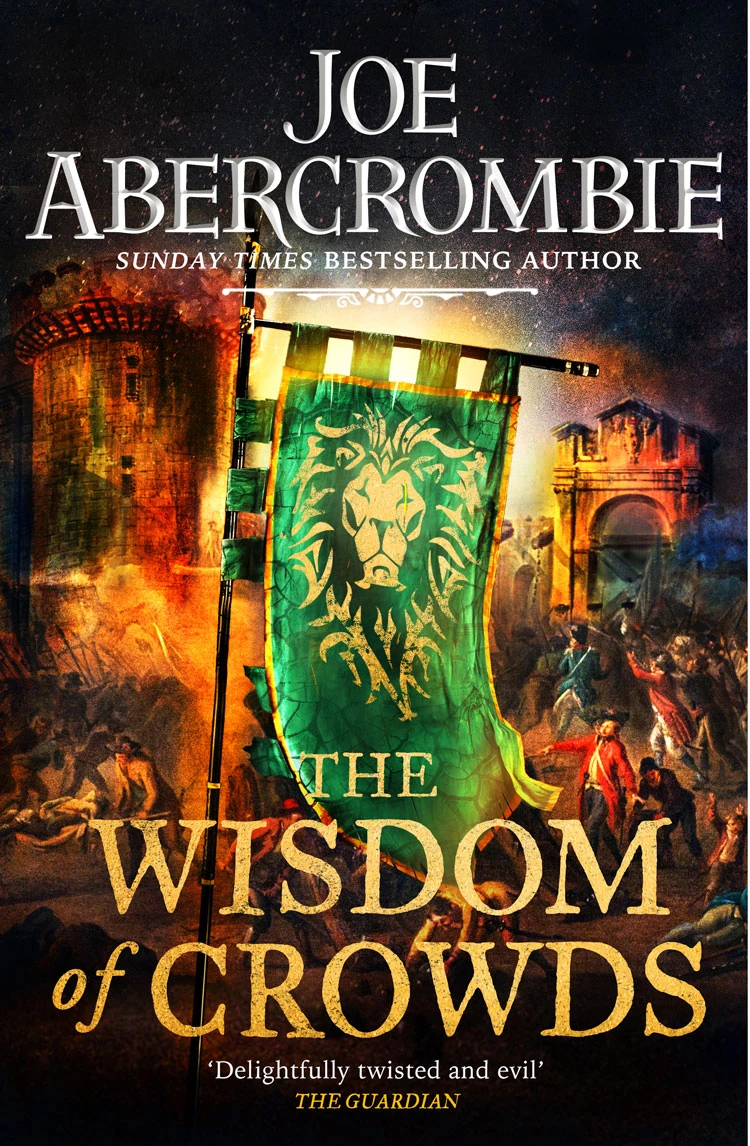
The Wisdom of Crowds

Finally, the Age of Madness comes to an end! With civil war, revolution and bloody cunning, the world of the First Law is finally brought into a new era with The Wisdom of Crowds.


Picking up almost immediately after the events of The Trouble With Peace we return to the Union in the aftermath of the pulse pounding events of the recent civil discord, only to find more civil discord awaits! King Orso has arrived home expecting his subjects to fete him as a hero, instead he finds a sullen population who seem to hate him more than ever. From political favorite to disgraced traitor, Leo dan Brock doesn't know whether he can expect execution or imprisonment. His wife, Savine dan Brock nee Glokta, is in much the same straights, waiting for the fates of her children to be decided.

In the far north Rikke of the Long Eye must now match wits with the cunning Black Calder, all while having to depend on the loyalty of the most disloyal man in the North, Jonas Clover.

Once again Abercrombie brings his dark and humorous take on the world to the fore, and he does it in a few surprising ways. Some uplifting, others very potently disturbing. There are revolutions, battles, and terrifying leaps of faith. Here we explore the darker side of national mass movements, and see a few familiar notes from history, and with some familiar sinister characters from the events of A Little Hatred.

In truth, much as I love Abercrombie, I came away both awed and a little disappointed by this book. It is still a stellar read which ties all the characters together, and explores the power of shared trauma and deadly political intrigue, but it seems to set up more subtle hints for the future than it does resolve major issues for the here trilogy as a whole. I did appreciate though, how well the characters grew and changed, and just how downright ruthless many of their actions became. It made for an amazing reversal of where so many started, and a very tragic end for some.

That being said, the reveals for the overarching mystery of this trilogy were amazing, and some of the final scenes left me slack jawed in how powerfully they were written! The twists must be read to be believed! It also gave a rather terrifying vision for the future of this story, and one I sincerely hope is eventually investigated!

A solid ending to a good trilogy.