Showing posts with label American Civil War. Show all posts

Monday, 6 February 2023

Balloons of War

With recent news about the transition of a Chinese spy balloon floating over the United States, my mind got turned to what balloons had done in war before. This was, surprisingly, an older practice than I thought!


The first time hot air balloons (rather than lanterns) were used in war was back in  1794, l’Entreprenant at the Battle of Fleurus by Revolutionary French forces to observe the Austrian movements. The Balloon Corps didn't get too much traction with the French forces, and Napoleon disbanded them in 1799. They would again be used by French forces in 1859 when France and Austria went to war over the fate of Italy and were extensively used for reconnaissance. They were again used in the Franco-Prussian War, most famously at the Siege of Paris, some for observation, but also to fly messages in and out of the city over the Prussian lines.

Most English historians are probably more familiar with the Union Army Balloon Corps in the US Civil War when the aeronaut Thaddeus Lowe used his own balloons to observe rebel movements for the US Army. The observation balloons were used at the battles of First Bull Run, in the various engagements of the Peninsula Campaign, Fredericksburg, and the Siege of Vicksburg. However, without political patronage and a military that did not readily adopt the idea of ballooning, Lowe's Balloon Corps languished and, effectively, ceased to exist in 1863.

Amusingly however, the United States can lay claim to the first use of an aircraft carrier, in a sense. A converted coal barge, the George Washington Parke Custis, was used to float the balloon Washington in the Potomac in 1861. 


The British army tinkered with the concept, and the army of the Empire of Brazil used observation balloons in the Paraguayan War, but it wasn't until the 20th century when ballooning for the military really took off (pun intended).

The most famous use of balloons for military purposes came in World War One. While observation balloons were common, the great zeppelins of the Imperial German military were the most conspicuous use of ballooning in that conflict. As observation vessels, bombers, and rough transports, they were used to good effect in the first years of the war, while also dropping bombs on cities to try and inspire fear.

It was then that the incendiary bullet was invented, bringing the hydrogen filled airships down in flames and generally making your survivability in one nil.


While observation balloons (and even spy balloons) have continued to be used, this is not the most common thing in war anymore. The true heyday was the 19th and early 20th centuries when the technology was emerging and we were not able to turn the most abundant fuel into fiery balls of death. So while the era of great military ballooning is long done, it is nice to see them make the news again once in a while!

Thursday, 17 February 2022

The Trent War at Sea

Recently, I did publish an article about what I called "the Cuban missile crisis of the Victorian era" otherwise known as the Trent Affair. In a nutshell, in 1861 the United States and Great Britain nearly went to war right in the middle of the American Civil War. I explored more of the details of that potential conflict there, but I have one little detail I would like to explore more in depth here. And that is the naval war.


With the war ostensibly starting over a ship seized at sea, it seems only logical to examine how the war might be fought on that front. I won't be going too deep into the ideas of battles between ships, fleet strengths, and other issues, which I touched upon briefly in my last article. And I've done some musing on what battles might look like and who would win, but that is a far more detailed analysis than I aim to provide here. Instead I want to examine what the United States had felt would be its most effective weapon, commerce raiding.

History buffs who know about either the War of 1812 or have read about German naval activity in WWI and WWII are no doubt familiar with those campaigns, but for anyone curious, in a nutshell here's why these tactics are adopted. A naval power with a battlefleet inferior to its opponent, like the US in 1812 or the Germans in either world war, will often decide to strike at their opponents commerce in order to take ships out of the line of battle that would otherwise be used against their own navy. This is not a war winning strategy, but it can have very powerful effects economically. Insurance for British shipping rose precipitously in each of these wars, and it caused millions lost in both money and supplies, with raiders making some areas incredibly unsafe for any neutral ships.

In a world where steam powered warships will be chasing sail powered merchant vessels, this will undoubtedly be even more disastrous!

We don't need to look to far to come across an apt historical comparison for how this campaign might look, the American Civil War had its own commerce raiders from the Confederate side. The most famous was the CSS Alabama whose global cruises captured 66 ships, sunk a Union warship, and caused over 6 million in damages. And that was merely one raider, which means we could expect the Union to do even more damage British commerce than the Alabama did to Union commerce right?

Surprisingly, probably not.

To be clear, I'm not making an argument that the US navy could not hurt British commerce, far from it, but merely that there would be large impediments to their ability to do so.

For starters, in no scenario in the hypothetical war does the United States Navy have freedom of action. Its vessels will, within a few weeks, be largely bottle up in harbor by a Royal Navy blockade. This happened in the War of 1812, and would happen here by and large. Like the Confederates proved, many would be able to run the blockade, but the American squadrons would, in few cases, want to seek action with their British counterparts. That means that it would be individual raiders running the blockade to attack British commerce.

Secondly, allow me to illustrate something. Here is a map of the routes taken by Alabama and some ports of call she utilized to keep her world cruise going:


Sharp eyed geographers will note that almost all the ports of call utilized by the raider are British ports of call, which would make them inaccessible to Union warships. This means they will have to take on supplies in neutral ports which are few and far between. 

Thirdly, the reason for that, is that the Royal Navy had peacetime stations all around the world to protect its empire and its maritime trade routes. Every major crossing from the Cape of Good Hope to Cape Horn could see a British warship patrolling it. These stations were given modest reinforcements during the crisis historically (but by no means major ones) and would possibly have received more as the war went on.

To illustrate why this is a problem, allow me to quote Rafael Semmes in his cruise from the Alabama on why he was successful for so long:

The time had now arrived for me to stretch over to the Cape of Good Hope. I had been three months near the equator, and on the coast of Brazil, and it was about time that some of Mr. Welles’ ships of war, in pursuance of the tactics of that slow old gentleman, should be making their appearance on the coast in pursuit of me. I was more than ever astonished at the culpable neglect or want of sagacity of the head of the Federal Navy Department, when I arrived on the coast of Brazil, and found no Federal ship of war there. Ever since I had left the island of Jamaica, early in January, I had been working my way, gradually, to my present cruising ground. My ship had been constantly reported, and any one of his clerks could have plotted my track, from these reports, so as to show him, past all peradventure, where I was bound…the old gentleman does not seem once to have thought of so simple a policy as stationing a ship anywhere. The reader who has followed the Alabama in her career thus far, has seen how many vital points he left unguarded. His plan seemed to be, first to wait until he heard of the Alabama being somewhere, and then to send off a number of cruisers, post-haste, in pursuit of her, as though he expected her to stand still, and wait for her pursuers! This method of his left the game entirely in my own hands

Essentially, because the Union had pulled back its smaller peacetime presence to blockade the Confederacy it did not have enough ships to hand to station them at any point where they might block a Confederate raider. The Royal Navy by contrast has, and will continue to have, these peace time stations all over the world. This combination of port facilities in British hands and a larger global naval presence means that any Union commerce raiders would face daunting odds at making their presence felt. There is no doubt they would cause problems, but these would not be ones which are insurmountable.

Though I can already hear the question, why would the United States not just swamp the British with hordes of privateers? To answer that question one must, ironically, be familiar with the end of the Crimean War and the Declaration of Paris. 

In an oddity, the negotiations there set down the decree that European nations would no longer be willing to indulge private navy's or the commissioning of commerce raiders. The United States, being aware of its smaller navy and the potential for action against Britain, declined to sign. Enter the Civil War, and the United States realizes that by not being a signer of the Declaration, the European powers would have no reason to respect their wishes and a fleet of Confederate privateers might pummel their global shipping. Quickly, they declared they would abide by the Declaration and so the ports of Europe closed themselves to prizes from Confederate raiders, which resulted in the Confederacy being unable to profit from their raids, and so had to burn them.

If the United States found itself at war with Britain, they would face a similar problem. Privateers would find themselves shut out of European ports, or prize vessels simply seized and returned to their owners (as happened to the CSS Tuscaloosa). This would dent and deny the US any monetary prize for their work. No private raiders, but plenty of commissioned warships with commissioned crews converted from merchant steamers.

Finally, the British have a system that they would turn to in 1812 and both world wars, convoys. This is a slower system to be sure, but in 1812 it meant that ships in convoy were rarely lost, it denied the American raiders any easy prey, and it would get supplies to the war front in a reliable manner. Such a system would assuredly be turned to in any American war. I certainly imagine that the British Admiralty may hesitate to do so for a while, believing steam merchantmen can outrun their pursuers, but pressure will eventually make this a necessity.

The American merchant fleet, on the other hand, will have no such luck. Much like historically, where it re-flagged en masse to escape Confederate predations, it would find itself either captured, re-flagged, or simply swept from the seas.

Much like the Confederates in the historical civil war, the Germans in the world wars, or even the Americans in 1812, this would not be a war winning strategy in any hypothetical Trent War. Much worse for the US than 1812 is that the Royal Navy would not be distracted by a conflict with France, and so be able to devote its attentions to the US. The war at sea would be hard fought, and cost many lives and ships, but the commerce war would be lost on the first day. 

Monday, 8 November 2021

The Trent War

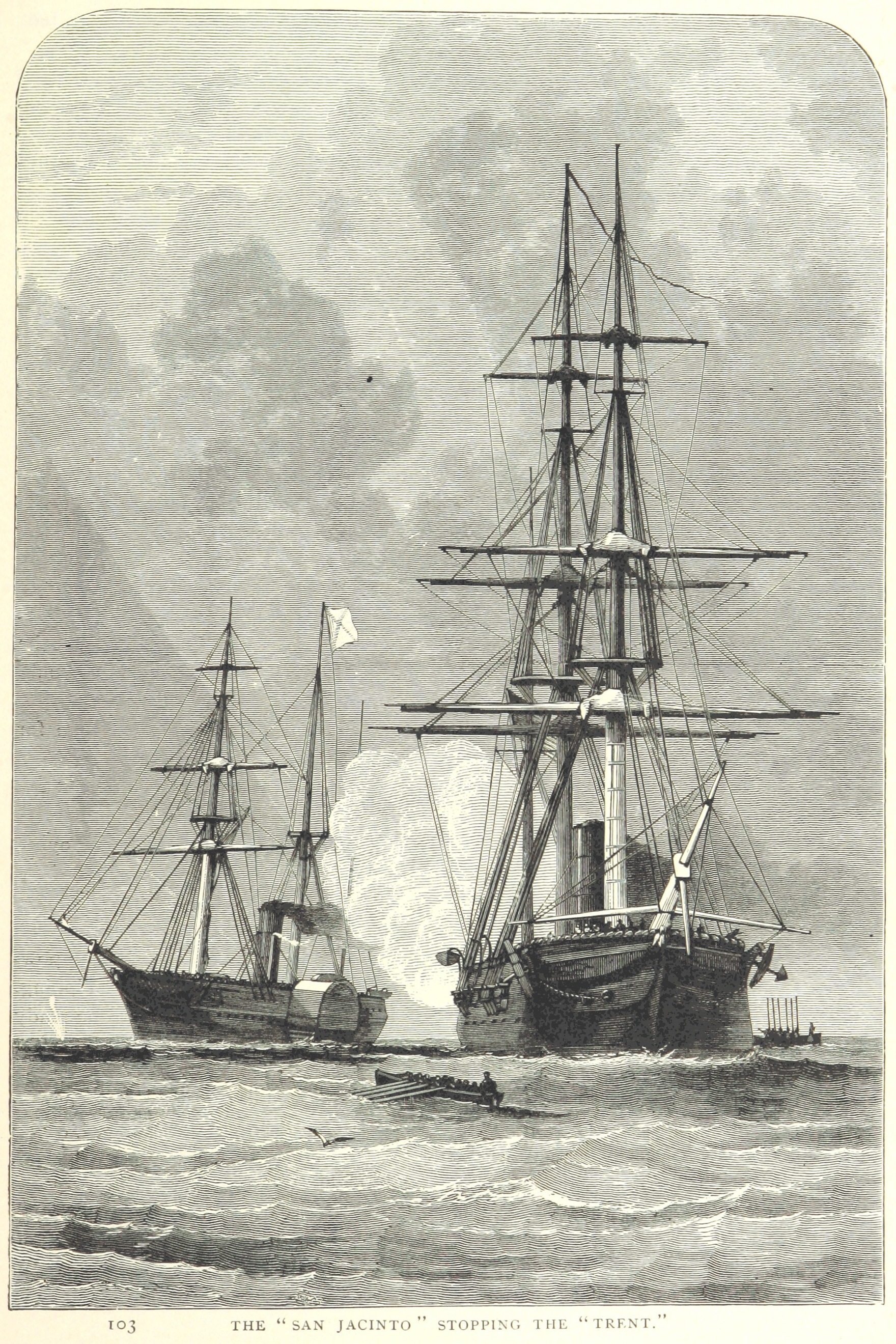
On this day, one hundred and sixty years ago, the United States warship, the USS San Jacinto, fired a warning shot across the bow of the British Royal Mail Steamer, the RMS Trent. In doing so, the captain of the Jacinto, commanded by Charles Wilkes, was taking an action which would nearly plunge the United States into war. Such a war would surely have been one of the greatest calamities of the 19th century, plunging the whole English speaking world into a conflict which would surely wrap the whole world in flames.

The Trent Affair, has been called the Cuban Missile Crisis of the 19th century, and coming almost exactly one-hundred years before that Earth shaking crisis, that is an apt comparison. For some background, the United States and the British Empire in 1860, were not good friends. While the US had close economic ties to Britain, and many immigrants from the British Isles (and primarily Ireland) still came to the US, the economic and political elite in Britain were somewhat aloof of "Cousin Jonathan" as the US was then known. There had been war scares since the War of 1812, with border crisis like the 1838 Caroline Affair, The Aroostook War, the Oregon Boundary Dispute, and only in 1859 the abortive "Pig War" which nearly set the two nations to war over a pig in the Pacific. In each case, cooler heads prevailed and diplomacy proved the order of the day. 

In any case, in 1861 the slaves states in the Union seceded after the election of Abraham Lincoln to the White House. The new so-called Confederate States tried to form an explicitly slave holding republic, and in response the Union called for 75,000 volunteers to crush the rebellion. From there, four years of bloodletting followed. That same year, Britain declared neutrality in the conflict, granting belligerent rights to both sides. This outraged the Union as they felt it was a step towards recognizing the Confederacy as an independent nation, as it granted some recognition of Confederate warships, and the right to take on provisions. Though this was not, in fact, a step towards recognition, it did show a certain bias in British thinking at the time. They remembered how the Thirteen Colonies had been impossible to subdue, and many concluded that the Confederacy - with roughly as much territory as western Europe - in seceding was a fait accompli which would mean it was only a matter of time before the North was forced to recognize that the United States were united no more.

Of course, the Union would not do that without a fight, and so the Confederates sought proper recognition from the powers of Europe. This was exactly why the Jacinto stopped the Trent, in order to seize two Confederate diplomats bound for Britain and France. Truthfully, the account of this stop and seizure must be read to be believed, from belligerent passengers facing down armed US Marines, diplomats hopping through portholes, and a swell on the waves nearly knocking everyone together in a dangerous pile of bayonets and human limbs, it is a minor miracle that no one was hurt, let alone killed. And historically, even with British outrage, the Trent Affair was resolved diplomatically.

This of course begs the question, well what would have happened if someone had been killed and the crisis was not resolved diplomatically? The answer is war, a great and terrible war.

For simplicity, we can assume that someone is killed on board the Trent and Britain is outraged. Abraham Lincoln of course would not be fool enough to intentionally goad Britain into war, and most likely he would have either capitulated, or pushed for foreign mediation of the problem. Ironically, he would have run into what in the 21st Century we would term, a public relations problem. As mentioned, many in Britain assumed that the secession of the South was a done deal, and the North would have to cut its losses. The other thing many assumed was that in doing so, the United States would make good on those losses and turn around and invade Britain's North American possessions in Canada to do that. This was not helped that those making decisions in London did not know much about Lincoln and his cabinet, it had only one recognizable man, William Seward. The problem was that William Seward was known for often saying the US should invade and annex Canada, which naturally - to the British Prime Minister at the time, Lord Palmerston - meant that this was indeed the plan.

Historically, when the British responded to the Trent Affair, they sent an ultimatum with an expiration date of seven days. This was to ensure that the United States could not do what many in Britain feared it would do and simply make peace with the South, turn its armies north, and seize Canada. If Lincoln were, in this counterfactual scenario, to send a suggestion hoping for international arbitration, Britain would most likely see this as a stalling tactic and prepare for war.

Truthfully, that is exactly what took place historically. Britain, upon receiving news of the events on the Trent, ordered out 11,000 soldiers and all the arms and other engines of war they would need. At the same time, in the United Province of Canada, orders were given in late December to muster 38,000 militia, while in Nova Scotia and New Brunswick, new volunteer companies were being formed. The British were evidently prepared to send 28,000 men immediately to North America. How many Canadians could have been mustered and armed is an open question, but in April of 1862, 14,000 men were available, and it is hard to doubt that in a war crisis, anything less could have been raised, and more surely could have. Should the British have fully committed to the war they could have mustered a great number of soldiers from the British Isles, troops stationed in the Mediterranean, and other places. The crisis did end historically in December, but had more men been sent, the size of the British forces prepared to fight the Americans would not be inconsequential.

The United States army in early 1862 numbered over 500,000 men. Nothing to sneeze at! However you can't move all those men to attack Canada, you need many facing off against the Confederacy, will have to dislodge others to defend the coasts, and some are also serving in the interior or in California! My own guess is the Union could shake loose roughly 12-14 divisions (3 Corps) to defend New England and invade Canada, call that roughly 150,000 men overall.

On the naval side, there is more of a mismatch. In 1862, the size of the Royal Navy showed over 465 screw vessels, 115 paddle vessels and 110 sailing ships, totaling 690 vessels in all. I provide here another tabulation here which shows only the major sailing ships and not the nearly 200 gunboats in service, which can be perused in the December 1861 Naval List. It should however, be a sobering number in comparison, with roughly 339 active ships worldwide.

The United States Navy, by contrast, had 264 ships. Of these however, roughly only 100 vessels were steamships, the remainder being sailing ships or other ships converted for the needs of the naval blockade. Not many are fast or modern steamers, or even proper warships. This puts them at a severe disadvantage.

Important to note however, that at the start of the war Britain has an advantage in ironclads. Whether it be older broadside batteries built for the Crimean War, or modern warships like the ironclad HMS Warrior or her smaller sister Defence, the British can send larger and superior ships to North American waters. The USS Monitor would not be launched until March, and she is restricted to New York, and her only company would be the USS Galena, who had very thin armor compared to any other ironclad of the period. Sister Monitors would most likely only be rolling out roughly 90 days after the Monitor's initial launch. This leaves very little to hold the line until roughly June/July 1862, and the British too will be building more ironclads of their own.

Not only will this war not be confined to the Atlantic, but on the Great Lakes both sides will be scrambling flotillas of gunboats. On Lake Erie, the US has an advantage by having the only functional warship, the USS Michigan, but on Lake Ontario, they will be scrambling to catch up as Britain can send gunboats or ironclads up the Saint Lawrence to help control that lake and defend Canada. The Richelieu River would also end up as a battleground as well, with flotillas needed to be constructed to defend or attack towards Montreal. In each case the Canadians have an initial advantage due to the proximity of British guns and sailors and access to the St. Lawrence once it opens in the spring.

We do of course need to discuss the third combatant, the Confederacy. They would have roughly 270,000 troops present for duty at the start of 1862, and without the need to defend their own coasts from attack, would be free to redeploy thousands to support their armies in Virginia and Tennessee. Though they don't have much of a navy, that doesn't really matter when you have the biggest navy on Earth stepping up for you does it?

This is, very roughly, the strength of the various sides going to war in 1862 should this war go hot.

How then, might this war be carried out?

At some point in early January/February 1862 the USN and Royal Navy will fight a series of skirmishes, ranging from ship to ship fights to more than likely one pitched battle in the North Atlantic and the Caribbean. We know roughly what the British hoped thanks to a brilliant article by Kenneth Bourne, commissioners appointed to the task in 1862, and the British commander of the North American and West Indies Squadron did leave ideas for what he hoped to accomplish written down. This would mean that in the first months of the war Britain would be putting most of her efforts into either destroying or driving to port as much of the USN as they could. This would maybe net a few modern ships, but I credit the US enough to think they would begin evacuating ships and men from likely points of attack by the RN once the British minister in Washington leaves, while leaving just enough old or less reliable ships (and men in forts) to hold what they have and enforce a legal blockade so that in the event war does not break out, they cannot be said to have let up on the blockade.

These first few months would lead to a depressing bit reading in the North as the newspapers reported on forts captured, ships sunk or captured, and likely thousands going to prison camps in British colonies or the Confederacy. Many ships though, would make it to port, and be able to harass the British as they tried to set up a blockade of over 1,200 miles of coastline. There is no serious doubt they could sustain this blockade, merely how long it may take to be effective. 

While Britannia rules the waves, much of the war on land would be stalled. The British would have advanced partially overland, seizing posts across the border in Maine to control the route their soldiers historically marched through. They may also launch an overland raid into New York to seize (or more likely raze) the incomplete Fort Montgomery at the head of Lake Champlain. This would undoubtedly cause outrage in the Union, and they would be chafing for the chance to strike back.

We can also make a pretty good guess on how this would go as none other than future General in Chief of the Union armies Henry Halleck had written about the most important way to attack Canada in the 1840s, an overland attack on Montreal. This serves two purposes, first it cuts off the western portion of Canada (modern Ontario) from support from Britain by sea, and secondly it delivers control of the Saint Lawrence River below Quebec to the invader. Most likely an army would (as had been done in 1775 and 1812-13) advance up the Richelieu River to attack the city and attempt to take it. 

Problematically, the British know this, and would most likely be prepared to meet the Union somewhere on the field of battle in between. Expect the first great clash between an American "Army of the Hudson" and the British "Army of Canada" somewhere along the banks of the Richelieu in May of 1862. 

Meanwhile the Union would be sending an army to invade Canada West. This would both tie down troops otherwise intended to defend Montreal, and also snag bits of British territory to use as bargaining chips at the peace table. If they could cross the Saint Lawrence and take Kingston, they would be able to concentrate on besieging Montreal and then potentially Quebec. 

The British for their part, wished to attack the city of Portland Maine in order to seize an all weather railroad terminus at the Atlantic. This would most likely lead to a British attack, and potentially siege, of the city, further tying down US troops who would otherwise be used elsewhere. 

What then is the Confederacy doing? Considering they could have gathered as many as thirteen divisions in northern Virginia (potentially 125,000 men) I think that Joseph Johnston would be under great pressure to attack Washington. Meanwhile, McClellan and the Army of the Potomac (most likely a similar size) is going to be waiting to either attack or be attacked. How that campaign would play out would be up in the air, but it would feature two of the largest armies ever assembled in North America going head to head. Considering the fair amount of blunders and problems in handling command and control in 1862 on both sides in the Peninsula Campaign and the Seven Days Battles, I don't expect anything definitive to be decided.

Out West, a similar situation holds true. Albert Sydney Johnston (historically of Shiloh fame) would most likely find himself facing a similar situation he faced in April of 1862 historically, but now he has access to everything he can get his hands on. I fully anticipate he may go forward and attack the still disparate Union armies and re-invade Kentucky. Will he prove more successful than Braxton Bragg? 

Beyond the Mississippi, I can see little really changing, though some quirks of fate may drive the Confederate fortunes better or worse. On the Pacific slope, other than a blockade of San Francisco, the British probably seize the San Juan Islands, bloodlessly ending the Pig War.

My own expectation is that by July of 1862, the British will have seized Portland, while blunting the early invasion of Canada East, keeping them out of Montreal. In Canada West, the Union will have captured Toronto and everything west of it. Meanwhile, on the Virginia front, two massive armies will grapple with one another like clumsy giants, pushing the battle lines north or south as the fortune of war goes, though to give credit I do think McClellan could push the Confederates out of Centreville and towards the Rappahannock. Out west, the Confederates, if they do better than at Shiloh historically, blunt any invasion and are marching back up the river towards Nashville, seeking to drive the Union out.

Where the war goes from here, who can say? Economically, the Union would be in a pickle as the blockade would hurt their economy, and most Union finances came from either money earned on the tariff, taxes and printing money. The Confederate economy relied on printing money and it sent them into an economic tailspin that ended up destroying the nascent nation as effectively as Union cannon and warships. The blockade would hurt, while perversely the Confederacy is open for business and can sell cotton on the world market to their hearts content, which most likely makes for a much better economic situation. Britain too would be hurt, but not nearly so badly as the United States. 

If Lincoln can politically manage to accept a 'white peace' with mild reparations before the end of 1862, he absolutely will. However, should he be unable to do so, I can unfortunately see the war dragging into 1863-64 to the Union's detriment. Every year another man, rifle and bullet is spent fighting Britain in Maine or Canada, is another year the Union is not fighting the Confederacy and not strangling their economy. Even should the Union make peace with Britain, is it likely they can turn around and continue the war into 1865, or potentially even 1866? This is perhaps the only scenario where the Confederacy could emerge as a functional and not economically wrecked nation, and if it did, that would have terrible consequences for world history as the Slave Power pushes on.

I do not regard this as a good outcome. North America would be divided between four nations (Canada, The US, CSA and whatever happens in Mexico) all of whom may have reason to distrust one another. Canadians would feel bound to the mother country more than ever, and the Confederacy, if it gained its independence by foreign assistance, would most likely seek out foreign allies. 

I've covered the bare bones here, but there's much more to talk about. I've explored the topic myself, and am currently writing a projected trilogy which would cover just such a war. The first book Wrapped in Flames, is currently closing in on the 50% finished mark. I'd love to hear other thoughts on the idea, and it is one which is extremely intriguing and still worth exploring.

Saturday, 31 July 2021

Harbor of Spies

 As is usual in July, I found myself immersed in a good historical novel. Once again I found myself in the 1860s as the Civil War is raging. However, like a previous review, this time I was not in the frigid north of Canada, but in the sunny climate of Havana on the island of Cuba. It is here that one young sailor finds himself caught in a series of frustrating twists, with the Spanish government on one side, Confederate spies on another, and a not too sympathetic Union Navy in front of him, this poor lad finds himself caught in a Harbor of Spies. 

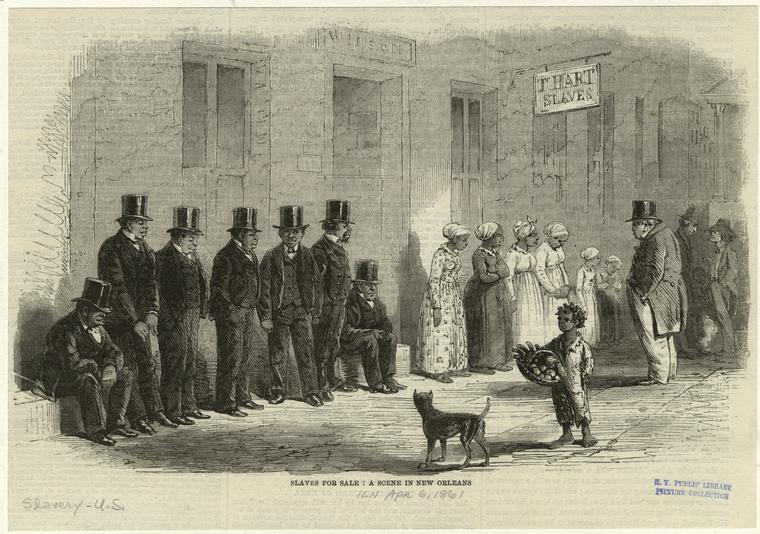
I was first drawn to this book by a comment on a message board talking about Spain in the Civil War. What many do not realize is that Spain, while neutral in the Civil War, made a fortune off running the Union blockade. Cuba, and Havana especially, sympathized with the Confederacy. The island ran on slavery much the same as the Antebellum South, with plantations making coffee, sugar, and other cash crops which sustained the wealth of Imperial Cuba. Unsurprisingly then, the planters of the island sided with the slaveowners of the Confederacy.

This made Havana a very strategic port. It was close to the Gulf coast, and fast steamers or stealthy sailing ships could threat their way through the Union blockade and deliver much needed arms and ammunition to the Confederacy, while bringing back valuable cotton in return. It was a lucrative business, and many men in the island made their fortunes in this trade, doing much to keep the war going for the Confederate cause.

Enter into this story, Everett Townsend, a young Maryland born sailor who was drummed out of the Naval Academy shortly after the outbreak of the war. He has fled to a small sailing schooner travelling to Cuba with a load of Maine lumber, trying to find his way after disappointing his father. A tragic accident has left him in command of the little ship, and then a surprising encounter will introduce him to the world of espionage, deceit and blockade running that all runs from Havana. When he saves an escaped prisoner from the infamous El Morro prison, his life takes a very sudden turn.

Like my last civil war read, this story is intriguing largely because it explores the foreign reactions to the American Civil War. There's some mention of the big players, Lincoln, Seward, Davis and Lee, but it is very much in the background. The focus is all on the Spanish government in Havana, the Confederate agents there, and the Union agents trying to stop them. 

I quite enjoyed this story because it takes place in a country I've visited and come to love (Cuba) and it does regal the reader with historic details of the island under Spanish rule. From the fabulous culture to the horrors of slavery, the author paints a vivid picture of the island in the 1860s. The city of Havana especially is given a lot of love to show off both the slums of poor workers, sailors, and slaves, but also the opulent wealth of the Spanish Empire and the islands slaver aristocracy. The society comes alive and we see a very fascinating, and disturbing one.

It is though, a story with many nautical themes, and as such it does not disappoint! The running of the blockade is explored in fascinating detail. I admit I was quite surprised at the depth of knowledge and research the author put into getting the small pictures of blockade running right. The nautical runs into Southern ports and out again to Cuba was breathtaking and had me on the edge of my seat as I tried to not sweat bullets like the sailors on the little blockade runner here. It gave me an appreciation for the historical bravery of men who ran the Union blockade of the South whether for ideological reasons or profit!

Secondary to this though, is the exploration of the many espionage acts taking place against the backdrop of the Civil War. This book goes to great lengths to explore the ways spying and counter-intelligence worked in the 1860s. Conflicting loyalties, ideology, and greed certainly all play their parts! Whether it is street level informants, foreign agents, or blockade runners, we get a look at how the cat and mouse game of shell sales and ship registry worked to make the lucrative machine of blockade running function. I was very impressed by the detail and story telling elements worked into these depictions, and it was quite fun to see it all come together in various runs! The way shifting loyalties play a part is key to the story and I won't spoil anything!

It is a very interesting story, espionage aside, about mysterious heritage, conflicted loyalties, and the city of Havana and the society it promotes. I did find some of the mysteries to be well played up, with an overall satisfying conclusion, but thought the book could have been even fifty pages longer to bring those issues which Townsend struggles with to a more satisfying and intimate conclusion. Though the story did leave some dangling plot lines which, probably, should have been addressed, it does an excellent job in bringing Townsend's character arcs satisfyingly forward.

Harbor of Spies is an excellent piece of historical fiction, and well worth reading for its action, intrigue and amazing depiction of such a pivotal piece of the Civil War that often gets overlooked in the battles and politics most history buffs focus on. I'm thrilled I picked this one up!

Wednesday, 2 June 2021

The Battle of Ridgeway

In June 1866, the year before Canada would become Canada, a group of Irish patriots under the moniker the Fenians, crossed into Canada with a simple plan. They would invade Canada and hold it hostage in exchange for Ireland's freedom. If this plan sounds insane, it's because it is. However, many were convinced they could make it work, and many would die before the whole fiasco came to an end.


The Fenians were a group of Irish rebels who were determined to free Ireland from British rule. Active for roughly twenty years. Founded in 1858 by American Irishmen and former rebels from the 1848 rising, the Brotherhood would try to recruit men to fight for Irish independence. Their earliest successes came when many men gained experience fighting in the Irish Brigade and other bloody battles in the American Civil War. Indeed, many of the future Fenian leaders such as John O'Mahoney, Thomas Sweeney and John O'Neill would see their first action in the Civil War and gain experience leading men.

In the aftermath of the Civil War, there was a large number of armed men with experience in war, but no one to fight. Why not then, the Fenian leadership asked, lead an invasion of Canada to conquer the, at this point disparate colonies and hold them hostage in exchange for Ireland's freedom? This was not a universally popular idea, and it led to a split in the Fenian leadership. However, plans for an invasion went ahead anyways. It is estimated as many as 50,000 men volunteered to be a part of this invasion. When push came to show however, the Fenians only managed to get a few thousand men organized, and most were dispersed once the American authorities got into action.

On the Canadian side, British spies actually had managed to penetrate the Fenian organization. They had successfully predicted a previous Fenian raid on Campobello Island in April of 1866 which was dispersed without issue. This in turn, lowered the guard of the Canadian authorities in Canada West (Ontario) who felt there was nothing to fear from the Fenian menace. Alarms had been common in 1865 and in 1866 the Canadians felt certain that they could control a Fenian invasion.

When John O'Neill kicked off his invasion in June it was not a secret to either Canadian or American authorities. However, none could pinpoint the exact location the crossings would take place at.

It was actually meant to be part of a broader strategy. One Fenian force would march on Toronto, another on Quebec, and they would overwhelm the Canadians. In actuality, on O'Neill's invasion of the Niagara Peninsula got off the ground, and there were only a few other small skirmishes 

In a well planned action, the Fenians first disabled the only warship on Lake Eerie, the USS Michigan by subterfuge. This allowed O'Neill to begin landing men across the Niagara River. Without USN ships to stop him, he was able to cross nearly 1,400 men to the Canadian side. The quickly seized the town of Fort Eerie, and began trying to bring over Irishmen to their side. They received no local volunteers.

Meanwhile, the Canadians quickly learned of the invasion and ordered out the militia, calling over 14,000 men to arms. In Toronto, the men of the 2nd Battalion of the Queens Own Rifles hastily mustered in Toronto and was quickly delivered to the Niagara frontier by train. They were joined by a similar quick mobilization of the 13th Battalion of Volunteers from Hamilton and two other quickly mobilized companies of militia in an ad hoc brigade. They were placed under the command of militia Col. Alfred Booker who, like the men under his command, had no experience with war, unlike the oncoming Fenians. The Canadian forces numbered about 850 men, while their Fenian counterparts numbered between 700 and 800 men.

Learning of Booker's route of march (possibly by 'tapping' the Canadian telegraph lines) O'Neill swiftly night marched his men from their initial position at Black Creek to the Ridge Road near the village of Ridgeway which would give the battle its name.

Booker's men had bivouacked for the night at Port Colborne. He had originally planned to make straight for Fort Eerie and take the town from a supposed Fenian rearguard. However, early in the morning on the 2nd, he received orders from the superior authority, British Colonel Peacock leading the 47th Foot and a larger relief column with cavalry and artillery, that he was instead to move to Stevensville and meet this column where the joined group, then over 2,000 strong, would attack the Fenian positions.

For reasons never adequately explained, Booker followed the spirit of Peacock's orders, but not the letter. Instead of moving to meet the reinforcement column along Skerk's Crossing to Stevensville, he advanced to Ridgeway and took the Ridge Road. This would lead to the Fenians learning of the change and being ready to meet the Canadians on the afternoon of June 2nd.

The following battle was, for all intents and purposes, little more than a skirmish between infantry battalions. Though each was grandiosely a brigade, none was stronger than a full strength battalion of regular infantry. There was no cavalry or artillery, and so it would come down to the skill of each individual commander. Though the Canadians behaved admirably, advancing into the Fenian fire and driving off their skirmishers and discomforting the Fenian left flank, a series of events that has never been adequately explained soon drove the Canadians from the field.

For some reason, in the midst of the Canadian advance, the order to "form square" was given. Whether it was the sighting of a party of mounted Fenians who acted as scouts, or merely a mistake by a bugler, the Canadians dutifully carried out a formation which had been drilled into them. Booker, immediately realizing his mistake, ordered the men back into line. Other accounts maintain that an attempt to relieve the front line by bringing up a fresh company of men caused confusion. Whatever the case, the Canadian militia was soon milling about in disorder. Seeing this, O'Neill ordered a bayonet charge which promptly routed the Canadian center. In contrast, the Canadian flanks withdrew methodically, skirmishing with their opponents, but the men did not regroup, and individuals and companies disorderly withdrew to Port Colborne. 

Seven Canadians would be killed at Ridgeway, while another two would die of their wounds days later. A further 22 Canadians would die of disease sustained while in camp in the subsequent weeks.

Six Fenians died on the field at Ridgeway, with another three known to have died of wounds after the fighting ended. Fenian casualties are difficult to estimate as many fled to the United States afterwards. However, another four Fenians would die in the lesser known but nearly concurrent Battle of Fort Eerie. 

A small Canadian force on the tugboat W. T. Robb, led by Colonel Stoughton Dennis who in his first action of bravely running in the face of danger, led 50 men to hold the town and hopefully capture any stragglers from an assumed Canadian victory. Instead, they encountered over 800 Fenians retreating from Ridgeway and other positions. In a doomed last stand the Canadians fought, but many were wounded - miraculously none killed - and captured. Other than this brief humiliation though, the Fenians let them go as they had to flee the oncoming British reinforcements.

In the aftermath, much blame was passed for the defeat. Only a victory at Pigeon Hill by the Canadians would salve the bitter wounds of what happened on the Niagara Peninsula. Booker was ultimately found to be moderately to blame for the fiasco, but the Canadian government at the time was quick to try and pass off the blame to the individual soldiers themselves, rather than admit it had not handled the crisis properly. O'Neill meanwhile, would be feted as a hero to the Fenian cause, and it would be celebrated. He would subsequently lead two further failed invasions of in 1870 and 1871. The Fenians themselves would peter out by the 1880s, replaced by later incarnations of the Irish Republican movement.

It was Canada's first real test of battle. The nine men who died in battle or afterwards have never properly been remembered. While most Canadian students have learned the story of the Fenian Raids and their roll in helping shepherd the various colonies towards Confederation, it is a battle itself which is rarely explored. Peter Vronsky has written perhaps the best single volume on the battle, and I myself used it as a guide to this piece. It is a book well worth reading, and may enlighten many people on a sadly unappreciated piece of Canadian military history.

One can only wonder what might have happened had the Canadians not gone the way they had, or what could have happened had Booker gone straight to Fort Eerie instead. That though, is speculation for another time!

Saturday, 20 June 2020

Retro Review: Gone With the Wind

In 1936 Margaret Mitchell wrote a classic book Gone With the Wind which almost overnight became a bestseller, and to this day has seen more than 30 million copies printed worldwide. Lest anyone think that successful novels becoming movies shortly after their release, the film Gone With the Wind was released in December 1939 with an all-star cast and has gone on to be widely considered one of the best films ever made. It is so ubiquitous you've probably been influenced by it even without ever watching the film or reading the novel!

So, almost one hundred years on and many cultural shifts later, does this film stand up to scrutiny? Is it a classic romance, or a piece of Lost Cause propaganda depicting an idealistic Antebellum South? Read on and find out! A good plot synopsis follows, so spoilers are ahead below the cut!

The film is wonderfully cast. Vivien Leigh as Scarlett O'Hara, Clark Gable as Rhett Butler, Leslie Howard as Ashley Wilkes, Olivia de Havilland as Melanie Wilkes, Hattie McDaniel as Mammy, Barbara O'Neill as Ellen O'Hara and many, many more. Quite frankly I don't think you could get better actors for this film, and I'm amazed at the quality of it even nearly a century on. Credit really does go to Gable and Leigh however, with Leigh especially notable for carrying the film almost on her shoulders. The dialogue and rapport she has with Gable really does carry these two flawed characters well, and their tragic romance is beautiful! Leigh as the leading lady is very impressive and the energy she puts into the role is just stunning. 


It went on to win eight Oscars, including best actress for Leigh and best supporting actress for McDaniel who became the first African American to win an Oscar. 

The wonderful score leads us through the whole movie, and I really think you can't get much better than it.The film, in the tradition of the time, has a long beautifully scored opening introducing our principle cast and characters and a bit on the setting. Perhaps an (in)famous tagline 'a civilization gone with the wind' which leads into the story itself.

We begin at the fictional plantation of Tara, based somewhat on the old ballad The Harp That Once Through Tara's Halls (beautiful song) and is the home of an Irish descended planter family, the O'Hara's. 

We're quickly introduced to our main character, the spritely and quick witted southern belle Scarlett O'Hara. She is the beau of all Southern gentlemen, and is fawned over by the Southern gentlemen. They wish to talk of nothing but war and she finds this dreadfully boring, wishing she were being invited to more lively parties. This goes on as she prepares for one hosted by her father at the hall where the men discuss politics and the upcoming war. Therein, they see the objections of one Rhett Butler, who firmly believes the South has no chance. It is, frankly, a fantastic scene and was my first introduction to the film in university beyond cultural osmosis. 

Wednesday, 8 April 2020

Why an Independent Confederacy Would Be a BAD Thing

As it is now April, and something of a self-proclaimed "Confederate Heritage" month, I would like to illustrate why a world where the Confederate States of America winning its abortive war of independence would be a very bad thing.

The American Civil War, for those who do not know, was fought from 1861-1865 over the subject of slavery in the United States. Those states which would comprise the Confederate States were all in the deep South, 11 slave holding states whose economies depended on the chattel slavery system which supported the lucrative cotton export business. The secession was indirectly sparked by the election of Abraham Lincoln in 1860 after years of rising tensions after events like the Dredd Scott court case and the political bloodshed of Bleeding Kansas. The bloodiest war in American history followed with over 800,000 dead.

The penultimate result was that the American Union was saved, slavery in the United States (and ultimately, the Western Hemisphere) was ended, and in the immortal words of Lincoln ensured "government for the people by the people shall not perish from the Earth."

However, even in the aftermath of the war a "Lost Cause" ideology began to develop in its wake. This romanticized the conflict, trying to rationalize the deaths of hundreds of thousands of men who fought on the wrong side of the conflict. A romantic view of the Antebellum South developed, a land of graceful belles, honorable men, yeoman farmers and happy slaves working for benevolent masters on colorful plantations. Naturally, this made the South look less dark and more desirable in hindsight, which even gave rise to such romanticism in novels and movies like Gone With the Wind.

Literally called The Lost Cause, Henry Mosler, 1868

In reality, beyond this romantic view, the Confederate States was a country fueled by slavery, powered by a strong central government, and a country with internal divisions between secessionists and Unionists. Fellow blogger Sean Korsgaard did an excellent piece on the biggest misconceptions about the Confederacy, and I encourage you to check it out. Had it succeeded in its attempted rebellion, the world would have been a much poorer place for it.

To begin with the simplest observation, the United States, far from girding the continent, would be balkanized into two nations, and potentially more should some sort of secession fever take hold. Instead of a nation stretching from sea to shining sea, you might end up with something looking like this:


Multiple disparate republics hemmed across the continent and a United States potentially cut off from its Pacific coast. Even with just the two, the United States would suddenly have a potentially hostile neighbor on its southern border, one which had just fought a destructive and bloody war against it with the very real possibility it might do so again.

This opens up two further problems for future history. The first is that the United States might fall into isolationism as it has no reason to look beyond its own borders for fear of a conflict, literally, on the steps of the national capital. Hell, the national capital might not even be Washington anymore in this scenario as it might be moved further away from any prospective frontier in favor of some old spot like Philadelphia. A sore humiliation that would be for the United States.

The second problem would be that, without United States proving it could project unprecedented military power in its own backyard, the powers of Europe might be tempted to play around in the New World. Already in 1861 a combined alliance of Spain, France and Britain, seized Vera Cruz in Mexico to compel the Mexican government to pay its debts. This in turn led to France trying to prop up a puppet monarchy and make Mexico a de-facto colony. Spain too tried to seize hold of its old colony on Dominica, fighting a bloody war to try and hold it. They even spent money on a naval conflict to seize guano rich islands off the coasts of South America. Britain too had interests in places from the San Juan Islands to Hawaii, and could have benefited from a balkanized US. The nascent Confederate States too might attempt to seize Cuba as had been a dream of Southern politicians for decades.

Without the United States to exert pressure on foreign governments to ward off these European encroachments, might these imperial adventures have succeeded? Might we see the Americas once again under the European thumb?


Another, and far more depressing, scenario would see the delayed end of slavery in the United States itself.

The Thirteenth Amendment to the US Constitution was by no means a slam dunk when it was initially proposed in 1863. In order to pass, Lincoln had to exert considerable political capital and personal influence to get it through Congress, while it had previously failed one vote already in June, it needed to overcome a thirteen vote deficiency to pass by the needed two-thirds majority. In a situation where Lincoln most likely has lost the election and has no political favors to spare, Democrats who voted for the amendment might feel no pressure to do so, and those who historically abstained may vote to strike it down. Instead of being passed and ratified in January 1865, a more Democratic inclined Congress may instead let the vote die on the floor, and the Republican Party may be unable to exert any pressure to take the issue up again.


Now, slavery would die out in the North sooner or later, there were only 400,000 enslaved persons in loyal states in 1860, and that number would most likely be halved in the aftermath of the war. But, those slave masters uninclined to give up their property or the institution, may keep people in bondage in the North. This does not mean slavery extends indefinitely, but that it may take perhaps a decade to finally end the practice in the United States. A sad fate for many, and a sad coda to a shattered nation.

Ultimately, both (all?) nations would be poorer with a secession of the Confederate states. Assuming no 'secession fever' then even these two nations would be poorer than the undivided United States. Though a United States which has not fallen into more than two nations will still become a powerhouse, it will not be quite as powerful as it was. Still far more powerful than the nascent Confederate States, but not as strong as it would be otherwise. Would it then fall into the system of alliances which ripped the world apart in 1914, or whatever other global system emerges from 1860 onwards and bring North America into a war to end all wars?

I think it can be argued that a world where the Confederate States managed to gain its independence could be considered a very dark world. One where slavery continues well into the 19th century in the American South and beyond. The Confederacy would seek to expand into places like Cuba and Central America, and other European powers would definitely take advantage of a distracted United States. It's a world where democracy might be regarded as bad idea, the American experiment having failed.

Though many entertaining stories have been written about such a world, from one of my favorites the Shattered Nation series and of course the Southern Victory series by Harry Turtledove, to the classic Bring the Jubilee and even an alternate history by Winston Churchill; I think it is better that this idea is merely a thought experiment rather than a reality. It is interesting to speculate on, but not something I would sincerely want to have happened.

Personally, I'm glad to live in a world where the only true Confederate flag was a white flag.

Friday, 19 April 2019

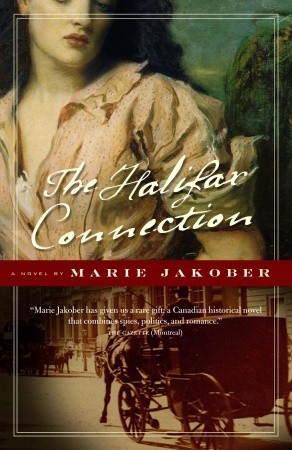
The Halifax Connection

Though I often talk about fantasy, contemporary politics, science fiction, and movies, I'm also going to review for you book from a genre that is close to my heart. That genre is historical fiction and the book is The Halifax Connection by Marie Jakober.


Set primarily in the city of Halifax, this story stretches from early 1862 to September 1864 and follows a colorful cast of fictional characters from all stations of life. Our main protagonist is Erryn Shaw, a disgraced aristocrat and former theater manager who has fallen on hard times. We also get a look into the life of a domestic servant Slyvie Bowen, with the supporting cast of Matt Claverly and Colonel Hawkins.

The backdrop of the novel of course, is the American Civil War. Not many know this but Canada was prime real-estate for Confederate spies and blockade runners. Halifax especially grew rich off the war as Confederate ships and blockade runners would often seek refuge there. Haloginians themselves came from a society which was fiercely loyal to the Mother Country and felt a certain kinship with the South at the time. To find men of high principles and ideals who would oppose them would have been a rare thing indeed.

That the novel chooses to do just that is very much to its credit.

Our story follows mainly Erryn and Sophie. Erryn is a failed theater manager (well, it burned down) who is falling on hard times while Sophie is a former factory worker emigrating to Canada to find work and a new life away from the horrors she has seen in the mill town of Rochdale.

The story kicks off when Erryn is asked by his best friend Matt, to spy for the Governor General. Halifax is full of Confederate agents and sympathizers, who wish nothing more than to involve Great Britain and her Empire in the war to hopefully tip the scales in favor of the cause of independence for the Southern states and their Confederacy. Sucked in to a vortex of lies, espionage, and mad schemes, Erryn finds himself on a twisting path of conflicting loyalties and friendships while publicly renouncing all his ties to his former life and friends who support the Union.

Slyvie meanwhile, is just crossing the Atlantic on the cheap when her ship is set upon by the Confederate raider Alabama. This gives her a lasting enmity for the Confederacy and all it stands for. However, she finds herself falling for a man she meets in Montreal, and that man is Erryn Shaw, who is playing host to the Confederate agents he can find.


Into this story we get something of a twisting love affair between two people who deeply care for one another, but who, ostensibly are on the opposite sides of an ideological divide.

I will admit that, as the piece goes on, it feels like more of a love story than a spy story. There is (to me at least) a decided effort by historical fiction authors to 'spice up' a piece by including a risque love story. Personally, I've never found that remotely necessary to engage with a piece of historical fiction. However, in this case we do at least get a very well written love story between two well fleshed out characters who portray life in the 1860s in pre-Confederation Canada quite well.

As a spy story I would argue the piece leaves much to be desired. Even though Jakober does her best to keep the spy drama going, I found the plot lacked an overall enemy, villain, or objective. Though it was true to life in the British authorities basically whacking Confederate schemes where they could be found, I might have felt more inclined to be hooked by an overarching adversary for the characters to be confronting. The story certainly had one set up in the person of an old enemy from Erryn's past!

That isn't to say though, that the book doesn't work well on its own merits. It does portray the events from Canada in the Civil War quite well, even making the Chesapeake Affair, a backdrop of one of the most pivotal scenes in the book.

Jakober has done her research, this much is clear. She understands life in Nova Scotia (Halifax specifically) quite well, and does a wonderful job portraying the divided opinions of the Canadian people in the 1860s. That she incorporates a number of real life events into the series is much to her credit, and she does it with a deft hand. Though her characters are fictional, she sets them up in real historical events and plots. She makes a very shocking revelation at the end which I simply cannot spoil for casual students of history or readers. You will be taken aback by it, all the more for that it is based on true events.

I liked the characters and I liked that Jakober did her absolute best to stay true to history. There is no embellishment on the side of action or drama, nothing which would necessarily conflict with history as we know it, and lots of emphasis placed on attitudes and ideals from the 1860s.

As historical fiction, I found this novel first rate. Definitely worth a read from fans of romance, historical fiction and Canadian and Civil War history buffs.

Wednesday, 27 March 2019

A Short Civil War What If

I should make no secret that I have been a fan of studying the American Civil War since I was very young. I blame my uncle for this as when I was younger he was also a big American Civil War buff, to such extent that for my 5th birthday my brother and I were taken to Gettysburg to watch a reenactment in 1997. Suffice to say I remember very little of this, but I am told my brother and I were weirdly knowledgeable for five year olds. I do fondly recall however, growing up seeing my uncles civil war memorabilia around and often playing with the figures he collected.

My dual interest in alternate history has led me to speculate often on 'what might have been' if different actions had happened. And so, I present to you a brief speculation for your consideration.


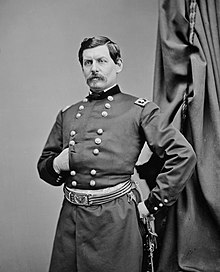
As history tells it, on November 7th 1862, George B, McClellan, who had commanded the Army of Potomac for 16 months, was dismissed by President Lincoln. In his 1864 The Army of the Potomac, General McClellan's Report of its Operations While Under His Command McClellan relates that he was preparing to deliver a great blow to Lee with his army in November. He had moved over 120,000 men in roughly two weeks towards Lee’s army in Virginia and by his own accounts was preparing to force a battle upon Lee. In his Report he relates that “I cannot doubt that the result would have been a brilliant victory for our army.”[1] 

Let us, for a moment, indulge McClellan and assume that, for whatever reason, Lincoln decides not to dismiss the general on November 5th, and instead allows him to continue in his tenure as commander of the Army of the Potomac. What then, might have been the result of McClellan’s cool belief in victory in 1864?

McClellan’s 1864 Report paints a far different picture from his personal correspondence in 1862. He told his wife on the 25th of October 1862 that he did not expect Lee to fight before Richmond[2]. He seemed to set his own objective as Culpeper Court House, and from there we have no clear idea of what he intended despite his later prediction of a great victory.

However, Longstreet beat McClellan to Culpeper comfortably, moving in half the time it took him to make the same march. Lee had nearly divined McClellan’s intentions by the 6th of November[3]. He wrote that if the enemy continued to advance he would unite Longstreet and Jackson’s corps through Swift Run Gap, joining at Madison through Gordonsville. From there he anticipated the ability to menace McClellan’s right flank. McClellan had fears regarding his army's ability to use the Orange and Alexandria RR and viewed its capacity as overrated[4], so he would most likely then have directed his army to Fredericksburg. In his forward movement however, he abandoned Ashby and Snicker’s Gap, this allowed Jackson to send men across the Blue Ridge Mountains on the 13th and harass the armies’ rear columns historically.

Jackson suggested advancing his corps to threaten McClellan’s flank and rear, which Lee agreed with should it be feasible. Should the enemy further advance, Lee directed him to be pulled back. In this instance, with McClellan’s slow advance still pushing forward, but leaving his rear open. Jackson most likely mounts an embarrassing attack on McClellan’s rear which gives him pause, and allows Jackson time to regroup with Lee. However, if McClellan’s forward momentum continued positively on the 10th and 11th, Lee might recall Jackson and continue to implement his planned withdrawal to Madison. It should be noted that in his Report McClellan believed Jackson was at Chester and Thorton’s Gaps, when in reality he was closer to Snickers and Ashby Gaps[5], some 18 miles north, and so his rear is actually exposed rather than covered. He had in fact, left his rear uncovered[6].

Delayed communications may allow Jackson’s raid on McClellan’s supplies to go forward, but this will most likely halt McClellan’s advance as he turns to meet this threat. Should Jackson receive Lee’s orders to withdraw on the 13th as he did historically, he would immediately make for the rendezvous with Lee. The timing of that can only be speculated, but we should not assume he tarries long, and unites with Lee at Madison.

In the face of a unified army, and an increasing supply line. McClellan’s most likely option is to move his force to Fredericksburg, which will make an advance of 35 miles. This movement would take at best, four or five days, and at worst weeks. This would allow Lee to discover the change of base, and either relocate himself for a defence on the North Anna or to attack isolated portions of McClellan’s command. Most likely, he does as he had done historically and moves to intercept McClellan at Fredericksburg.

McClellan is now faced with a prospect similar to that of Burnside in December of 1862. The question then is, what does McClellan decide to do? Does he cross in the face of what he believes to be superior numbers? Or does he sit and wait, planning a new campaign?

In the face of an entrenched enemy, it is likely the armies merely return to winter quarters. The upside may be that there is no disastrous Battle of Fredericksburg, as McClellan's dismissal and the obvious disposition of Lee's army make imminent action unlikely. From there though, it is anyone's guess as to how the campaign's play out in 1863. Does Burnside refuse the command and Hooker take over? None can say for sure.

In summation, I hope this lays out my reasoning behind my belief that even had McClellan been allowed to continue in his tenure of command, he would not have held it long. An extra month will not save him.

----

As a note, the letters referenced (unless otherwise specified) come from the War of the Rebellion: Official Records of the Civil War, Serial 28, available online through the Ohio State University.

[1] Report, pg. 652

[2] George McCllelan, The Young Napoleon, Stephen B. Sears, pg. 337

[3]Lee to Davis, Nov. 6th, 1862 (pg. 698): "General Jackson's corps is in the valley, his advance being at Front Royal. I do not think they will advance very far while he is in position to threaten their flank. Should they, however, continue their forward movement, General Jackson is directed to ascend the valley, and should they cross the Rappahannock, General Longstreet's corps will retire through Madison, where forage can be obtained, and the two corps unite through Swift Run Gap. No opposition has yet been offered to their advance, except the resistance of our cavalry and pickets. I have not yet been able to ascertain the strength of the enemy, but presume it is the whole of McClellan's army, as I learn that his whole force from Harper's Ferry, to Hagerstown has been withdrawn from Maryland, leaving only pickets at the fords, and but few troops at Harper's Ferry." See also, Lee to Stuart, Nov. 7th, 1862, pg. 703.

[4] George to Mary McClellan, Nov. 7th, 1862, The Civil War Papers of George B. McClellan: Selected Correspondence, 1860-1865, pg. 520

[5] Report, pg. 652

[6] Report, pg. 651. See also, Lee to Stuart Nov. 9th, 1862, pg. 706-707