Thursday, 10 November 2016

Conservative Insurgency: The Struggle to Take American Back 2009-2041 and our own 2016

So yesterday, on November 9th 2016, I woke up to something a year ago I would have laughed off as impossible, and utterly unrealistic. However, much to my own shock, Donald J. Trump has won the American election with a surprising cascade of victories in key battle ground states. Some people are horrified by this news, others are elated, but one thing is certain, Trump's victory was divisive.

However, on the 8th I began reading a book I purchased on Kindle so many years ago on a lark. That novel was Conservative Insurgency: The Struggle to Take American Back 2009-2041 by right wing novelist Kurt Schlichter.


What originally attracted me to it I cannot recall other than it had a catchy cover and comparisons to World War Z's writing style. It has the writing style down pat, but hardly as compelling a story. In brief, it is, since its 2014 publish date, it is now a piece of alternate history wherein "constitutional conservatives" are launching a long campaign of taking back their country through a political and cultural campaign against the nebulous forces of 'progressives' and 'liberalism' and to re-institute "the conservative vision of the Founders" against progressive dominance as exemplified by a two term President Hillary Clinton.

During this re-read I was struck by the uncanny similarities between many of the ideas espoused by these fictional characters, and the real life supporters of Donald Trump. Such were the similarities that I could not get many of them out of my head. So I thought that one interesting way to comment upon the unexpected events of our own time was to look at the ideology and methods that let this happen through the fictional lens of a novel.

In the novel itself it discusses a "cultural war" being waged against the forces of liberalism, and many would say that this is true today from one side of the political aisle. Most of the view point characters in the novel themselves express that they are trying to win their country back from the forces of the unpatriotic liberals. In order to do that, they set out to detach themselves from an ineffective GOP, wage a cultural war to make 'constitutional conservatism' more palatable to the masses by showing them that it is the liberals who are the racists, the liberals who don't support women, and the liberals who support big government and spying on the American people. Make of these claims what you will of course, but the book is all about attempting to show that these ideas of small government conservatives are palatable to people because they encourage personal liberty and freedom versus the liberals who just hunger for power for powers sake. And that the "progressives" will just use slander and lies to discredit and dismiss conservatives as "racists" and "bigots" who can be safely ignored in public discourse.

Ironically the book manages to hit on a number of points which are rather pertinent both in understanding the outcome of the recent election, and in hopefully understanding the common ground that can be found to lessen the division brought about by the election.

For instance, in the novel it discusses the idea of banding together with 'pot culture' as a symbol of personal freedom which is a means of taking away a section of people who would vote Democrat by passing laws which allow the freedom of choice in the matter and remove the burden that smoking or growing pot on the justice system. This is heralded as a step forward in forging a consensus around 'conservative' values. In real life though, during this election California, Massachusetts, Maine, and Nevada all passed legislation which would legalize marijuana, and so did the states of Arkansas, Florida, and North Dakota. So there may be something in the idea that this can bridge gaps. Rather than the false equivalency supported by the novel that "Right leads to freedom, left leads to tyranny."[1]

The novel also manages to hit an interesting number of highlights on the campaign which propelled Trump to power. For instance it discussed that due to the new conservative presidency there was a "border wall" which stopped illegal immigration and prevented millions of unregistered voters from supporting the Democrats.[2] This rather succinctly foretells Trumps long term (and impractical) promise to construct a wall to keep illegal immigrants out, and his promise to deport millions of illegal immigrants. This was the mean and potatoes of Trumps speeches from near the beginning, and one which seems to have meshed nicely with the views of enough Americans to propel him to power.

There is also touched upon the ideological feeling that global warming is a hoax [3a,b]. This seems to be a popular position as well, one cultivated by Fox news, and one happily espoused by Donald Trump, who at one point called it a Chinese hoax. This has been something he has campaigned on getting off of, and most specifically to remove the United States from various global warming related treaties.


However, there are two important points which I think the novel addressed which were very important in explaining the rise of Trump to the White House.

The first is that the novel is constantly harping on the GOP as not standing for 'conservative values' or not standing for the voters. That is something I believe the novel had right then, and is most certainly something the United States electorate agreed on in elevating Donald Trump to the Republican front runner. A political outsider, he has floated the idea of running for president since at least 1988, and he has never had any political experience, and compared to the insiders like Jeb Bush or Ted Cruz he was a breath of fresh air. However, he and the novel made the point that the GOP itself is not speaking for its own constituents. There was a feeling of frustration with the GOP establishment and one which we have seen has been fed since the rise of the Tea Party in 2008. The frustration voters must have felt as they saw their jobs disappearing and infrastructure crumbling[4], all against the backdrop of both a party elite which did not care about them, and an opposition which routinely mocked, marginalized, and discarded them.

That dovetails into a second point that these people were by and large reacting to a culture which regularly abuses and disregards them. That is to say, this is a rural vs urban divide, as David Wong eloquently articulates in his own article. In the novel though, this is presented as a great media gap of the "liberals" disregarding anyone who is conservative as 'racist, bigoted, or stupid' and simply writing them off as a lost cause. In the novel, as in real life, this is something that frustrates and alienates. In real life of course this is a problem where media has merely worked to portray these rural, culturally conservative folk as backwards and bigoted people who are best consigned to the dust bin of history. Calling half of your opponents base 'bigoted deplorables' is hardly engineered to garner either sympathy for you, or your policies.

As outlined in the excellent Cracked podcast on the subject this pattern of alienating a dismissing the people who supported Donald Trump and his policies, both by targeting them indirectly, and their candidate, merely served to strengthen the movement that rallied behind him. This was a direct reaction to eight years of Democrats in the White House, a Republican Party which had become out of touch with its own base, and fear of an uncertain future. Yes, these people are afraid, and concerned about their future. 59 million Americans did not just out themselves as closet racists. Dismissing them as such is counterproductive, much like this novels attempt to dismiss all liberals as power hungry hypocrites who follow a morally bankrupt ideology all for the sake of enriching themselves. It's merely a recipe for creating a toxic environment in social and political discourse.

When one examines how close this election was, with Hillary winning roughly 47.7% of the popular vote to Trump's 47.5%[5] then we can see that creating a further gulf between the people on both sides of the aisle should probably be avoided.

Though allow me to address one thing here. Just because people who voted were Trump were not themselves bigots, does not mean Trump did not rise to power on a wave of bigotry and he was not bigoted. Because boy did he ever. Trump has legitimized some disgusting attitudes and prejudices (which we can already see having a negative impact) that give lie to the idea racism and sexism are not a problem, and ones that, in my humble opinion, make him unfit to govern in Washington in the 21st century. His supporters were willing to overlook this though (much like supporters of Bill Clinton overlooked his sex scandals, and like many have overlooked Obama's poor record with expanding the NSA and drone warfare) because he brought them hope that they finally had someone willing to listen to their concerns.

Though let me be clear, just because someone voted for Trump does not mean they're beliefs, concerns, and fears for the future are invalid. It means that they voted for someone who they felt would address their concerns with what they see as the slow collapse of their country. Simply labeling all these people as bigots and racists and shutting their voices out is so destructive to long term reconciliation that I think such an idea should be rejected out of hand. The future voters need to be building bridges and trying to bring each other together to accomplish more, much as the novel here describes doing (but not in the way the author would like of course) in order to accomplish things that will truly make the United States great again.

There is a reason why rather than professing doom and gloom, commentators who had savaged Trump were able to speak through their disappointment and push for reconciliation between the two divided sides. They don't want a country split into two armed camps. They want a nation which will be stronger. Even Trump himself was asking for unity in his acceptance speech. Hell as David Wong said, Don't Panic. There is no reason to fear Trump will usher in a fascist empire, and even if he wants to roll back the clock on civil rights, he has to go through the voters first. Even if he does, he can't stay in office forever, and everything awful he might accomplish (or try to accomplish) can be undone. It's a democracy, the voters can push back!

Now why am I, a Canadian, writing about this?

Being honest, I think Trump is unfit for the office he has been elected to hold. However, he is the elected president of the United States. Everything he does will effect my country and many of his campaign promises may be devastating in the short term, or even in the long run if you compare his health and tax plans.

He has promised to make American great again. So did another man:


The Reagan years left a legacy of voodoo economics, enormous government debt, and an AIDs epidemic. And he campaigned on similar emotional appeals to fears and hopes.

It is my hope that Trump will be a blip on the map, a last hurrah for ugly populist rhetoric in the United States. He may have though, broken the traditional way politics is carried out, upsetting the political apple cart and letting more diverse candidates into the system and forcing the parties to listen to their constituents needs, and not tell them what they need. This has positive effects in the long run as it may shake up the system and allow new blood in.

In conclusion however, I know many people are hurting, confused, and shocked. But remember, there is hope. My prayers are with my neighbors to the south and I encourage every one to hold on. We are in what the Chinese call, interesting times. Thankfully, times much less interesting than the ones portrayed in the novel mentioned above.

------

1] Schlichter, Kurt. Conservative Insurgency: The Struggle to Take America Back 2009 - 2041 (Kindle Location 1910). Post Hill Press. Kindle Edition.

2] "Of course, we’ve deported a fair number and with the border wall up there’s no more tidal wave coming north." Schlichter, ibid, (Kindle Locations 1131-1132).

3a]"The guy who was into global warming? Remember that scam? It’s freaking six degrees outside!”
Schlichter, Kurt. ibid, (Kindle Locations 2044-2045).

3b]"Al Gore made a fortune off the global warming swindle—" Schlichter, ibid, (Kindle Locations 556-557).

4] Yes, the article is rather nakedly partisan, but it has one of the most succinct descriptions of the total failings of the American infrastructure I could find.

5] Making this the 5th time this has happened in US history. As of time of writing these numbers are accurate.


Friday, 25 March 2016

The New Normal? Unintended Consequences.

Thirty-four dead in Brussels and three hundred wounded. Simply a small number of victims in an ongoing campaign of terror around the world perpetrated by one of the most evil organizations in the modern day. ISIL, the Islamic State of Iraq and the Levant, has emerged to fill some of the power vacuum left in the Middle East since the disastrous US invasion in 2003.

How long this apocalyptic cult posing as a country can sustain itself is an open question, one which should worry long term military strategists and politicians for the foreseeable future. This is a tragic turn of events, but one which comes on the heels of poorly thought out goals set down over a decade ago.

With the power vacuum in Iraq created by the American invasion in 2003, the toppling of governments and the unrest of Arab Spring, and the rising xenophobia in Europe alongside the exodus from the war zones of the Middle East we see a vicious cycle of desperation emerging in the region. Thousands of desperate, angry young men are resorting to extremism to find purpose in their lives as they find their homes turned to rubble and few prospects in a new world that is hostile to them.

None of this could have been accurately predicted in the years leading up to these events. However, the short sighted actions of those who initiated the invasion will be judged historically, but the unpredictable dominoes cannot not be laid at their feet however, and we must remember actions will always have unintended consequences. What is frightening is how far these actions have led to the precise scenario that those who carried them out hoped to prevent. In a terrible irony the world is now threatened by a group more organized and farther reaching than those who carried out the 9/11 attacks. We can only hope that they can never repeat that level of destructiveness.

For now though, as the dominoes continue to fall, the world must sit back and hope that they can come up with a strategy for defeating both extremism abroad, and at home.

What worries me though, and ought to worry many others is what I found myself asking in the wake of the Belgium attacks. Is this the new normal? Are we one day going to get used to living in a global war zone between extremism and Western ideals? Will we be able to look at the list of deaths on the news and the new explosions in cities around the world and simply shrug on get on with our lives? We already can ignore the bombs going off throughout the Middle East and Africa, will we one day be immune to the bombs going off in Europe?

I would sincerely hope the answer is no, but we can only wait and see.

Tuesday, 13 October 2015

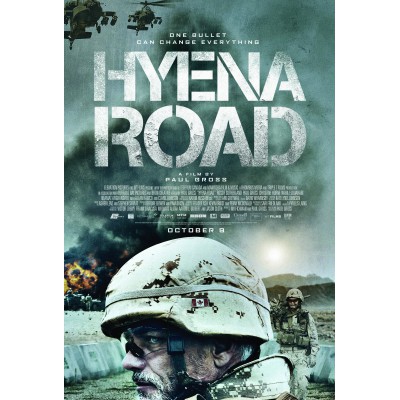
Hyena Road

I just had the absolute pleasure to watch the 2015 Canadian film Hyena Road. I have to say it was a spectacular movie, way more moving than the recent WW2 film Fury. It was, simply put, a masterful piece for a Canadian film.


The film is set at an unspecified time during the War in Afghanistan and is a Canadian film written, produced, and directed by Paul Gross (of Passchendaele fame) which was a real treat to see. The story follows the tale of a sniper team as it secures a road (Hyena Road) being constructed deep into the heart of Taliban territory, while they come into contact with a mysterious Afghan elder known only as 'the Ghost' and in the process get neck deep into local conflicts that are raging all around them. Overlooking all is a wily cynical intelligence officer trying to see the big picture.

Hyena Road's story is masterfully done with each character getting an adequate amount of screen time, and it will constantly leave you guessing as to what happens next. The main characters are all fully fleshed out with supporting scenes, and the myriad of sub plots all roll together in a simply fascinating ending that leaves you literally on the edge of your seat. I really don't want to say too much about the story for fear of spoilers but suffice to say it is well done. There are a series of overarching stories which really come together in a big way at the end.

Our principle cast of characters leads with Paul Gross who plays the aforementioned intelligence officer whose voice over narration sets the stage for our setting and much of the overlying narrative. In the beginning we see the squad consisting of Ryan (Rossif Sutherland) Travis (Allan Hawco) Hickie (David Richmond-Peck) and Tank (Karl Campbell) caught in a dangerous mission which they must navigate out of using their wits and aid from NATO forces directed to them by Captain Jennifer (Christine Horne) whom Ryan is far more intimately involved with than regulations might allow. The mysterious tribal elder The Ghost is played by Neamat Arghandabi, who despite not speaking a single word of English in the film, is a force all his own merely by his presence.

My only complaint that I  might offer up regarding characterization is that the side characters were in need of a bit of fleshing out versus the main characters, but each is a joy to watch as witty and natural banter seems to flow right from the beginning to end whether it is from soldiers under fire or men and women in a non regulation relationship trying to show their feelings.

One of the nice things about this film is that it really is a love letter to the Canadian Forces, showing off professionalism and character, getting the military jargon down to a tee. At the same time it portrays them as human beings with flaws, conflicts, fears, and problems all their own; not attempting to white wash them or show them as incapable of making mistakes. You feel that these are real characters, serving in a real war in stressful situations who can live or die at any moment. The film really keeps you in a state of anxiety regarding the characters fates and I give it a real thumbs up for that.

While it also doesn't shy away from portraying soldiers as real people with flaws (and some very colorful vocabularies) it definitely doesn't shy away from violence. The film's opening scene is a teenaged boy burying an IED and receiving a fist sized hole through his chest for his troubles. The gore is realistic, and surprisingly it felt almost tasteful for how not over the top it was. Blood is shed, and many people die, but it isn't the point of the movie.

That being said, this isn't a Hollywood blockbuster. The production values show at times with some scenes being simply stock footage, but the editing tends to hide this well. There are some moments where it certainly doesn't do the film credit (such as really blatant insertions of real soldiers footage into scenes where it doesn't totally make sense) and some moments where the special effects aren't quite right, but that is forgivable.

Overall this is an excellent film. I have to admit it had me on the edge of my seat for much of the run time, which is a decent two hours. I would really encourage anyone who likes a good war film to go out and see it, especially if you're a Canadian. It's important to support local film efforts and this is a film that sincerely deserves that support.

So if you can, buckle your seatbelt and strap in for a trip down Hyena Road.

Friday, 13 February 2015

Why I Love/Hate the Emberverse

WARNING: SPOILERS AHEAD

Hey there readers I'm just here to talk about a particular series that is both very near, and very far, from my heart.

S.M. Stirling was, in my teen years, one of my favorite writers. He can craft amazing worlds, write some fairly catchy dialogue, and turns out scenarios that are at times so wild that you can't help but be sucked in (I don't think I will ever forget the skirmish with bandits where the protagonists take refuge in what turns out to be an abandoned pornographic store in The Protector's War). And he has written many excellent adventure books, Conquistador, and the Peshawar Lancers which are just too fun to read. He of course is also the author of the infamous Draka series which has probably been picked over as much as A Song of Ice and Fire for details.

However, he is probably currently most famous for his newest (and longest running) series, the Emberverse. The basic premise is that on March 17th 1998, at 6:15 pm a worldwide event known as the Change disables all electronic technology, and even alters the laws of physics which prevents gunpowder and even steam technology from functioning properly, in an instant thrusting humanity back several centuries. The first book in the series (Dies the Fire) follows an excellently written post-apocalyptic scenario where two groups struggle to survive in this fundamentally changed world.

The book follows an interesting cast of characters as they build a new world (even reality) out of the ashes of the old, some good and some bad. The different societies and nations which emerge are fascinating, and the characters themselves are just great. That's not to say they don't go through some hardship. Though from the individual duels and skirmishes, to the sweeping battles of the later series each battle scene is a joy to read and amazingly detailed with twists and turns around every corner.

You have former marine Mike Havel who leads a motley band of survivors in a quest for safety across the Mid West after having survived a plane crash, and Juniper Mackenzie, a Wiccan priestess who bards her way across Oregon who leads her own group to her inherited cabin in the Williamite Valley. Mike founds a warrior society of soldier settlers who take their own territory and hold it against all comers, while Juniper founds a neo-Celtic clan that adopts its new identity with gusto that makes even its founder slightly uncomfortable. These societies develop into things of their own, well beyond their founders intentions in interesting ways.

The first trilogy in the series is fantastic, well fitted together and each book has a tight narrative that you can really sink your teeth into. I will shamelessly admit that they are some of my favorite books of all time, and I have probably read each one at least three times. Mike Havel, Astrid, Juniper, and Nigel Loring are a four very interesting characters who grope their way through a changed world and establish themselves and the groups they bring with them as a new nation, each with its own very unique quirks. They are shaped by the presence of a central antagonist in the form of the neo-feudalist warlord Norman Arminger and his hyper-competent wife Sandra.

While the series tends to present things on unashamedly black and white lines (good guys good, bad guys bad) it doesn't detract from the superb world building, and some of the greatest battle scenes in fiction. The books all tied together well, and presented a compelling story about leadership, survival, and change.

Imagine my pleasant surprise at hearing that a new saga for the Emberverse would be appearing all the way back in 2007. This saga got off to a great start, with an interesting new cast of characters and the promise of exploring more of post-Change North America. We even had amazing new villains in the form of the scary dogmatic religious CUT (Church Universal and Triumphant) and its Prophet, Sethaz.

Now don't get me wrong, these books got off to an amazing start, but they started to teeter on the edge of disappointing very swiftly.

Though I should start by saying that Stirling's skill at world building has not decreased, and the books continue to be amazing romps through a totally different world (which technically counts as alternate history) with the amazing innovations and different survival techniques we've come to see, the force driving that adventure however, diminishes significantly with each volume.

There's no shortage of interesting characters. We have the mercenary salvage man from out East, Ingolf Vogeler, the son of amazing archer extraordinaire Edaine Alyward (and his lovable pooch Gabranth), Father Ignatius from the amazing Knight Templar-esque monks of Mount Angel, and Odard Lieu, son of a villain from the previous trilogy. We also have returning characters in the form of the all-grown up Matilda Arminger (only daughter of the villain Norman Arminger) the twin daughters of Mike Havel, Ritva and Mary, and finally the bastard child of Mike and clan chief and priestess Juniper Mackenzie, Rudi.

I think many readers will understand why I list him last.

At the heart of the series problems from here on in really is this one character. While we have a cast of excellent supporting characters, but they tend to take the back burner whenever Rudi is on screen. Rudi is a very dull, uninteresting, and very poorly executed heroic character whose very presence tends to drag down the novel. In fact he renders almost every other character inconsequential. The main villain of the series (Sethaz) gets progressively less and less screen time until he effectively becomes mostly background noise with only his secondary villains having any screen time at all, and even then its fairly secondary to the plot. He can really do no wrong, and this is outrageously demonstrated in one scene where Matilda overhears a conversation where it sounds as though he is having an affair with another woman and sets up what could be some amazing character drama...only for the next chapter to start with how she was wrong because when she asked Rudi whether he was cheating on her he angrily said no. For me at least that really torpedoed any sense of realism in character development.

The overarching plot of this saga isn't even bad. It's a quest to find a magic sword which will counter the influence of the a dark power which is feared to be rising alongside the CUT. This is backed up by the trials and tribulations of the questers as they cross the vast expanse of North America and run into local politics, CUT allies, savage neobarbarians, and being constantly pursued by CUT fanatics. Some very fun adventures take place amongst the new Sioux nation (with a gripping event involving buffalo) and we get an in depth look at the new nation of Iowa, arguably the most powerful nation in North America now, with a bevy of satellite states surrounding her in the crop rich plains. There's even a great background story about things back home with the war!

The problem again though, is Rudi. The book often goes out of its way to break the "show don't tell" rule when we run into him, and characters will spend pages talking about all the reasons you should like him and all the reasons why he is amazing, and why he is such a good leader. None of this is actually shown to us the readers (unlike with previous archetypal leaders like Juniper or Mike) and we have Rudi with many informed abilities. He is never in any clear danger as he is absolutely unbeatable in combat (which before we see this many other characters spend a good deal of time informing us) and even the sub plot back home tends to devolve around describing how awesome a leader Rudi will be. Despite suffering a serious wound at one point, it doesn't even wind up seriously inconveniencing him as the series goes on. His presence drains any tension from the books and you don't even fear for his friends as things continue. In fact his friends situations get even less screen time and very little development beyond off hand mentions of things happening or a few scenes here and there.

The books from The Scourge of God on really suffer thanks to this. To me, the ultimate disappointment came when we arrived at The Lord of the Mountains where the series had been building up to an epic battle between the forces of good and evil. Now as I've mentioned Stirling can write amazing battle scenes, and with a series that has airships and hot air balloons still being a practical thing the immense undertaking that is plotting and portraying this battle should have been easy for him. Instead we have a series of incredibly underwhelming build ups and an absolutely disappointing let down with a waste of all the books potential epic moments which flop spectacularly in showing us the culminating battle between good and evil. From wasted pages describing the teenage adventures of two squires who are supposed to deliver a message, to simple scenes of meetings where the good guys cheerfully predict their victory over their foes. The book has zero tension, and in an ultimate sin manages to make what should have been an amazing battle boring and utterly unengaging.

However, the novels afterwards have been, well, not incredibly interesting. Despite much tension of when Rudi is supposed to die (a prophecy that he will not live to see his first gray hair) the books play it fairly tamely and he simply dies before he gets any gray in his hair, in middle age. He lives a long healthy life, and becomes a great king. Again we don't really see any of this and are for the most part informed of it by other characters.

The most recent release, The Golden Princess, is now primed to follow a new set of characters into a new quest, for a new sword.

While this one promises to be more nautical, and somewhat more engaging in that it will take readers from the deserts of California to Australia, and finally Japan, it has thus far disappointed. I can say with absolute confidence that people should wait until the follow up volume, The Desert and the Blade, comes out. You will find yourself much more satisfied, since Princess is very lacking in plot advancement versus overflowing with obligatory scenes where characters talk about how amazing Rudi is and describe the very technical feudal terms for feudal government and the neo-Celtic lifestyle. The story honestly just seems to cut off half way through, so I hope the new book will pick up where we left off.

In spite of  the series great  flaw with an unrelatable hero, it does mostly play to Stirlings strengths of world building, battle, and adventure. And you know what? That's a good thing. People may not like the characters, and I'm one of them, but the world Stirling builds is so detailed and intricate that you can't help but want to explore it. He crafts some amazing societies which you will find yourself going back and reading about just to catch glimpses of them. He paints a hauntingly beautiful picture of a completely changed North America built on the bones of our old civilization, and its wonderful.

Though I may not have cared to deeply for the meat of the second saga, I reiterate my love for the first trilogy and recommend it as an excellent series to anyone who wants to enjoy a good book. Stirling is still a good writer, and while it may take a while for the new books to get into the swing of things I fully expect that like the previous books it will contain some amazing gems that will leave you saying "Holy Crap! Did that just happen!?"

It has for me, and I hope it will for many others.

Friday, 14 November 2014

Soapboxing in Writing

Now some people reading this may not quite know what soapboxing is. Well it's a rather old expression relating to raising an impromptu platform and giving a speech. In terms of writing it's the idea that an author uses his works as a platform to wax on about his philosophy or ideologies. Many authors do this intentionally or unintentionally, in fact I agree with David Weber when he says that, "In other words, while no writer can avoid stepping up onto a soap box, whether he wants to or not, when he starts writing military or political fiction, I am perfectly willing to subordinate my personal views on many of these questions to the strength of the storyline I'm working with." [1]

However, I believe that no matter what genre a writer steps in to he/she is going to be soapboxing or at least pushing some of their ideology into the work. This can be because of their world view, their opinion on a certain subject, or more importantly, how they perceive the world around them, which always colors an authors work no matter how much they may try to avoid it.


The being said there are some who soapbox more than others. 


I've read a large number of books which wax on philosophically about their authors personal beliefs or the way the world ought to work in their eyes. In fact a large number of them can even be entertaining in spite of the heavy handed anvil which the author drops on your head. A good example of a decent soapbox would be Michael Z. Williamson's Freehold, which is basically a libertarian screed on everything from war, to nudism. While finding many of the political positions and parts of the philosophy utterly absurd, the story they were wrapped in made it all so fascinating. The characters had some depth to them and weren't simply walking mouthpieces for the ideology and had quirks and flaws of their own. Not War and Peace but still some fun popcorn reading that you can sit back and enjoy.


Now as a counterpoint to that of course is a book written completely as an ideological rant. Atlas Shrugged being the go to example, but I'd like to cite a book I reviewed waaaay back when, is a truly terrible book called Enemies Foreign and Domestic by Mathew Bracken. While Atlas Shrugged is a bloated book that wallows in its own self-importance this book is taken by the author as both a realistic expression of the world at large and a wonderful example of how to cram lots of hate speech into one novel, then build a trilogy around it. Basically it's an authors anger filled rant against society and how evil his political opposites are. The characters are flat, rather boring and two dimensional, and the villains are such thin cardboard cut outs it doesn't even merit calling them caricatures. In short it is every example of how not to write a novel.


Not to sound like I'm picking on the right wing here's a left wing ideological spout called Christian Nation which in short is about how American right wing Christians are secretly plotting to install a theocracy in America and undermine it's Constitution and the march of progress. Basically it's an excuse for the author to cry wolf and talk about the evil religious people he doesn't like. It makes about as much sense as Enemies but is probably less offensive to the average person in its insanity. The characters there too are flat, shallow, and two dimensional and the work again wallows in its own self-importance about the message it is delivering while spooning out a heavy dose of cultural/intellectual elitism that is distinctly uncomfortable.


Now here I've just been highlighting the worst examples of soapboxing in fiction, when there are in fact excellent examples that can be found which don't bludgeon you over the head with the ideas and ideology that don't go out of their way to offend you. In stark counterpoint to the previous work you have Margaret Atwood's The Handmaid's Tale a deep and emotional piece which caricatures the extreme right wing beliefs of Christian Fundamentalists. You also have George Orwell's 1984 which is a piece taking totalitarianism to its logical extreme. Each of these pieces is a masterpiece of the genre and rightly so.


This isn't just in books written as political tracts though. In fantasy you have men like Brandon Sanderson who insert their own beliefs on human nature into their works by how the characters themselves act and view the world, and it balances out well between the heroes and the villains who all have deep three dimensional reasons for their actions. Then you have someone like Terry Goodkind who, although he writes arguably some fantastic work, can let his own political agenda seep in at inopportune moments. Though he is still an excellent writer. As fun as Richard is, it can be rather distracting when he gets caught up in a situation where he has to deliver a rant on why organized sports is stupid[2].


To that end I would just like to point out it isn't a bad thing to let your beliefs influence your work. It's probably impossible for you to not let them influence it. However, there is a way you can do it that it will stand out as a classic versus a heap of unintelligible garbage that only a few radicals will ever appreciate. Your story, as always, takes precedent over your ideological views, and it has to be a story that manages to flow with your ideology. The ideology should guide the story, not take it over.


It's possible that someone with some unorthodox beliefs out there might have the next 1984 in the making, but they just can't find a way to get their Winston to not be a cardboard cut out with human emotions and desires because they can't think how that interacts with their ideology. My advise is think of the human element first, and the ideological element second. If you can't find a rational way to have people react to your ideology or philosophy, then it's probably not one humans are capable of adhering to anyways.


========


[1] David Weber FAQ's: How close are the parallels in the Honorverse politics and our present day politics?


[2] No really this is actually part of the plot in the book Confessor. Even if it is sort of a blood sport.

Sunday, 14 September 2014

Why I Prefer AD vs. CE

Well recently in one of my Christianity classes we got into the topic of what BCE and CE means, and contrary to some, no it does not mean 'Christian Era' instead it is a 'neutral' term meaning 'Common Era' which is supposed to define the commonly used dating system in the modern era. Now understand this, the debate over the use of Common Era (or BCE/CE vs. BC/AD) is not a modern phenomenon, in fact the use of CE goes back nearly 400 years with the first use of CE appearing in Latin in 1615 and English in 1708 showing that, despite what some would think, we are not unique in attempting to change the dating system.

Now here's the thing, most arguments against the use of BC/AD are those who are attempting to pursue an idea of 'religious tolerance' or pluralism and inclusiveness in the dating system adopted by the world in an attempt to be more neutral to the global community. Never mind that this in and of itself is absurd since the Gregorian Calendar was foisted on the globe through the imposition of European ideas on local cultures completely upending their own way of time telling and was imposed by force. Nor does it take into account already existing counter calendar systems which are explicitly religiously based (such as the Muslim calendar or the Japanese Imperial calendar which measures the year from when the first emperor sat on the throne). It also ignores the fact that the Gregorian Calendar currently has religious ties to ancient religions built into it (the months and days being named after gods). The most important thing is that, for all intents and purposes, the global community uses this calendar for convenience sake.

However, what grinds my gears about the idea is that rather than attempt to remove any connection to previous time keeping or cultural strata they simply adapt the 'Christian' calendar making the change completely cosmetic and utterly pointless. In that same vein I sincerely doubt that most people, even of other religions, strenuously object to the use of this type of Calendar or really notice it at all to begin with.

Now for the plainly reactionary part of my little essay here. Functionally and culturally there is absolutely no need to change the dating system effectively in use for hundreds of years (well in the Western world at least) and reasons for changing it because it might 'offend' are laughable since it was through Western cultural hegemony which the current dating system became 'common'.

Though as a little aside, let me just offer up one suggestion to those who wish to make a 'neutral' dating system. Rather than simply trying to rewrite the current calender in a pointless PC exercise, how about just starting a new dating system? I know it's harder than just cosmetically altering the one we currently have, but at least it's more intellectually honest.

Here's a thought, how about we celebrate one of man's crowning achievements as the new more neutral dating system? Let us hypothesize that we can start if from October 4th 1957, when Sputnik was placed in orbit and man finally had access to the high frontier. We can say that starting that day is a new era (or hell just starting on the new year of 1958 for convenience sake) and every year after (we can say that the time from October 4th to December 31st is the 'year zero') becomes a year of the new Cosmic Era (CE). That would make today September 14th 56 CE. Rejoice for one of the greatest moments of mankind's history!

Now that may seem just silly, but it's a hell of a lot more honest than just trying to tie in a 'correct' idea to the existing dating system. It has worked without popular complaint for the last hundred years (or I suppose technically since we started the Gregorian calendar). To me though, it is just as silly to implement a cosmetic change which no one really cares about, and no great majority is asking for.

This is one of those traditions I will gladly stick too.

Wednesday, 30 July 2014

Flashing Steel Flashing Fire: A Short Story Collection.

Well readers here I being you another excellent review. I have given some glowing reviews of the works of author Matthew Quinn's work before. Here though I offer you the opportunity to enjoy all of Quinn's published works, as well as three new stories as yet seen by the world in one easy reading location.

I present to you, Flashing Steel and Flashing Fire!


This is of course an anthology, making it one of Quinn's longest published works so far. I've reviewed some of the stories available in the publication already, so I think I'll just stick to talking about two of the stories contained herein.

The first new story I'd like to talk about is Nicor. Nicor is a sort of combination period piece combined with a horror story. Here we have the Vikings taking on an eerie mythological swamp beast in a battle to the death and they find their weapons and courage almost useless when fighting the beast. Its interesting as it's told through the POV of a young first time raider who has never been a-reaving before. His nervousness and uncertainty paint a vivid contrast to the experienced raiders he stands beside. With a fun twist at the end it's a delight.

Next we have Lord Giovanni's daughter. I have to admit that this one was the most difficult for me to read, not because it was a bad story, but because I have very little point of reference for the villainous reptilians who populated the story. Imagining them was difficult so it took me a while to properly get into it, but once I did we had the right amount of wit and creativity to make for a fascinating read!

The next new piece is the very interesting prologue to an aborted fantasy series called Lord of the Dolorous Tower. This one is interesting as it has a fascinating blend of post-apocalyptic fiction and high fantasy. The characters are essentially two lovable rogues from their village who go exploring an old tower. It offers some fascinating ground work for a world in which it is suffering from an asteroid strike. It deals with some fascinating magic and world building while giving us a great romp with these two explorers, though it is a wee bit dark I'll just say.

Finally we have the ending piece Westernmost Throne. It's a 'political' horror story which is fairly unique in and of itself. It follows the tale of a young political secretary who discovers she may be in just a tad over her head when her up and coming political boss turns out to be more than he seems... I won't say too much here as it needs to be read to be appreciated. This one certainly subverts expectations! I can say I quite enjoyed it and I think you will too!

Now that't it for all the new material, but it has a number of old favorites like Melon Heads and Illegal Aliens! If you've ever read any of Matthew Quinn's work before I highly recommend you pick this piece up! It's a fantastic anthology and as I've said before, Mr. Quinn does not disappoint.

So I heartily encourage you to go pick it up!