Showing posts with label Joshua Johnson. Show all posts

Friday, 29 November 2013

On Kings and Other Titles


Well it's a common trope in fantasy that we are in a medieval setting and of course every medieval setting must have an authority figure of some sort, and that of course is the king.

Here is an appropriate music video to get you psyched up and thinking about kings:


Awesome music aside, it's rather telling we are always thinking of kings in  fantasy setting. It's actually very unusual in human history to see anything but some variant of the king-vassal relationship in politics and daily life. Our modern political system is less than a few hundred years old, and would be seen as phenomenal (or idiotic) by most previous societies on earth.

In fantasy though one can always count on seeing the good/evil king sitting on his throne surrounded by scheming lords and advisers in his court. Unfailingly we see the fates of kingdoms resting in the hands of plucky heroes, we see crowns being won and lost, and we see kings as characters and come up with the issue of ruling.

Though some must ask; why all the time kings? Can't we see emperors, samurai, daimyo, caliphs, sultans, chiefs, viziers, and pope's engaged in such situations as well?

My answer is that of course we can, there just seems to be a lack of them out there.

I personally doubt that it has anything to do with uninterested authors or less than receptive audiences, but in reality most likely has more to do with that all these titles and positions of authority, in varying degrees to one another, can be summed up under that millenia old word and phrase for a ruler, and that is king.

The title of king is of course one that could be easily translated into many languages or extrapolated from whatever word locals use to call their ruler. The position, and the authority that rests with it, is going to be much the same. Whether a sultan ruling from a palace in India, or an African chief ruling over a great swathe of the Savanna with his warrior armies, the position, power, duties, and authority is going to be very similar to what we would consider a king.

In writing of course this can get cliche to some people, but I tend to disagree simply because of the powers and duties any ruler (no matter what title we give him) will have when it comes to making himself the leader of a pre-industrial (or even post-industrial for that matter) nation. Slapping a fancy made up word on the position is not going to hide the fact that this person is for all intents and purposes, occupying the same position as a medieval European monarch.

This of course should not discourage authors from trying something new and attempting to experiment with the accepted idea of how kings rule and set up authority. Writers should by all means attempt to subvert and play with the tropes we've long accepted as part of the fantasy genre, and we should be seeing people experiment with different political systems and theories for setting up how kingdoms run and govern themselves.

From the Confucian principles that governed Imperial China, to the religious inspiration that justified the rule of the Caliphs across the Middle East, it's important for writers to set their sights on other modes of ruling and how a ruler gets his authority and how a vassal is beholden to him.

While I've heard some authors say that its hard to keep people interested in a character once he becomes king (S.M. Stirling famously saying that it's boring because its all meetings and reports) and that they lose much of the action and drama that could be presented I have to strenuously disagree! In fact in my humble opinion, once a character becomes king and faces the difficulties of ruling it can become a defining moment in a series!

They have to deal with plots, counter plots, swirling alliances and petty grievances, marriage proposals, siring heirs, leading armies in battle, managing the affairs of the kingdom, dodging assassins, and in a fantasy setting this can be offset by some more mystical elements being thrown in! It's sad that some authors seem to miss this. You don't necessarily need a king to be a main character, they can just be secondary characters sitting off to the side advising or hampering the main character.

For instance look at King Elhokar from The Way of Kings by Brandon Sanderson. Elhokar is a young paranoid king who rules a nation mostly in name but still has the power of his office. He is a supporting character to Dalinar (one of the main characters) and at times both helps and hinders Dalinar's actions. He is hardly boring and has a number of fascinating character tics which make him function well and give him a distinct personality.

Then just look at the in depth look at kingship and authority which A Song of Ice and Fire gives to us. We go from kings who are bad to kings who are not so bad in a brief time. The story looks at people who do have power and agency (much like a king would) and shows that despite the fact they still have to deal with petty politics and somewhat mundane matters (Eddard hearing petitions from smallfolk and lesser nobles was a scene which I've heard some people found tedious) but duly demonstrates that showing a man of authority in action shows off his character through how he carries out those actions. Stannis is another good character to show that kings are not all just dull reports and meetings, but people driven by a call to action and a personal sense of justice. Though we haven't seen any POV's from him yet, we have seen his character in action on the Game of Thrones television show which truly helps get a feel for the man and what he does.

In Joshua Johnson's The Cerberus Rebellion we get a POV from the point of view of King Eadric who is the character that starts off the book. Here we see the character of the man who rules the nation. He is far from a boring character and his varied attitudes towards his advisers and vassals is one which frames his interactions with the rest of his realm. We get to see he is a 'big picture' person who looks at the larger issues in his realm while neglecting his vassals smaller needs seeing them as irrelevant to his plans as a whole. This of course is what ends up getting him in hot water.

For another fabulous POV of people who eventually become rulers one need look no further than the Wheel of Time by Robert Jordan. There are many characters who are (or become) rulers in their own right and they were some of the most fascinating character arcs I'd ever read.

So personally I think having a ruler as a main character is something that can really be used well in a piece of fiction, whether you are examining the authority and rights of rulers, or simply making them characters in the grand scheme of things its fascinating.

All in all kings are force in fantasy that will be sticking around for quite some time, whether we call them emirs or shogun is a matter of semantics in terms of what force the character represents. They may be heroes, they may be villains but they capture the romantic vision we have of epic fantasy and they do it quite well.

Tuesday, 22 October 2013

The Cerberus Rebellion

Well it's time for that long promised review. Now here I am going to reviewing another Kindle novel I purchased, and it's not just another short story either. No this work is full fledged novella comprising a whole cast of delightful characters and awesome battles, all revolving around a growing trend in modern fantasy, the idea of gun powder fantasy.

As a short aside so readers will understand, gunpowder fantasy is a fantasy setting which features gunpowder weapons, ranging from flintlocks to full fledged firearms. Much like Brandon Sanderson's Alloy of Law, Stephen King's Dark Tower series or  Brian McClellan's A Promise of Blood. However some books only feature guns to help differentiate them from epic fantasy, gunpowder fantasy is revolved around fitting magic into an advanced setting outside the middle ages. The Cerberus Rebellion by Joshua Johnson does just that.

From: gunpowderfantasy.com


The world of the Cerberus Rebellion is an interesting one, the Kingdom of Ansgar is ruled by a paranoid and brooding king, Eadric Garrard, who sees the rise of the Chisean Empire across the seas as a potential future threat to his own realm. Egged on by foreign diplomats and by his own advisers he decides to martial his armies and intervene in the conflict across the Vast Sea and safeguard his realm.

However, Eadric is not a well loved king, and not all his subjects are as eager to go to war as he. Then we have Magnus Jarmann, ruler of Kerberos, once a sovereign nation, now under the heel of the Asangari occupation. He is eager to win his realm's independence back, all he has to do is wait for the right moment. Finally we have Lord Raedan Clive, Baron of the Broken Plains who is a warrior first and foremost, a politician second.

This delightful cast of diverse main characters, each with competing interests and ideas, sets us up for a thrill ride through politics and war.

There are of course plenty of fun secondary characters in the series, like Raedan's brother Hadrian, and the king's advisers who all color the events of the novel depending on their own outlook. They serve as wonderful supporting characters who fill in the dynamics of the story and serve as windows into the upper crust of the world.

The story itself is not slow at all. From the get go we see things moving both militarily and politically. What helps this along of course is that it is in a setting where you don't rely on just men on horseback but telegrams and railroads which all speed along the important messages and allow for very little lag time. Here I have to applaud Johnson for his skillful mix of court intrigue and politics with the practical and often harsh realities of early industrial war and the nitty gritty of the battle field.

The resulting combination is something akin to Game of Thrones meets Bernard Cornwell's Sharpe series.

It's an interesting world with politics that are distinctly feudal in their application (for instance landed aristocracy still holds an enormous amount of power compared to our world in a similar time) and one which is clearly influenced by such. It combines the appendages of a modern and centralized state with those of a late medieval one where the king controls all the armories with the best weapons and artillery, but the aristocracy can still call on a powerful military levy of its own.

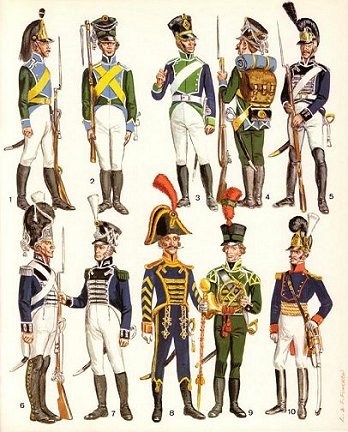
It's even reflected brilliantly in some of the battle scenes! There is no national uniform for any of the armies so the infantry marches to war in their house colors, which causes immense confusion and disorder on the battlefield (similar to our own histories Napoleonic Wars with soldiers lack of standard uniforms leading to friendly fire incidents) and is something the characters comment on more than once.

Think this, only just a bit more confusing.


It's also a sort of fascinating look into a society where a medieval style of command and control still reigns with titles of aristocracy such as 'Knight Commander' sitting in the chain of command alongside more familiar ones like lieutenant and major. The lack of a true unified command structure in most cases too makes for some rather interesting, and in one or two cases unfortunate, situations.

The battles of course are superbly done with little confusion from the point of view of the characters, and we get what is, in my opinion, a good vague outline of the actual battlefield and course of the battle itself while dealing with what only the character on the ground sees and then once the battle is done do we see the full scope of the action and what has happened. From a narrative perspective it makes things more thrilling and tense as the characters don't fully grasp how they are affected in the thick of it, yet they tend to make great leaps and advances.

Of course they are not military fools and at a few points characters make great leaps which change the course of battle thanks to good foresight and clever maneuvering of their forces.

Now one criticism I would have is that of the roughly six battles we see in the book only two are presented in great detail to the end. Sometimes the author forms a wonderful and suspenseful buildup to a turning point in the battle, only for us to miss it completely and have the narrative skip straight to the aftermath. While it was a bit of a suspense killer it did hasten the events of the novel along and I won't say the story suffered greatly for it.

The character interaction too is fun and educational, giving us details about the world these characters live in. The sub-plot focusing around the potential marriage of Raedan in order to sire an heir and cement his claim the Broken Plains is fun and quite amusing since it shows off Raedan's personal strengths and weaknesses, alongside his magical abilities.

Another thing I would like to congratulate the author on is his inclusion of elves in the story without making it feel cliched or shoe-horned in to fit the necessary fantasy mold. The elves seem to be perfectly natural in the world and they insert themselves as individual characters and personalities alongside their human counterparts with their long lived and magical nature filling an important niche in noble politics.

The inclusion of magic too was well done, though at times it did seem like a secondary focus of the plot, but it played an important role in Raedan's story arc. The way magic is handled was interesting to me, especially how it plays into the nature of griffons and how one controls them.

All in all the book is a wonderful read with a climax which leaves you begging for more. Johnson shows off his stuff as a writer with great promise leaving us with a fascinating new fantasy world to explore. I say the book is worth a read as it is a nice long read at a very affordable price. I would say that you could do well to part with three dollars for more than three hours of entertainment.

---
On a related note Johnson has a wonderful website where he posts about his world, industrial fantasy in general, and updates on his writing projects. He also has a myriad of short stories available on Amazon. This is his Facebook page, if anything here has intrigued you, check him out!