Friday, 21 August 2020

Planetary Invasions

In science fiction the idea of our planet being invaded, or other planets being invaded, is sufficiently old enough to be a trope. It all started back when H. G. Welles imagined Martians slinging themselves towards Earth to mash us with their tripods and death gas. From there it's evolved into many different scenarios some of which still involve us on Earth, to fascinating wars between the stars of other human or alien civilizations. Recently I've been pondering on that after I watched two very interesting videos between people who examined the idea of planetary invasions.

The first is from the excellent channel Space Dock which puts together wonderful work on the spaceships and vehicles of many franchises. They themselves have a drama called the Sojourn coming soon. Definitely check it out. But for our purposes watch their brief video on Planetary Invasions.

In contrast we have one video from Isaac Arthur discussing the subject. It's a longer one and it raises many interesting points. His channel is simply amazing for an in depth look at futuristic science based concepts on how we may do things in the future. It's honestly one of the best futurist channels and series I've ever encountered, sincerely worth checking out if you're interested in that kind of thing.
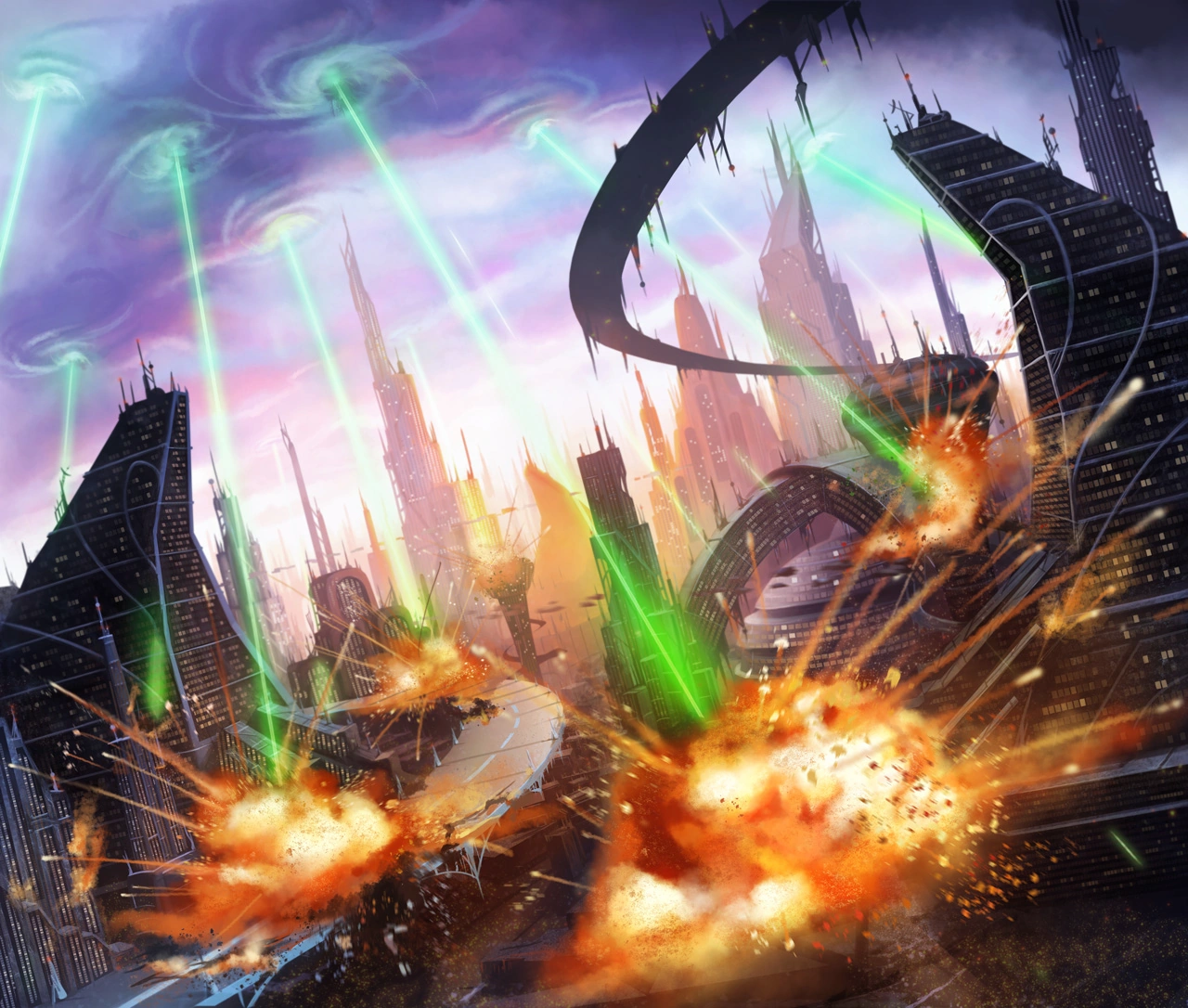
Credit to Alexander Tooth, from wookiepedia

Both these videos raise very good points, and they have contrasting opinions. In the first video we do see that it is argued that a planetary invasion is basically infeasible. Some Operation Barbarossa style mass landing and invasion taking years, decades, or perhaps centuries, to fully pacify a planet through mechanized warfare from above and below. The crux of the argument is that this is a huge waste of time and resources, especially when you presumably have ships in orbit that can hammer your opponent at your leisure. Then if you have no hope of relief and no friendly ships in the area, fighting on serves no purpose. You don't need legions of soldiers, just large landing forces to take and hold the vital aspects of planetary infrastructure and then garrison forces to keep the planet yours.

The second video has a more wide ranging view. It presumes that planetary assaults or invasions are feasible. The main point is that, after all, if you're jetsetting around in space with any sort of casual interstellar travel then the mobilization of resources to invade and crush another world or system of habitats (especially if you rule over multiple star systems and have great automation) is almost trivial. That being said, it makes a very pertinent point that a planet is not necessarily a helpless target. 

It is a point worth considering as any civilization which can do travel casually at interstellar distances is probably not really having to worry about the whole issue of delta-v in a gravity well. That means that, while an opponent who does control the orbitals has an advantage, the people at the bottom of that well are not nearly so defenceless as we might assume through our lens of 21st century technology where an asteroid barreling through our gravity well is a very terrifying prospect. Your vital sites are probably ringed with powerful railguns or missile batteries which can shoot destruction at any ship foolish enough to park in orbit.
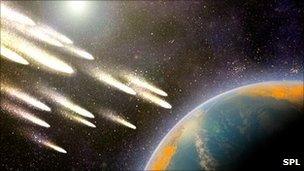

In fact with that view, the traditional image of a ship parking itself in orbit and blasting a planet with it's weapons seems silly. No ship could risk parking in orbit without worrying about taking crippling damage or being rendered combat ineffective. The proper image might be a vessel in the age of sail bombarding a land fortification and having to outnumber the guns of the fort to hope to overpower them before it can be rendered ineffective itself. The planet can shoot back.

What you might see instead is ships engaging in what amount to bombing runs, first moving to cripple or take any orbital defences, then moving in unpredictable patterns to try and crush the ground based defences. If that doesn't work, clearing a landing corridor to insert marines who can disable or capture those defenses so the fleet can put itself in a position to command the ultimate high ground and compel a plant's surrender would be your next best bet. In the book Tiamat's Wrath there is an interesting example of this that works very well from both a tactical and a dramatic perspective.

This is actually a point I've considered for some time. I've mused about interstellar warfare before and why it might happen. In my own, as yet unfinished Service to the State science fiction novel, I've thought about how you could make a planetary invasions feasible, so my own view actually falls somewhere between that of the two videos.

Part of that view does come from finding that in universes like those of the Honor Harrington series that if you've countered gravity to the point you're using it in your weapons, the idea you can't make some kind of planetary based weapons system which could cripple or severely damage a ship seems baffling. It does seem to me that there would need to be an invasion, but one aimed at very limited and achievable goals so your fleet could enforce the threat of death from above.

Some blame might come from Robert Heinlein's Starship Troopers which, though an excellent novel I recommend everyone read, did draw it's inspiration pretty heavily from the work of paratroopers in WWII and the island hopping campaign in the Pacific theater. In the Pacific the small Japanese garrisons which held out across numerous little islands with their coastal batteries and then fighting to the last man against the power of the American gun line and the overwhelming firepower of Marine divisions set the course for the campaign. The Japanese might have inflicted casualties, but they had only the small resources of their islands to call upon and no hope of resupply. This has, I think, colored interpretation of how planetary assaults might go. A planet doesn't generally have that problem unless you wreck the infrastructure so thoroughly that further resistance is simply futile.

In Isaac's video he makes a very good point about the resources of a planet, and how future technology might make it possible to basically weaponize an entire planet's population, or make them know no fear. However, even with fantastic automation or fearless soldiers, there is a point where your offensive options and economic support would be so ground down that your ability to resist is functionally irrelevant as the invading power could zap you whenever they felt like it and destroy or immobilize your remaining assets. At that point, it's either guerrilla resistance or surrender.

That's why in my mind I think a planetary invasion might fall somewhere between these extremes of Honor Harrington and Starship Troopers. A planet isn't defenceless unless it has no real orbital defences or ground based weapons, and even with those ships can work to attire them, and then send in the marines to seize and hold them until the fleet in orbit can establish an advantageous position. Unless you know you have a relief fleet coming, there's no reason to keep fighting.

Of course, this is all just speculation and trying to harmonize the plausible with the realistic and make compelling story telling. Future warfare is liable to be so destructive it's unimaginable to today's soldiers or civilians. It does make for interesting reading or musings though.

Monday, 17 August 2020

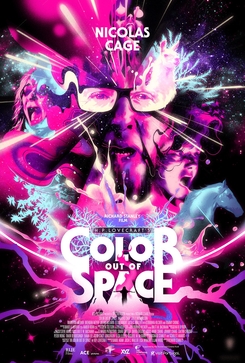
The Color Out of Space (2020)

Recently, thanks to Covid-19, a film was released digitally which would otherwise have been cruising for a decent premier as a very interesting horror film. That film is The Color Out of Space! I have been anticipating this movie for a while now, having been a fan of the original 1927 Lovecraft short story, I was looking forward to seeing a modern adaptation of it. It had some interesting promotional art, and most importantly, to me, one of the big names was going to be Nicholas Cage.


The original story is set in 1882, with the movie instead moving forward to the 21st century sometime in the 2010s in a small place in the sticks, just a while outside the town of Arkham. Normally I don't like this kind of setting change, but the film does it really well I think, and quite deftly neutralizes the problems of modern technology in horror movies besides.

We begin with some opening narration, quoted directly from the original short story. It then moves on to establish the Gardener family. Their daughter, Livinia (Madeleine Arthur) is out practicing spells in the woods when she is stumbled upon by hydrologist Ward Phillips (Elliot Knight) who is out testing the water table for a proposed reservoir. Then we get some establishing shots of the family, and the film actually spends a very good amount of time establishing why we should care about these people. Nathan Gardener (Nicholas Cage) has moved his family to the remote farm his father owned as a way to save costs after his wife Theresea's (Joey Richardson) bout with breast cancer. His two sons, elder Benny (Brenden Meyer) and youngest Jack (Julian Phillips) are typical adolescent and youthful males besides. Jack is always scared of something while Benny likes to smoke pot with the land's resident squatter Ezra (Tommy Chong) who lives in a remote 'off grid' cabin on the property.

It's a loving family which has its issues. Nathan has taken up alpaca farming because he believes it's the future while his wife is a remote worker who takes clients over the web. The physical and social distance puts strain on the family, a lack of reliable wifi and worries over their kids getting to school or medical care are all typical problems in the 21st century. It's all laid out well in the opening scenes and I really appreciated that the film took time to make me care about these people.

Then the comet hits and all hell breaks loose.

Seeing the titular crash landing from outer space was fun. It was done in a bit of a hokey way (an eerie purplish light filling the whole area but for some reason only one person looks at it) and a spectacularly creepy landing leading to more outlandish results. Little Jack finds a new imaginary friend and the crops start to taste weird, while time seems to flow...differently for the Gardeners. Things spiral steadily downhill from there as Phillips tests out the stuff he found in the meteor and comes to the conclusion there's something undeniably alien about it.

Visually, the movie is great at leaving you in suspense. There's no in your face examples of the color (beyond well, the color) and it builds suspense over the course of the film to some of it's more genuinely horrifying moments. People and animals beginning to change, and I found this approach to be very well done, with some similarities to The Thing which I found to be very well adapted. The steady descent into madness these circumstances bring is delightfully creepy as characters at first just try to adjust to weird, but not otherworldly, experiences. The actors brought out the Lovecraftian themes beautifully, with Nicholas Cage bringing his world class ham to the screen making his descent spectacularly terrifying! The man can still deliver!

Stand out performances do go to Madeleine Arthur and Elliot Knight for their roles. Arthur plays Livinia who is, after all, a teenager caught up in a horrible experience to a tee, and Knight plays the poor hydrologist sucked into an otherworldly circumstance very well. I really thought he was going to die halfway through the film! Their little subplot crush on each other makes for some cruelly tense moments later in the film, and I really felt for both of them as things spiraled out of control.

There were some excellent nods to Lovecraft in the film. From Livinia reaching for the Necronomicon in desperation as her world falls apart, to Ward being a graduate of Miskatonic University, the film made itself broad in appeal to the general public, but also having enough nods to keep Lovecraft fans enraptured by how well it did the original material.

Now there were some small errors I felt. There were a few character tics and subplots which were not well explored. The Garderner family is supposed to have some kind of feud with the mayor over their property and the construction of the resevoir, but nothing ever comes from that or is explained. Then there's something about the resevoir supposed to provide water to 'half the East Coast' which also drops with nary a whisper. Then the color itself is... well it's basically purple. I know we can't have an actual alien color within this medium and it works much better in your head, but having the color shift more would have been more visually appealing to me at least.

However, this is a genuinely thrilling horror film. If you know the original story you're in for some surprises, which is good. Then if you're used to regular horror films you're also going to be surprised for how well it handles older material and makes it accessible in the modern age. It is a movie I would definitely recommend watching and is sure to at least make you think twice about where your water comes from!

Saturday, 8 August 2020

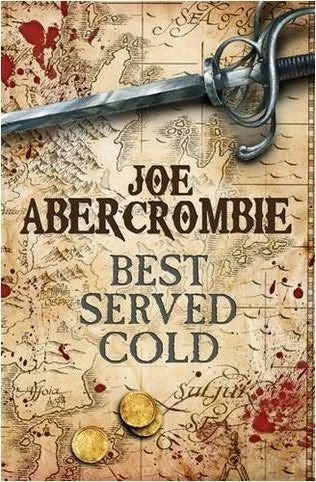
Best Served Cold

What happens when you combine Quintin Tarantino with Guy Gavriel Kay and Alexander Dumas? You get a low fantasy story of rip roaring revenge across a continent! We find these blended together in Joe Abercrombie's amazing Best Served Cold! This is hands down my absolute favorite book of Abercrombie's. I'm not exaggerating when I say it is possibly one of my favorite novels of all time either. 


I originally read this work back in the summer of 2017, and I immediately fell in love with it. By the time I had already read the First Law trilogy for the first time, and the book The Heroes so I happily jumped in to the events in this far off land of Styria. Naturally this is part of the 2020 re-read.

What is fabulous is that you don't necessarily have to know the First Law trilogy to read and enjoy this book. There's references to the former plot, the former cast (with one even showing up in the flesh) but the mentions are vague enough and with little real association to the former series that it really just serves as interesting background information to the story while informing readers well caught up on the meta-plot about things going on since the end of the original trilogy. It's nice and ambitious that way, but also won't turn off casual readers.

The new cast is largely fresh. We do have two characters we've seen before, namely Caul Shivers of the North and the infamous soldier of fortune Nicomo Cosca who was first introduced at the Siege of Dagoska in Before They Are Hanged. Both of them were sufficiently deep secondary characters they they manage to become wonderfully enmeshed in this story. 

Our main protagonist though is Monzcarro "Monza" Murcatto, Captain General of the Thousand Swords, the most feared mercenary company in all of Styria. She has fought her way to the top of the heap and is very determined to stay there. She's a new character, well actually mostly new. She's first mentioned offhandedly by Cosca in Before They Are Hanged as part of his backstory for how he fell from grace commanding the Thousand Swords. Betrayal runs deep in Styria after all. And sadly, that is precisely what happens to Monza. Despite having served loyally at the side of Grand Duke Orso of Talins for eight years, he fears her power and orders the murder of her and her brother Benna. Hurled off a mountain, crippled, and left for dead, Monza swears revenge on the seven men who were in the room when it happened.

She enlists the help of killers, mercenaries, poisoners and torturers to do this. First with Caul Shivers, and then with the numbers obsessed former prisoner the oddly named, taciturn Friendly. Padding out her merry band of assassins are the flame haired Shylo Vitari, and the preening, pseudo intellectual Master Poisoner Castor Morveer and his apprentice Day. Together they must kill seven of the most well guarded and powerful men in Styria in the middle of a war, or die trying.

The three main leads though, are Monza, Cosca, and Shivers. Shivers has set out to be a better man than what he was in the North, where he fought in wars and blood feuds. Unfortunately, he finds himself entangled in the mother of all blood feuds when Monza enlists his aid in killing her betrayers. Monza, who already had a dark reputation, has been twisted by her desire for revenge and looks at the world in a dark a cynical way. Cosca meanwhile, veers between being a genius or a madman who just loves to put himself in danger. Their different goals, becoming better, and seeking revenge, all play off one another as they attempt to change to either fit their circumstances or overcome them. Each one reaches new lows and soars to new heights. I'll leave to your imagination which that is before you read it.

At it's heart the story actually does have a pretty deep and complicated message on whether people can change, and whether revenge is worth it. As Monza leaves corpses piled up in her wake, she finds herself feeling very different, and it doesn't bring the dead back, but it makes her feel. The interplay of her conscience and that of Shivers, and Cosca's well...lack of one, is what makes this epic drama across a continent flow very smoothly and with a number of twists and turns in characters and circumstances which are deftly woven together needing to be seen to be believed.

Her foes are also interesting. Grand Duke Orso is playing for keeps across all of Styria, and that makes his role in this little drama all the more powerful. He is at the peak of his might, looking to make his sons rulers of a unified nation, and his subordinates and allies are no less powerful, but that doesn't mean their invulnerable. Our heroes, or villains depending on where you stand, go up against him and make it a very fun competition against great odds.


In fact, I think that the continent of Styria itself deserves to be seen as a character. It is a continent oft mentioned in the first trilogy, but never seen. Other than the land from which Grand Duke Orso and Queen Terez and a few minor characters, hail, it's only known for its wine, glass, treachery and mercenaries. If there's one thing which is not in short supply in Styria, it's treachery.

The continent has never been united, and it has been riven by the rivalries of the various city states. The greatest among them, Talins, Visserine, Ospria, and Sipani, having vied for position for centuries. In the current climate though, Talins has risen to be powerful enough to challenge them all for dominance, and in response Ospria and Visserine have declared an alliance with the other city states and formed the League of Eight to challenge the power of Talins. This has lead to the Years of Blood, two decades of continuous war. Steadily though, they've been ground down by Monza's military genius, and it seems Talins will reigns supreme over the whole continent with its first king ever.

These politics, and the changes in the world, are well woven into the plot. From comments on the old glory of Styria to commentary on printing presses, new inventions and new methods of war, the book deftly springs around any accusations of stagnation on the part of Circle of the World. Instead we find a very richly developed land in a renaissance fantasy which shows a changing world in terms of both technology and politics which our characters have to navigate. It's one which I hope more authors will follow.

I very much think that as a standalone book with a richly developed setting, characters, plots and motivations, it is hard to beat. I picked up many subtle details and plot points I missed in this reading, much like on my re-read of the original trilogy this year. It really made me love, revile, and revel in these characters and their story all the more.

Even if you don't think 'grim dark' fantasy is your thing, I would advise you to pick this one up and give it a try. Great story with a strong cast, and enough surprises that you definitely won't get bored!

Wednesday, 29 July 2020

The Atlanta Incursion

Once again I'm coming back to the works of Matthew Quinn. He's got a new book for us, the second book in his The Long War series (as it is now titled) and a direct sequel to his first full length novel The Thing in the Woods which I reviewed back in 2017. Here now though, we are given the events of The Atlanta Incursion!

As a warning, some minor spoilers will follow from the events of Thing, but nothing that will spoil the whole plot!


The story picks up roughly a year after the events of Thing and takes place in the Atlanta metro area in the aftermath of the Great Recession. There's plenty of abandoned areas, decrepid buildings, and gang activity to keep prying eyes away from things you'd rather not see. Unfortunately, that doesn't work out for young Javion, a member of the the Edgewood Jack Boys who, while out on a mission to bruise up a rival gang, finds that his simple turf war has suddenly taken on implications of an interstellar nature.

Meanwhile, young James Daly is doing what most kids his age are doing; managing his school life, studying for tests and attending classes, keeping his long distance relationship going and also staving off nightmares about confronting an eldritch horror in the woods last summer. Just simple freshman school worries. All through this he's trying to manage his friendship with his roomate Eli, and then with his girlfriend Amber, another survivor of those terrible events last May.

There's something strange going on in Atlanta though. Bizarre sightings, drones flying around, and perhaps Extra Terrestrials roaming the streets at night. James himself begins to see this, confused and worried, he thinks maybe he needs more sleep. However, it turns out that the events from last summer might not be as complete as he would like.

James was much how I remember him from the last book, but has had some definite character growth. Quinn also goes to show that he isn't unscathed from the horrible events he witnessed before, with nightmares, and some survivors guilt. I can say he captures this quite well from a narrative standpoint, and uses those feelings in both James and Amber to display character growth, vulnerability, and even some access to their inner badass when the time calls for it. 

Amber is also well handled. I did criticize the last book for this character failing the Bechdel test, and her treatment has improved. She's far more her own person, not only thinking about her attraction to James and has her own inner demons which haunt her in the story. I do think there was better opportunity for her to have another female character to play off on, instead of just one conversation with her roomate. Overall though, her arc and agency in this story is well handled and I applaud Quinn for upping his game with her and her actions in the story. Near the end she does get a pretty amazing scene which alludes to her rural heritage and something about it is just oh so right!

Our two new characters, Javion and Eli, were much more enigmatic. Javion comes across as one hell of a hardass who progressively survives more and more punishment, becoming something of a badass. He was already someone who grew up tough on the streets of impoverished Atlanta, so his growth is handled nicely and does go some way to explaining his resiliency. I think he was deftly handled for a character who could have ended up as something of a stereotype, and in light of events going on which took place just before this story came out, his life experiences (and distrust of Atlanta PD) were both timeless and timely if that makes sense. I am looking forward to seeing more of him in the future. I will admit though that his third act was less impressive than I had hoped for.

The final new character, Eli, was a bit of a mystery to me. It's true he's not entirely new (I made sure of that) but he's name dropped only a few times in Thing so he felt new at least. He's James's roomate, has some trouble accepting the alienation James is experiencing as James (for obvious reasons) can't really talk it out with him. His Jewish background and life is fairly well explored, and his friendship with James is fleshed out more, but beyond that, I didn't really know what to make of him and his character, unlike the first three, feels almost incidental to the story rather than an integral piece of it.

That being said, there were many fun moments in this book. The shoutouts to popular culture, especially from the 80s, 90s and 2000s was fun for someone like me who grew up immersed in a similar nerdy culture. The many references to the X-Files or Men In Black made me grin. That those were something of a running monologue in Javion's head endeared him to me. The sort of low key cultural jabs at city living Eli and the rural Amber were a fun contrast between rural and urban culture (especially one reference to James 'going native' which also cracked me up) and having transitioned from a rural to urban lifestyle myself it was quite relevant. 

I also enjoyed the 'secret war' aspect of the series. It makes sense for an X-Com style organization to be fighting aliens that aren't landing in big motherships. Though a lack of understanding of the alien goals, more speculation about why they did what they did, and a little bit of frustration with a paucity of prisoners did leave me in the dark to what precisely was going on. A small frustration was a moment where an alien speaks stunted English and then later we're informed the aliens never communicate back which felt...odd? I think I might have understood more if we'd seen or heard about the aliens taking other prisoners because it renders Javion's plot more sensible. That aside, it worked nicely for upping the stakes for the next installment, which I always appreciate.

The third act was quite well done, with very competent and exciting action scenes put forward, as I've come to expect from Mr. Quinn, and it had me on the edge of my seat for a bit (I finished the final third of the book in one sitting). I will admit that one aspect of the final fight made me skeptical, without spoilers, I didn't quite see the reason James got pulled into the fight in the way he did. It performed well and James still came off as a greenhorn, but the set up could have used a bit of tweaking in my opinion.

Overall, this book is great in that it manages the transition quite well in an Alien kind of way. By that I mean that where The Thing in the Woods was akin to the film Alien, what we see in The Atlanta Incursion is definitely a sequel in the Aliens vein of story telling. Fun and filled with equal parts dread and action.

A great read, I recommend it!

Sunday, 26 July 2020

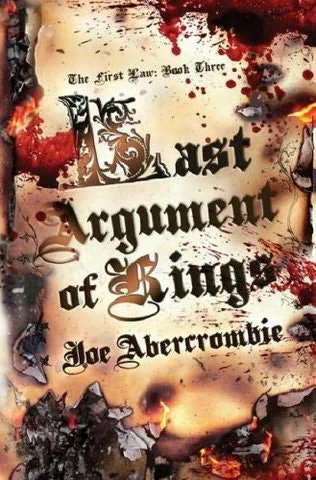
Last Argument of Kings

At last I come to the final installment of the excellent First Law trilogy. We finally see how our 'heroes' end up, whether their quests were all in vain, or whether they can save themselves in one last bloody blaze of glory. In doing so can they actually become better people? But what you need to know is that debts are called in, war horns sound, and with fire and steel we come to the Last Argument of Kings!


As the ending to a trilogy, I couldn't really ask for better. The characters have their important arcs wrapped up, the many mysteries which the series are, mostly, answered. The fact that it leaves us with an open ending for the future while bringing the main trilogy to a satisfying conclusion is part of what makes it such a stand out work. 

We have our main cast, Luthar, West, Glokta, Ferro, Logan and Dogman as they have survived war, treachery and pointless quests. Each has risen, or fallen, in the world and learned to take stock of their new surroundings. Some of that though is bloody difficult. And emphasis on bloody. I will endeavor to be brief to avoid any spoilers because this series really deserves to be read in full. Needless to say though, the quest in the west has ended, the Siege of Dagoska is over and the war in the North is still bleeding on! There's scores to settle across the Circle of the World.

The interesting highs that a few characters reach are well worth watching. It makes for some very, very satisfying turns of events. I quite enjoyed how the little things each book added up over time led to this fiery conclusion which worked so well. I liked the action, the tension, and the true pulse pounding terror I felt at parts of the story. No punches were pulled here.

Like any good author, Abercrombie severely raised the stakes across the entire trilogy, no less in the last acts of this story. Every time you thought he might have run out of surprises he throws more at you. I found myself being pleasantly (and unpleasantly) surprised at how the story ended up turning out. There were some betrayals I didn't see coming (or even remember before this re-read), a few fun twists, and some overall great scenes in both terms of action and revelations. The churning chaos behind the scenes is almost as fascinating as what we see on screen as the players begin stepping out of the shadows and various pieces begin to click together in your head.

Then of course he just doubles down on the action. The blood runs red in this piece, and I really felt the viscera flowing alongside the heroism and pointlessness of war here. It locked in a sense of powerlessness the powerful might feel at the top as well as showing how much a bird's eye view of events might not offer us as much control as we think. The great ending set piece battle really drove that home and I was amazed at how well Abercrombie orchestrated it.

Having finally reached the end of the trilogy, I couldn't be more satisfied with my re-read, and really recommend the events of the First Law trilogy to lovers of fantasy.

Monday, 20 July 2020

2069

© 2020 Matthew Stienberg


Mare Tranquillitatis, Luna, United States Lunar Territory, 2069 AD

In the vacuum of space you can’t hear the whir of the drones pneumatic levers as they drive pilons home. There’s no sound from vernier thrusters as they hover above you and gently kick up Lunar regolith around your feet. You can’t even feel it as it brushes against your suit in a fine dust. The barely perceptible mist is only a haze through your helmet. Beyond you lays the scope of the cosmos, stars barely visible, and the Earth not yet rising beyond the thin Lunar horizon.

“Damn pretty innit?” Your partner says to you.

“Mhm.” You agree absently over the radio in your helmet. He’s standing on the other side of the construction site, not even in line of sight, but he knows what you’re thinking all the same. Every old Lunar veteran already knows what a rookie on their first tour is thinking.

“Pretty soon it’s gonna be coming up over the horizon. Just you wait.”

You’ve seen the pictures of course. Who hasn’t? Earth cresting the Lunar horizon,a view so alien from what anyone on Earth is used to. Even the orbital hotels, with their position right above Earth, can’t claim a view like this one. Only the moon could provide it. That’s part of why you're up here though, because there’s only one great place to get a view like it.

The buildings going up already have sponsor logos, all from big multinational companies or the US government. Winged eagles, letters, mousy ears, and shining discs proclaim a ‘who's who’ of sponsors. They’re going to be pieces of the enormous rotunda celebrating mankind's first steps on a non-Terran body. You’re disappointed you can’t see them. They’re covered in heavy tenting, keeping them free of the moon dust as the other workers call it. They won’t be unveiled again until just before the grand opening, probably not until a few months from now. By then your tour on the Lunar surface will be over though.

It seems a shame, coming all the way to the moon and not seeing where the first man planted his footsteps.There were others of course, now brutally obscured by the first working visitors, run over by great automated Lunar rovers, or otherwise lost in the unthinking rush to profit from the cheaper access to orbit. Progress they say. Destruction some call it. All you know is the pay is great, even if no one can give you any real long term prognosis on the health risks. That’s okay, the consortium is footing the bill, and that money is going to keep you comfortable for the rest of your life. It’s well worth the risk.

“They say they’re gonna name the town up here Armstrong,” Your partner chatters away. You briefly wonder if he does this because of the silence of space is so obvious otherwise. It’s way too quiet when you first step onto the Lunar surface. Some people embrace it, others want to drive it away. He seems of the latter type.

“Big debate though. Others want to call it Apollo, more egalitarian to the other guys who flew that original mission you know?”

You resist the urge to nod and just go ‘mhm’ over the radio. Your partner continues obliviously.

“Some saying it should be named after the guys who first mapped it. Some medieval Italians naturally, Giovanni and Fabricio I think, well, F-something or other anyways.”

You're pretty sure he means Francesco Grimaldi. But correcting him would disrupt his flow, and he needs to talk.

“Then some other guy, big billionaire obviously, he says he wants to stamp his name on the spot. Government says no, they won’t let him name the spot no matter how much money he throws at it. Now some weird nerds on the net want to name it after science fiction writers. The one they had in mind has a crater on Mars named after him now though. I think his ghost will be happy with that.”

You nod, briefly forgetting for a moment the action is completely meaningless in a space suit.

“Still, I think it should be Armstrong, only seems respectful y’know?”

“Armstrong sounds fine.” You say. Only mildly interested in the constant one sided conversation floating through your headset.

There’s a flash on your Heads Up Display, a warning, a drone is misbehaving nearby. You swivel your head to give the remote operators at the base a better view and more visual data to supplement telemetry data. There’s a curse over the team radio as someone swings an automated crane out of the way of one of the hovering drones dropping the pylons which will support the great rotunda.

“This is why we watch the construction site, instead of the stars. Isn’t that right people?” The shift supervisor grumbles.

“Yes, of course.” You reply. A blush creeps into your face, and you’re glad no one can see you. It’s a rookie mistake and you’ll be hazed for it in the mess hall when you get back, but it’s okay. The stars are always worth it.

You go through the motions for another hour; watching, feeding visuals back to the drone controllers and supervisors, the monotony of construction in space. Soon the day’s shift will be done and the other work crews will come in. The rotunda is coming along, soon it will be time for the more delicate hands on work the drones can’t quite replicate yet. The later crews will go over your progress with a fine tooth comb and then in a few months the obscenely wealthy will flock to the spot where men first set foot on the moon. Some government official will probably jet up to oversee the ceremony, some fiery speech about something. Definitely not about working together. Not with the Chinese and the Russians already trying to muscle in.

Word had it the Chinese were hard at work developing Shackleton Crater on the South Pole, developing Malapert Mountain for their own needs. There’s always talk in the mess hall about the ‘slow start’ at Peary Crater on the North Pole. The supervisors don’t like that kind of talk, bad for morale they say, but they never crack down on it. They’re too curious.

“You’re doing it again.” Your partner chides. Startled, you swivel back to the site. You’d been looking towards the South Pole. “Look into the feeds when you’re back on base.”

Laughing, you keep focused for the last ten minutes of the shift until the supervisor announces the all clear. There’s a rover coming to drop off the next crew, and you bound towards your own rover, your partner coming around to meet you.

No one really walks on the moon. The gravity is too low. It’s a lot of hopping, or almost dainty foot falls. Moving with slow purpose. You hop, your partner moves daintily, with the careful steps of a Lunar veteran. You beat him to the rover easy, leaning on one of the massive kevlar and mesh tires.

“You’ll get tired of that real quick you know. Loses its charm after probably the fiftieth time you go bouncing around on the Lunar surface. Walk before you run rookie.” He passes you a thumbs up which you return. You don’t think you’ll ever get tired of that.

“Though speaking of running, you hear they’re launching a space probe to Alpha Centauri next week? Those guys on Earth...”

You’re already tuning this news out as the hatch cycles open and you look over your shoulder. The tenting covering the Apollo 11 site is still there. Will be for a while yet. The rotunda takes shape, not yet having the feeling of permanence that the rest of the moon seems to exude. You look down at your own footprint, wondering how long it will take before it fades away, or is more likely walked over.

Your partner's warning rings in your ear. Will you get tired of it? Can all the wonder seen around you really end up as just a background to your work day? That seems impossible. How could it? It’s the moon, it can’t be just another tourist trap. Sparing one last look at the sheets on the rotunda, you wonder. You step inside, the hatch begins to close. It’s just another work day still.

Tuesday, 14 July 2020

A Storm of Swords

Coming on to the third installment of the fantastic A Song of Ice and Fire series, I've finally reached A Storm of Swords and begun reading it in earnest. This book I probably remember the least about from originally reading it, and I think I had a very dim view of much of the book at the time, and I absolutely remembered certain events wrong. In fact, I even confused some major events in this novel for those which took place in A Feast for Crows! So on sitting down and reading this again, it was very much like reading the book for the first time!

Some major spoilers are following since you can't really have a review of this book without them. If you haven't read this book or watched the show, be warned!

The book begins with House Lannister triumphant. Even though this is a supposed victory for House Baratheon, it rings hollow. The three male heirs are dead or defeated, the King on Dragonstone driven into the sea, the King in North has won every battle but now he faces the united strength of the south and west, while the ironborn have overthrown his castle and occupied much of the North, and Tyrion Lannister himself has fallen from grace.

Meanwhile in the North with the ironborn invasion, now the King Beyond the Wall comes pounding to the South and with him the might of the Free Folk with raiders, warriors and giants, but nipping at their heels are the mysterious but deadly Others. Jon Snow finds himself on the wrong side of the Wall, and maybe on the wrong side of the war.

Intrigue, betrayal, and weddings abound as the realm remains split in A Storm of Swords.

Another copy of a book which owes me nothing.

As laid out, all the characters here are in a moment of transition, the war is still being waged even though it is largely won in the south. However, the North, the Iron Islands, and the Riverlands are still in revolt against the Iron Throne. It is looking less and less likely though that these revolutions can continue. The new King of the Iron Islands has launched an ill fated invasion of the North, but this has only served to weaken the power of the King in the North, and so now the war may be for nothing. Worse, he may have made an indiscretion off the battlefield which may cost him more than any defeat ever could.

Like I mentioned above though, this book is chock full of action and events. I had actually misremembered parts of it and changed them to be part of A Feast for Crows in my head. It was a revelatory experience to go back and read the nail biting build up to things like, the Slavers Bay Campaign, the Battle of Castle Black, the Red Wedding, and the Purple Wedding. Seeing the details intricately built up to, betrayals, poisons, and political chicanery was absolutely amazing. I had forgotten just how much went into this book and how important it became for the later volumes.

One of the great themes was that of victory and loss. None of the victories we see on screen come without loss or complications. I enjoyed that each win still managed to bring with it a series of losses, and in some cases outright defeats.

Dany's arc was fascinating as it shows her maturing, but also questioning some of her goals and motivations while having trouble with some of the issues of her youth. I did enjoy that she became something of a wicked badass when doing all this. It's a tale that hits close to my heart because of my love of Civil War history, and the parallels are fascinating to look for.

Jon Snow's story is also interesting as it careens from a spy thriller to an epic story of siege and diplomacy, with so many twists it really made my head spin as I was reading it. I found the whole story with Mance Rayder to be compelling as it explains the threat of the Wildlings, and the threat that hangs over the whole Seven Kingdoms with the Others.

One story line I remembered astonishingly little of was that of Sansa Stark. I think back when I first read this I mostly skimmed her story, which is probably a grievous error. It was so much richer than I remembered, full of intrigue, subtle hints at the nature of the Tyrell's and their plans, while crossing so well with that of Tyrion Lannisters. He finale in the Vale was so well done, I really did underestimate her as a character when I first read this series.

Outside of Tyrion's arc (because how can you not love Tyrion? And the duel, that duel!) I would say that these were the stories that kept me going. Reading all of Catelyn's arc was gut wrenching as this time I knew where it lead. Seeing all the events coming to a head, in a way that really ties off what I consider to be the perfect trilogy in A Song of Ice and Fire,was immensely satisfying. I have more thoughts on why I think the first three books are so well done, and slide so seamlessly together, but those are for another time.

For now I would just like to finish by saying that A Storm of Swords is truly a masterpiece of the writers craft with such deftly handled foreshadowing and amazing plot arcs that it was well worth my time to reread. I'm in love with Westeros all over again.