Showing posts with label Suspense. Show all posts

Tuesday, 12 January 2021

Artemis

In the 2080s, the only city on the Moon, Artemis, is a bastion of the future frontier. Catering to upper class tourists, eccentrics, and people who just want to get away from Earth. Due to being located on the Moon though, it has some strict rules about what can and cannot come into the domed community providing for the two thousand permanent inhabitants and varying numbers of tourists. Fortunately, Jasmine "Jazz" Bashara is the smuggler extraordinaire who provides everything you might want or need. She spends most of her time dodging former RCMP constable Rudy DuBois while trying to get rich in a notoriously stratified Lunar society. When she comes across a job too good to be true, she finds herself in over her head.

Welcome to the Moon, welcome to Artemis.

Weir sets up a meticulously detailed city on the Moon. He finds justifications for why things are the way they are, how the economy runs, and why people might want to come to Luna to settle and work their way towards a very specific future. From why certain goods are contraband, the economics of being in a business guild to being independent, and all the sundry details in between, Weir does a phenomenal job of making you believe that someone managed to set up an international space conglomerate in Kenya and get the funding to build an entire city on the Moon!

From welding to worries of space extravehicular activity, I felt like I could be seeing a real place off Earth. There's even a very cleverly done essay detailing his reasoning for the space economy. I'm the nerdy sort that reads that type of thing so it really appealed to me. From launch costs to tourists at the Apollo 11 landing site, you really see how this society ticks.

Jazz is also a real gem of a character. The entire story is told from her perspective and her head is a hilarious place to be. She's enmeshed in Lunar society and always trying to climb to the next rung. Her caustic attitude and rapier wit make her a joy to live through. The way she interacts with other characters from her accomplices, her friends and family, and her adversaries are so human and believable that you can't help but be impressed by her 'get it done' attitude and willingness to do what's right. 

Supporting her are her Earthbound pen pal Kelvin in Kenya, the eccentric scientist Martin Svoboda, and millionaire Trond Landvik who is one of her high paying repeat customers. He comes to her with a very strange plan that is outside Jazz's normal routine. However, when he offers her more money than she can possibly make in her usual honest (or dishonest) work, she can't help but accept.

From there though, things get crazier than she can imagine. It's a very lethal case of follow the money!

The story is one of suspense and mistrust as Jazz flees her semi-comfortable existence in the city and has to go on the run in its' underbelly so she can find out who is and isn't on her side. There's tense Lunar surface chases, games of cat and mouse in cramped passageways and tourist thoroughfares, and an ever unfolding chain of events over who really controls the city. It was fascinating the way that real science was rolled into the plot and used to generate tension and seriously raise the stakes along the way.

This is a fun and suspenseful science fiction read grounded in realism and witty characters. It's not a long read, so pick it up if you have the chance!

Monday, 26 October 2020

Shattered Hourglass

The third installment of J. L. Bourne's Day by Day Armageddon series manages to bring our story to an international world, and tie off some loose threads which we have been dealing with since the dead first walked. In a story that provides the best of Robert Kirkman, George A. Romero and Tom Clancy, we see the end of the world from the Arctic to Honolulu in Shattered Hourglass

Minor SPOILERS for the last two installments follow.

In this next installment of the series we have a new look at the world ravaged by the zombies created by the "anomaly" which causes the dead to rise and seek to devour the living. This story switches from previous first person narrative as journal style to a multi-POV, third person style novel which has more in common with fiction usually found in this genre. The main protagonist is still Kilroy, but now we have Special Operators, some of the original Hotel 23 survivors like John and Tara and scientists trapped in an Antarctic Research outpost. It's a dizzying array of characters providing a greater look at the global zombie outbreak. We get hints of what happened in Europe, the Middle East, Africa, and Asia. 

Our focus though does remain on Kil and his drafting into Operation Hourglass, which is a mission charged with finding out what the Chinese government was working on prior to the dead rising. Inside a secret facility on the Chinese mainland, there may be a way to cure humanity and prevent the dead from continuing to rise. Meanwhile, special operators working in support of the remaining US government are working to both sustain Operation Hourglass, and to deal with the shadowy organization known as Remote Six, which may put our embattled protagonist in mortal peril. Finally, his former Hotel 23 family lives onboard the USS George Washington while trying to aid the remaining US military command and keep the American Dream from fading into undeath. 

I will admit that beginning the third installment was a bit jarring, as I had immensely enjoyed the original journal style entries and the intense focus on our single protagonist. However, the sheer scope of this tale and the many complex moving parts did necessitate an expanded cast to keep things going. It did add some freshness to the story which kept my expectations high, and allowed for more varied and scary plots. From the isolation of the Antarctic research team, to the constant running and gunning the Special Operators had engage in, I found that this story never had a dull moment.

The final twist to the story though, in my opinion, made this really worth it. There was a great set up, and an answer, to why the world suddenly became the way it did. I won't spoil it, but if you want something that works as a zombie virus story, and perhaps helps keep you in the world and a high stakes international mission, this was a great way to do it. It honestly combined everything good about Tom Clancy's Rainbow Six novel and Robert Kirkman's The Walking Dead for an exciting high stakes plot.

While I didn't enjoy it as much as the original two installments, I will admit I had a great time reading this book again for Halloween!

I will be discussing some spoilers below the cut, so if you haven't read the first two novels, I highly recommend checking them out and you can find my reviews for each, here and here. SPOILERS below! 

Friday, 23 October 2020

Devolution

In our very tech focused and hyper-integrated world, it can be hard to imagine just how brutal and unforgiving nature can be. Try to picture then, a quaint and cute little haven away from the hustle and bustle of the technological world, surrounded in an oasis of natural phenomenon. This is the small planned community of Greenloop, situated in the Pacific Northwest and in the shadow of the magnificent Mount Rainier. Still hyperconnected to the comforts of the modern world though, wifi, great cell reception, drone deliveries, and biofueled houses which you can adjust at your leisure. 

Truly a small piece of paradise.

Until the mountain erupts. In a flash of fire and fury, the modern world is swept away, leaving the people lounging here stranded. All one once the inhabitants of Greenloop are cut off from the outside world, their access gone, drone deliveries, gone, and they're stranded in an unforgiving environment at the onset of winter. But it's just a matter of time until they're rescued right? Perhaps, but what if the eruption of Mount Rainier has driven something more dangerous, something more deadly, something more primal towards them? What happens when these modern people, who have never known the terror of primal nature, its mercilessness and its hardship, come face to face with their potential primitive past? You get a severe case of Devolution.

Max Brooks new novel sets out to tell an engaging scary story, one quite appropriate for the modern world.

The story is told in the familiar scrapbook style, revolving around the nameless journalists' interviews with those familiar with the incident, excerpts from news pieces, and the main meat of the story, the diary of Kate Holland. Her story is one told with an interesting twist as she writes a diary to deal with her stress from the overwhelming nature of everyday life, to keep her therapist abreast of how she's feeling, and chronicle her own state of mind to see her progress and express herself.

Her trip has, with her husband Dan, been undertaken to improve their marriage, give them some piece of mind, and help them get back on track. 

They meet the colorful cast of other eccentrics coming from the Pacific Northwest to relax and unwind in this isolated, but technologically connected community. Run by the stunningly beautiful and technologically savvy team of Tony and Yvette Durant, the community looks amazing with its individual houses and common house. 

The other members of the community, the overweight and arrogant philosopher Reinhardt, the power couple of Carmen and Euphemia with their adopted daughter Palomino, husband and wife Bobbie and Vincent, and the reclusive but powerful presence of the elderly and diminutive Bosnian artist, Mostar. This little group, thrown together from diverse backgrounds, will suddenly have to survive their own little apocalypse.

It tells an interesting story of city dwellers who are expecting nature to revolve around their needs. They feel that, with technology, their little group can tame nature. That they've all only lived in the city, never interacted with untamed nature, and have no survival skills that don't revolve around technology, doesn't really occur to them. It puts human need for technology and community front and center, and shows how the hyper-individualistic and society of instant connection can be sorely tested by extreme situations. They also learn the hard way that nature is not nice.

All of the issues of being cut off from greater society, planning for long term survival, and otherwise pulling together, might have been overcome if it were not for the sudden intrusion of another group of equally desperate primates. The Sasquatch. This throws everything into turmoil as these new critters are desperate and hungry, and the humans of Greenloop, while smart and intuitive, are not exactly equipped to fight them off. Whether from sheer lack of preparedness, a semi-naïve philosophy of harmony with nature, or simple inability to understand their new neighbors, the people of Greenloop are very much unprepared for the danger they face.

Like most of Brooks works prepping does feature, to a greater or lesser degree, into the overall story. He tries to outline practical examples of disaster preparedness, reminders about the fragility of high technology in emergencies, and that most people don't really know how to survive in the wilderness. It's an honest, not really preachy, way of putting forward the idea of keeping yourself ready for even a mild natural disaster which, I can say from experience, can really throw you for a loop. It also takes a few potshots at tech gurus, thinking nature is calm and pleasant, or that humans can be effortlessly on top of the food chain. Though most of all, reminding us that nature is full of wild animals and not tame petting zoo critters.

We have a great slow build to the story, with the gradual encroaching disaster, a slow creep of the monsters, and a build up to a tense, unknown situation with a brutally climactic ending. One of the true triumphs of the book is so comprehensively dealing with the modern problem of instant communications in horror, by using the destruction from the Rainer eruption to so totally cut off the characters. It gives you a real feeling of isolation and horrible solitude that is hard in our modern world, and I think that every time this is pulled off well for an author it should be applauded.

I definitely think it's great to have Max Brooks back in the game of horror. He writes phenomenally well, establishes a diverse, exceptional, and unique cast of characters, and uses them in an unexpected and interesting way. They really do jump off the page, through the biased views of the narrator, and with the "after action report" of the various interviewees. A great read for 2020 and anyone who loves the horror genre! 

Monday, 17 August 2020

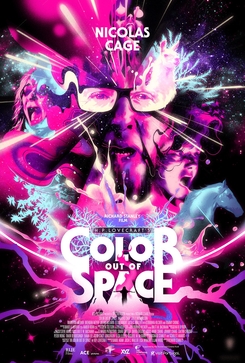
The Color Out of Space (2020)

Recently, thanks to Covid-19, a film was released digitally which would otherwise have been cruising for a decent premier as a very interesting horror film. That film is The Color Out of Space! I have been anticipating this movie for a while now, having been a fan of the original 1927 Lovecraft short story, I was looking forward to seeing a modern adaptation of it. It had some interesting promotional art, and most importantly, to me, one of the big names was going to be Nicholas Cage.


The original story is set in 1882, with the movie instead moving forward to the 21st century sometime in the 2010s in a small place in the sticks, just a while outside the town of Arkham. Normally I don't like this kind of setting change, but the film does it really well I think, and quite deftly neutralizes the problems of modern technology in horror movies besides.

We begin with some opening narration, quoted directly from the original short story. It then moves on to establish the Gardener family. Their daughter, Livinia (Madeleine Arthur) is out practicing spells in the woods when she is stumbled upon by hydrologist Ward Phillips (Elliot Knight) who is out testing the water table for a proposed reservoir. Then we get some establishing shots of the family, and the film actually spends a very good amount of time establishing why we should care about these people. Nathan Gardener (Nicholas Cage) has moved his family to the remote farm his father owned as a way to save costs after his wife Theresea's (Joey Richardson) bout with breast cancer. His two sons, elder Benny (Brenden Meyer) and youngest Jack (Julian Phillips) are typical adolescent and youthful males besides. Jack is always scared of something while Benny likes to smoke pot with the land's resident squatter Ezra (Tommy Chong) who lives in a remote 'off grid' cabin on the property.

It's a loving family which has its issues. Nathan has taken up alpaca farming because he believes it's the future while his wife is a remote worker who takes clients over the web. The physical and social distance puts strain on the family, a lack of reliable wifi and worries over their kids getting to school or medical care are all typical problems in the 21st century. It's all laid out well in the opening scenes and I really appreciated that the film took time to make me care about these people.

Then the comet hits and all hell breaks loose.

Seeing the titular crash landing from outer space was fun. It was done in a bit of a hokey way (an eerie purplish light filling the whole area but for some reason only one person looks at it) and a spectacularly creepy landing leading to more outlandish results. Little Jack finds a new imaginary friend and the crops start to taste weird, while time seems to flow...differently for the Gardeners. Things spiral steadily downhill from there as Phillips tests out the stuff he found in the meteor and comes to the conclusion there's something undeniably alien about it.

Visually, the movie is great at leaving you in suspense. There's no in your face examples of the color (beyond well, the color) and it builds suspense over the course of the film to some of it's more genuinely horrifying moments. People and animals beginning to change, and I found this approach to be very well done, with some similarities to The Thing which I found to be very well adapted. The steady descent into madness these circumstances bring is delightfully creepy as characters at first just try to adjust to weird, but not otherworldly, experiences. The actors brought out the Lovecraftian themes beautifully, with Nicholas Cage bringing his world class ham to the screen making his descent spectacularly terrifying! The man can still deliver!

Stand out performances do go to Madeleine Arthur and Elliot Knight for their roles. Arthur plays Livinia who is, after all, a teenager caught up in a horrible experience to a tee, and Knight plays the poor hydrologist sucked into an otherworldly circumstance very well. I really thought he was going to die halfway through the film! Their little subplot crush on each other makes for some cruelly tense moments later in the film, and I really felt for both of them as things spiraled out of control.

There were some excellent nods to Lovecraft in the film. From Livinia reaching for the Necronomicon in desperation as her world falls apart, to Ward being a graduate of Miskatonic University, the film made itself broad in appeal to the general public, but also having enough nods to keep Lovecraft fans enraptured by how well it did the original material.

Now there were some small errors I felt. There were a few character tics and subplots which were not well explored. The Garderner family is supposed to have some kind of feud with the mayor over their property and the construction of the resevoir, but nothing ever comes from that or is explained. Then there's something about the resevoir supposed to provide water to 'half the East Coast' which also drops with nary a whisper. Then the color itself is... well it's basically purple. I know we can't have an actual alien color within this medium and it works much better in your head, but having the color shift more would have been more visually appealing to me at least.

However, this is a genuinely thrilling horror film. If you know the original story you're in for some surprises, which is good. Then if you're used to regular horror films you're also going to be surprised for how well it handles older material and makes it accessible in the modern age. It is a movie I would definitely recommend watching and is sure to at least make you think twice about where your water comes from!

Monday, 29 April 2019

Black Summer

If you have ever watched the fun/gory Z-Nation on television on Netflix, you'll be pleasantly surprised that the same team behind that have gotten together to put on a great little miniseries in a zombie filled world. However, this time we have a series which is not only terrifying, but an amazing testament to the zombie genre as a whole.

This is the eight episode series Black Summer


Set six weeks into the ongoing zombie apocalypse, we follow a diverse cast of characters who are struggling to survive and find somewhere safe to run. We are first shown a trio of people on the run, waiting for the end of a bombing run in order to be evacuated to a safe zone. On the way, we see many other refugees on the run, and get introduced to a colorful and diverse cast of characters.

Things quickly go to hell though as we discover one of the trio has been bitten. The military immediately bugs out and drives off, leaving a mother and father suddenly without their child. From there, we play catch up as other characters moments intersect and converge, with many unintended consequences and struggles. But as a warning, don't get too attached to any of these characters, the show plays for keeps.

From the cowardly survivor Lance, mysterious Spears, to the non-English speaking Sun, we have a great little cast of characters who are unique and clever. Though having little or no background they aren't completely well rounded. They're acted amazingly though, putting you in their situation rather than their story.

They're not prepared for the apocalypse, at all, and it shows. Rarely are the zombies killed easily, and often they cause lots of trouble and only fail to kill people by their limited intelligence. That the world seems to be in its death throes doesn't help, as soldiers are overwhelmed and it seems all civil government has essentially broken down.

With its short run time, it's an easy binge. Though, with how scary some episodes are you may find yourself not wanting to binge watch!

Each scene is well shot, usually from a close angle which puts you right in the characters head space. We see their facial expressions, and can really feel the terror they are undergoing. The subtle use of music and ambient sounds makes you cringe. Something as simple as the background noise of an air conditioner really got my heart pounding at one point as I just expected a zombie to come running out at the characters on screen!

The conservation of detail too, with characters facing only one or two zombies at a time early on, made it really terrifying. Even one monster was too much to handle for most, and was a totally life threatening situation, even when a character was armed!

One particularly jarring episode takes place in a high school, and let me just say, if you think children are innocent, you may not think so after watching this! The use of little details to perturb, scare, and crank up your expectations really pays off at the end. It culminates in bits of creeping fear and a series of non stop chases which keep you guessing at who will live or die until the very end.

All in all, there isn't too much overarching story beyond a mother looking for her daughter during the apocalypse. That allows for some scant meaningful plot and leaves very little in the way of meaningful details to be examined as the story goes on. It's meant as a short piece which will tug at your brain and leave you wondering when the zombies will show up, or who is or isn't going to make it out.

As a brief horror mini series, I'd happily recommend it. It has all the right scares and all the right tension. Worth a watch.

Thursday, 17 January 2019

Retro Review: Rebecca (1940)

Recently I had the absolute pleasure to watch 1940's Rebecca directed by none other than that supreme suspense shooter, Alfred Hitchcock. As perhaps is no secret, I'm a huge fan of retro films, whether colored or black and white. Alfred Hitchcock of course, is a film giant who is well known for his mystery and suspense. The book which Rebecca is based on is - criminally I am told - unknown by the greater public nowadays. Penned in the 1930s and published in 1938 by Daphne du Maurier, it tells the tale of all the tragic goings on at Manderly, the ancestral home of the de Winter family.


That the book was an amazing success would be an understatement. Going from smash hit to box office in two years is pretty exceptional in this time period. What was also exceptional was that Alfred Hitchcock, who wanted to make the film more 'funny' was told no. One just didn't do that to Hitchcock! With that in mind however, Hitchcock still delivers his classic thriller drama and shows off some amazing camera work in this film! It won two Academy Awards, and in 2018 it was chosen for preservation in the United States National Film Registry by the Library of Congress as being "culturally, historically, or aesthetically significant."

Beginning in the South of France (as one does in the 1930s when dealing with the British upper crust) at Monte Carlo, we come across our nameless protagonist (Joan Fontaine) as she serves as a paid companion to the stuffy and overly chatty Edythe Van Hopper. One morning, while out for a stroll, she oversees a man she assumes is moments away from commit suicide, so she calls to him. The man, visibly annoyed, tells her to mind her own business, but does not jump.

She next encounters him with Edythe, and learns that he is in fact Maximilian de Winter (Laurence Oliviere) the heir of the great de Winter family. Our nameless protagonist is timid and used to being pushed around, and Max, as he likes to be called, is forceful in his ways. However, he takes her on a whirlwind romance and, unexpectedly, asks her to marry him.

From there, she is whisked away to the Manderly estate, the realm of the great de Winter family. There she is introduced to the eerie Mrs. Danvers, the matron of the household staff and begins to see that tragedy haunts the halls of Manderly. A specific specter lingers over her as well, that is the ghost of Maxim's former wife, the eponymous Rebecca.

The film does an excellent job of ratcheting up the tension from the opening shots, to the claustrophobic moments where we zoom in on a character's face to see their terror written plainly across it. The atmosphere and the acting is all geared towards making you fear for the poor nameless protagonist as she is thrust into a new world which is strange and alien to her, and one haunted by a vengeful dead woman.

Fontaine portrays her nervous and bewildered character well. She has nervous ticks, slouching and constantly rubbing her hands together when feeling stressed. Cringing away from others, but especially the terrifying Mrs. Danvers who proves to be her indomitable adversary.


Mrs. Danvers (played by Judith Anderson) becomes a horror in her own right. While outwardly severe and at least maintaining the facade of the new Mrs. de Winter being in charge, she bullies and cajoles Maxim's new wife and attempts to drive her away. She is fanatically loyal to her former employer, even after her death.

Rebecca is a phantom in this film. Having died one year before the events of the film we know her only by her reputation and the effect of even mentioning her to Maxim has. Her rooms in the West Wing are all off limits, and maintained by Danvers as a mausoleum to her deceased employer. Her grace, beauty, and effortless excellence is often commented upon in relation to our poor nameless protagonist.

Perhaps the best scene in the whole film is one where we are tracing Rebecca's last steps. Almost done entirely in narrative, with the rare presence of an actor, it uses the camera, props, and the rising and falling in the voice of Maxim to stage and follow the scene. In this scene, we get a sense of the never seen character, Rebecca. It is, put simply, a masterpiece of film. You are lead around and can practically picture the character there, even though you never once see her directly in the film. The narrative is so gripping and intense with revelation that you cannot look away.

Hitchcock of course, does an excellent job setting atmosphere with his work in the film. From creepy dissolves where Mrs. Danvers ghostly face fades menacingly into another object, to well cut footage of characters in states of shock, anxiety, or grief. With less camera angles than a modern director could manage without, he uses easy shots to capture your attention and fix you on specific points within range, all the points he wants you to see. His method of shooting the film "in camera" was designed to make the film one seamless production from start to finish. He rejected some of the more melodramatic suggestions of the producers and manages to create a grand spectacle of cinematography.

Of course, the film is not completely faithful to the novel. While there is heavy emphasis on the perfect nature of our ghostly Rebecca and the emphasis is on our nameless protagonist, each fall short of du Maurier's vision. Her work wanted to emphasize how different Rebecca was from the standard female protagonist (while also making her something of a victim) and using our nameless protagonist as a victim of her society, being dominated by her husband, who must have things just so. This sadly is not picked up on by most, and the protagonist becomes attached (perhaps from Stockholm Syndrome) to Maxim and hopelessly devoted to him.

Oliviere plays the forceful and haunted Maxim well. Blustering between goodnatured enthusiasm to temperamentally domineering, going into a frenzy when he is reminded in almost any way of the dead Rebecca. His brooding nature is revealed gradually throughout the film, but he is never anything but controlling in his mannerisms.

The supporting cast is well rounded, from Maxim's devoted servants and to his manager and friend Frank Crawley. They all bring their subtle and powerful moments to the story.

The score, while appropriate for a 1940s audience, will probably grate and frustrate a 21st century audience. Relying on string music to bring in the tension, it is appropriately discordant at times, while also seeming confusing and out of place at others. It was an issue in evolution and though I do understand how it is supposed to work, I find that my ears just don't like string music in supposedly comforting scenes vs tense ones.

Rebecca, though, is a great film if you're looking for something suspenseful and shocking. The twists are all amazing, and you will be on the edge of your seat as our poor nameless protagonist tries to unravel the mysteries of Manderly. Another retro film I encourage you to see.

Wednesday, 16 January 2019

Some Quick Streaming for January and February

Just in the last few days I've learned of some interesting series and films coming up. I'm hoping to share them with you so you too can enjoy what promises to be a fascinating few hours of Netflix and streaming.

Firstly, we have the History Channel. True to form, having moved on from history and WWII to aliens and conspiracies is broadcasting the historical drama Project Blue Book which will be a 10 episode series following Josef Allen Hynek who in real life was involved with the aforementioned Project Blue Book, one of several studies undertaken by the US to determine the existence of UFO's and whether or not they were real.

The subject of constant investigation and curiosity, it will I think, make for some interesting watching. Whether the History Channel will continue its proud tradition of mucking about with real history remains to be seen though. However, a perusal of the real Project Blue Book does make for some interesting reading all its own.

Secondly we have the Netflix film IO which premiers January 18th. Set on a post-apocalyptic Earth made toxic by global warming, humanity has largely evacuated their home world to colonize the Jovian System, specifically Io. Some however, have been left behind. We will be following the efforts of Sam (the daughter of scientist Henry Walden) and another survivor named Micah. They are hoping to make it to the last launch of a rocket leaving for Jupiter. The question is whether they can survive the toxic wasteland which used to be Earth to get there.

On January 25th we get the absolutely bonkers action flick (adopted from the graphic novel of the same name) Polar. A retired hitman, settling into a life in a remote Alaskan town, only for the assassin company he worked for to try and 'appropriate' his retirement policy by trying to kill him and kidnapping his one friend. He goes on a rip snorting bloody string of vengeance in a familiar trope, but one that looks like it will be simply epic.

In February we have two spooky ones coming out.

Firstly is one which I had the pleasure of seeing on Halloween a few years ago. Happy Death Day was Groundhog Day meets Scream, which was an admittedly amusing combination. Now we have a sequel just in time for Valentine's Day. Happy Death Day 2 U. With a similar premise, but now more people are effected by the Ground Hog Day like experience, and maybe this will try answering the weird issues which surround how it got started in the first place.

Though I'm not sure how I feel about this sequel, I'm very open to giving it a shot.

Secondly we have Velvet Buzzsaw which seems to be an intriguing look into the high art world through a horror lens. When an unknown artist is found dead, his works seem to come to life and exact grizzly revenge on those who used the art world for money. Starring Jake Gyllenhaal and other amazing people such as Renee Russo and John Malkovich, it looks like it will be an amazing romp through the high art world with some bloody massacres in between!

So there's some good entertainment, terrifying and action packed, coming up. Stay tuned for it!

Sunday, 14 October 2018

And Then There Were None

As it is Halloween, I've been pursuing some spooky reads in my spare time and just plowed through the delightfully suspenseful Agatha Christie novel, And Then There Were None. Originally published in 1939, it became Agatha Christie's most popular novel and one of the best selling novels of all time with over 100 million copies published.

The set up is deliciously simple. Ten strangers are invited to the mansion of an eccentric millionaire in August at some point in the 1930s. While they do not know each other, they have all been contacted by an acquaintance knowing details about their lives, little do they know that this is no ordinary acquaintance. The mansion, set on the foreboding and isolated Indian Island, is the most modern in Britain, with all the comforts of home one could ask for off the coast of Devon. As they arrive, queer things begin to take shape, as no one understands quite how they've all gotten there.

Quaint as the mansion is, they are all struck by the strangeness of their situation, with a mysterious poem involving Ten Little Indians enshrined above each of their beds. Soon however, they are all confronted with horrible secrets from their pasts, and it becomes clear everyone there is hiding something. Worst of all, one of them may be a killer.


Now obviously, I cannot tell much more without fear of spoilers, but I must say that the story is set up very compellingly. With all the dark secrets each character holds, and their unique traits and individual sins you have both a hard time sympathizing with them, but getting to know them you begin to hope they don't die. It's a clever and ghoulish idea when you get down to it.

Christie does a bang up job of capturing the isolation and desperation the characters feel as the dread inevitable begins to set in. They have no way off the island, no way to contact the outside world, and no idea who is stalking them in their tiny prison.

As well, the growing paranoia and desperation amongst the characters is fascinating to watch. Otherwise reasonable individuals become hysterical, and murmuring, plotting, and suspicion set in as it becomes clear no one can be trusted. Despite thin veneers of polite civility, as their numbers dwindle, those imprisoned on the island cannot help but turn on and to each other in hope of safety.

Exploring the increasingly desperate psyches of these guilty persons as they each end up coming out about their own pasts is fascinating. The struggle to survive and the hope of getting off the island will ensure that readers are sucked in and tear through this piece. It's a psychological thriller at its finest, and one which I would highly recommend to anyone who loves the genre.

The ending of course, has a fantastic twist, one which more astute readers may figure out early on. I can assure you though, you will find it very satisfying and spooky.

Though the original title Ten Little N---ers is deemed (correctly) far too offensive for today's market, it is apropos of the time period it was written, and anyone seeing copies with that title should't balk it just for that. In spite of that, the book has become Christie's best selling work and her most adapted, even above those of the venerable Hugo Poirot. With a genuinely unique mystery and setting that will strain the reader who attempts to figure it out, its no wonder it has sold so well for decades. The most modern adaption is the 2015 BBC version, which for those who haven't read the book and prefer to watch, I would recommend for its amazing cast and closeness to the original novel.

Until next time, be wary of accepting strange invitations to fantastic locations!

Tuesday, 25 June 2013

World War Z (Film)

Well readers here I am critiquing the most recent zombie film of the year. That film of course is the same-title-of-the-book-but-different film called World War Z.

Now as some of you (but hopefully most) may know this movie is based of a book of the same name by author Max Brooks (and yes he is related to that other Brooks) and is a continuation of the mythos set up in the Zombie Survival Guide he wrote some years previously. The film however, is an in-name-only adaptation with the sense that the is a world wide zombie apocalypse going on.

A while ago I saw the first trailer and upon realising it wouldn't be a movie version of the book decided I would cease to put it past Brad Pitt and give the movie a second chance in my mind. I realised that the film would be a mythos unto-itself and felt that instead of criticizing the film for not being enough like the book I would decide to let bygones by bygones and watch it and enjoy it for what it is.

Though what is this film you ask? Well read on and find out!


First off though let me set down two of the films largest pre-showing failures. The first is that in a very controversial move for a zombie film it only has a rating of 14A which is well below the R rating most zombie films get. This of course removes any gore factor the movie could have provided and stops the idea of zombies eating people from being an issue on screen. These two things are bad in and of themselves as it removes the gore/cannibalism factor that is mostly essential to the zombie genre. The second is that the film right off the bat bills itself as more of another over the top action film which looks incredibly cheesy to say the least.

Now the film itself is something that opens up on a rather confusing note playing some very interesting music over a number of strangely irrelevent images of nature and humanity (some showing animals being eaten) but tells us nothing about the plot or where we will be seeing the story set. We then get a cut to a scene of Gerry Lane's (Brad Pitt) children jumping on him to wake him up. Then a thinly done spread of news reports referencing a very vague blink-and-you-miss-it rabies outbreak and the implimentation of martial law...somewhere? I really can't remember. We then cut to downtown Philiadelphia where Lane is stuck in traffic. His mirror is smashed off by a speeding police car and then another police officer is killed when a garbage truck driven by either a man who is turning or being attacked (you can't tell) is smashing through traffic.

Then zombies show up. And by show up I mean some people who you can barely differentiate from the running masses of people around them start attacking people. Due to the restrictions on footage of people being eaten we see the zombies bite people then run off to bite more people. In a 28 Days Later style fast turn the people die and reanimate into zombies (this using the loosest sense of the word) in seconds. They then turn into an unidentifiable mass of running people who tackle others so it is essentially impossible to tell attacking zombies from fleeing people.

The first ten minutes and already the film is looking like a disaster! You can't tell the zombies from their victims and you don't even understand where they came from! This could have been fixed with the whole walking zombie thing. They could be blood soaked shamblers wandering into the crowd and grabbing people forcing them down making for a confusing panic as people run away. That's a big detractor.

Next we amble on into some looting territory as Brad Pitt struggles to get supplies to his family and a UN administrator (Fana Mokoena) agrees to help him get out of dodge on a helicopter. He then stumbles upon a Spanish family who lets them hide in their apartment for the night. The next morning the family escapes and shows an astounding degree of common sense by improvising a bayonet for Pitt's rifle, tying ropes around their wastes to prevent them from getting lost, and having noise discipline. (All pretty survivalist if you ask me). This then leads to a truly great scene where they have to shuffle back and forth from hallways in a dimly lit building and make their way to the roof.

I will admit that even though I knew what was going to happen I was legitimately stressed out and sucked in. To that I give the director props since this will later be a staple of the movie. The scene was done well and you actually felt a sense of dread as the characters stumbled around not 100% sure of their destination. Accompanied by crazy music and wonderful direction this is probably one of the best scenes in the movie, next to the ending of course.

The stressful scenes, great lighting and actor coordination (though not acting) are probably the high points of this film with one scene being masterfully coordinated in each section, from the overrun US base in Korea to the rapid run through Israel, and the well done finale in the WHO research center in Wales. Each scene is a pump action thrill ride as you are kept guessing at which secondary characters will survive (since obviously Pitt can't die) and just how close Pitt will come to serious mutilation. Sadly the zombie killing is either kept to a minimum or is masked by dim lighting and good camera work or cut away shots.

Truth be told I am rather impressed the film manages to make it still feel stressful or the zombies seem scary without the gore and guts.

Though let's take a break to talk about the zombies for a moment. As stated earlier, in the beggining of the film you can hardly tell an attacking zombie from a running human, that isn't helped as time goes on. Sure they start to look more bestial and kinda sickly, but for all intents and purposes they are lame and don't fit the zombie mould other than a few hamfisted attempts at scary makeup.

I guess it could be a zombie, or a really angry hobo.


In the movie they emit cries similar to the necromorphs in Dead Space which while when you can't see them it's scary but when you can its underwhelming. They run, which as zombies go is a problem that deserves a whole other article to express, and they seem to be able to return from the dead in seconds. This isn't the only way they flout science! No they act like African Driver Ants and come in swarms which are able to clog entire streets, or in one infamous instance, form a less that human semi-pyriamid and scale a hundred foot wall...somehow.

Pictured: Zombies...I guess...


Let me now address the two worst sequences in the film. The first is a sequence which takes place in Israel and is basically ripped off part and parcel from the book with the character of Jurgen Warmbrumm and his entire speech ripped straight from the novel along with the whole giant wall section. This feels out of place and shoehorned in since unlike the rest of the film is has something to do with the novel. It was rather annoying to watch since it seemed to contribute nothing to the film (other than adding the character Segen and getting Israel eaten as the zombies come in) other than showing so much changed between even the trailer and the film itself with dialogue going from 'Russia is a black hole' from the trailer to 'India is a black hole' in the film (making an even larger change to seem that unlike in the book the outbreak starts in India, which shows that Hollywood is probably more sensitive about upsetting China and Russia than India).

The Israel sequence is doubly bad since the zombies impossibly scaling the wall is more irritating because the reason they eventually decide to scale it is ridiculous! The film establishes the zombies are attracted to sound, and yet the wall around Israel (not to mention the copious ammounts of traffic coming in) must be carrying sound for miles. Yet when people start singing on a loudspeaker that is when the zombies decide to scale it. It seems to have been added in for no other reason that to give us another thrill sequence, which I didn't enjoy as much mostly for the stupidity of it.

The second worst sequence is the plane incident where the zombies basically crash a plane after one infected soul gets inside and tears shit up. It speaks for itself how bad it is since I decided that it was so boring I could take a bathroom break and I was assured I missed nothing. The ending was basically just any other movie crash.

Then we have the contrived plot twist at the end which saves humanity. After that is some awesome sequences of people running from zombies. If the movie had been like that I would have loved the whole thing! However the amazing stresser sequences still worked perfectly well for my taste and made something that would have otherwise been unbearable, bearable.

Though let's face facts however, this is not a zombie movie. This is a movie where we see Brad Pitt go from one scene to another and run from faux zombies who you never really see. Sure there are some tense and fun moments, and you can get swept up in the excitement of certain scenes, but this isn't really a good movie and there are no characters other than Pitt's who stick out.

For characters there are his bland and mostly annoying family members, a young premier scientist who promptly dies, a semi-useless UN big shot, and a colorful cast of extras who don't do much with Pitt's character leading the way to victory each time. So yeah there never is any doubt that Pitt is the most important person in the world, and we never get to see anyone else do anything amazing save for screw up and leave Brad to save the day.

My final thoughts on the film are that it's ok. It's not great, not terrible, but not to good either. It has its moments, some fun action scenes, and a number of fun bits that can be interesting to watch. Hell I might even see it again when it's out of theatres. If a friend buys it.

Sadly it's not what World War Z could (or should) have been. We don't get the good zombie drama we should have, and we certainly don't get the world destroying apocalypse we were promised. Instead we see Brad Pitt running from place to place never doing anything.

Instead of this:

We get this:

For two hours.


In the end though we just have to remember this film is possibly going to have sequels, and that is the real apocalypse.

2 stars out of 5, and that's being generous.