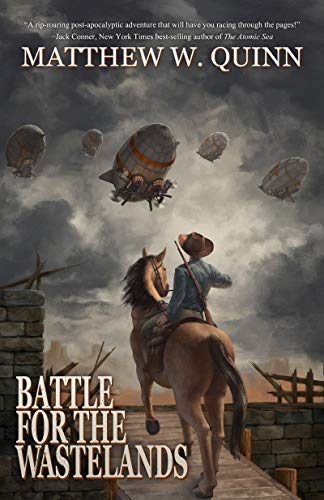
Recently I got to read a book I have wanted to read for a long time. Fellow blogger and writer Matthew Quinn had talked about his full length novel Battle for the Wastelands for many years. After a long process of submissions, Mr. Quinn finally went the self publishing route and made his novel available to the public! Here's my full review of Battle.
Set in an indeterminate period after a post apocalyptic event, we find our protagonist Andrew Sutter, traversing the wastes along the Iron Desert within the fertile Basin. His home. Carroll Town, is ruled over by the despotic and terrifying Flesh Eating Legion under the command of rebel turned warlord Jasper Clark. With a terrible drought afflicting them, a heavy tribute is demanded, sparking a minor rebellion and when Andrew takes up arms, he finds he might not know what true battle holds.
Meanwhile, the ruthless warlord Grendel, first lord of the Northlands, is struggling to hold his fledgling empire together. Though he has largely crushed all his foes, his underlings are now clashing with one another. It threatens to split his tenuous hold on the Basin lands into splinters and destroy everything he has built. Within his new realm he has friends and enemies. One being his concubine and former woman of the ruling Merrill family, Catalina, who seeks a way to plot against him. The other is Alonzo Merrill, leader of a ragtag rebel army opposing Grendel and his cronies, but fighting a losing war along the Southern Wall, a series of fortifications designed to drive the remainder into the desert.
Can the rebels manage to beat the first lord of the Northlands? Or will they be swallowed up by the progress of empire?
I definitely found that the novel was fast paced, which was good for the amount of information you receive when reading it. It starts off with a brief introduction into the Iron Desert and Caroll Town, but then its hard fighting and lots of dying!
Andrew is, without a doubt, our main viewpoint character. He is the audience surrogate seeing the issues of the world at large. Young, headstrong, and very unsure of himself he finds himself thrust into a war he barely understands until it gets personal. Seeing the despotism of Grendel's empire up close, he throws himself whole heart into fighting it.
While I enjoyed Andrew, I actually don't think he was the most interesting character in the book. His young naivety and limited scope for viewing the problems in the Basin as a whole, made him have only a one track mind. That is, the specific struggle against the Flesh Eating Legion under Jasper Clark. This was an engaging story, with a great cast of supporting characters (who had a terrifying life expectancy) that kept me hooked.
Many of Andrew's scenes were where the action in the story shone through, and it starts off bloody. It then gets up close and personal. Largely, this is where the meat of the story excels, with it being well described and satisfyingly bloody. From knife to bayonet wounds, to the after effect of mortar bombardments, you aren't left in the dark about the horrors of combat. Though after a point, some of the description did feel perfunctory, especially in the first third where it didn't come off as quite as strong.
The use of old vs. new style weapons was pretty clever. The dirigibles flying around give any enemy a massive advantage in both scouting and firepower, but there are ways to defeat this. The most obvious course is to have a dirigible of your own, but there are other ways. I think one of my favorite visuals from the book is when Andrew and other Merrill troops are waiting behind a rise in a hill, all rifles aimed skyward with a 'balloon popper' cannon to try and blow a patrolling dirigible out of the sky if it spots them. Coupled with the rarity of Old World weapons (automatic rifles and machine guns) you get some pretty awesome steampunk action with bolt action rifles going against SAW weapons on occasion and all the imbalances that creates.
Perhaps the most interesting aspect though, is the politicking in the villain camp. While the good guys are (largely) united in purpose, the bad guys are quickly devolving into fighting amongst themselves. Grendel is after all, a warlord, and the people he works with or conquered were also warlords. And much of Grendel's time is now spent dealing with his uppity subordinates.
In the neo-fuedal future setting of the world, this works quite well. This is why I really appreciated Grendel as a character. All of Grendel's scenes are deliciously Machiavellian as we see the tyrant plotting and outsmarting opponents while trying to crack the problem of how to pass on his empire to his heirs. His son Falki (who will be starring in an upcoming novella) is something of a pain in the ass for the tyrant. Though Falki is clever in his own right, he is still a boy used to immature outbursts and doesn't quite understand the fine art of terror and politics the way Grendel does. The two competing view points between the two makes for some nice tension in Grendel's plot, and it makes me look forward to how they will play out in the future.
Grendel of course, keeps a bevy of concubines, and they too have their own politics. Trying to get their sons higher in the line of succession, and in Catalina's case, trying to get him to remember his Merrill heritage rather than the role Grendel is trying to set for him. Of course, Grendel is not entirely blind to that either. Catalina will hopefully be a major character in the future, and I look forward to seeing her use her position to her advantage as well as she possibly can.
In these scenes we also get useful world building. We learn how Grendel runs his empire, the various (and myriad) factions he employs, and even delightful little details like union/guild systems which can do things like go on strike! It makes for some fascinating interplay, and at the end of the novel seems to be setting the scene for intrigues and struggles for the good guys! I really look forward to seeing more of that in the future.
The one place where I think the world building did not shine though was establishing the overall setting. I had actually believed this was a future Earth, and while I couldn't match the geography in my head, things began to break apart as I read more. The exact nature of the Old World is left mysterious, and with little tell for how it fell apart or what technology was left behind. Much of this was based off of the world 'moving on' in the Dark Tower series, but I think that more explicit calling to the different nature of this world and then a smidge more info or theories about the Old World would have helped ground the setting.
Enjoyable little nods to the Old World abounded, one scene where Andrew is wandering through the Iron Desert and finds the remains of an abandoned house was a fun aside. The weapons and their rarity/effectiveness was a fun jump in any action scene. I did find myself hoping that other Old World tech which wasn't just weapons would come around, and maybe that will be a future plot point. Fingers crossed.
If I had to make one criticism of the novel, it was that I found the first act to not be as strong as it might have been. Andrew's early arc is well established, but we wait a while for anything to come involving Grendel or the Flesh Eating Legion (which itself could probably have been fleshed out more too) and their overall place in this world. Once we get past the initial Caroll Town arc though, the story picks up, snagging your attention and never letting go. The second and third acts I breezed through as I had time.
As a story though, it makes a valid argument for steampunk not being dead or unusable as a genre. Dirigibles, trains, telegraphs and machine guns are all intelligently and compellingly used. The Western look and feel is never wasted, and the clever plots and compelling characters are well put together. If you're looking for some great action and a really, really fascinating villain, I cannot recommend Battle for the Wastelands enough. And with a novella coming out in the near future, you won't be waiting for more from this fascinating world! Check it out!
The internet lair of Matthew Stienberg. A blog where my thoughts, ideas and writings can be seen!
Tuesday, 28 January 2020
Friday, 17 January 2020
Ottawa Underground Legend
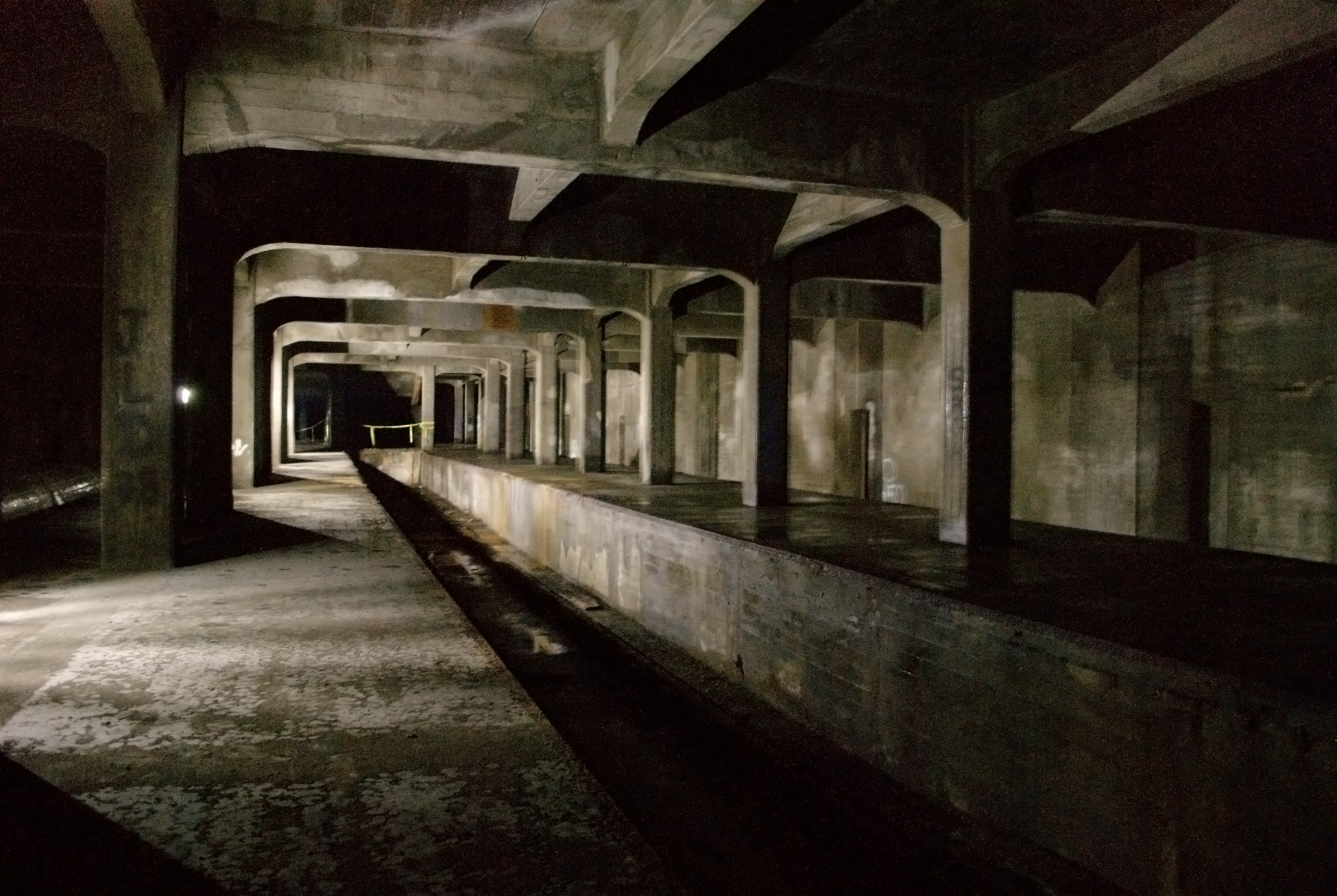
Some urban legends have more truth to them than we think. My own city, I discovered recently, has a few as well. Way back in 2012, there were reports of an abandoned rail tunnel, complete with train, compiled by an enterprising journalist of the Ottawa Citizen. He looked into rumors that someone had found an entire train just abandoned beneath the earth. So he went digging.
Bar side tales told that there was an abandoned train tunnel in the depths of Ottawa. Perhaps from an original attempt to get the city an underground rail system for its street cars, or maybe it was from an old brewery. For the latter, it was out of use since 1967, and no one had seen it since.
That was, potentially, until 2015 when some workers literally fell through the floor into the old tunnel. Needless to say, they were quite surprised and no one could figure out why it had been hidden. Mapping it out on old municipal maps, the rail line was discovered to extend perhaps as far as Carp and Rockland either way.
Now, its not clear from this latter article whether the tunnel in question refers to the conclusions of the 2012 Citizen article that the 'abandoned subway' is a part of the old brewery tunnel, or whether this is a completely different small rail system. There has been precious little follow up journalism on the subject, and it seems that it may well fall into the topic of urban folklore once more.
However, the fact that one has just happened to turn up is both fascinating and perhaps a little alarming. It should make us pause at just how many secrets cities, even small ones of only over a million, can hold after so many years. What else could be lying just beneath our feet?
A special shout out to Voices in the Attic for originally sharing and bringing this to my attention. They've got a great spooky Twitter feed to follow too. Definitely check these guys out!
Tuesday, 14 January 2020
Leviathan Wakes
So, we come to the first book of the 2020 re-read. I originally read this novel in the span of three days while I was in Australia after my brother recommended it to me. I was a bit skeptical, but I picked it up and I literally couldn't put it down. I don't think a book has ever had me going "holy crap" as I finished chapter after chapter of the book as much as this one did.
That book, was Leviathan Wakes.
The premier novel in the Expanse series was actually written by two authors under the pen name James S. A. Corey, the pen names for Daniel Abraham and Ty Franck. The work originally began as a setting for a large role playing game, but author Abraham said "People who write books don't do this much research," and so the genesis for this now eight book series was born.
It is set centuries in the future, roughly in 2350. Earth supports a large and bloated population of 30 billion. Mars is Earth's wayward daughter colony and eternal terraforming project, or one giant science experiment. Meanwhile on the lesser asteroids and planetary bodies, Ceres, Ganymede, Eros and hundreds or thousands of smaller asteroids and stations, the people of the Belt struggle to survive in the most hostile environment known to man. But into all this, a massive spanner is thrown into the works by a man named James Holden.
Minor spoilers follow this point.
The story is told through two viewpoint characters, the first being the XO on an old icehauler the Canterbury after being drummed out of the navy. Righteous and sure of humanities good side, he has a dangerous habit of speaking his mind too freely. Secondly is a native "Belter" and detective Josephus "Joe" Miller who works the beat on Ceres for the resident police force Star Helix Security. Cynical, jaded, and something of an alcoholic, he works to keep people breathing and enforce the laws on the Belt's busiest port when he gets a strange case on his desk.
With two characters who have such diametrically opposed views of humanity, it is fascinating to see them put in similar situations time and time again, while also overcoming amazingly Herculean odds to accomplish their goals. The two are perfect foils for one another, and I don't think I've encountered a duo like them for a while.
They fit organically in the established setting described above. It is a world rich with political tension, inequality and for the reader, utter wonder at how far it seems mankind has come in colonizing the Solar System. However, as they show, this isn't without cost as the Inner Planets (Earth and Mars) squat on the neck of the Belt (the various moons and asteroids) giving them no representation of their own. Instead a myriad of resistor groups has formed the OPA (Outer Planets Alliance), terrorists, pirates or freedom fighters and a government all their own, depending on who you ask.
Into this ugly mix is the destruction of Holden's ship the Canterbury, with only a small batch of surviving crew members, Naomi Nagata, Alex Kamal, Amos Burton and Shed Garvey, surviving as they were on a shuttle at the time (these secondary characters also helps round out the story as well) This one act kicks off a round of violence solar system wide, and poor Detective Miller gets stuck in the middle of it on Ceres with his Earther partner Dmitri Havelock.
Each chapter in the story ups the stakes further and further, ratcheting the tension higher in each chapter. Even the few precious scenes where the characters feel slightly safe are few and far between as they end up thrust from one system spanning disaster to another. Like I said, I was almost invariably saying "holy crap" as each one ended since things seemed like they couldn't get worse.
The interplay of themes like government, representation, freedom of information, revenge, coupled with Holden's quintessentially optimistic view of humanity versus Miller's pessimistic view of it presents a nice play by play between the chapters. With Miller at first analyzing Holden through various lenses as either an insane optimist or eventually or as a righteous man with a big mouth. When the two do finally meet face to face it makes their interactions just that much more interesting!
In terms of science fiction the authors have intentionally gone for 'Wikipedia level plausibility' being that the technology and ideas you see in the series are not so far-fetched that they distract you from the story while also being real enough they can work plot points out through contemporary understandings of science and physics. I appreciated that as it let me have a base understanding of the setting, as well as seeing what technically worked and guessing at how some events might play out. I ended up being pleasantly surprised more often than not.
This also shines into the action of the series. With ship to ship combat having to take into account things like high gee maneuvering, which could accidentally crush the human body. Dodging around point defense cannon shots, torpedoes and railgun rounds is serious business, but the forces involved are similar to those put on modern fighter pilots. Power armor also makes an appearance as the modern militaries want their soldiers to survive in the airless radiation of space. That makes gunfights even more interesting! Though old fashioned gunslinging is the norm for this first installment.
Quite honestly the interplay between characters and ideas, and the massive solar system spanning implications of the meta plot kept me hooked to the point I was just unable to set the book aside either the first or the second time. Even with a second, perhaps more jaded, read through I really can't say I find anything wrong with the book. It comes together on numerous levels, the story rising and falling, giving you time to breath and then whipping you forwards on a break neck pace. It just works in all the right places I think.
I'm glad that I started the year with this book, as it is definitely one of the best science fiction books I have ever read. It will forever stand out in my imagination as a book which has set the standard for stellar science fiction!
That book, was Leviathan Wakes.
From wikimedia commons
The premier novel in the Expanse series was actually written by two authors under the pen name James S. A. Corey, the pen names for Daniel Abraham and Ty Franck. The work originally began as a setting for a large role playing game, but author Abraham said "People who write books don't do this much research," and so the genesis for this now eight book series was born.
It is set centuries in the future, roughly in 2350. Earth supports a large and bloated population of 30 billion. Mars is Earth's wayward daughter colony and eternal terraforming project, or one giant science experiment. Meanwhile on the lesser asteroids and planetary bodies, Ceres, Ganymede, Eros and hundreds or thousands of smaller asteroids and stations, the people of the Belt struggle to survive in the most hostile environment known to man. But into all this, a massive spanner is thrown into the works by a man named James Holden.
Minor spoilers follow this point.
The story is told through two viewpoint characters, the first being the XO on an old icehauler the Canterbury after being drummed out of the navy. Righteous and sure of humanities good side, he has a dangerous habit of speaking his mind too freely. Secondly is a native "Belter" and detective Josephus "Joe" Miller who works the beat on Ceres for the resident police force Star Helix Security. Cynical, jaded, and something of an alcoholic, he works to keep people breathing and enforce the laws on the Belt's busiest port when he gets a strange case on his desk.
With two characters who have such diametrically opposed views of humanity, it is fascinating to see them put in similar situations time and time again, while also overcoming amazingly Herculean odds to accomplish their goals. The two are perfect foils for one another, and I don't think I've encountered a duo like them for a while.
They fit organically in the established setting described above. It is a world rich with political tension, inequality and for the reader, utter wonder at how far it seems mankind has come in colonizing the Solar System. However, as they show, this isn't without cost as the Inner Planets (Earth and Mars) squat on the neck of the Belt (the various moons and asteroids) giving them no representation of their own. Instead a myriad of resistor groups has formed the OPA (Outer Planets Alliance), terrorists, pirates or freedom fighters and a government all their own, depending on who you ask.
Into this ugly mix is the destruction of Holden's ship the Canterbury, with only a small batch of surviving crew members, Naomi Nagata, Alex Kamal, Amos Burton and Shed Garvey, surviving as they were on a shuttle at the time (these secondary characters also helps round out the story as well) This one act kicks off a round of violence solar system wide, and poor Detective Miller gets stuck in the middle of it on Ceres with his Earther partner Dmitri Havelock.
Each chapter in the story ups the stakes further and further, ratcheting the tension higher in each chapter. Even the few precious scenes where the characters feel slightly safe are few and far between as they end up thrust from one system spanning disaster to another. Like I said, I was almost invariably saying "holy crap" as each one ended since things seemed like they couldn't get worse.
The interplay of themes like government, representation, freedom of information, revenge, coupled with Holden's quintessentially optimistic view of humanity versus Miller's pessimistic view of it presents a nice play by play between the chapters. With Miller at first analyzing Holden through various lenses as either an insane optimist or eventually or as a righteous man with a big mouth. When the two do finally meet face to face it makes their interactions just that much more interesting!
In terms of science fiction the authors have intentionally gone for 'Wikipedia level plausibility' being that the technology and ideas you see in the series are not so far-fetched that they distract you from the story while also being real enough they can work plot points out through contemporary understandings of science and physics. I appreciated that as it let me have a base understanding of the setting, as well as seeing what technically worked and guessing at how some events might play out. I ended up being pleasantly surprised more often than not.
This also shines into the action of the series. With ship to ship combat having to take into account things like high gee maneuvering, which could accidentally crush the human body. Dodging around point defense cannon shots, torpedoes and railgun rounds is serious business, but the forces involved are similar to those put on modern fighter pilots. Power armor also makes an appearance as the modern militaries want their soldiers to survive in the airless radiation of space. That makes gunfights even more interesting! Though old fashioned gunslinging is the norm for this first installment.
Quite honestly the interplay between characters and ideas, and the massive solar system spanning implications of the meta plot kept me hooked to the point I was just unable to set the book aside either the first or the second time. Even with a second, perhaps more jaded, read through I really can't say I find anything wrong with the book. It comes together on numerous levels, the story rising and falling, giving you time to breath and then whipping you forwards on a break neck pace. It just works in all the right places I think.
I'm glad that I started the year with this book, as it is definitely one of the best science fiction books I have ever read. It will forever stand out in my imagination as a book which has set the standard for stellar science fiction!
Friday, 10 January 2020
Aurora
My first review of 2020 is not on any of the books from my big re-read. It is instead one I began in 2019 but just finished now in early 2020. That book is another of Kim Stanley Robinson's, but on a different track. Here we follow people travelling across the interstellar void between the stars in a generation ship. They travel towards Tau Ceti, and aim to establish a new colony for mankind.
This story is Aurora. Published in 2015, it is a great take on the idea of a settler society sent out to colonize the stars on behalf of those from Earth and it tries to examine the plausibility and morality of such an action as well as setting out the plausibility of a functional generation ship.
Does it tell a good story and bring mankind to faraway places? Read on and find out!
Now, I'm very interested in the concept of a generation ship, how it could be made to work, and how it could even stick on its original mission. I've been fascinated by the idea ever since I saw the show "Ascension" which deals with an interesting take on the idea. By its nature, Aurora appealed to me. An examination of a society which has grown up over a century on what amounts to an artificial floating environment in the depths of - for lack of a better term - a void is fascinating. I really do believe that the novel captures the challenges and problems in keeping such a society going quite well.
The unnamed ship is divided into two rotating rings (A and B) and each contains a number of biomes. These biomes have been designed to carry a minimum human population while supporting the maximum amount of biodiversity possible in a 2 by 4 kilometer space which can bring as much of Earth to their potential new home world around Tau Ceti as is practical while keeping up a good chunk of biodiversity to support the various ecosystems.
Our main protagonist is the daughter of the de-facto chief engineer of the ship Devi. The girl, Freya, is out main view point character besides the Ship itself. The ship is a sophisticated AI based on a quantum computer system. Even this AI (Ship) does not really know if it is self conscious or not, which forms a running background to the narrative which is rather fascinating to watch unfold as the plot goes on. Say one thing for Robinson, but he writes a damn fine speculative AI.
The plot follows Freya from her childhood in the biome of Nova Scotia to her eventual rise to the position her mother held and the leadership role that plays.
Though this is ostensibly a story about colonization of another planet, it deals far more with the ethics of a generation ship (even if the original crew were willing volunteers, is it just that their descendants must carry out their mission?) and the sustainability of such an endeavor. Over a century into the journey, the systems seem to be breaking down. There is legitimate fear that the people on the ship are de-evolving or undergoing serious genetic strain. Poor Freya is seen by her mother Devi as 'slow' in comparison to her forebears.
With space and carrying capacity on the ship limited, the population is capped at just over 2,100 people. This in and of itself is a cause of consternation and concern for many as they will be legitimately unable to start families or have children. It has led to problems in the past, and some even try to cheat the system - with occasionally fatal results, as in the case of the parentage of one character Jochi.
These struggles are all highlighted against the uncertainty of what their arrival in the Tau Ceti system will bring, and whether they will even be able to terraform the planet upon their arrival. The looming question of whether it will all be worth it hangs over them as it is a certainty that Freya's generation will be the ones who set foot on their potential new home world.
Despite this, only some of the novel is given over to discussing the issues of terraforming or interstellar colonization and much more is focused on the issues of keeping the ship viable, how such a society can function in the face of a complex and multi-generation mission and the ethics of such a plan originally.
In typical style, none of the characters we see are particularly deep, and much more time is devoted to the systems and problems facing the generation ship and the Ship itself in a slow evolution from an advanced quantum computer to a potentially self aware machine, even if Ship itself doubts the whole truth of this assertion.
The considerations of how exactly one would go about manning and sending off a generation ship, and how to keep it running are all very well explored. The potential pitfalls, the biological and potential generation problems are also examined in often grim detail. Even things such as missing enough of a noble gas like bromine for completeness sake is looked at! Would these small biomes be able to get away from the problems of a limited biosphere and small gene pool? Would humans be able to develop well on what is essentially a small island? We have some exciting rides and questions to keep us going to the end.
However, the ending ultimately fizzles out in comparison to the action of the second and early third acts in the story. Their are high stakes, but the issues, fates and even original ideas which launched the whole plot centuries in the past are not really explored, and we ultimately end up on a confusing series of incomplete feeling epilogues rather than a concrete ending for any of our characters.
While an exciting novel for its content, it does almost end up being a polemic against its very premise. There will be no spoilers in this review, as I would encourage people to look to the book to understand its arguments. I would recommend it to anyone keen to look at an interesting story of the ethics and logistics of a generation ship. Despite a strong opening, it doesn't quite stick the landing.
This story is Aurora. Published in 2015, it is a great take on the idea of a settler society sent out to colonize the stars on behalf of those from Earth and it tries to examine the plausibility and morality of such an action as well as setting out the plausibility of a functional generation ship.
Does it tell a good story and bring mankind to faraway places? Read on and find out!
Now, I'm very interested in the concept of a generation ship, how it could be made to work, and how it could even stick on its original mission. I've been fascinated by the idea ever since I saw the show "Ascension" which deals with an interesting take on the idea. By its nature, Aurora appealed to me. An examination of a society which has grown up over a century on what amounts to an artificial floating environment in the depths of - for lack of a better term - a void is fascinating. I really do believe that the novel captures the challenges and problems in keeping such a society going quite well.
The unnamed ship is divided into two rotating rings (A and B) and each contains a number of biomes. These biomes have been designed to carry a minimum human population while supporting the maximum amount of biodiversity possible in a 2 by 4 kilometer space which can bring as much of Earth to their potential new home world around Tau Ceti as is practical while keeping up a good chunk of biodiversity to support the various ecosystems.
Our main protagonist is the daughter of the de-facto chief engineer of the ship Devi. The girl, Freya, is out main view point character besides the Ship itself. The ship is a sophisticated AI based on a quantum computer system. Even this AI (Ship) does not really know if it is self conscious or not, which forms a running background to the narrative which is rather fascinating to watch unfold as the plot goes on. Say one thing for Robinson, but he writes a damn fine speculative AI.
The plot follows Freya from her childhood in the biome of Nova Scotia to her eventual rise to the position her mother held and the leadership role that plays.
Though this is ostensibly a story about colonization of another planet, it deals far more with the ethics of a generation ship (even if the original crew were willing volunteers, is it just that their descendants must carry out their mission?) and the sustainability of such an endeavor. Over a century into the journey, the systems seem to be breaking down. There is legitimate fear that the people on the ship are de-evolving or undergoing serious genetic strain. Poor Freya is seen by her mother Devi as 'slow' in comparison to her forebears.
With space and carrying capacity on the ship limited, the population is capped at just over 2,100 people. This in and of itself is a cause of consternation and concern for many as they will be legitimately unable to start families or have children. It has led to problems in the past, and some even try to cheat the system - with occasionally fatal results, as in the case of the parentage of one character Jochi.
These struggles are all highlighted against the uncertainty of what their arrival in the Tau Ceti system will bring, and whether they will even be able to terraform the planet upon their arrival. The looming question of whether it will all be worth it hangs over them as it is a certainty that Freya's generation will be the ones who set foot on their potential new home world.
Despite this, only some of the novel is given over to discussing the issues of terraforming or interstellar colonization and much more is focused on the issues of keeping the ship viable, how such a society can function in the face of a complex and multi-generation mission and the ethics of such a plan originally.
In typical style, none of the characters we see are particularly deep, and much more time is devoted to the systems and problems facing the generation ship and the Ship itself in a slow evolution from an advanced quantum computer to a potentially self aware machine, even if Ship itself doubts the whole truth of this assertion.
The considerations of how exactly one would go about manning and sending off a generation ship, and how to keep it running are all very well explored. The potential pitfalls, the biological and potential generation problems are also examined in often grim detail. Even things such as missing enough of a noble gas like bromine for completeness sake is looked at! Would these small biomes be able to get away from the problems of a limited biosphere and small gene pool? Would humans be able to develop well on what is essentially a small island? We have some exciting rides and questions to keep us going to the end.
However, the ending ultimately fizzles out in comparison to the action of the second and early third acts in the story. Their are high stakes, but the issues, fates and even original ideas which launched the whole plot centuries in the past are not really explored, and we ultimately end up on a confusing series of incomplete feeling epilogues rather than a concrete ending for any of our characters.
While an exciting novel for its content, it does almost end up being a polemic against its very premise. There will be no spoilers in this review, as I would encourage people to look to the book to understand its arguments. I would recommend it to anyone keen to look at an interesting story of the ethics and logistics of a generation ship. Despite a strong opening, it doesn't quite stick the landing.
Saturday, 28 December 2019
The Great 2020 Re-Read
Over the years I have compiled a not insubstantial library. There are over 200 books presently in my collection, and two thirds of those are science fiction, fantasy and historical fiction, a fraction mystery, and about a quarter are history books covering everything from the Crusades to a two part biography of John A. Macdonald, evened out by a smattering of poetry and philosophy books.
While most of my non-fiction books serve as reference books, occasional re-reading and useful guides, I have read many of the books in my library at least twice over the years, but not all of them. However, with so many books to go through I have decided I will probably be downsizing in 2020. To do that though, I have to reread a significant amount/decide how to dispose of them.
But I would be lying if I said this great re-read was really about downsizing.
In reality, much of this re-read is going to be going through series I love once again and enjoying them. It will be a huge roll down memory lane, looking to jump back into fandoms and various authors worlds. It is going to be probably my most ambitious reading project ever undertaken.
Now while I tell myself this will mean I won't buy any new books in 2020, I'm well aware that would make me a huge liar. But, the biggest focus for this coming year is going to be on re-reading some series I haven't picked up in earnest in a while. Allow me to give you a small sampling of the reading goals for 2020:
Finishing a re-read of the Wheel of Time series. This has actually been in the works since 2016, but with so many other books and some limitations on my reading time, I have worked hard to pack it in. As of 2019 I am nine books in, having finished Winter's Heart most recently. The goal is to reach the 14th book again by the end of 2020.
Revisiting the First Law universe. I originally read these books way back in, I think, 2014. I devoured them all in about a month, and only finished all the outrigger novels (not counting short stories) last year. I have started what promises to be an exciting new trilogy, and a going back means I will probably be able to refresh my memory on a lot of things from that series.
A Song of Ice and Fire is a world I have not revisited since 2015. I will be, starting in January 2020, diving back in to Westeros and re-familiarizing myself with that world, with a hopeful look towards 2021 for it to continue.
I will also be looking at The Stormlight Archive once again. I actually originally picked up that series at a dark time in my life, and it helped me through a serious case of both writers block and personal ambivalence. Doing a deep re-read of that series will really help me understand what will be happening for when the fourth book in the series premiers in 2020.
Similarly, I will also be again going through the Mistborn trilogy and its successor series as it currently stands. Those books have fond memories in my mind, and going through them again will be extremely fun.
Outside the realm of fantasy, I will also be re-reading The Expanse series starting in January. I have had a soft spot for this series since my brother introduced it to me while I visited Australia. It's one of the best science fiction series I have come across, and I really do want to dive further into it before the final book comes out.
These and other single novels will be my main focus for 2020. Some I may end up chucking, but others I will probably keep waiting to explore more of their settings or revisit them again in a few years time.
My goal is also to catch up on and finish some other series. The Gentleman Bastards by Scott Lynch and The Broken Earth trilogy by N. K. Jemsin along with The Dark Tower by Stephen King. These have been slow starts in the last half of 2019, not for lack of interest but a mere lack of time! Driving through these is hopefully going to help expose me to more author's styles and give me plenty of enjoyment at the start of the new decade.
So, in addition to pledging myself to writing over 100k words in the coming year, I am aiming to read numerous fat novels as well. Can I accomplish it all? Only time will tell and I hope you'll join me in this long journey through the new decade!
While most of my non-fiction books serve as reference books, occasional re-reading and useful guides, I have read many of the books in my library at least twice over the years, but not all of them. However, with so many books to go through I have decided I will probably be downsizing in 2020. To do that though, I have to reread a significant amount/decide how to dispose of them.
But I would be lying if I said this great re-read was really about downsizing.
In reality, much of this re-read is going to be going through series I love once again and enjoying them. It will be a huge roll down memory lane, looking to jump back into fandoms and various authors worlds. It is going to be probably my most ambitious reading project ever undertaken.
Now while I tell myself this will mean I won't buy any new books in 2020, I'm well aware that would make me a huge liar. But, the biggest focus for this coming year is going to be on re-reading some series I haven't picked up in earnest in a while. Allow me to give you a small sampling of the reading goals for 2020:
Finishing a re-read of the Wheel of Time series. This has actually been in the works since 2016, but with so many other books and some limitations on my reading time, I have worked hard to pack it in. As of 2019 I am nine books in, having finished Winter's Heart most recently. The goal is to reach the 14th book again by the end of 2020.
Revisiting the First Law universe. I originally read these books way back in, I think, 2014. I devoured them all in about a month, and only finished all the outrigger novels (not counting short stories) last year. I have started what promises to be an exciting new trilogy, and a going back means I will probably be able to refresh my memory on a lot of things from that series.
A Song of Ice and Fire is a world I have not revisited since 2015. I will be, starting in January 2020, diving back in to Westeros and re-familiarizing myself with that world, with a hopeful look towards 2021 for it to continue.
I will also be looking at The Stormlight Archive once again. I actually originally picked up that series at a dark time in my life, and it helped me through a serious case of both writers block and personal ambivalence. Doing a deep re-read of that series will really help me understand what will be happening for when the fourth book in the series premiers in 2020.
Similarly, I will also be again going through the Mistborn trilogy and its successor series as it currently stands. Those books have fond memories in my mind, and going through them again will be extremely fun.
Outside the realm of fantasy, I will also be re-reading The Expanse series starting in January. I have had a soft spot for this series since my brother introduced it to me while I visited Australia. It's one of the best science fiction series I have come across, and I really do want to dive further into it before the final book comes out.
These and other single novels will be my main focus for 2020. Some I may end up chucking, but others I will probably keep waiting to explore more of their settings or revisit them again in a few years time.
My goal is also to catch up on and finish some other series. The Gentleman Bastards by Scott Lynch and The Broken Earth trilogy by N. K. Jemsin along with The Dark Tower by Stephen King. These have been slow starts in the last half of 2019, not for lack of interest but a mere lack of time! Driving through these is hopefully going to help expose me to more author's styles and give me plenty of enjoyment at the start of the new decade.
So, in addition to pledging myself to writing over 100k words in the coming year, I am aiming to read numerous fat novels as well. Can I accomplish it all? Only time will tell and I hope you'll join me in this long journey through the new decade!
Monday, 23 December 2019
Warrior of the Altaii
I'm sadly a little late to the party proclaiming the awesome which is this book, but rest assured, it is wonderful to be reading a work that Robert Jordan wrote so long ago and I would say it is amazing that we are able to get our hands on it. How does a dead author publish a new book you ask? Simple! His loving wife and editor releases a novel he wrote which got tragically overlooked way back when!
This novel is Warrior of the Altaii!
Set in an unnamed fantasy world, we follow the story of Wulfgar, a lord of the Altaii people, who are by and large the masters of the Plains. They live a hard life, hunting, raiding and running slaves across the plains to the various trade cities. The most powerful of those is Lanta, a land of trade and slaves where the Altaii people often come to perform commerce. However, there is a plot now developing among the rulers of Lanta and a rival people of the Plains, the Morassa, and it is a plot aimed at destroying the Altaii.
Wulfgar must now trust a strange Wanderer, a woman from another world, and his Sister of Wisdom and her magics in order to try and save his people. But they are opposed by powerful magics themselves and even worse, the interference of the strange Most High who are like gods. Will he be able to save his people? Or will they be laid low by the machinations of their enemies?
Written in the first person, it follows the story of Wulfgar and tells it through his, and by extension, the culture of the Altaii's eyes. His people are mismash of Mongols, the Great Plains peoples of the Americas and the mounted hordes who terrorized the Roman Empire like the Huns. This makes for a very alien and sometimes unsettling culture. It is a wonderfully unique story to follow, and it has fun visuals and really shows how Robert Jordan was emerging as an author.
The story wears its love of history and fantasy (in particular, Conan the Barbarian) on its sleeve. There are numerous fascinating parallels to our own world, many strange plot elements and creatures, and even deep disturbing dungeons in which our hero must face his fears.
Now, I really don't want to say much to spoil the story for you, but I can say it is a fun and light read. At only 98,000 words you can breeze through it. Some pieces in it have not aged particularly well though, with some characterizations feeling a little cringey (particularly the different plots of the Queens of Lanta) and the very secondary nature of the female characters was sometimes a little eyebrow raising. Our aforementioned Wanderer gets little agency and could probably be replaced with a stuffed teddy bear and the story would change very little. The range of slavery, pillaging and executions may not run well with modern audiences either. However, overall you can really see how Jordan built his writing style from this, and he did an amazing job creating a rich setting where he could play out this drama of the people of the Plains versus the people of the cities.
What is perhaps the most fascinating thing about this novel though, is how one can recognize the bones of the Wheel of Time series in this single story.
Throughout, one can find numerous scattered echoes of what would become the setting for the Wheel of Time. The Altaii are pretty obvious inspiration for the Aiel from that series, with the harsh honor code, rough warrior lifestyle and their respect for men and women's laws - each distinct and separate from one another - which define daily life.
In the Sisters of Wisdom you have a template for the Aei Sedai, as they are women and only women may do magic. Men are not allowed, nor really capable, of doing so. The Most High, at a stretch, might be assumed to be stand ins for the Asha'man, but that is not incredibly likely. One big later plot point though, seems very much like the prototype for the all important ta'veren story element from the Wheel of Time, and it was kind of amazing to read.
The Backbone of the World, a great mountain chain separating the East from the West and the Spine of the World in the Wheel of Time are very similar, while the Plains and the Aiel Waste, serving the same function as toughening up the Plains people.
There are no one on one swaps for characters, and the story is its own unique piece of writing, very different from the later third person and multi character epic Wheel of Time would be.
However, what really drives my love of this piece is using it almost as a history book. Sifting through it I see the early forms of Jordan's writing and get some insight into how he began to weave the elements together which would end up forming the Wheel of Time. As a piece of research or wonderful way of examining the story telling in his world it is second to none. On its own it is enjoyable, but the extra layer of wonder for us fans of his magnum opus is just beneath the surface where we can see ideas and inspiration bubbling up which would drive some of the plot for the later work.
Definitely a worthwhile read for fans of the Wheel of Time and anyone who appreciates both modern and old fantasy at its finest!
This novel is Warrior of the Altaii!
Set in an unnamed fantasy world, we follow the story of Wulfgar, a lord of the Altaii people, who are by and large the masters of the Plains. They live a hard life, hunting, raiding and running slaves across the plains to the various trade cities. The most powerful of those is Lanta, a land of trade and slaves where the Altaii people often come to perform commerce. However, there is a plot now developing among the rulers of Lanta and a rival people of the Plains, the Morassa, and it is a plot aimed at destroying the Altaii.
Wulfgar must now trust a strange Wanderer, a woman from another world, and his Sister of Wisdom and her magics in order to try and save his people. But they are opposed by powerful magics themselves and even worse, the interference of the strange Most High who are like gods. Will he be able to save his people? Or will they be laid low by the machinations of their enemies?
Written in the first person, it follows the story of Wulfgar and tells it through his, and by extension, the culture of the Altaii's eyes. His people are mismash of Mongols, the Great Plains peoples of the Americas and the mounted hordes who terrorized the Roman Empire like the Huns. This makes for a very alien and sometimes unsettling culture. It is a wonderfully unique story to follow, and it has fun visuals and really shows how Robert Jordan was emerging as an author.
The story wears its love of history and fantasy (in particular, Conan the Barbarian) on its sleeve. There are numerous fascinating parallels to our own world, many strange plot elements and creatures, and even deep disturbing dungeons in which our hero must face his fears.
Now, I really don't want to say much to spoil the story for you, but I can say it is a fun and light read. At only 98,000 words you can breeze through it. Some pieces in it have not aged particularly well though, with some characterizations feeling a little cringey (particularly the different plots of the Queens of Lanta) and the very secondary nature of the female characters was sometimes a little eyebrow raising. Our aforementioned Wanderer gets little agency and could probably be replaced with a stuffed teddy bear and the story would change very little. The range of slavery, pillaging and executions may not run well with modern audiences either. However, overall you can really see how Jordan built his writing style from this, and he did an amazing job creating a rich setting where he could play out this drama of the people of the Plains versus the people of the cities.
What is perhaps the most fascinating thing about this novel though, is how one can recognize the bones of the Wheel of Time series in this single story.
Throughout, one can find numerous scattered echoes of what would become the setting for the Wheel of Time. The Altaii are pretty obvious inspiration for the Aiel from that series, with the harsh honor code, rough warrior lifestyle and their respect for men and women's laws - each distinct and separate from one another - which define daily life.
In the Sisters of Wisdom you have a template for the Aei Sedai, as they are women and only women may do magic. Men are not allowed, nor really capable, of doing so. The Most High, at a stretch, might be assumed to be stand ins for the Asha'man, but that is not incredibly likely. One big later plot point though, seems very much like the prototype for the all important ta'veren story element from the Wheel of Time, and it was kind of amazing to read.
The Backbone of the World, a great mountain chain separating the East from the West and the Spine of the World in the Wheel of Time are very similar, while the Plains and the Aiel Waste, serving the same function as toughening up the Plains people.
There are no one on one swaps for characters, and the story is its own unique piece of writing, very different from the later third person and multi character epic Wheel of Time would be.
However, what really drives my love of this piece is using it almost as a history book. Sifting through it I see the early forms of Jordan's writing and get some insight into how he began to weave the elements together which would end up forming the Wheel of Time. As a piece of research or wonderful way of examining the story telling in his world it is second to none. On its own it is enjoyable, but the extra layer of wonder for us fans of his magnum opus is just beneath the surface where we can see ideas and inspiration bubbling up which would drive some of the plot for the later work.
Definitely a worthwhile read for fans of the Wheel of Time and anyone who appreciates both modern and old fantasy at its finest!
Tuesday, 3 December 2019
Writing Update 2019
Hello readers! I'm here to bring updates on my writing as of 2019.
This year has been only somewhat productive as it has been extremely busy. I have however, managed to jump onto a number of disparate projects as well as deciding on a few main projects. I'll be giving a short list of each project and listing them from primary to secondary.
Firstly, my novella Integration remains in the queue for the Tor novella pile from summer 2018, and so there it shall remain until I get feedback. Depending on the feedback, I will be shopping it around again after some editing. I will post any new updates as they come.
My goals from last year slipped by unfortunately. But I did make progress on a few works.
The first is, what I hope to be have finished by New Years, my first draft of the story Priests of the White God a nautical, fantasy, horror story which I'm hoping to self publish in 2020. Following that is another untitled horror story estimated to be around 7-10k words for publication hopefully in October 2020.
Another project, Finiphobia, unfortunately stalled out completely. The premise of two aspiring authors in a zombie apocalypse appeals to me, but managing the story has been a difficult task. I may come back to it, but for now it is firmly on hiatus.
Alongside those, I have two novella length works in the offing.
The first is a novella project I have been nipping at for a few years which I hope to polish off and complete. It is a science fiction project called The Virtue of Battle. Based somewhat on the events of the Chilean Civil War in space, it is meant to be a short military sci-fi piece to get some practice in at expanding characters and works up to novel length. Meant to be 50k words.
Another piece I'm working on is an alternate history novella, hesitantly titled A Road Not Taken. This work is based around the historical 1866 Battle of Ridgeway. The battle came about as the leader of the Canadian force, Colonel Booker, was meant to take one road to meet with another column coming down from Chippawa. However, he did not, and ended up meeting a Fenian party along Ridge Road and enduring a humiliating defeat. What if he went the way he was supposed to though? How would that have changed things? Also aimed at being 50k words, this one is slightly easier to write as it will be using a cast of historical characters and will be my first attempted foray into published alternate history.
In addition, I am still plugging away at my first full length fantasy novel with a current word count of 11,872, or roughly 10% towards its projected 100k word count. It's pretty well fleshed out, and I'm mostly happy with the story so far, but we will see how the year goes. This one has no set premier date, but is on the back burner.
Now, my goals for 2019 were very modest compared to these. In total, I'm working towards writing something like 120,000 words this coming year, and I'm hoping to have a decent amount of time to devote to it. First over Christmas, and then over the summer, with a personal goal of at least 500 words a day, working towards 1,000. It's an ambitious goal, but it is something to strive for in the new decade.
I fully intend to keep people posted as this develops! Until next time!
Subscribe to:
Posts (Atom)