Showing posts with label Technology. Show all posts

Sunday, 9 July 2023

The Ross 248 Project

Humanity has a future amongst the stars. One such star system is the Ross 248 system which sits 10 light years away from Earth. As a red dwarf star Ross gives off less intense radiation than our sun, but is much dimmer. The creators of the anthology, Les Johnson and Ken Roy (real scientists who've also done some real great fiction) chose this because it was suitable for their purposes. They modeled the system on the Trappist-1 planetary system, which gives the readers (and importantly the writers) a shared universe with firm rules to play in. In doing so they draw on real science, and extrapolations of other existing scientific ideas to create the fascinating world of The Ross 248 Project.

In the 27th Century, so the premise goes, four starships; Ceres' Chariot, Copernicus, Guardian E, and 34-of-Kristie, arrive within decades of one another within the Ross 248 system and begin establishing habitats for the various peoples of humanity. By the 25th Century, in the background, there's a few distinct groups. Regular humans from Earth and her Lunar colonies, Cerites who are the genetically modified peoples that live on Ceres, Artificial Intelligences which propagate through careful selection of futures, and members of the Space Patrol, a transnational military arm of Earth and her colonies which exists to protect people from the dangers of space or the domination of space as a tactic against other factions. These are the different groups populating the stories.

Below I will be posting largely spoiler free reviews of these stories!

Garden of Serpents (Patrick Chiles): Arriving at Ross 248e, a small planet optimistically named Eden, the Space Patrol vessel Guardian E heads into this seemingly good to colonize world to set up a beach head so the scientists can get down to business. The soldiers go first to make sure there isn't anything that decides humans are tasty with whatever the local variant of ketchup is. Private Chandler makes his way down with his fellows and at first its nothing but a boring patrol, and then members of his unit begin to disappear without a trace. Well paced and full of a subtle edge of threat, I enjoyed this one because it set the tone for the potential dangers of an alien world right off the bat. It also has a good communication between soldiers, with a good sense of duty mixed in. The ending is suitably thrilling, and one which I think may take readers by surprise!

The only critique I might personally offer is that, tonally, it seemed off with the rest of the anthology. There was nothing wrong with the story at all however. Chiles characterization and prose are excellent.

And a Child Shall Lead Them (Stephanie Osborn): The Cerites from the Solar System are setting up their own little colony on the airless moon Liber and Arinna, a Cerite who has not yet reached adulthood to earn the 'C' prefix to her name like her parents C'Ekeko and C'Eiru, or her awkward suitor C'Helios, is working on her study of the star Ross 248 itself. It's difficult as a child among her people to be taken seriously, and occasionally she resents that fact. However, she does know a lot about stars, but will it be enough to convince them that something potentially disastrous is coming? The "disaster movie" vibe of this story was terrific in the best sense of the word. It has enough legwork put in by Osborn that the growing sense of unease hits you early on, and then the pel mel scramble as the story builds is gripping to read. My biggest problem was leaving my lunch break and not finishing it in one sitting!

Once again, nothing wrong with the story, as it is functionally amazing and well plotted with its highs and lows. However, without a concrete understanding of Cerite biology going in immediately the reader may be somewhat lost as they could find the flow confusing without knowing the ins and outs of Cerite society. That said, it sets up the Purple Parrot Bar, a water cooler which will show up again and again in this anthology!

Philosophical and Material Foundations of the Space Patrol (Brent Ziarnick): Less of a story and more of a treatise on this universe's Space Patrol, its founding, and what it represents as an institution and its goals. I loved this one because it takes real history and ideas and fleshes them out into what an institution could be and why it might be called for. In case no one had picked it up, the Space Patrol is based off Interplanetary Patrol from Robert Heinlein's Space Cadet novel, with similar goals and a relative detachment from national governments as well. It is institutionally further fleshed out with more for readers to understand. While I enjoyed it, I did hope we got a bit more of the "future history" to set up this institution, but it comes only in the broadest sense. Still well written from a philosophical perspective and worth checking out in the anthology just for its ponderings.

Somebody's World (Laura Montgomery): Yes, in space, we will still have lawyers. Laura Montgomery writes an interesting depiction of salvage rights in another solar system. I must sadly say I did not really enjoy this story. Not that it was boring, as it offered some tantalizing mysteries, but the argument between the lawyers of whether they had the right to settle the planet, who owned it, ect, seemed so trite. It didn't help that there does not seem to be a large oversight body which can definitively come down on what the law is, even the Space Patrol seeming nebulous in that regard. Without a sense of stakes, who benefits, or why this is the most important thing for us to be doing, the story felt wound together from twine with my suspension of disbelief constantly at a dangerous breaking point. Perhaps someone with more background in law than myself would be riveted, but it just wasn't for me.

Kraken Rising (Daniel M. Hoyt & E. Marshall Hoyt): Set on the water world of Poseidon, we get a front row seat to some intense machinations between scientists. The brilliant, but distractible, scientist Adam believes he can turn the water world into a planet humans can easily inhabit quickly. His old friend and colleague Sabrina, is at odds with his data, and the project managers of the whole endeavor see no point in trying to run a messy colonization effort that stands a not inconsiderable chance of also ruining the planet for life for centuries if it goes wrong. Unfortunately, Adam decided he knows better. It's a race against time to see who can reach him first and, hopefully, make sense of his plans. Its a fun story told in flashbacks, present action scenes, and with some running scientific explanations. I loved this story because it was two well established characters and a deteriorating friendship all against the backdrop of a potential doomsday device going off! The action was solid, and the imagery they evoked of a water world always trapped in a slight crimson storm painted a haunting, yet beautiful, picture in my mind. The Hoyts knocked this story out of the park, one of my favorites in the anthology!

Terraforming Planets Under a Red Sun (Matthew S. Williams): Another essay versus a story. However, this one is great for prospective science fiction writers who enjoy info which could be invaluable to world building. Williams writes a great essay chock full of useful scientific information.

Dim Carcosa (D. J. Butler): Private Investigator Prashanth Satyadeva on Toe Hold is having trouble. First, he has a series of strange and unrelenting dreams that claw at his mind when he sleeps, depriving him of rest. Secondly, the daughter of the colonies one coffee consortium (and thus fabulously wealthy family) has gone missing and no one knows where she may have gone. That means he has to navigate the currently decaying colony to try and track her down. But life on Toe Hold is difficult as a resource shortage and crammed living space is making people much more tribal than they may have been even a decade ago. Can he navigate the various factions on Toe Hold, keep his head on his shoulders, and figure out what is wrong with his head? A really clever detective story, and I'm a sucker for science fiction crime stories. With a readers deeper understanding of the issues in Ross 248 by this point, there's a lot to enjoy as Prashanth works his way through the corridors of the various habitats. If you understand the title reference, you'll find this story extra fun!

Echoes of a Beating Heart (Robert E. Hampson): Childhood can be hard, especially when you're not technically a child. Davey is a young Artificial Intelligence growing up with a human family on Eden while his mother (the AI that 'birthed' him, Juno) resides aboard a ship. His human 'parents' Hans and Molly are helping socialize him with humans. However, Davey, like any child, is bored and a bit moody. What can his whole family do? Fortunately, a new family moves into the dome where he resides and they soon begin getting together and researching the planet itself. They start their own adventures, and like any children on the cusp of being teens, get into trouble. As someone who is never particularly moved by stories about AI, I have to commend Hampson for how he wrote about a hypothetical development and childhood of AI. It made for an extremely compelling story of maturing, fitting in, and how what are effectively two different life forms can interact and thrive in the same environment. The friendships and family bonds formed are quite touching, and you see the work put in by all participants to keep the children, mechanical and biological, safe and thriving. Definitely one of the best in the anthology.

1-of-Antonia (Monalisa Foster): Taking a bit of a break from the Ross 248 system, we travel back to Pluto where AIs have their own little culture. It is also where humans go to immerse themselves in virtual reality. How this works is well explored by Foster as a man refuses to leave his virtual world and an AI, the titular heroine, is tasked with bringing him out. It's a bit off kilter at first getting run back to the Sol System, but the story it establishes works to immerse you more in how virtual reality is placed into this setting. I did enjoy the way this story played with how the lure of virtual worlds could be addicting, maybe even semi-soul destroying.

MTBF (Mean Time Between Failure) (J. L. Curtis): Another detective story, but with a buddy cop addition. Nik and Bear, two members of the Patrol, one human and one AI, are tasked with taking over the banking system on the world of Nordheim in the emerging colony of New Hope. There they will run transactions, and most importantly, police errors in the system which could spawn disasters. Unfortunately for them, at New Hope there seems to be many disasters, but small. Why are they only showing up now, and who is behind it? Why would someone want to sabotage a thriving new colony? Curtis runs the angles well here, with a fun mystery that obscures the outcome for readers. Is it a rebellious AI? Some shady human faction? Curtis leads you through this with lots of clever worldbuilding, funny characters and high stakes. Definitely one of the best installments in the anthology!

A Field of Play (K. S. Daniels): Once again back in the Solar System at Pluto, we have our first all AI cast working for human good. Yato and Noburu, the 'children' of the AI Chandra, are tasked with running a simulation of the future for a wealthy client. In doing so they make some disturbing discoveries about humanities trajectory and fall into the robotic version of despair. How can you make your imperative to protect humans align with what looks like the mathematical certainty of human caused self-destruction? Daniels writes a convincing voice for AI, while also presenting them with a fascinating problem to solve. I absolutely can't spoil this one because it has elements that bring much of the anthology together!

Not Too Tired (Les Johnson & Ken Roy): The story by the men who put it all together! Unfortunately, I can't go very deep into details as it picks up almost as a direct sequel to Field of Play with narrative elements which takes from almost every other story. Needless to say, you combine the hard science these two authors have with some well driven conflict set up over the arcs of these smaller stories, and you arrive at some excellent drama to end the anthology off on!

As usual, Baen has delivered us an anthology packed to the brim with excellent stories. Filled with hard science fiction, and a few fantastic elements, you have an anthology that delivers all the perils of settling a new star system from the comforts of your home. If you love space colonization stories, don't miss this one!

Tuesday, 9 August 2022

Coup D'etat

In the near future, the ruler of the Emirate of Kabat has died, and after having brutally murdering most of his sons, his final traumatized son shall inherit the throne. In bad news for his very skilled daughter, her brother has become a religious fanatic from his father’s awful treatment. If he enacts his mad plans that can only mean destruction for her country. She has no choice but to enact a coup d’état.

Christopher Nuttall brings us another pulse pounding thriller through the eyes of the forces of Executive Solutions, a mercenary company hired for the task of overthrowing a sovereign government.


Though the unfortunate Princess Sultana is our eyes in the Palace, the main plot revolves around the leader of Executive Solutions, former British special forces soldier Malcolm Smith. He’s on what promises to be a life long vendetta against Islamic terrorists after a revenge squad targeted his family and killed his wife and child. When it was covered up by the government for security purposes, he dedicated himself to his own private war. In a way, he reminds me somewhat of George Taylor from Ralph Peters The War in 2020, but if he’d formed a mercenary company instead. Competent and full of blood lust, he has a cadre of loyal men and women around him, and will do his damned best to ensure they all make it home while inflicting maximum damage on the enemy.

The management for how exactly a small mercenary company is supposed to overthrow a sovereign state with a functional military is explored in depth. While much of Kabat’s armed forces are revealed to be embarrassingly inept, it does have a core Royal Guard of foreign mercenaries who are effective and aggressively adaptive. This, alongside their access to heavy weapons and air support, is one of the greatest problems to be overcome.

While looking at the logistics of a not strictly sanctioned coup, it also goes into major details on how mercenary recruiting in Britain tends to work, who often provides the manpower, and how hard it is for private armies to form because buying weapons beyond rifles and grenades is actually something many governments want to keep a lid on. That makes the unofficial help from the British government a godsend, but doesn’t get them everything they might wish they had!

The problems in many oil monarchies are also examined and ruminated on in depth. From the lazy elite, the use of what is tantamount to state bribery to placate people, the effects of gilded cages, and the effective slavery of many so-called guest workers is all showcased. This is a problem known to many Gulf monarchies, and the fictional Kabat is merely a patchwork of ideas from many smaller states like Yemen or the UAE with their history and economy. From old British imperialism to modern oil and economic wealth, its a system which breeds corruption and misery. The mercenaries are aware they may not be fighting for the most benign of states, but a terrorist harboring theocracy is much worse.

All of this insightful societal examination and the major plotting for the coup is what forms the lead up to the quite explosive third act. There’s plenty which goes well, and a lot that goes wrong. I was impressed by the detail used from the reconnaissance in earlier chapters which was directly incorporated into the way the action in the finale gets framed. It’s a very pulse pounding ride to the end, which leaves a lot of the ultimate outcome in doubt, both for the heroes and the villains of the story.

Nuttall delivers on the action in many visceral scenes with appropriate exchanges of gunfire and heavy ordinance, with commentary on the tactics (or lack there of) for terrorist fighters, and the skills of the mercenaries. One particularly enjoyable moment comes from them finding a pair of functional A-10 Warthogs, which make a grand slam appearance at a moment of crisis. Any work which uses them gets a positive nod from me.

Coup D’etat is an exciting near future thriller which incorporates some elements from the early 2010s, the War on Terror, and an unorthodox cast of characters who are fighting against some nicely unsympathetic villains. I managed to binge read this from start to finish and quite in enjoyed it the whole way through. For a well thought out thriller you really can’t go wrong with this one!

Saturday, 9 July 2022

Canada's Telecom Oligopoly

Recently, if you were one of over eleven million Canadians who depends on Rogers for telephone communications, internet, or a myriad of other digital services, you were left without access to service. Many Canadians woke up on Friday and realized they could not text, make phone calls, access their banking information, internet, or streaming services. Worse, phones could not even call 911 in an emergency. This is despite the fact that, by law, Canadian telecom providers are supposed to enable their devices to reach 911 at all times.

How did a third of the Canadian population suddenly find themselves without service? Well, no one actually knows yet.

While the exact problem which brought down over a third of the telecommunications industry is currently not known, why this is such a problem is not a mystery. 


In Canada, over 90% of the telecoms market is owned by the Big Three providers, Rogers Wireless, Bell Mobility and Telus Mobility, with these big three controlling nearly twenty-nine million subscribers. The only other network that comes close is Freedom Mobile with another two million subscribers. The smaller networks are not national, and none even come close to providing the coverage that would be reliable or desirable outside large cities, which makes them untenable for Canadians who live in rural areas. Furthermore, this will be Rogers second major outage in the last few years. Not a good look for Canada's largest telecoms provider.

This oligopoly, essentially, sets prices for Canadians on a whim. The government did, in the last few years, force the major telecoms companies to reduce prices by 25%. However, with recent inflation and the attempted merger of Rogers and Shaw, this is not quite the boon we had hoped for. And in truth, there is nothing stopping the Big Three from raising prices in the future to 'cover costs' as they see fit. Canadians already pay some of the highest costs in the world for communications, and we're very much aware of this.

While I can't give you an easy answer on the outage, I can give you an easy answer on how to fix bad service and high prices.

Most would argue that the best way to fix the telecoms problem is the regular capitalistic slogan of 'increase competition' which would, probably, lower prices initially as the market was flooded by foreign competition. However, that would not last forever and might end up seeing much of Canada dominated by the US's own version of the Big Three in corporate mergers we're unable to stop.

However, we already have a home grown solution to this. Crown Corporations provided much of the regional and provincial communications for nearly a century across much of Canada. In fact Sasktel in Saskatchewan still does for that province. It used to be the same in Alberta and Manitoba until those were privatized or bought out with regulator permission. The only private communications distributor who still can compete on a regional level with the Big Three is Québecor which provides much of the French language services and entertainment. For further reading on the power and innovation of Crown Corporations, I'd heartily recommend The Sport and Prey of Capitalists by Linda McQuaig.

These regional exceptions and crown corporations are important because they show that the Big Three are not remotely necessary to provide us with communications. In a supreme irony the Big Three also cease to apply 'exchange rates' in regions where regional operators supply real competition and require pricing adjustments to keep people with their services. The ability of Canada to create a national telecommunications Crown Corporation is not seriously in doubt, and it could be run quite easily off government revenues, if Canadians paid even a fraction of their annual phone bills in tax revenues to run a national telecoms service we could have some of the cheapest telecommunications in the world. The average Canadian spends over 2,000$ on phone bills a year, almost 10% of what the median income earner pays in taxes!

While I can see the objections to a national telecoms provider, I would point out that treating telecommunications like a basic service such as road maintenance, sewage maintenance, and healthcare, can only benefit Canadians. All attempts to privatize the former mentioned services anywhere in the world have only led to suffering, higher costs, and lower standards of care. Should we treat something as necessary to 21st century living as cell phones and the internet any different? This outage has shown just how much of a disaster allowing a third of any industry to be dominated by an ultimately unaccountable corporation can be; putting it back in the hands of the public is only right.

Wednesday, 18 May 2022

The Second Sleep

In 1468, a young priest is sent to bury his predecessor in a remote village. In arriving he sees that the man was distinctly odd, with a number of coins, bone fragments and bits of glass from the ancient world in his collection. Did his seeming obsession with the ancient world lead to his death? What does he know of the lost world of the ancients?

For you see, this is not our 1468.

In his new novel, Robert Harris delivers another exciting tale of alternate history. The world is only just rising from peril, and it is enduring a time of The Second Sleep. Some spoilers follow.


I've reviewed Harris's work before, Fatherland being a staple of the alternate history genre, but he delivers exciting reads in straight historical fiction and thrillers as well. This new work of his is merely another excellent exploration on these themes with a twist. Considering it came out in 2019, just before our own cozy catastrophe took place, it seems fitting to review it after the fact.

Young priest Christopher Fairfax sets out from Exeter to a small village called Addicott St. George, where he is tasked to perform a funeral and at least perform mass for the people until a replacement can be sent. There he discovers that all is not as it seems in this little village. The people are dour, rural, and insular, which bothers Fairfax as he goes about his duties and tries to flee as quickly as he can. Unfortunately, bad weather traps him in the little valley, and he thus must work to do his duties. 

He does though, come upon a mystery. The old priest had a collection of items from before the apocalypse, coins, plastic, dolls and a complete Apple iPhone on display. Alongside them, a series of heretical books that seem to challenge the teachings of the Church where the world was destroyed by the Beast. At the funeral he meets local notables John Hancock and Sarah Durston, who verify the priest had strange doings. A minor tension mounts between Hancock and Fairfax as they both seem to vie for the affections of Lady Durston. The mystery deepens as they learn that there is supposedly a treasure hidden near where the old priest died. They set out to discover more about his yearnings for the past.

In turns out that the story has picked up up roughly eight centuries after an unspecified calamity which has been identified as the Apocalypse of John from the Book of Revelation by the people at the time. It is an interesting response as, in a similar story to A Canticle for Leibowitz, the people living through this calamity have knowingly thrown off the technological society of their forebears and then wrapped the fall of the old world in religious significance, which has been spun into official history by the power of the Church in order to keep England (mentioned as now unified under Church and Crown) in order unlike the calamity of the bad old days.

With this forceful renunciation of technological society, old superstitions come back hard. Ghosts, demons, evil spirits, and other ideas are rife in rural areas, and even some cities. The Church does little to dissuade these ideas, and even frowns on many innovations. Wind, water and muscle power are the primary movers of society, and though they have not lost access to gunpowder, the weapons of the day are crude in comparison to those that came before the Apocalypse. Harris also paints a haunting picture of a world where the old has washed away, the glories of the 21st Century looked on at like ancient Roman ruins, and barely a trace of the ancient world still stands. It's emblematic in how many of the (now ancient) manor houses of England are either in ruins or barely kept afloat by proud aristocratic families.

That this old history is presented as a minor mystery is a bit odd. Everyone knows the world collapsed, and it seems that the Church also helped tie society together again, which meant that at some point in the past the collective trauma of the Apocalypse pushed people to adopt this story that the world did indeed end - in a way. After eight hundred years much of that would be forgotten, and Church teaching would have calcified into a more mystical version and other histories might indeed be suppressed. But with everyone knowing technological society collapsed, one of the main mysteries (especially the how and why) never quite gets addressed satisfactorily. Indeed, for what one of the major revelations turns out to be in the end it is barely hinted at, at all and could have provided a much more compelling drama!

That being said, the obfuscation of the calamity, the Church efforts to cover up the past, and the way society has regressed, does create an interesting crusade to find out about the old world. The mystery and interplay between characters is fun as it shows a healthy skepticism amongst many which runs up against rigid attempts at imposing order on society in the after a calamity long ago.

While perhaps not the great mystery it was meant to be, it certainly paints a vivid picture of a world which has moved on from its former glory. Humanity has survived, but has it thrived? The characters present interesting contrasts and make for some amusing drama, while showing us just how people live in this world. It also reminds us that no society is immune from decline or collapse, and raises disturbing questions about just how secure our own world is. Fascinating reading.

Wednesday, 23 March 2022

Walkaway

In the not so distant future, the world is falling into shambles amid climate change as encroaching privatization leaves many without work, without insurance and without hope. Though technology is plentiful and scarcity could be a thing of the past, the grinding desire of capitalism to own and consume leaves no room for that. It has led many people to simply up and walkaway from the default world and trust altruism and omnipresent technology to help them get by. They're talked about in hushed tones by others. They're terrorists, radical anarchists, Mad Max style hooligans, and much worse. But for some, the crushing horror of the default world is too much and they take their chances with the walkaways.

Enter Natalie Redwater, scion of a zotta (ultra-rich) family and her new friends after a crazy night at a "communist party" where they flip on old printers and just give everything away. After a run in with the law, she and her new friends Hubert-nineteen middle names-Espinoza (otherwise known as Etcetera) and Seth decide they've had enough and decide to give it all up and go walkaway. Enter Limpopo, a veteran walkway and sort-or proprietor of the B&B, a walkaway community where you can stop and get adjusted. She shows them the ropes and helps them decide if they want to stay.

In the background however, the world is changing with technologies that could change the meaning of life itself, and Natalie's ultra rich father, Jacob, has power and reach. Will he let his daughter get out from under his thumb or will he leave her to the changing world of the late 21st century?

Walkaway is a sort-of piece of utopian fiction where a new world is struggling to be born. This is author Cory Doctorow's bailiwick, with the common themes he talks about in both fiction and non-fiction. Omnipresent surveillance, creeping capitalist domination, and the possibility of a post scarcity society just at our fingertips. In this novel he presents a radical ideology of pacifism, technological sustainability, and gift economy which exists outside the norms of capitalist society.

Doctorow does a wonderful job elaborating on these ideas throughout the novel, his characters having real motivations for what they do, and complex and all to humanly flawed personalities which clash with their own ideologies more often than not. Though the throws a lot of slang and terminology at you, he does a good job explaining most of it and fleshing out how his world works, why the walkaway society is great, but by no means perfect. With the power of efficient recycling and 3D printing, the society is one which seems enticing, if weird and alien to the world of default sensibilities. Ideas of owning nothing, and carrying little more than what you have on your back are not only rational, but with the power of printing, viable.

Though the story starts from Etcetera's perspective, it is largely that of Natalie's and her work in adapting to the walkaway lifestyle and the world. The other driving characters are Etcetera and Limpopo who all shape the story to one degree or another alongside others introduced later on.

Walkaway spans multiple years, but this is never clearly indicated between chapter breaks. I found myself getting lost in the plot a few times as suddenly we were years down the line and I had no indication of what had happened which jarred me from the story more than once. The slang and jargon often goes unexplained with you having to pick it up as you go along, which does work in most cases but was a bit confusing at times.

There is also very little preamble into the state of the world leading up to when people just walkaway and despite some mentions of wastelands or abandoned properties I found myself wondering how so much land simply got abandoned. With looks at climate change and mentions of bankruptcy and social disorder, I had some inkling, but much of the world was a little vague for my taste.

That said, I do have a certain thrill that 99% of the book takes place in Canada. Doctorow is a Canadian by birth, and the setting early on in and around Toronto and Niagara was a huge tug at my heartstrings. It made for a nicely familiar setting to me, with talk about some differences between Canada and the US, but also some delightful time shock as it examined the breakdown and atomization of society to this future norm where I scarcely would have recognized Canada of the later 21st century!

Doctorow also does wonders with the aspects of passive and non-violent resistance. Not that walkaways won't defend themselves, but they almost exclusively use non-lethal means, except against drones and that doesn't count. That is part of the walkaway ethos where people can't take something from you if it wasn't yours to begin with. The action in the book primarily revolves around this kind of retreat and technical battling against aggressive electronic warfare by the state. It made for many amazing action scenes in which, on many occasions, no one actually dies! A very different form of action from what I'm used to.

Like any good utopian fiction, it grapples with the flaws and pitfalls of the society it creates. Selfish people still exist and they can drag the whole thing down - no one really solves the free rider problem. There's also the benefits, and they do seem legion. The science fiction aspect of course also plays a role with the technology, with some very interesting ideas being bandied about.

Walkaway is a radical utopia with warts and all. Despite some difficulty jumping in, I did enjoy the story and the trajectory for these characters. It's a fascinating world with radical ideas and some beautiful character growth. Give this one some love.

Friday, 9 April 2021

2034

Just beyond the scope of my recent WWIII reads, we come to the not too distant future with a thriller set in the year 2034. The novel was written by Elliot Ackerman and Admiral James Stavridis, both had military experience and an insight into the world of the military from the top to the bottom. It made me quite curious to see their views on what a future conflict with a peer competitor might look like.

The novel is, unsurprisingly, set in early 2034, taking place in the South China Sea and Iran at first. It looks at one of the areas of heightened tensions in the world and from there tries to trace a series of events where the two global powers end up in a series of increasing miscalculations and escalations which lead to, if not all out war, then a fairly close approximation of it.

Told through the eyes of USN Captain Sarah Hunt, Marine pilot Major Chris "Wedge" Mitchell, deputy security advisor Sandeep Chowdhury, Revolutionary Guards Brigadier General Qassim Farshad, and finally Peoples Liberation Navy Commander Lin Bao. Through this cast of characters, from diverse and at odds nations, we see truly horrific events unfold in ways we can only hope will never happen.

In 2034 we see the authors being just ambitious enough with the history leading up to these events to engage the reader but not bog them down with geopolitics. We have references to India fighting a brief proxy war with Pakistan, Israel losing control of the Golan Heights, Russia annexing Belarus and much of Ukraine, and Iran engaging in various client state building wars in Iraq, Afghanistan and Syria. The US political system has apparent faced so much gridlock that the president is an independent and an octogenarian Putin still rules Russia, with NATO slowly falling apart in the background. It's enough background to keep an audience engaged, but not so much that you can't hope to understand the world around you.

Looking at these events also helps explain why the United States becomes extremely concerned with face saving measures in the Pacific, rather than potentially concentrating on the broader outcome like further Russian aggression in Europe, Iranian proxy wars and other factors a US which is humiliated by a foreign power might suffer. 

The novel's main premise, and overall cautionary moral, is to chide many American commentators and planners who blithely assume the United States will remain at the top of the technological dog pile. In begins with the Wèn Rui Incident in the South China Sea where unspecified advances in Chinese cyberwarfare capabilities blackout the communications of a small USN flotilla, and swiftly lead to shots fired. Almost concurrently an F-35 is hacked by (supposedly) Iranian forces who force it to land inside Iran and take the pilot hostage. Either incident alone would be enough to trigger a harsh response, both trigger an escalation.

A United States shorn of its usual expectation of technological advantage discovers itself lacking many options it might otherwise employ beyond brute force. Miscalculations in Washington and Beijing each lead to more shots fired in anger, and horrendous consequences ensue. 

Unlike my previous reads, where combat and technological know-how was highlighted, this book was much more interested in things like exploring nightmares from someone who commanded a losing battle, an old warrior seeing too much and desiring peace, and a political man thrust into a situation he was totally unprepared for and his much more powerful boss has to save face against. That doesn't mean we don't get a look at war, but the action scenes are few and far between, with battles largely being described after the fact. It made for an interesting change of pace and an overall shorter book (300 pages vs the 400-900 of previous reads) that flowed very easily.

That's not to say this was necessarily an improvement. The story, after all, is trying to present a cautionary tale that the US may find itself too dependent on overall technological superiority and lacks any strategic deterrent outside its nuclear arsenal. This did, overall, lead to a very limited look at strategy (the US's potential allies in the Pacific are all absent, and only the potential enemies get mentioned, suggesting something has gone horrifically wrong with international alliance systems) and it did leave me with more than a few questions on that front.

While I understood that the premise of the story would be impossible without the Chinese developing an advantage on some front, it did feel a bit odd that so many of the US's other contemporaries, like India, had completely blindsided it on similar fronts. Not necessarily impossible - the year the war is set is nearly fourteen years away, plenty is possible - but just very convenient for the plot. 

It was an interesting story, but the characters did feel a little thin. Sarah Hunt in particular had some of the most moving moments, but I felt I never really got inside her head the way I did for Wedge, Chowdhury or Farshad. Chowdhury was the most globe trotting character, going between the White House and New Delhi, engaging in delicate political maneuvers and probably having the most "American" outlook by being a proud immigrant and dealing with the backlash many immigrants in similar situations would face. The other characters were fine, but Lin Bao fell almost too far in the territory of a mediocre villain at times. In complete fairness to the novel though, no nation really comes off as a "good guy" in this scenario, with everyone being guided by realpolitik rather than rational policy decisions.

2034 is a chilling piece of future history. Whether you find the scenario realistic or not, it does its best to show how a future war might not be one we're overly familiar with, but no less deadly for all that. An intriguing and cautionary tale which may be well worth your time.

Tuesday, 6 April 2021

Red Metal

In a world not too different from our own, Russia has lost control of a valuable piece of real estate in Kenya. Embarrassed, angry, and it's political apparatus threatening to fall into irrelevance, the Russians aim to reassert themselves in a world where they have been beaten down since the Cold War ended. Their only option is to unleash a tide of Red Metal.

The authors Mark Greaney and Rip Rawlings IV collaborated on this project and brought quite a bit of experience to it. Greaney is perhaps best known as being the last and most connected collaborator with the late Tom Clancy, and having a quite successful career of his own with his Gray Man series. Rawlings is a former Marine Corps infantry and reconnaissance officer who has begun writing his own fiction as well. From their diverse backgrounds, they've come together to do quite a lot of research and put it into one very exciting package!


Another piece of alternate history with the Russians thundering across the European plains! This one just edges in as it was written in 2019 and set in 2020, so something like the War in 2020 but very different! I'll admit I was attracted to this one because it was set in a contemporary setting, and trying to keep up with recent technologies. It made for some intriguing military analysis, and many, many tense action sequences.

Unlike my last two reads, which contained lots of older history with the Cold War in full swing, we find ourselves in the 21st century, the Soviet Union dismantled, NATO hovering over Europe, and the Russians quite upset with how their fortunes have turned out. We're in the internet age, Facebook and satellite communications are more prominent than even in the fantastic works done by Clancy or Peters. Though one might ask themselves, how does war come about in such an age? To their credit, the two authors go to lengths to convince you why the war happens and how these plans are concocted. It's all rather believable and makes for an interesting set up, similar to Red Storm Rising. It was immensely enjoyable, and I found it quite interesting to see a deep effort by the Russians to carry out a maskirovka in line with modern expectations. The pages spent establishing it were vital to seeing how the conflict breaks out.

The Russian plan, codenamed Red Metal, is one of calculation and sweeping depth. It involves a raid into Europe to blind NATO, using armored columns, suped up war trains with artillery and anti-air assets, and the insertion of Spetznaz forces to distract and blind the NATO alliance. Like the Russian generals, I too was shocked by it's depth and audacity. The way it ends up being carried out is quite bombastic, clever, and really worthy of a Bond Villain in its cunning and menace.

The authors have done a very good job in describing modern war. There's hackers knocking out the web, drones scouting artillery positions, and satellites being blinded or destroyed by ASAT missiles. From the internet to special forces teams, they don't overlook anything that might need to go boom to get the ball rolling in the early 21st century. One of the coolest things though are the Red Lighting trains, primed for deception and military support. Being rolling command posts, armored support columns and anti-air batteries all in one, it made for a very exciting aspect no one might have considered before!

Red Metal also includes a large and diverse cast of characters. From the ground, to the skies, to below the seas, it's a diverse group for a large war. I never found myself bored by the characters or their stories, and besides one painfully shoehorned in romance sub plot, the characters were all deeply interesting in their interactions. 

On the American/NATO side we have Lt. Colonel Dan Connelly, a former field commander who is now behind a desk and working with his army counterpart Major Griggs who is intelligent, but a chronic underachiever. Lt. Colonel Tom Grant, a tank logistics and maintenance officer and interim commander of his regiment while his commander goes home on Christmas leave. We also have Captain Raymond "Shank" Vance who pilots at A-10, Lt. Sandra "Glitter" Glisson an Apache pilot, and a Polish militia soldier Paulina Tobiazs. Finally, prominent among others still, is Pascal Arc-Blanchette, an old French spy who willingly stays in Africa and his son Captain Apollo Arc-Blanchette, French special forces operator.

Then on the Russian side we have Yuri Borbikov, the mastermind of Red Metal. Humilated after being forced to withdraw from a rare earth mind in Kenya in 2017, he has masterminded the plot to humiliate NATO in return. The two generals who will carry out the plan are Eduard Sabaneyev and Boris Lazar. Sabaneyev is an up and coming officer in the military while Lazar, the Lion of Dagestan, is one of the finest soldiers in Russia. This trio are our main viewpoint at the Russian side of the war, other than occasional one off characters who flesh out the action. Unfortunately, the Russians generally turn into Bond villains, complete with war crimes and supervillain trains, quite quickly. With one notable exception there's not a lot of humanizing the enemy, and we get into some nationalistic chest beating early on.

The action though, is just spectacular. These authors have clearly spent time in warzones, and the detail they put into the weapons, their uses, and it's effects on humans is intense. Whether being shredded by an A-10's cannons, blown apart by tank main guns, or incinerated by a fuel air bomb, the authors don't spare you the horrors of modern war. It was engrossing reading about everything from an undermanned militia unit fighting a Russian advance column, to a full regiment of US Marines fighting off Russian armor and artillery from a well fortified position. With all that, characters die, and the happy endings are few and far between.

I will confess that the presence of one of my favorite modern war machines, the ugly but beautiful A-10 Warthog did inspire much of my praise for this book. It is used to well and the character who drives his 'hog to the bitter end, was fun to watch. From the awesome of blowing through massed Russian armor to the almost absurd of a trio of Warthogs fighting off a pair of Su-57 fighter jets I was hooked.


If I can make one major criticism, the story by the rough half way point did begin seeing the lucky breaks start falling almost one sided towards the US/NATO. The tone shifts from one of well plotted and established action to one of enormous convenience for NATO forces. Russia still gets its licks in, but by the last two hundred pages I could accurately predict the general outcome, somewhat disappointingly. Too many things swing just the right way for the NATO forces which robbed the final moments of much of their dramatic tension. Even had there been some slight tweaks to this formula it might have raised the bar that much higher for me.

However, as a contemporary war thriller, with espionage and action, I was pleasantly surprised at how detailed and exciting Red Metal turned out to be. I'm sincerely hoping these authors produce another war thriller together because they collaborated extremely well on this one. The ending hints at another potential conflict on the horizon, and - in the world of fiction at least - one can hope! A definite recommend.

Monday, 15 February 2021

Red Storm Rising

In the 1980s, the Cold War still raged. It was projected to keep running well into the 90s and the 21st century. In fact, it almost went hot in 1983 from a combination of Soviet paranoia and Reagan's obstinacy on the international stage. Able Archer almost saw the Soviets react to a NATO build up in Europe. That may have been a factor prompting Tom Clancy and Larry Bond to collaborate on one of the great technothrillers of the era.

Though Clancy's name is plastered on the book, he assures us it was very much a collaborative work. That does tend to show in what ends up being concentrated on.


This is the story of Red Storm Rising.

Published in 1986, it was set twenty minutes into the future, and tried to describe a conventional war between the USSR and the East Bloc, and then the United States and NATO on the other side. It spends the first two hundred pages or so going to painstaking effort to try and set up a way for a conventional war between the two blocs to emerge, and while it can be taxing in a book ostensibly about what amounts to the Third World War, it is genuinely appreciated to get the feel of a political thriller.

Soviet politics means that they must contrive a reason for war, and they dedicate a highly detailed maskirovka to trying to politically split NATO. It partially works, but gets semi-foiled by an enormous stroke of luck for the Western forces. I'll return to that in a bit.

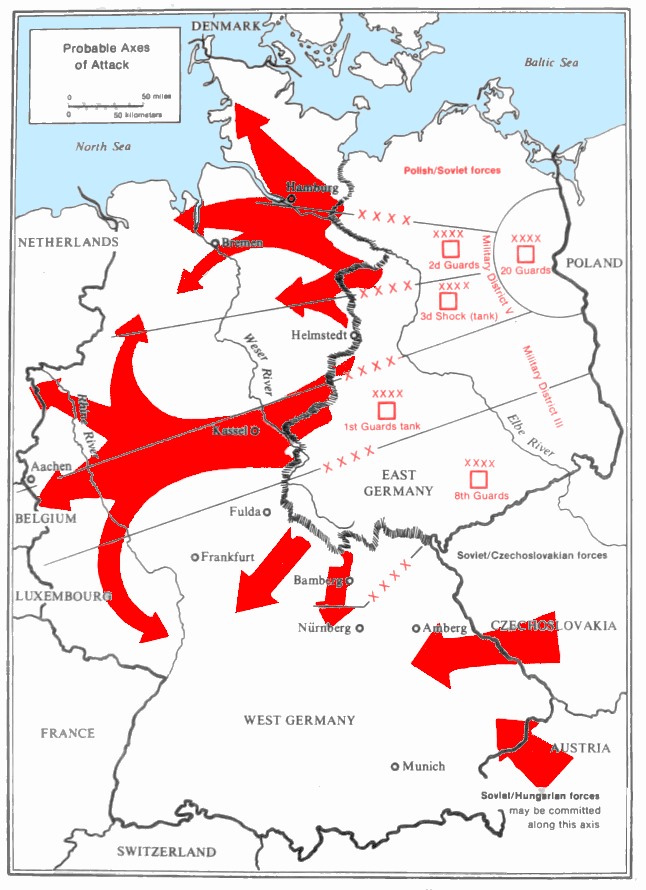
War breaks out, and we end up with a situation looking like this:


After hostilities start we flit back and forth between a few view point characters. Some are integral to the overall story, others are not. The people we end up spending the most time with on the NATO side are the captain and crew of the frigate USS Pharis, the submarine USS Chicago, Robert Toland, an intelligence analyst and Michael Edwards, an Air Force meteorologist on Iceland. There's some other characters mixed in (the driver of an M1 Abrams, fighter pilots and drivers of the fictional F-19 Frisbee) but these four are the ones we spend the most time with.

On the Soviet side we have Pavel Alekseyev a commander of armored forces, energy minister Mikhail Sergetov and his son Ivan who serves on Alekseyev's staff. Then there's various named and unnamed Soviet commanders and troops who play some part in the story. 

The British, Americans and Soviets are all well represented, but the other members of the Warsaw Pact or NATO only really show up in passing or in scenes where they're necessary for some plot point or another. The main drivers of the story are the ones mentioned above and they provide access to the campaign both above and below the Atlantic Ocean, in the air, and on land.

Like many items in the technothriller genre, it throws a lot of technical data at you. If you're familiar with the genre or some of the period weapons systems (or looking to learn some) it's a decent speculation on what a war might look like. On the seas it plays out much like the Battle of the Atlantic in both world wars as Operation REFORGER is undertaken to get American troops and supplies to Europe to hold the line.

You can tell that Clancy and Bond played to their strengths in this story. There's a vast amount of space in the novel is dedicated to describing submarine warfare and anti-submarine warfare by the NATO navies, and then the air war over the seas and land in Europe. Larry Bond had previously worked designing wargames based around naval war and Clancy's best work was The Hunt for Red October so you can't blame them for doing what they know well. It does give the war a much needed expansion of scope from the seas to the skies which might be otherwise overlooked.

That being said, the story really overlooked the war in Europe, which one would expect to be the main event. Instead, we spend a lot of time dealing with the campaign around Iceland which, while interesting at times, sucked up a lot of pages which might have been better spent with characters caught up in the fighting around Germany. I didn't mind the diversions in Iceland, but they ate up a lot of time and I never felt that the ground war in Europe got the attention it might have deserved. 

I won't critique the war itself, that's for people with a much better understanding of tactics and strategy than myself. However, I will note that for NATO to do as well as it did, especially on the ground, ended up relying on a massive number of lucky breaks and coincidences. From catching a Spetznaz operative in very contrived circumstances to a deception plan going better than can really be imagined in the late ground war, and Soviet troops held back, things had to break just right for this to work. I felt that the authors were really having to avoid straight up admitting that the Soviets would probably have ground the NATO troops into the dust, and perhaps this was why the ground war was an afterthought as they remained in places where NATO had a definite edge or there was more competition. Without a lot of effort being expended looking at the fighting in Europe, I can't say.

The cast too is not particularly deep. They serve their purpose, having enough personal moments to make them human and not one dimensional, but never really feeling like those with lives and dreams outside the war. None were very well rounded, and the Soviets just barely manage to not come off as simple card carrying villains. Unlike Ralph Peters, The War in 2020 we don't get a lot of insight into the Western political minds vs those of the Soviets.

I would almost describe this book as if The Anglo-American Nazi War were a true novel. Just as much jargon, but more characters to keep you reading and intrigued at events as they play out. 

Overall, this is an interesting novel which tries to posit why the war happens and nukes don't fly. It does a good job portraying all the technology at the time (everything that wasn't classified and the known Soviet capabilities) within the limits of knowledge. Though the plot is not particularly exciting since I was able to more or less guess much of what would happen, it did keep me turning the pages to see how things would play out. 

Lacking a bit of the oomph one would expect in a war novel, and more than a few wasted pages, it nevertheless manages to present a vision of the terrors of modern conventional war and the clash of arms that could have been if the war had gone hot in the 1980s.

Saturday, 6 February 2021

Stories of WWIII

The Cold War, a 'frozen' conflict lasting from roughly 1947-1991, pitted the world's two great powers and their allies against one another. Hanging against the backdrop of this was the hellish destruction of WWII, and the ever present threat of nuclear annihilation following the successful detonation of a Soviet atomic bomb in 1949. It was the specter than haunted my parents and my grandparents generation. I however, was born after the war ended, just missing the end of the Warsaw Pact and the Soviet Union. So other than the continuing existence of nuclear weapons, I didn't grow up in the shadow of ICBM's trained on my home.

However, while there's lot's of talk about the Cold War going "hot" most of those scenarios refer to the sudden, terrifying appearance of a mushroom cloud over some city in the US. There's another scenario though, one where the bombs don't drop and mechanized forces backed up by missiles and satellites tear into each other across the European continent.

It seems, that Soviet plans all revolved around fears of a NATO nuclear first strike attack on the Soviet Union. In response, the Soviet Union would launch a limited nuclear strike of it's own to disrupt the ability of NATO forces to defend themselves while aiming to drive to the Rhine to force a diplomatic solution. Interestingly, it seems the USSR never contemplated a nuclear first strike against NATO, with one notable exception. They were were so confident of their conventional superiority that they expected to win any war on the ground which would cause NATO to launch it's own first strike against them.

Assessing the Soviet superiority in both mechanized warfare and troop strength (if not necessarily technology) it seems likely that the USSR with it's limited objectives and local superiority could have won a conventional WWIII in Europe. At least that was the fear.

There was a brief period in the 80s and 90s where this fear was assessed in fiction. I've been musing on that since last year when WWIII was trending on Twitter, and had been meaning to read some of the fiction around that. I settled on two books which, I feel, outlined the beliefs in Western (or at least American) fiction best. The first is by the most popular technothriller writer of the 80s and 90s, Tom Clancy with his classic Red Storm Rising which chronicles a war in the late 80s between NATO and the Warsaw Pact. Secondly, I'm reading Red Army by Ralph Peters which, well, chronicles the same. Thirdly, I'll be reading a modern take on a war between the Russians and Europe, Red Metal by Mark Greaney.


That will be my big reading project for the start of 2021, and it will be an interesting comparison in the techno thriller genre. Same themes, different stories, and very different ideas. Stay tuned!

Before I go though, I'd just like to recommend the Fuldapocalypse blog which regularly reviews this kind of fiction and gives you some interesting insights into the genre as a whole. And if you want to know more about the Cold War in general, you should definitely check out the Cold War channel on YouTube for the work they do on exploring this conflict! Well worth your time for fact or fiction!

Wednesday, 30 December 2020

The War In 2020

Reading this book made me realize, as bad as 2020 was, it could really have been a lot worse. Originally written in 1990, Ralph Peters' The War in 2020 is now firmly in the territory of alternate history. Penned in the twilight of the Cold War, the Soviet Union had not yet undergone its dramatic collapse, in many supposedly well educated circles there were fears that a technologically ascendant Japan would make the United States obsolete with a few strokes on a keyboard, and the old securities of an ascendant America might slide out the window. We weren't quite at the farcical End of History period some predicted, and there wasn't yet only one superpower. It was, in some ways, very easy to imagine a different 2000, one where there were more rising powers and impotent old enemies.

The mildly prescient tagline includes "The World of the 21st Century is barely recognizable. War has ravaged almost every continent - a pandemic plague has swept impartially around the globe", which, in light of a Drug War in Mexico, numerous warm or hot wars in Central Asia, Africa, the Middle East and Europe, seems eerily prescient. The world Peters imagines and our own 2020 also happens to coincidentally be one where a global pandemic is ravaging the world. A black man with a southern VP sits in the White House, and the United States is engaged in multiple open ended military campaigns far from home. Thankfully though, this isn't that, and merely rhymes discordantly in the bizarre present we find ourselves in.

Peters' imagines a United States having watched its old Soviet enemy fade into obscurity, and so has decided it can downgrade on defense spending. This comes to bite them in the ass as Japan uses its technological know how and powerful trade and economic muscle to propel itself to being a power not to be trifled with. They decide to institute a long running series of proxy wars designed to gradually sap American strength and in the wake of a brutal global pandemic, move to collapse one fading power and potentially eclipse all others in Eurasia.

Enter George Taylor, a survivor of a disastrous American intervention in Zaire, where a brief fight against a Japanese backed South Africa ends in debacle, and spreads the new plague to America's shores. He fights in a few smaller proxy wars before finding himself at the tip of the spear in Soviet controlled Central Asia. Supporting him are Howard "Merry" Meredith, Manuel Martinez, and David Heifetz, honest men who are trying to make the best of a bad situation. They've formed bonds through blood and steel, through campaigns from urban pacification in the continental US, to anti-guerilla campaigns in Latin America. Facing an unprepared and disease gutted military at home, and an only semi-functional at best of times and shambolic at worst allied Soviet military, the men must do what they can to stem the tide of separatist rebels propped up by Japanese advisors and technology.

The story then follows this diverse cast of characters across Washington, Moscow and the Central Asian steppes. There's predictions about the future of warfare, technological progress and how it affects war fighting. We have some hit and miss interactions. I don't necessarily read older works for their predictions on the future, but I do tend to love how hit and miss things can be. Needless to say, much of the technology predictions and geostrategic ones are completely unrelated to our world. The various wonder weapons and technology dreamed up by the author bear no real resemblance to what a battlefield in our own world looks like. As cool as vehicle mounted laser weaponry, massive computer guided warfare, and ever versatile fighting vehicles is, we're not really close to it.

That said, the M-100 fighting vehicle portrayed in the novel deserves some mention. It's an air cavalry vehicle which functions as gunship, command ship, electronic warfare vehicle and troop transport all in one. In can move a unit of dragoons into a combat zone, take out hundreds of armored and support vehicles by itself, and jam enemy signals at the same time. It can hide itself with camouflage with few restrictions, and is a top of the line fighting vehicle replacing the old Apache gunship. Essentially, it's an amazing wonder weapon which can do many things, a jack of all trades, but master of none. Peters actually portrays it as being less than infallible, mechanically problematic, and all its systems are so new it doesn't necessarily work one hundred percent as advertised. This honestly made it a rather refreshing system to be shown in a techno-thriller. 

What I truly appreciated about the story is that Peters didn't portray it as one side effortlessly crushing the other. The Soviets are driven back by Japanese technological superiority and the strength of local forces, but in a few cases manage to make savage and punishing counter attacks. The Japanese technical superiority is undone by emerging American weapons systems and those in turn are stretched to their limit by being untested in the field while not being totally superior to their Japanese counterparts. There's no wonder weapons, no side is presented as woefully inferior to the other, and even the ostensibly inferior powers manage to take the superior by surprise.

Peters writes war exceptionally well. I rarely found myself enthused in the vein of a Tom Clancy novel or a David Weber fare, or bored by the predictable curbstomping of one side. It was nuanced, and the barbarity, the cruelty, heroism and suicidal commitment to duty were showcased in equal measure on all sides. Both sides largely believed in their own cause, wanted to win for their own reasons, and did the best they could with the material they had. They were even hampered by poor political decision making by their respective leaders and subordinates, whether those be in Tokyo, Moscow or Washington. It left commanders frustrated, shackled, or sick with worry about their choices. There were massacres, the use of weapons of mass destruction, and very grim realities of modern war. It was a bloody business, and very nicely done.

I truly enjoyed that Peters made his characters flawed. Colonel Taylor for instance, hates the Japanese with a vicious streak that borders on pathological. This isn't portrayed as a virtue however, and even Taylor admits that it impairs his judgement. His subordinates have a fanatical desire to please their commander, and they all have their own flaws. This, in a few cases, leads directly to their deaths. Their enemies are not simple cardboard cutouts, some don't actively believe in their cause, and others simply fight to fight on another day. I appreciated that there wasn't any dues ex machina which forced the scales one way or another, and indeed I was actively in suspense about the outcome until the end.

This isn't to say the book is without flaws. The portrayal of the female characters was pretty atrocious. I found myself mildly reviled by the way a few of the woman were portrayed and even some of the men talking about women (if accurate in a gross misogynistic sense) was unreadable. I tended to skim over those parts. The portrayal of the Muslim characters does lack similar nuance, and by and large they do serve as the disposable cannon fodder of the story, being the acceptable antagonists. They lack a certain nuance that writers unfriendly to them today would find striking, but in the name of a popcorn action read, you could gloss over it without thinking too much.

My final assessment of this book though, is that Ralph Peters does military fiction right. He doesn't provide some miraculous solution to the conflict, there's no instant win the characters can pull off, and there's high and real stakes. People die and you can actually feel those losses. The characters are well established enough that I can sympathize with their loss, and there is glory, but also horror, in war. The ending doesn't provide you with all the solutions, and you might even wonder what these characters will move on to, but such is life after war. The War In 2020 may not have quite predicted the future, but it does tell an entertaining story of a future that never was.

Tuesday, 20 March 2018

Self Driven Madness

In something I predicted personally a while ago, but can't help but chuckle at now (I have a dark sense of humor sometimes ok?), Uber has suspended its self driving car program after a pedestrian was killed by a car in Arizona. It seems the woman was jaywalking when she was struck, which may explain why there was no warning when she was hit. Needless to say, jaywalking is a problem for human drivers, much less for an automaton in its infancy.


Now personally, I think self-driving cars are the future, to such an extent that the personal ownership of cars may be an oddity for our children and descendants. However, I do not think the future is now. The technology is fairly new and in its infancy. There are many new steps and tests that must be taken before it can be said that these vehicles are reliably safe, what with many previous accidents having been in the news. This, in my opinion, means that it will be a few more years before this technology is used on the larger scale, and well into the future before we see self driving cars as a day to day reality.

However, imagine in the future, not owning a car but being able to access one whenever you need it. You sit at home, but need to go somewhere and so call not a cab, but a car company who send a car from a garage which picks you up and can either stay with you at your destination or return to a garage only to come fetch you again later.

Imagine if you will then, not having the need to own a car personally but subscribing to a company which will send you one when you call. Parking garages might be temporary hangers for streams of vehicles that are simply waiting between calls to shuttle people back and forth to destinations as needed. This has the potential to unclog the roads as street parking might be a thing of the past, driveways and big garage additions might not be a factor in planning new houses.

This might cut down on cars on the road, and if these are electric cars in the future they might not even need gas stations as electric cars don't need to run as far. Personal vehicle ownership might then only be a thing for those who live in the country, and even then why might some towns not have these great garages to curry to self driving cars that their denizens might like but not personally need.

I can think of a few advantages, but even a few disadvantages. Cutting down on personal car ownership might be a net positive, but it could also limit the mobility some currently enjoy otherwise. If they still run on fossil fuels, and not be a positive for the environment, and these "holding garages" might be nightmares when it comes to urban planning on how to locate them or where they could be best placed to help cities grow. Hell, the skill of driving might eventually fade from the general urban populace!

All of this of course is idle speculation on how the future might work out. Currently though, I think its clear these technologies are in their infancy and have some ways to go. They will be the future I think, and how they change the future will be interesting to see.