A broad title, but one I thought I ought to address after reading both this recent piece by Christopher Nuttal, and the attendant piece he was writing based on. The idea of course raises some interesting questions regarding a sort of stasis in Science Fiction and Fantasy, whether that be Medieval Stasis, or simply technology and mores being stuck Twenty Years in the future or in Modern Stasis.
For this article though I will be examining only the idea of fantasy being stuck in medieval stasis, and the sort of changing social mores that we might associate with medieval society.
This isn't just technology mind you, but the world as we understand it with the divine right of kings, an all powerful nobility, and the common display of peasants and landowners who struggle against the upper classes. Often times, we find this exact paradigm present in fantasy, or at least a rough facsimile of it in a written work. A sort of "standard fantasy setting" if you will.
Picture it; a number of rural villages, big castle overlooking them, and in the cities nobles and merchants squabbling over money with the king. Knights in armor ride around alternatively slaying dragons or oppressing the peasantry. Dirty hovels cling to the roadsides and inns pander to wayward travelers (which oddly enough, is something of an anarchism in itself). Sometimes monsters stalk the night, and demons terrorize the land. These will either be dismissed or hindered by a stand in for the Catholic Church. And of course, everyone will speak with an English accent.
This of course, is an error in fantasy.
Monday, 13 November 2017


Saturday, 11 November 2017
Remembering Passchendaele
Today, on November 11th, we solemnly remember the men and women who have given their lives year after year in service of our country. This year however, it coincides with the 100th anniversary of a brutal blood letting which enveloped France exactly a century ago. This was of course the three month Battle of Passchendaele.
This bloody contest over a sea of mud for little gain was actually objected to by the commander of the Canadian Corps, Arthur Currie. He predicted that the battle would cost 16,000 Canadian casualties and was eerily accurate as it wound up costing 15,654 causlties to the Canadians.
It was an awful slog. One Canadian would say "The ground beggars description. The strongest and youngest cannot navigate without falling down."[1]. Indeed that is almost an understatement. The battlefield was a sea of mud which drowned men, mules, and horses, saw supplies simply sink into the mire, and sucked at men's legs like glue. Truly the sea of mud defies description or belief, especially belief that someone would think such a mad attack would succeed in anything.
In the end the Canadians prevailed, and the village was captured. The outcome though, has been debated back and forth for a century at this point, and it is doubtful that any consensus will ever truly be reached on the matter.
What cannot be doubted however, is the courage, valor, and unrelenting heroism shown by the Canadian Corps. They played a key role as shock troops for the Entente across the Western Front all the way to the armistice that was signed 99 years ago. Since then Canadians have been active on battlefields from France to Africa, giving their lives in the name of peace.
The valor of Canadians then and now should not be forgotten. The continued service of our men and women in uniform should be praised and acknowledged for what it is, and we should never forget those who have given their lives in service to this country at home or abroad, now and forever.
We remember.
-----
1] Pierre Burton, Marching As To War, Page 185, Doubleday Canada, 2001
 |
| Courtesy of Wikimedia Commons |
It was an awful slog. One Canadian would say "The ground beggars description. The strongest and youngest cannot navigate without falling down."[1]. Indeed that is almost an understatement. The battlefield was a sea of mud which drowned men, mules, and horses, saw supplies simply sink into the mire, and sucked at men's legs like glue. Truly the sea of mud defies description or belief, especially belief that someone would think such a mad attack would succeed in anything.
In the end the Canadians prevailed, and the village was captured. The outcome though, has been debated back and forth for a century at this point, and it is doubtful that any consensus will ever truly be reached on the matter.
What cannot be doubted however, is the courage, valor, and unrelenting heroism shown by the Canadian Corps. They played a key role as shock troops for the Entente across the Western Front all the way to the armistice that was signed 99 years ago. Since then Canadians have been active on battlefields from France to Africa, giving their lives in the name of peace.
The valor of Canadians then and now should not be forgotten. The continued service of our men and women in uniform should be praised and acknowledged for what it is, and we should never forget those who have given their lives in service to this country at home or abroad, now and forever.
We remember.
-----
1] Pierre Burton, Marching As To War, Page 185, Doubleday Canada, 2001
Tuesday, 31 October 2017
The Disappearance of Wilson
This is my first "published" short story. Put here for free on my blog for Halloween.
A bit of back story, this is a piece of Flash Fiction, written in a single sitting. Though it is technically a short story I like to think it came to me in a flash. I thought of it while out in the Northern Ontario cottage country, going on a Lovecraft binge, which, surrounded by picturesque nature and country made me think the Canadian wilderness probably had many secrets to hide.
In a restless night I sat down and put pen to paper (or fingers to keyboard as it were) and the story poured out over the course of a few hours. There was some minor tweaking in the later stages as I adjusted the plot, and a few amazing beta readers helped out with some of the language and words. However, this is probably the most I have written in a single sitting, and I hope to write more.
I also happen to like this one as it happened to top out at exactly 3,000 words. A small something, but it gets a chuckle from me every time I see it.
Hopefully I can scare people with more as I write, but I want to write other fun things too. For now though, join me as we take a journey through the history of this small town that inexplicably vanished into the night...

Sunday, 29 October 2017
The Thing In The Woods
With 2017 we have another delightful tale of horror from writer Matthew Quinn. I've been pleased to review some of his work on this blog before, and I can tell you with supreme confidence he is an excellent writer. His latest offering of terror comes to you from the South in Georgia. Get ready dear readers as we journey south, deep into the wilds, and confront the murderous cult that supports, The Thing In The Woods.

This story is set in 2010 in the fallout of the Great Recession which has raged across the globe, in the little town of Edington. The story is very much driven by that backdrop, driving the leader of the cult in his devotion to protect the town. Our main character is forced into the poorer section of town by the loss of his father's high paying job and into dire economic circumstances.
Thing explores the story from both a Lovecraftian perspective (the unknown horror in the Woods and its unfathomable goals) and the cultural perspective. The methods of the cult are by no means commendable (blood sacrifice to an eldritch horror) but the desires are. The cult seeks to protect Edington from outside interference, and of course, keep the horror from eating everything in the immediate area. However, perspectives on how good this is vary, even inside the cult.
This story is set in 2010 in the fallout of the Great Recession which has raged across the globe, in the little town of Edington. The story is very much driven by that backdrop, driving the leader of the cult in his devotion to protect the town. Our main character is forced into the poorer section of town by the loss of his father's high paying job and into dire economic circumstances.
Thing explores the story from both a Lovecraftian perspective (the unknown horror in the Woods and its unfathomable goals) and the cultural perspective. The methods of the cult are by no means commendable (blood sacrifice to an eldritch horror) but the desires are. The cult seeks to protect Edington from outside interference, and of course, keep the horror from eating everything in the immediate area. However, perspectives on how good this is vary, even inside the cult.
Saturday, 21 October 2017
The Necronomicon
The Necronomicon is a name that sends chills up the spine. Penned in the 8th Century by the Mad Arab Abd-al-Hazred, it contains the chilling secrets of the Old Ones and their blasphemous powers. Despite numerous attempts to suppress it and the knowledge it contains, it continues to crop up across history in the hands of those who would use it for ill.
A very troublesome book.
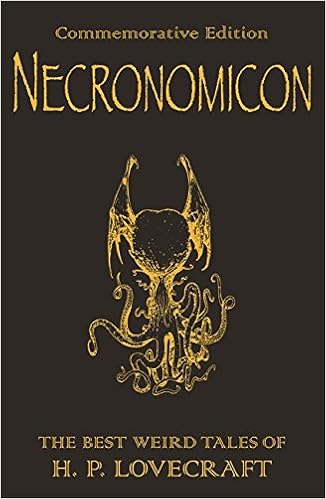
A very troublesome book.
Monday, 2 October 2017
October Time!
Hello everyone! It's that time of year again, and Halloween is fast approaching. I however, have some big plans for October. This month I will be reviewing four fantastic terrifying tales, one each week. These books are ones that are either near and dear to my cold dead heart, or ones that I think are worthy of recognition.
I will also have a bit of a surprise for everyone of my own. It's a little one, but one that I intend to top off the month with by putting out! Until then I'll just tease you with this image to give you some ideas!

Stay tuned for my big scary reveal October 30th!
I will also have a bit of a surprise for everyone of my own. It's a little one, but one that I intend to top off the month with by putting out! Until then I'll just tease you with this image to give you some ideas!

Stay tuned for my big scary reveal October 30th!
Tuesday, 26 September 2017
Guest Post: Donald Trump, Liberal Millennials, and THE THING IN THE WOODS
Though the 2016 election was a surprising turn of events for people all around the world as the unexpected candidate Donald Trump snatched the Republican nomination from out of nowhere then created the greatest electoral upset in nearly a century; it is not as surprising as finding a Lovecraftian horror infesting the woods near your where you live. Though maybe for some of you it was. Here author and fellow blogger Matthew Quinn lays out how some of his characters from his recent novel, The Thing in the Woods would most likely have acted if this story were set ten years further on in history during an election year. Being set in rural Georgia (a state which Trump carried with over 50% of the vote) it is easy to see how the ages and occupations of these characters set them out in support of nefarious goings on, or bias them against it and how such biases can be used to make excellent conflict in stories. I'll let Mr. Quinn take it from here and show you what he means.

The 2016
presidential election was, at least in part, a generational conflict. A
significant chunk of Donald Trump's support came from older, more
traditionalist people who disliked recent cultural and economic changes. Fears
of "cultural displacement" motivated members of the white working
class to vote for a man one would think
resembles a particularly boorish boss instead of a champion of the little guy. A
great many self-identified Christians supported Trump despite his
history of rancidly un-Christian behavior for much the same reason.
Subscribe to:
Posts (Atom)