Wednesday, 29 December 2021

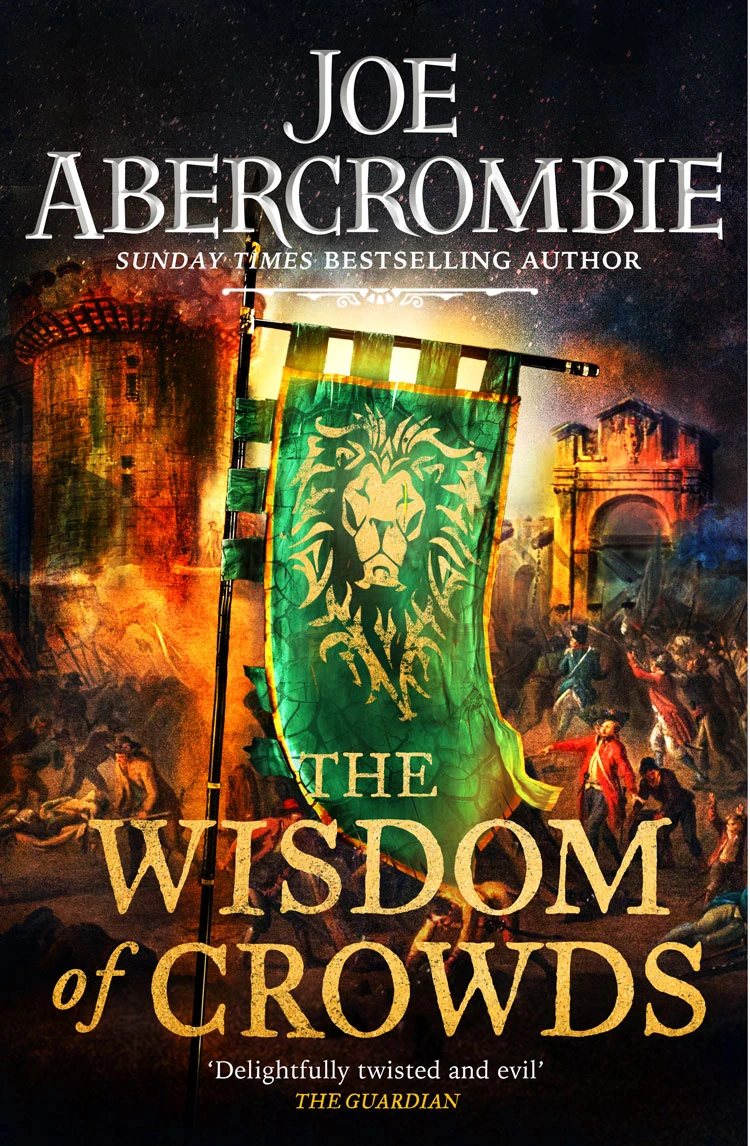
The Wisdom of Crowds

Finally, the Age of Madness comes to an end! With civil war, revolution and bloody cunning, the world of the First Law is finally brought into a new era with The Wisdom of Crowds.


Picking up almost immediately after the events of The Trouble With Peace we return to the Union in the aftermath of the pulse pounding events of the recent civil discord, only to find more civil discord awaits! King Orso has arrived home expecting his subjects to fete him as a hero, instead he finds a sullen population who seem to hate him more than ever. From political favorite to disgraced traitor, Leo dan Brock doesn't know whether he can expect execution or imprisonment. His wife, Savine dan Brock nee Glokta, is in much the same straights, waiting for the fates of her children to be decided.

In the far north Rikke of the Long Eye must now match wits with the cunning Black Calder, all while having to depend on the loyalty of the most disloyal man in the North, Jonas Clover.

Once again Abercrombie brings his dark and humorous take on the world to the fore, and he does it in a few surprising ways. Some uplifting, others very potently disturbing. There are revolutions, battles, and terrifying leaps of faith. Here we explore the darker side of national mass movements, and see a few familiar notes from history, and with some familiar sinister characters from the events of A Little Hatred.

In truth, much as I love Abercrombie, I came away both awed and a little disappointed by this book. It is still a stellar read which ties all the characters together, and explores the power of shared trauma and deadly political intrigue, but it seems to set up more subtle hints for the future than it does resolve major issues for the here trilogy as a whole. I did appreciate though, how well the characters grew and changed, and just how downright ruthless many of their actions became. It made for an amazing reversal of where so many started, and a very tragic end for some.

That being said, the reveals for the overarching mystery of this trilogy were amazing, and some of the final scenes left me slack jawed in how powerfully they were written! The twists must be read to be believed! It also gave a rather terrifying vision for the future of this story, and one I sincerely hope is eventually investigated!

A solid ending to a good trilogy. 

Thursday, 9 December 2021

Leviathan Falls

Across four years, and two continents, I've been enthralled by the world(s) of The Expanse series and all the amazing imagery it has thrown at me. From re-reading the series last year, to prepare for the final installment, I've been eagerly waiting for the events of Leviathan Falls to sweep me off my feet. Here now, we come at last to the end of the saga which began with the phenomenal Leviathan Wakes as we set our sights on the end of this series.

SPOILERS FOR ALL BOOKS OF THE EXPANSE FOLLOW.


Picking up roughly a year after the events of Tiamat's Wrath, we find the crew of the Rocinante in something of a stalemate with the now fading Laconian Empire. The Underground is still fighting back, but with the Laconians still being the most powerful military force, they can exert a lot of pressure, though it's unclear how long that will last. However, the events of the time of Laconian dominance have effected them all. The status quo is very much in flux, with a waning empire and dark gods scratching at the walls of reality. 

James Holden is partially traumatized from his time at the hands of his Laconian captors, while his crew now deals with the stresses of a life constantly on the run. Even with 1300 worlds to run to, it is still very difficult to flee a former hegemon. Helping them slightly is their crewmate/hostage Teresa Duarte, the now adrift daughter of the former emperor of humanity. Sent to track her down is Aliana Tanaka of the Laconian Marine Corps, so she can bring back her emperor at all costs.

As the penultimate story in this series, it is very much more of what fun we expected with daring escapades and rigorously plotted space action. There are almost no new locations, with the familiar settings of the slow zone, Laconia, and Sol being the most well charted and important overall. The mysteries of the protomolecule are explored and, in many ways, resolved as the series wraps up and we learn of the aliens who built the ring, and not a little bit about how they died. Turns out it can be a really bad idea to park your empire in an alternate reality.

Once again our shared humanity is one of the main ideas being explored, and on showcase in this work is the power of individuality and the privacy of our own minds. That too does a very fascinating exploration of the concept of a hive mind. It speaks to how the human mind, a singular and individual piece of equipment is something that is not used to being shared with others. We like the privacy of our own heads, and the idea of people being able to ferret out our deepest thoughts and secrets is both terrifying and violating. Humanity did not evolve for those structures! Tanaka's story does an amazing job exploring this, and she might be the best character to explore it through.

As the story continues it wraps up the stories of the crew of the Rocinante mostly to our immediate satisfaction. Holden and Naomi have reunited after a painful separation, but are still deeply in love. Alex is still flying, but realizing that all this rebelling, fighting and running is making him miss out on seeing his family grow up and his ability to connect with them. Amos is, well he's still Amos no matter what.

Outside of that crew we have Elvi and Fayez, last seen in Tiamat's Wrath doing research on the entities that killed the gate builders. They and their very cool ship the Falcon are still trying to understand the creatures that came before them and use that understanding to keep the creatures wanting to wipe humans out away from us, or at the very least find a way to negotiate with them. Their story is very much one of discovery and ethics and I felt it was handled in a very tasteful manner, especially in the time it was written!

Between them all is Teresa Duarte, now effectively an orphaned child. She has been, somewhat, adopted by Amos and is used to being obeyed without question, and so has difficulty fully fitting in with the various crews. She is still a child, a very powerful and well educated child, but a teenager all the same when it comes down to it. Her desires and interactions were rather well explored, but I felt that for all her introduction, she was almost criminally underutilized, and unlike many of the cast, did not receive a proper ending to her story overall.

Our main protagonists do all get very satisfactory wraps on their major arcs otherwise, with some mysteries solved, character traits being brought to their logical ends, and successful evasions of some (but not all) disasters reached. For Holden, I was a little surprised that he did not manage to find a way, with all the research available and the eventual power, to negotiate with the dark gods. However, it is to the credit of the series that the aliens are, well, alien and it keeps them enigmatic and mysterious beyond the broad strokes to the very end. Something that I still very much appreciate. Maybe some won't, but I do think that it is clever how we never get the whole picture.

The ending though, is gut wrenching. I was on the verge of tears as I read some of the final lines, but the epilogue had me laughing out loud for how well some things read. It leaves many questions unanswered, but satisfactorily wraps up the series in a way that will leave readers both intrigued and heart broken. 

For all galaxy hopping saga, that might be all we can ask for. 

Saturday, 27 November 2021

Dune (2021)

This year, I got to see yet another adaption of the 1965 classic science fiction novel by Frank Herbert, Dune. I've previously watched the extremely psychedelic 1984 version, and clips of the 2000 television miniseries. Having been in the works for years, and initially supposed to air in 2020 until derailed by Covid, it finally premiered in October of 2021. Does the film live up to the hype that has surrounded it? Find out!

Created by Denis Villeneuve, the master behind the excellent films Sicario, Arrival, and Bladerunner 2049, whose imagery seemed to inspire so much of real life 2020, this promised to, at the very least, be a feast for the eyes. From pre-production stills, to the trailers, we were not left wanting in all the visuals of eight thousand years in the future. It was, without a doubt, visually appealing. 


From the oceans and castles of Caladan, to the windswept and hostile sandy deserts of Arrakis, the worlds depicted by Villeneuve are breathtaking. Enormous visual spectacle is put together, whether its ships taking off from underwater, enormous worms moving in seas of spice laden sand, or massive ships sending fleets down to planets, we see just how big the universe is. It's so refreshing to see how the world changes. 

This is all accompanied by a phenomenal score by Hans Zimmer, which pulls you in just as well as the visuals. Impeccably paired with the stunning sights, we see that it is an amazing auditory experience as well with the music giving the beats from dread to hope to joy. I found it enthralling and I simply couldn't be distracted from what I was seeing. The mid point of the movie where the fighting rages was so well done that I lost myself in the spectacle for quite a while.

The casting especially is excellent, with House Atreides well rounded out by its ruling Duke Leto (Oscar Isaac) and Lady Jessica (Rebecca Ferguson) and their son and heir to the Dukedon, Paul Atreides (Timothée Chalamet). Their loyal retainers Gurney Halleck (Josh Brolin) their mentat, Thufir Hawat (Stephen McKinley Henderson), the Suk doctor Wellington Yueh (Chang Chen) and finally, swordmaster and mentor to Paul, Duncan Idaho (Jason Momoa). 

Opposing them are the forces of House Harkonnen, led by Baron Vladimir Harkonnen (Stellan Skarsgård) his monstrous nephew Glossu Rabban (Dave Bautista) and their own mentat running many schemes Piter De Vries (David Dastmalchian) serving a secret plot to bring down the Atreides.

Between these two warring factions lay the Fremen, a group of desert dwelling warriors who have been trod on for years by Imperial tyranny. Among them is the respected leader Stilgar (Javier Bardem) and the woman of some of Paul's visions, the mysterious Chani (Zendaya). 

Put together its an amazing ensemble cast who will blow you away with their excellent work!

With the aesthetics, from the set design to the costuming, you'll be blown away. It has some amazing science fiction work which is brought low enough with the clever inclusion of swords, knives and personal shields that you get a real sense of a changed future. The armor worn by the various factions makes them immediately identifiable, the clothes and apparel feels natural, and the sets are all geniusly designed. I loved how distinct and permament it all felt. Beautifully rendered in practical effects and CGI.

The story, in its bare bones, is told very well for this nearly three hour adaptation, and there are some scenes shot almost shot for shot in how they are represented in the books. The scenes on Caladan in particular and the heroic rescue of the crawler crew from a sandworm attack most of all. It was phenomenally well done in that regard.

However, the film seems to expect more than a passing familiarity with the minutia of the Dune universe. Some of that is easily incorporated into the film, from mentats to the Bene Gesserit, but much of the why of the story is left to be assumed. One famous scenes from the books is the Harkonnen's explaining their pathological desire to destroy House Atreides, but in the film we're almost left assuming the why and that the Harkonnen's are villainous because of how they look. So, much of the reasoning behind this centuries old feud is left for the viewer to assume rather than know. Similarly, with the Emperor being absent from this, the politics are a bit muddled, unlike the 1984 film where they are almost detrimentally front and center.

Casual viewers might come away struggling to understand a few things, the importance of the previous Duke dying in the Bull Fighting Ring, the hopes of Arrakis being green one day, Harkonnen cruelty, and the relationships between these houses, but its something you can reasonably infer. The Bene Gesserit are also well done, but almost absent in place and purpose except for the opening. Overall however, it is quite 

One thing that did baffle me was the PG-13 rating for a film which could have easily been rated R. There's not that much violence granted, and some special effects cover it very well, mostly with the clever shield fighting. However, it did seem to rob some of the more impactful scenes of their meat which could have been helped along by maybe a little more graphic depictions of the violence inherent in the battles or desert life. It just seemed like a lot of the action was a little subdued for that.

Overall however, this was a film which was gorgeous. From the acting, to the music to the set design, it leapt off the screen and kept me focused like few movies have done in the last few years. I was immersed, and I think even casual viewers will be too! Definitely worth seeing!

Saturday, 20 November 2021

First Thoughts on Amazon's The Wheel of Time

I am a huge fan of Robert Jordan (and eventually Brandon Sanderson's) amazing Wheel of Time series. It is a series which, consciously or unconsciously, much of modern fantasy owes some homage to. It has everything one might want, prophecy, madness, war, amazing magic, battle scenes, and a plot which can propel you through fourteen books and get you misty eyed at the end. Truthfully, I loved pretty much every minute I spend in the world Robert Jordan created, and I thank him for much of the work he did which inspired other authors. Now, however, Amazon has sought to bring his work to the small (very small) screen in their multi-million dollar adaptation of his series.

Does it do anything for readers or watchers? Let me offer my initial thoughts. I have, so far, only watched the first two episodes, which is what I will be basing my thoughts on. SPOILERS BELOW

Monday, 8 November 2021

The Trent War

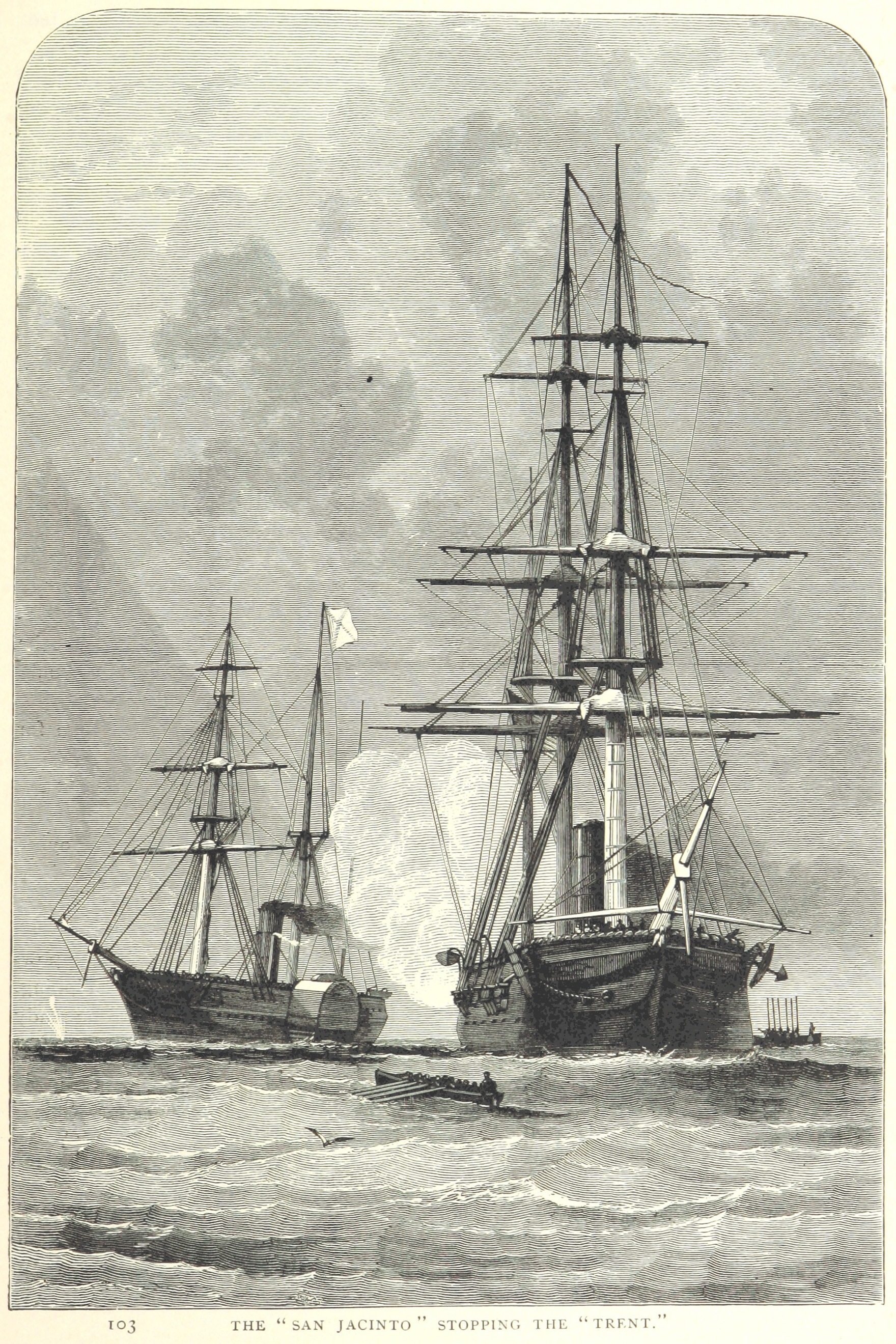
On this day, one hundred and sixty years ago, the United States warship, the USS San Jacinto, fired a warning shot across the bow of the British Royal Mail Steamer, the RMS Trent. In doing so, the captain of the Jacinto, commanded by Charles Wilkes, was taking an action which would nearly plunge the United States into war. Such a war would surely have been one of the greatest calamities of the 19th century, plunging the whole English speaking world into a conflict which would surely wrap the whole world in flames.

The Trent Affair, has been called the Cuban Missile Crisis of the 19th century, and coming almost exactly one-hundred years before that Earth shaking crisis, that is an apt comparison. For some background, the United States and the British Empire in 1860, were not good friends. While the US had close economic ties to Britain, and many immigrants from the British Isles (and primarily Ireland) still came to the US, the economic and political elite in Britain were somewhat aloof of "Cousin Jonathan" as the US was then known. There had been war scares since the War of 1812, with border crisis like the 1838 Caroline Affair, The Aroostook War, the Oregon Boundary Dispute, and only in 1859 the abortive "Pig War" which nearly set the two nations to war over a pig in the Pacific. In each case, cooler heads prevailed and diplomacy proved the order of the day. 

In any case, in 1861 the slaves states in the Union seceded after the election of Abraham Lincoln to the White House. The new so-called Confederate States tried to form an explicitly slave holding republic, and in response the Union called for 75,000 volunteers to crush the rebellion. From there, four years of bloodletting followed. That same year, Britain declared neutrality in the conflict, granting belligerent rights to both sides. This outraged the Union as they felt it was a step towards recognizing the Confederacy as an independent nation, as it granted some recognition of Confederate warships, and the right to take on provisions. Though this was not, in fact, a step towards recognition, it did show a certain bias in British thinking at the time. They remembered how the Thirteen Colonies had been impossible to subdue, and many concluded that the Confederacy - with roughly as much territory as western Europe - in seceding was a fait accompli which would mean it was only a matter of time before the North was forced to recognize that the United States were united no more.

Of course, the Union would not do that without a fight, and so the Confederates sought proper recognition from the powers of Europe. This was exactly why the Jacinto stopped the Trent, in order to seize two Confederate diplomats bound for Britain and France. Truthfully, the account of this stop and seizure must be read to be believed, from belligerent passengers facing down armed US Marines, diplomats hopping through portholes, and a swell on the waves nearly knocking everyone together in a dangerous pile of bayonets and human limbs, it is a minor miracle that no one was hurt, let alone killed. And historically, even with British outrage, the Trent Affair was resolved diplomatically.

This of course begs the question, well what would have happened if someone had been killed and the crisis was not resolved diplomatically? The answer is war, a great and terrible war.

For simplicity, we can assume that someone is killed on board the Trent and Britain is outraged. Abraham Lincoln of course would not be fool enough to intentionally goad Britain into war, and most likely he would have either capitulated, or pushed for foreign mediation of the problem. Ironically, he would have run into what in the 21st Century we would term, a public relations problem. As mentioned, many in Britain assumed that the secession of the South was a done deal, and the North would have to cut its losses. The other thing many assumed was that in doing so, the United States would make good on those losses and turn around and invade Britain's North American possessions in Canada to do that. This was not helped that those making decisions in London did not know much about Lincoln and his cabinet, it had only one recognizable man, William Seward. The problem was that William Seward was known for often saying the US should invade and annex Canada, which naturally - to the British Prime Minister at the time, Lord Palmerston - meant that this was indeed the plan.

Historically, when the British responded to the Trent Affair, they sent an ultimatum with an expiration date of seven days. This was to ensure that the United States could not do what many in Britain feared it would do and simply make peace with the South, turn its armies north, and seize Canada. If Lincoln were, in this counterfactual scenario, to send a suggestion hoping for international arbitration, Britain would most likely see this as a stalling tactic and prepare for war.

Truthfully, that is exactly what took place historically. Britain, upon receiving news of the events on the Trent, ordered out 11,000 soldiers and all the arms and other engines of war they would need. At the same time, in the United Province of Canada, orders were given in late December to muster 38,000 militia, while in Nova Scotia and New Brunswick, new volunteer companies were being formed. The British were evidently prepared to send 28,000 men immediately to North America. How many Canadians could have been mustered and armed is an open question, but in April of 1862, 14,000 men were available, and it is hard to doubt that in a war crisis, anything less could have been raised, and more surely could have. Should the British have fully committed to the war they could have mustered a great number of soldiers from the British Isles, troops stationed in the Mediterranean, and other places. The crisis did end historically in December, but had more men been sent, the size of the British forces prepared to fight the Americans would not be inconsequential.

The United States army in early 1862 numbered over 500,000 men. Nothing to sneeze at! However you can't move all those men to attack Canada, you need many facing off against the Confederacy, will have to dislodge others to defend the coasts, and some are also serving in the interior or in California! My own guess is the Union could shake loose roughly 12-14 divisions (3 Corps) to defend New England and invade Canada, call that roughly 150,000 men overall.

On the naval side, there is more of a mismatch. In 1862, the size of the Royal Navy showed over 465 screw vessels, 115 paddle vessels and 110 sailing ships, totaling 690 vessels in all. I provide here another tabulation here which shows only the major sailing ships and not the nearly 200 gunboats in service, which can be perused in the December 1861 Naval List. It should however, be a sobering number in comparison, with roughly 339 active ships worldwide.

The United States Navy, by contrast, had 264 ships. Of these however, roughly only 100 vessels were steamships, the remainder being sailing ships or other ships converted for the needs of the naval blockade. Not many are fast or modern steamers, or even proper warships. This puts them at a severe disadvantage.

Important to note however, that at the start of the war Britain has an advantage in ironclads. Whether it be older broadside batteries built for the Crimean War, or modern warships like the ironclad HMS Warrior or her smaller sister Defence, the British can send larger and superior ships to North American waters. The USS Monitor would not be launched until March, and she is restricted to New York, and her only company would be the USS Galena, who had very thin armor compared to any other ironclad of the period. Sister Monitors would most likely only be rolling out roughly 90 days after the Monitor's initial launch. This leaves very little to hold the line until roughly June/July 1862, and the British too will be building more ironclads of their own.

Not only will this war not be confined to the Atlantic, but on the Great Lakes both sides will be scrambling flotillas of gunboats. On Lake Erie, the US has an advantage by having the only functional warship, the USS Michigan, but on Lake Ontario, they will be scrambling to catch up as Britain can send gunboats or ironclads up the Saint Lawrence to help control that lake and defend Canada. The Richelieu River would also end up as a battleground as well, with flotillas needed to be constructed to defend or attack towards Montreal. In each case the Canadians have an initial advantage due to the proximity of British guns and sailors and access to the St. Lawrence once it opens in the spring.

We do of course need to discuss the third combatant, the Confederacy. They would have roughly 270,000 troops present for duty at the start of 1862, and without the need to defend their own coasts from attack, would be free to redeploy thousands to support their armies in Virginia and Tennessee. Though they don't have much of a navy, that doesn't really matter when you have the biggest navy on Earth stepping up for you does it?

This is, very roughly, the strength of the various sides going to war in 1862 should this war go hot.

How then, might this war be carried out?

At some point in early January/February 1862 the USN and Royal Navy will fight a series of skirmishes, ranging from ship to ship fights to more than likely one pitched battle in the North Atlantic and the Caribbean. We know roughly what the British hoped thanks to a brilliant article by Kenneth Bourne, commissioners appointed to the task in 1862, and the British commander of the North American and West Indies Squadron did leave ideas for what he hoped to accomplish written down. This would mean that in the first months of the war Britain would be putting most of her efforts into either destroying or driving to port as much of the USN as they could. This would maybe net a few modern ships, but I credit the US enough to think they would begin evacuating ships and men from likely points of attack by the RN once the British minister in Washington leaves, while leaving just enough old or less reliable ships (and men in forts) to hold what they have and enforce a legal blockade so that in the event war does not break out, they cannot be said to have let up on the blockade.

These first few months would lead to a depressing bit reading in the North as the newspapers reported on forts captured, ships sunk or captured, and likely thousands going to prison camps in British colonies or the Confederacy. Many ships though, would make it to port, and be able to harass the British as they tried to set up a blockade of over 1,200 miles of coastline. There is no serious doubt they could sustain this blockade, merely how long it may take to be effective. 

While Britannia rules the waves, much of the war on land would be stalled. The British would have advanced partially overland, seizing posts across the border in Maine to control the route their soldiers historically marched through. They may also launch an overland raid into New York to seize (or more likely raze) the incomplete Fort Montgomery at the head of Lake Champlain. This would undoubtedly cause outrage in the Union, and they would be chafing for the chance to strike back.

We can also make a pretty good guess on how this would go as none other than future General in Chief of the Union armies Henry Halleck had written about the most important way to attack Canada in the 1840s, an overland attack on Montreal. This serves two purposes, first it cuts off the western portion of Canada (modern Ontario) from support from Britain by sea, and secondly it delivers control of the Saint Lawrence River below Quebec to the invader. Most likely an army would (as had been done in 1775 and 1812-13) advance up the Richelieu River to attack the city and attempt to take it. 

Problematically, the British know this, and would most likely be prepared to meet the Union somewhere on the field of battle in between. Expect the first great clash between an American "Army of the Hudson" and the British "Army of Canada" somewhere along the banks of the Richelieu in May of 1862. 

Meanwhile the Union would be sending an army to invade Canada West. This would both tie down troops otherwise intended to defend Montreal, and also snag bits of British territory to use as bargaining chips at the peace table. If they could cross the Saint Lawrence and take Kingston, they would be able to concentrate on besieging Montreal and then potentially Quebec. 

The British for their part, wished to attack the city of Portland Maine in order to seize an all weather railroad terminus at the Atlantic. This would most likely lead to a British attack, and potentially siege, of the city, further tying down US troops who would otherwise be used elsewhere. 

What then is the Confederacy doing? Considering they could have gathered as many as thirteen divisions in northern Virginia (potentially 125,000 men) I think that Joseph Johnston would be under great pressure to attack Washington. Meanwhile, McClellan and the Army of the Potomac (most likely a similar size) is going to be waiting to either attack or be attacked. How that campaign would play out would be up in the air, but it would feature two of the largest armies ever assembled in North America going head to head. Considering the fair amount of blunders and problems in handling command and control in 1862 on both sides in the Peninsula Campaign and the Seven Days Battles, I don't expect anything definitive to be decided.

Out West, a similar situation holds true. Albert Sydney Johnston (historically of Shiloh fame) would most likely find himself facing a similar situation he faced in April of 1862 historically, but now he has access to everything he can get his hands on. I fully anticipate he may go forward and attack the still disparate Union armies and re-invade Kentucky. Will he prove more successful than Braxton Bragg? 

Beyond the Mississippi, I can see little really changing, though some quirks of fate may drive the Confederate fortunes better or worse. On the Pacific slope, other than a blockade of San Francisco, the British probably seize the San Juan Islands, bloodlessly ending the Pig War.

My own expectation is that by July of 1862, the British will have seized Portland, while blunting the early invasion of Canada East, keeping them out of Montreal. In Canada West, the Union will have captured Toronto and everything west of it. Meanwhile, on the Virginia front, two massive armies will grapple with one another like clumsy giants, pushing the battle lines north or south as the fortune of war goes, though to give credit I do think McClellan could push the Confederates out of Centreville and towards the Rappahannock. Out west, the Confederates, if they do better than at Shiloh historically, blunt any invasion and are marching back up the river towards Nashville, seeking to drive the Union out.

Where the war goes from here, who can say? Economically, the Union would be in a pickle as the blockade would hurt their economy, and most Union finances came from either money earned on the tariff, taxes and printing money. The Confederate economy relied on printing money and it sent them into an economic tailspin that ended up destroying the nascent nation as effectively as Union cannon and warships. The blockade would hurt, while perversely the Confederacy is open for business and can sell cotton on the world market to their hearts content, which most likely makes for a much better economic situation. Britain too would be hurt, but not nearly so badly as the United States. 

If Lincoln can politically manage to accept a 'white peace' with mild reparations before the end of 1862, he absolutely will. However, should he be unable to do so, I can unfortunately see the war dragging into 1863-64 to the Union's detriment. Every year another man, rifle and bullet is spent fighting Britain in Maine or Canada, is another year the Union is not fighting the Confederacy and not strangling their economy. Even should the Union make peace with Britain, is it likely they can turn around and continue the war into 1865, or potentially even 1866? This is perhaps the only scenario where the Confederacy could emerge as a functional and not economically wrecked nation, and if it did, that would have terrible consequences for world history as the Slave Power pushes on.

I do not regard this as a good outcome. North America would be divided between four nations (Canada, The US, CSA and whatever happens in Mexico) all of whom may have reason to distrust one another. Canadians would feel bound to the mother country more than ever, and the Confederacy, if it gained its independence by foreign assistance, would most likely seek out foreign allies. 

I've covered the bare bones here, but there's much more to talk about. I've explored the topic myself, and am currently writing a projected trilogy which would cover just such a war. The first book Wrapped in Flames, is currently closing in on the 50% finished mark. I'd love to hear other thoughts on the idea, and it is one which is extremely intriguing and still worth exploring.

Saturday, 11 September 2021

9/11 Twenty Years On

In my grandparents time, Pearl Harbor was one of the most defining moments of a generation. I don't think for my (or even my parents) generation, any event was so Earth shaking as those moments when highjacked planes flew themselves into the former World Trade Center in New York. The images from that day will haunt me for the rest of my life I suspect. The world will be living with the aftershocks for a generation to come.


Make no mistake, twenty years later we are living in the shadow of the Twin Towers collapsing. The world as we know it changed immediately after that event, and it took on a momentum of its own.

Perhaps because it is the 20th anniversary of that terrible day, or perhaps because of the chaos we have seen playing out in Afghanistan recent, but because of it all, I am brought back to when I wasn't yet ten years old and I saw the world change. I remember the news conferences, the repeated footage, and the tumultuous decisions around the clock as the news tried to keep up with the response to the deadliest terrorist attack in human history which killed nearly 3,000 and wounded 25,000. I even remember the fear that crept into everyone in some form or another. 

Barely a month would pass before the Bush administration ordered military action in Afghanistan, and until recently, we were living with a "forever war" where US and allied forces were fighting an uphill battle against a tenacious enemy who had harbored the man who carried out 9/11. Little would the world realize that the war would go on for nearly two decades, and the most powerful military in the world would lose. Whether it was because there was no coherent mission, enriching weapons manufacturers, it was a war that went on well past the point of sanity and only succeeded, broadly, in carrying out its goal of impoverishing Al-Qaeda, and killing Osama bin Laden. In Pakistan. 

That of course, was not all. Seemingly losing track of the mission at hand the Bush administration then contrived to invade Iraq and topple the tyrannical regime of Saddam Hussein, a man who had nothing to do with 9/11. This would lead to another "forever war" which did toppled Saddam, but did very little for the stability of the Middle East as a whole. All the consequences of that decision are still playing out to this day.

I have been reading all about that history recently. The bungling, the fear, the botched reactions, and it is sobering. I can only encourage people who lived through it, and those born afterwards, to go out and read the more accessible history detailing the choices made going to war, and after the wars had ostensibly "ended" according to the politicians. It's a mess that, twenty years on, is still difficult to understand. 

History aside, I am choosing to spend this 9/11 living for tomorrow. We must remember the dead from that day, but we cannot forget the innumerable graves dug across the Middle East by decades of war and pointless struggle. We should open our arms to those fleeing the consequences of the actions of the West in Afghanistan and Iraq, and we should do better on the world stage in the coming decades. 

So today, on the 20th anniversary of 9/11, I ask everyone to take a moment of silence, not just for those lost in New York, but for every life lost in the last two decades. Remember these tragedies, and remember that we can do better in the world. There are so many people who have grown up not knowing the collapse of the Two Towers and its traumatic images, and they don't need to live in the shadow of the mistakes of the past. We can build a better world for tomorrow, and we should set our energies to doing so.

Saturday, 31 July 2021

Harbor of Spies

 As is usual in July, I found myself immersed in a good historical novel. Once again I found myself in the 1860s as the Civil War is raging. However, like a previous review, this time I was not in the frigid north of Canada, but in the sunny climate of Havana on the island of Cuba. It is here that one young sailor finds himself caught in a series of frustrating twists, with the Spanish government on one side, Confederate spies on another, and a not too sympathetic Union Navy in front of him, this poor lad finds himself caught in a Harbor of Spies

I was first drawn to this book by a comment on a message board talking about Spain in the Civil War. What many do not realize is that Spain, while neutral in the Civil War, made a fortune off running the Union blockade. Cuba, and Havana especially, sympathized with the Confederacy. The island ran on slavery much the same as the Antebellum South, with plantations making coffee, sugar, and other cash crops which sustained the wealth of Imperial Cuba. Unsurprisingly then, the planters of the island sided with the slaveowners of the Confederacy.

This made Havana a very strategic port. It was close to the Gulf coast, and fast steamers or stealthy sailing ships could threat their way through the Union blockade and deliver much needed arms and ammunition to the Confederacy, while bringing back valuable cotton in return. It was a lucrative business, and many men in the island made their fortunes in this trade, doing much to keep the war going for the Confederate cause.

Enter into this story, Everett Townsend, a young Maryland born sailor who was drummed out of the Naval Academy shortly after the outbreak of the war. He has fled to a small sailing schooner travelling to Cuba with a load of Maine lumber, trying to find his way after disappointing his father. A tragic accident has left him in command of the little ship, and then a surprising encounter will introduce him to the world of espionage, deceit and blockade running that all runs from Havana. When he saves an escaped prisoner from the infamous El Morro prison, his life takes a very sudden turn.

Like my last civil war read, this story is intriguing largely because it explores the foreign reactions to the American Civil War. There's some mention of the big players, Lincoln, Seward, Davis and Lee, but it is very much in the background. The focus is all on the Spanish government in Havana, the Confederate agents there, and the Union agents trying to stop them. 

I quite enjoyed this story because it takes place in a country I've visited and come to love (Cuba) and it does regal the reader with historic details of the island under Spanish rule. From the fabulous culture to the horrors of slavery, the author paints a vivid picture of the island in the 1860s. The city of Havana especially is given a lot of love to show off both the slums of poor workers, sailors, and slaves, but also the opulent wealth of the Spanish Empire and the islands slaver aristocracy. The society comes alive and we see a very fascinating, and disturbing one.

It is though, a story with many nautical themes, and as such it does not disappoint! The running of the blockade is explored in fascinating detail. I admit I was quite surprised at the depth of knowledge and research the author put into getting the small pictures of blockade running right. The nautical runs into Southern ports and out again to Cuba was breathtaking and had me on the edge of my seat as I tried to not sweat bullets like the sailors on the little blockade runner here. It gave me an appreciation for the historical bravery of men who ran the Union blockade of the South whether for ideological reasons or profit!

Secondary to this though, is the exploration of the many espionage acts taking place against the backdrop of the Civil War. This book goes to great lengths to explore the ways spying and counter-intelligence worked in the 1860s. Conflicting loyalties, ideology, and greed certainly all play their parts! Whether it is street level informants, foreign agents, or blockade runners, we get a look at how the cat and mouse game of shell sales and ship registry worked to make the lucrative machine of blockade running function. I was very impressed by the detail and story telling elements worked into these depictions, and it was quite fun to see it all come together in various runs! The way shifting loyalties play a part is key to the story and I won't spoil anything!

It is a very interesting story, espionage aside, about mysterious heritage, conflicted loyalties, and the city of Havana and the society it promotes. I did find some of the mysteries to be well played up, with an overall satisfying conclusion, but thought the book could have been even fifty pages longer to bring those issues which Townsend struggles with to a more satisfying and intimate conclusion. Though the story did leave some dangling plot lines which, probably, should have been addressed, it does an excellent job in bringing Townsend's character arcs satisfyingly forward.

Harbor of Spies is an excellent piece of historical fiction, and well worth reading for its action, intrigue and amazing depiction of such a pivotal piece of the Civil War that often gets overlooked in the battles and politics most history buffs focus on. I'm thrilled I picked this one up!